
 Worksheets
Unit 1-3 CA
Total questions: 39
Worksheet time: 20mins
Name
Class
Date
1.
If a doctor is comparing the size of one person’s brain to another, this would be part of
a)
anatomy
b)
physiology
2.
Consider the following levels of organization: (1) cell, (2) organ, (3) mitochondria, (4) organism, (5) tissue, (6) system. Which is the correct order from smallest to largest?
a)
1, 3, 5, 4, 2, 6
b)
1, 2, 5, 6, 3, 4
c)
3, 1, 2, 5, 6, 4
d)
3, 1, 5, 2, 6, 4
3.
Which of the following is NOT one of the 4 major categories of tissues found in the human body?
a)
nervous
b)
vascular
c)
epithelial
d)
muscular
4.
Which of the following body parts is inferior to the heart?
a)
teeth
b)
stomach
c)
lungs
d)
eyes
5.
Which of the following body parts is lateral to the heart?
a)
teeth
b)
stomach
c)
lungs
d)
eyes
6.
Which of the following body parts is proximal to the elbow?
a)
wrist
b)
fingers
c)
toes
d)
shoulder
7.
If someone sliced you between the eyes and directly downwards, what type of plane would that be?
a)
median/midsagittal
b)
frontal
c)
cranial
d)
transverse
8.
Growth
a)
hormones increase the rate of mitosis, making you taller
b)
a mouse has a litter of babies
c)
the nutrients from your lunch are absorbed into the blood
d)
skeletal muscles are used to walk across the room
e)
as you run, sweat forms on your forehead
9.
Reproduction
a)
a mouse has a litter of babies
b)
the nutrients from your lunch are absorbed into the blood
c)
skeletal muscles are used to walk across the room
d)
as you run, sweat forms on your forehead
e)
glucose is combined to form glycogen for energy storage
10.
Excretion
a)
as you run, sweat forms on your forehead
b)
a mouse has a litter of babies
c)
the nutrients from your lunch are absorbed into the blood
d)
skeletal muscles are used to walk across the room
e)
glucose is combined to form glycogen for energy storage
11.
Metabolism
a)
glucose is combined to form glycogen for energy storage
b)
a mouse has a litter of babies
c)
the nutrients from your lunch are absorbed into the blood
d)
skeletal muscles are used to walk across the room
e)
as you run, sweat forms on your forehead
12.
Digestion
a)
the nutrients from your lunch are absorbed into the blood
b)
a mouse has a litter of babies
c)
skeletal muscles are used to walk across the room
d)
as you run, sweat forms on your forehead
e)
glucose is combined to form glycogen for energy storage
13.
Responsiveness
a)
you turn towards a sudden noise
b)
a mouse has a litter of babies
c)
the nutrients from your lunch are absorbed into the blood
d)
skeletal muscles are used to walk across the room
e)
as you run, sweat forms on your forehead
14.
Movement
a)
skeletal muscles are used to walk across the room
b)
a mouse has a litter of babies
c)
the nutrients from your lunch are absorbed into the blood
d)
as you run, sweat forms on your forehead
e)
glucose is combined to form glycogen for energy storage
15.
Maintaining Boundaries
a)
bacteria from a door handle does not penetrate the skin
b)
a mouse has a litter of babies
c)
the nutrients from your lunch are absorbed into the blood
d)
skeletal muscles are used to walk across the room
e)
as you run, sweat forms on your forehead
16.
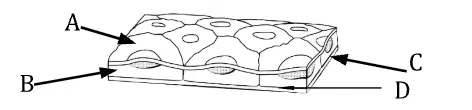
The picture below is an example of what type of tissue?
a)
nervous
b)
epithelial
c)
vascular
d)
muscular
17.
The structure in the picture above that represents the free surface is
a)
A
b)
B
c)
C
d)
D
18.
The type of tissue that contains goblet cells for secreting mucus is
a)
squamous
b)
columnar
c)
cuboidal
d)
keratinized
19.
Mammary glands contain not only secrete milk, but also a portion of the secretory cells. Therefore, mammary glands are an example of ____________ glands.
a)
merocrine
b)
holocrine
c)
apocrine
d)
endocrine
20.

Which of the pictures below shows a pseudostratified tissue?
a)
A
b)
C
c)
B
d)
D
21.
The 2 types of fibers are found in connective tissues are:
a)
adipose & elastic
b)
labile & stable
c)
parenchymal & stromal
d)
elastic & collagen
22.
Which type of cells become bone tissue?
a)
chondrocytes
b)
osteocytes
c)
erythrocytes
d)
fibrocytes
23.
When looking in a microscope, you notice large droplets of oil filling most of the cell’s space. Which type of connective tissue are you looking at?
a)
adipose
b)
cartilage
c)
dense regular
d)
dense irregular
24.
Which type of connective tissue is found in tendons, giving them rope-like strength in one direction?
a)
adipose
b)
cartilage
c)
dense regular
d)
dense irregular
25.
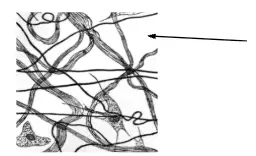
The space surrounding the cell body in a connective tissue that is often gel-like or watery (designated by the arrow) is known as the __________________.
a)
elastic fibers
b)
ground substance
c)
collagen fibers
d)
epithelial tissue
26.
Which of the following is NOT a function of skin?
a)
sensation
b)
production of vitamins
c)
excretion of waste
d)
secretion of hormones
27.
Which of the following is the correct order for the layers of skin from superficial to deep?
a)
hypodermis, epidermis, dermis
b)
epidermis, hypodermis, dermis
c)
epidermis, dermis, hypodermis
d)
ermis, epidermis, hypodermis
28.
Which of the following epidermal layers is made of cells that are constantly dividing?
a)
stratum lucidum
b)
stratum corneum
c)
stratum granulosum
d)
stratum basale
29.
Which of the following epidermal layers is only found in thick skin like that on the palms of your hands?
a)
stratum lucidum
b)
stratum corneum
c)
stratum granulosum
d)
stratum basale
30.
Which of the following epidermal layers is constantly being shed during your daily activities?
a)
stratum lucidum
b)
stratum corneum
c)
stratum granulosum
d)
stratum basale
31.
Your fingerprints are caused by
a)
a build-up of melanin.
b)
layers of keratin filaments.
c)
a layer of dermal papillae.
d)
blood vessels near your skin.
32.
The pigment produced by your skin that protects you from UV radiation is
a)
melanin
b)
Vitamin D
c)
keratin.
d)
collagen
33.
The arrangement of _________ in the dermis forms lines of cleavage.
a)
melanin
b)
Vitamin D.
c)
keratin
d)
collagen
34.
The dermis is composed of 2 layers: the ____________ layer, which is made of loose connective tissue and the ___________ layer, which is made of densely-packed fibrous tissue.
a)
cleavage, papillary
b)
subcutaneous, reticular
c)
papillary, reticular
d)
reticular, papillary
e)
cleavage, subcutaneous
35.
The sudoriferous glands found primarily in the armpits and groin responsible for body odor are known as
a)
apocrine glands.
b)
sebaceous glands.
c)
eccrine glands.
d)
subcutaneous glands.
36.
At which location is hair formed?
a)
hair follicle
b)
hair shaft
c)
hair cuticle
d)
hair bulb
37.
The glands that secrete their products near hairs are known as
a)
apocrine glands.
b)
sebaceous glands.
c)
papillary glands.
d)
subcutaneous glands.
38.
Which of the following characteristics are NOT true of both hair and nails?
a)
They are both made of keratin.
b)
They both protect our skin.
c)
They both originate at a matrix.
d)
They both have structures known as cuticles.
39.
Which of the following is NOT visible when looking at your fingernail?
a)
nail matrix
b)
proximal nail fold
c)
lunula
d)
nail body
100 %

