
 Worksheets
Directional Terms Assessment
Total questions: 50
Worksheet time: 25mins
Name
Class
Date
1.
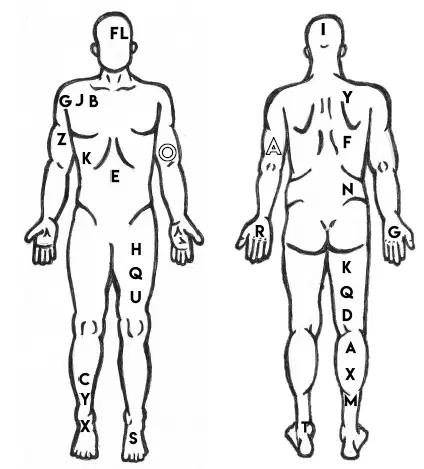
What is the most superior letter on the posterior side?
a)
F
b)
S
c)
T
d)
I
2.
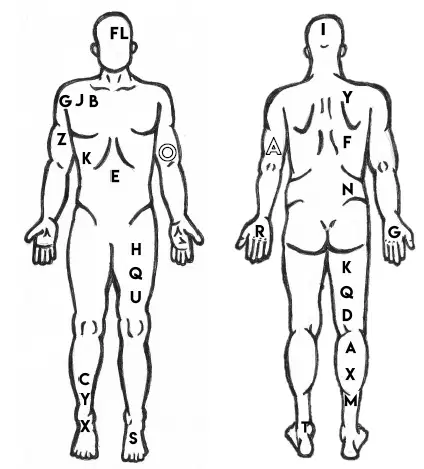
Which letter on the anterior side is most medial above the neck?
a)
B
b)
F
c)
E
d)
Z
3.
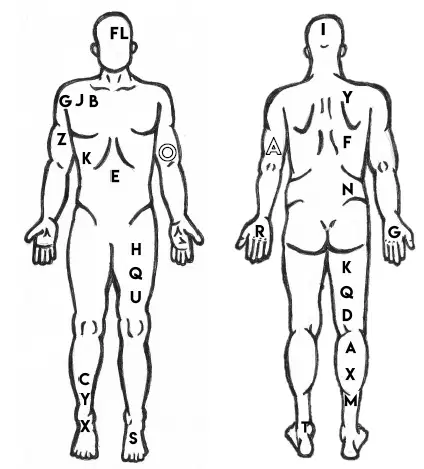
On the posterior side, which letter is one letter proximal to the letter M?
a)
K
b)
X
c)
Q
d)
A
4.
Your hips are _______ to your head.
a)
Superior
b)
Medial
c)
Inferior
d)
Anterior
5.
Your nose is on the ______ side of your body.
a)
Lateral
b)
Distal
c)
Anterior
d)
Posterior
6.
The distal end of your humerus (upper arm bone) is part of the _______.
a)
Elbow Joint
b)
Shoulder Joint
7.
The proximal end of your femur (thigh bone) is part of the _______.
a)
Hip Joint
b)
Knee Joint
8.
Your femurs are __________ compared to your tarsals.
a)
Inferior
b)
Distal
c)
Anterior
d)
Proximal
9.
Your shoulder is _________ compared to your sternum.
a)
Lateral
b)
Medial
c)
Distal
d)
Proximal
10.
Your heart is _________ compared to your shoulder.
a)
Lateral
b)
Medial
c)
Distal
d)
Proximal
11.

Lying on your back like this luge athlete is called __________.
a)
Superior
b)
Inferior
c)
Prone
d)
Supine
12.
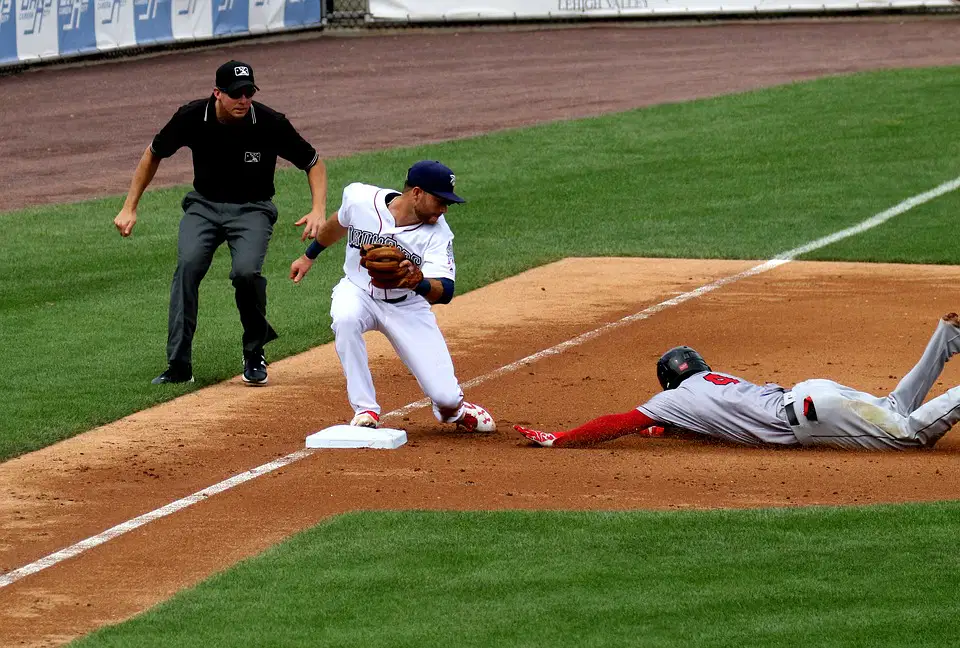
Being on your stomach like this sliding baseball player is called __________.
a)
Superior
b)
Inferior
c)
Prone
d)
Supine
13.

Which plane is in blue and splits you into front and back halves?
a)
Frontal/Coronal
b)
Sagittal
c)
Transverse
14.

Which plane is in red and splits you into left and right halves?
a)
Frontal/Coronal
b)
Sagittal
c)
Transverse
15.

Which plane is in green and splits you into top and bottom halves?
a)
Frontal/Coronal
b)
Sagittal
c)
Transverse
16.
The body position that is the basic reference position for all directional terms and planes is:
a)
supine position
b)
prone position
c)
side lying position
d)
anatomical position
17.
The frontal plane is also called the:
a)
supine
b)
transverse
c)
coronal
d)
midsagittal
18.
Ventral and __________ are used to describe the front of something.
a)
posterior
b)
anterior
c)
dorsal
d)
caudal
19.
The term that means back of the body:
a)
cranial
b)
anterior
c)
posterior
d)
caudal
20.
Proximal structures are _____________to/from the origin to the trunk.
a)
farther away
b)
closer
c)
equal
d)
none of these
21.
Distal structures are _____________to/from the origin of the trunk.
a)
farther away
b)
closer
c)
equal
d)
none of these
22.
If a structure is superior to another structure it is __________.
a)
lateral
b)
medial
c)
above
d)
below
23.
If a structure is farther away from the midline it is __________.
a)
lateral
b)
medial
c)
transverse
d)
inferior
24.
Flexion and extension are performed in what plane:
a)
caudal
b)
sagittal
c)
transverse
d)
frontal
25.
Scapular elevation and depression are performed in what plane:
a)
caudal
b)
sagittal
c)
transverse
d)
frontal
26.
A medial structure is _________ to/from the midline.
a)
equal
b)
away
c)
closer
d)
behind
27.
A superficial structure is closer to the __________.
a)
surface of the body
b)
heart
c)
feet
d)
head
28.
A structure that is farther away from the surface of the body is called a _________ structure.
a)
unique
b)
flat
c)
deep
d)
superficial
29.
Moving a body part toward the midline is called:
a)
adduction
b)
abduction
c)
rotation
d)
circumduction
30.
Moving a body part away from the midline is called:
a)
adduction
b)
abduction
c)
rotation
d)
circumduction
31.
Bending the joint between 2 bones is called:
a)
extension
b)
supination
c)
pronation
d)
flexion
32.
Straightening the joint between 2 bones is called:
a)
extension
b)
supination
c)
pronation
d)
flexion
33.
If you are lying on your back face up you are in the __________ position.
a)
prone
b)
supination
c)
supine
d)
pronation
34.
Moving in a circle at a joint is called:
a)
circumduction
b)
supination
c)
pronation
35.
Bringing the toes toward the shin is called:
a)
circumduction
b)
dorsiflexion
c)
plantarflexion
d)
pronation
36.
Pointing the toes downward or performing a heel raise is called:
a)
circumduction
b)
dorsiflexion
c)
plantarflexion
d)
pronation
37.
Horizontal abduction and adduction is performed in what plane:
a)
frontal plane
b)
coronal plane
c)
sagittal plane
d)
transverse plane
38.
You ask your friend for 20 bucks. He quickly shakes his head "no". What is the most dominant plane this movement occurs in?
a)
sagittal
b)
frontal
c)
transverse
39.
You woke up with a terrible crick in your neck. To stretch it out, you place your ear to your shoulder. What is the most dominant plane this movement occurs in?
a)
sagittal
b)
frontal
c)
transverse
40.
While playing cornhole, you toss the bag toward the board using an underhand throw. What is the most dominant plane this movement occurs in?
a)
sagittal
b)
frontal
c)
transverse
41.
You spot your friend in a crowd and need to get her attention. You wave your arms above your head in abduction/adduction motion. What is the most dominant plane this movement occurs in?
a)
sagittal
b)
frontal
c)
transverse
42.
The waiter asks if you would like more water. You nod your head to say "yes, please". What is the most dominant plane this movement occurs in?
a)
sagittal
b)
frontal
c)
transverse
43.
You bend over to touch your toes. What is the most dominant plane this movement occurs in?
a)
sagittal
b)
frontal
c)
transverse
44.
When a baseball player swings a bat, what is the most dominant plane this movement occurs in?
a)
sagittal
b)
frontal
c)
transverse
45.
When walking, what is the most dominant plane this movement occurs in?
a)
sagittal
b)
frontal
c)
transverse
46.
When performing a push-up, the wrists are in
a)
flexion
b)
extension
47.
You raise your hand to ask a question in class. Your wrist/forearm is in
a)
pronation
b)
supination
48.
You place your hand on your heart while reciting the Pledge of Allegiance. What is the motion of your elbow?
a)
extension
b)
flexion
49.
While standing from a seated position, your knees and hips perform
a)
extension
b)
flexion
50.
You must stand on your "tippy toes" to reach a book on a shelf. What is the action at your ankles>
a)
plantarflexion
b)
dorsiflexion
100 %

