
 Worksheets
Review for Physical Geography Test
Total questions: 20
Worksheet time: 11mins
James notices that the land near his village, which was once fertile and used for farming, is now dry and barren with very little vegetation. What is this process called?
the process by which fertile land becomes desert
the process of turning deserts into forests
the melting of polar ice caps
the formation of mountains
The three characteristics of climate are:
temperature, precipitation, and wind
humidity, soil type, and altitude
rainfall, sunlight, and soil fertility
cloud cover, latitude, and ocean currents
Tundra is:
a cold, treeless biome found in the Arctic and on mountaintops
a tropical rainforest with high rainfall
a desert with very high temperatures
a grassland with tall trees
The climate zone that has a rainy season in summer and a dry season in winter is called:
Tropical monsoon climate
Polar climate
Mediterranean climate
Desert climate
The climates that usually occur in the high latitudes are:
Tundra and Ice Cap
Tropical Rainforest and Savanna
Desert and Steppe
Mediterranean and Humid Subtropical
Rainforests are typically found in which latitude zone?
Tropical zone
Polar zone
Temperate zone
Arctic zone
Savanna vegetation is:
grassland with scattered trees and shrubs
dense tropical rainforest
desert with only cacti
alpine tundra with mosses
A __________ is a twisting funnel shaped cloud that forms over land.
tornado
hurricane
cyclone
waterspout
A polder is:
a piece of low-lying land reclaimed from a body of water and protected by dikes
a type of traditional Dutch windmill
a natural lake formed by glacial activity
a mountain pass in the Alps
Monsoons usually occur in which area of the world?
Southeast Asia
Northern Europe
Central America
Southern Africa
Three forms of pollution are:
Air, water, and soil pollution
Air, light, and sound pollution
Water, plastic, and noise pollution
Soil, thermal, and visual pollution
The following are forces that cause erosion:
Water, wind, ice, and gravity
Sunlight, sound, and magnetism
Electricity, heat, and light
Friction, pressure, and temperature
Humans are influenced by their environment in which of the following ways?
Crops they grow, houses they build, ways they travel
By ignoring environmental changes
By being unaffected by surroundings
By controlling all aspects of nature
Charlotte is studying the Aral Sea for her geography project. She discovers that the Aral Sea is shrinking. Why is this happening?
its rivers were diverted for irrigation.
it is located in a desert region.
it is being drained for drinking water.
it is shrinking due to climate change.
Typhoons usually occur in which area of the world?
North Atlantic Ocean
Indian Ocean
Western Pacific Ocean
Mediterranean Sea
Areas with higher elevation in a region are usually __________.
colder
warmer
drier
more humid
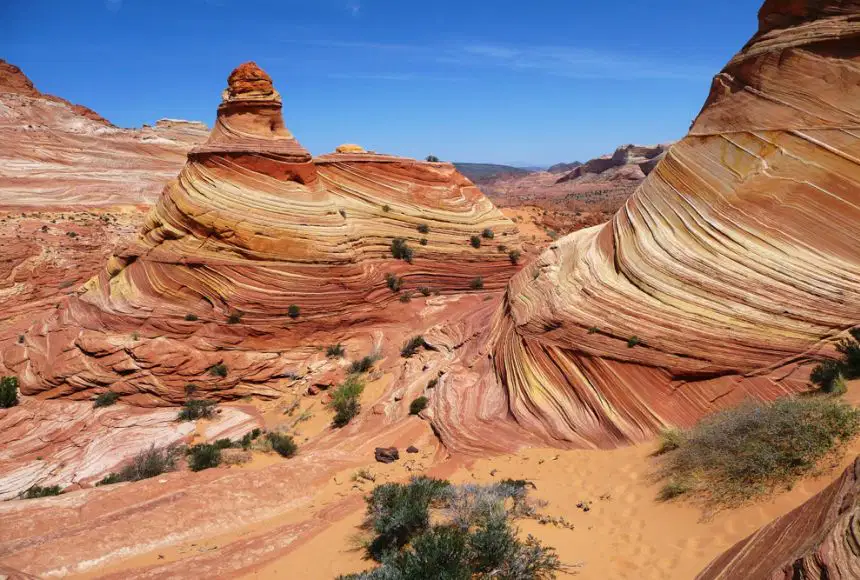
While hiking through a desert, Priya noticed a landform with smooth, wavy patterns in the rock, similar to the one shown in the image. What process is most likely responsible for the landform Priya observed?
(a)
Most places near the __________ have warm climates.
equator
poles
mountains
desert
Climate is defined as:
the average weather conditions in a region over a long period of time
the daily temperature and precipitation in a region
the amount of rainfall in a single year
the weather on a particular day
Taiga is found in which latitude zone?
Tropical zone
Temperate zone
Polar zone
Subarctic zone

