
 Worksheets
Unit 3 Test Review
Total questions: 40
Worksheet time: 21mins
Name
Class
Date
1.
The Harappan society developed and thrived -
a)
near a sea
b)
in the mountains
c)
along a river valley
d)
on a peninsula
2.
Which present-day country did the Harappan society develop?
a)
Egypt
b)
Iraq
c)
Pakistan
d)
Israel
3.
In comparison to other ancient civilizations, the early Indian societies were-
a)
isolated by geographical features making invasions difficult
b)
faced with a lack of fresh water sources and other resources
c)
known for their knowledge of shipbuilding on the Mediterranean Sea
d)
clustered around the Dead Sea in small fishing villages
4.
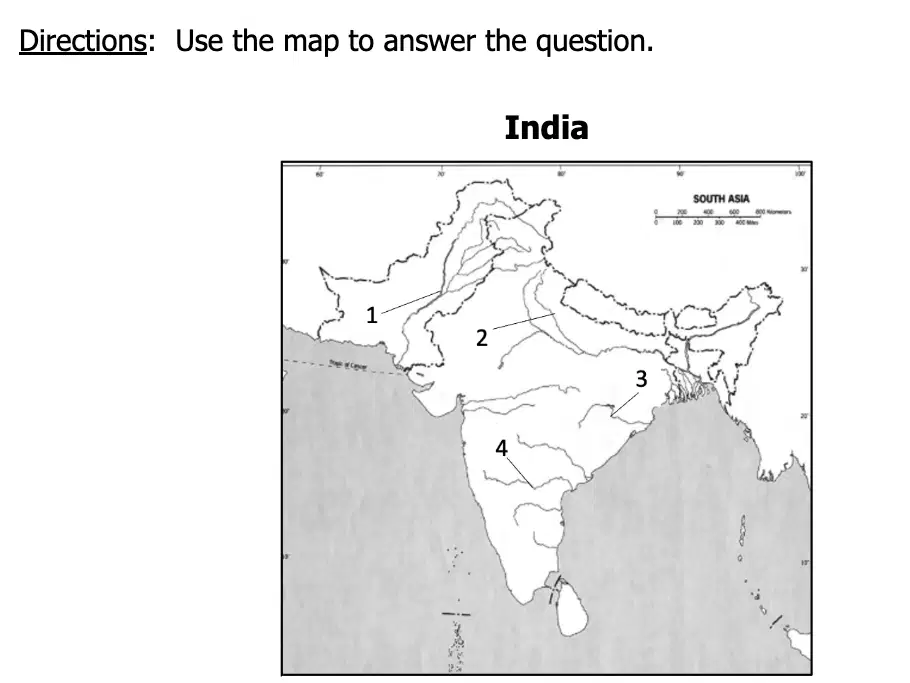
Which number indicates the location of the Indus River?
a)
1
b)
2
c)
3
d)
4
5.
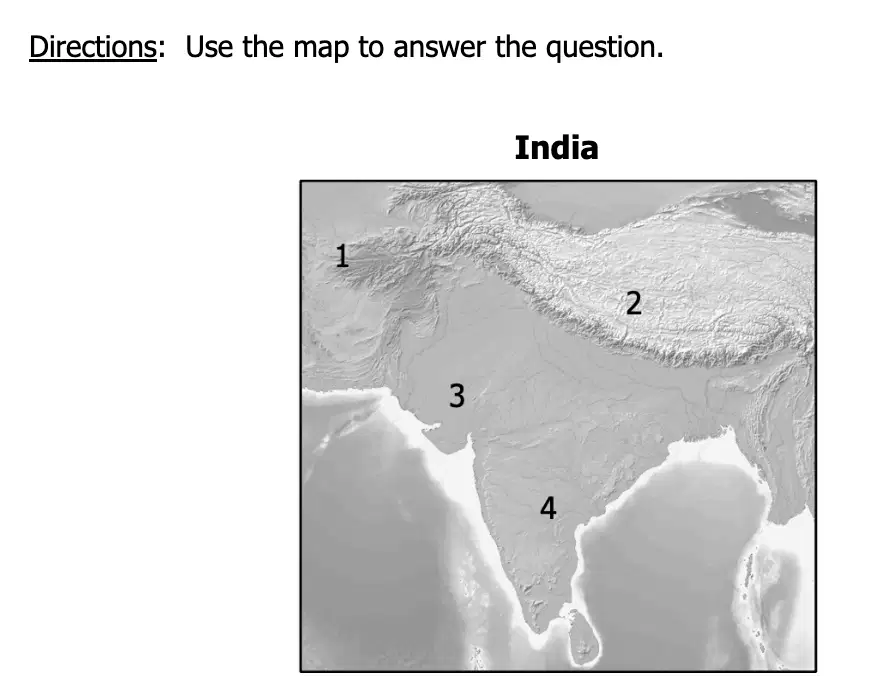
Which number is closest to the Himalayas?
a)
1
b)
2
c)
3
d)
4
6.
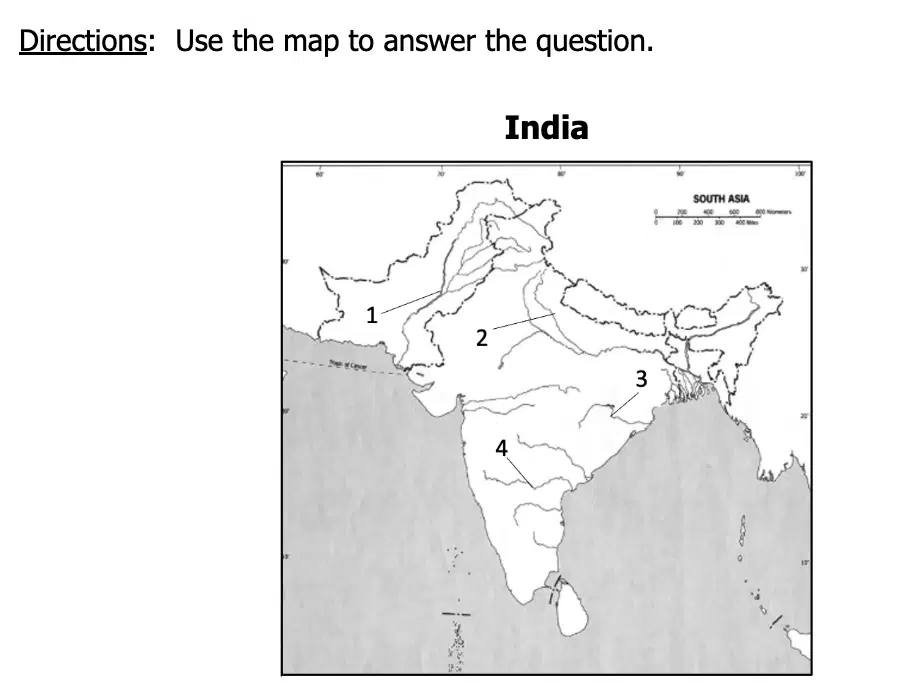
Early Indian civilization eventually spread to which river before expanding to the rest of the subcontinent?
a)
1
b)
2
c)
3
d)
4
7.
Over time in India, jatis was used to describe divisions by -
a)
language
b)
country
c)
occupations
d)
dynasty
8.
A traditional Indian caste system involved -
a)
providing equality for all people
b)
rejecting many Hindu gods
c)
a connection with monotheistic religions
d)
a social hierarchy of groups
9.
Which was considered to be the written language for early Indian societies?
a)
Hieroglyphics
b)
Alphabet
c)
Cuneiform
d)
Sanskrit
10.
Which politically united the Indian subcontinent into a single, large empire?
a)
Harappan
b)
Gupta
c)
Mauryan
d)
Aryan
11.
Which Indian empire was responsible for contributions in mathematics, medical advances, and the concept of a round earth?
a)
Aryan
b)
Gupta
c)
Harappan
d)
Mauryan
12.
Which are considered to be the oldest scriptures of Hinduism?
a)
Torah
b)
Vedas
c)
New Testament
d)
Ten Commandments
13.
The ultimate goal of or liberation from samsara is -
a)
moksha
b)
charity
c)
humility
d)
harmony with nature
14.
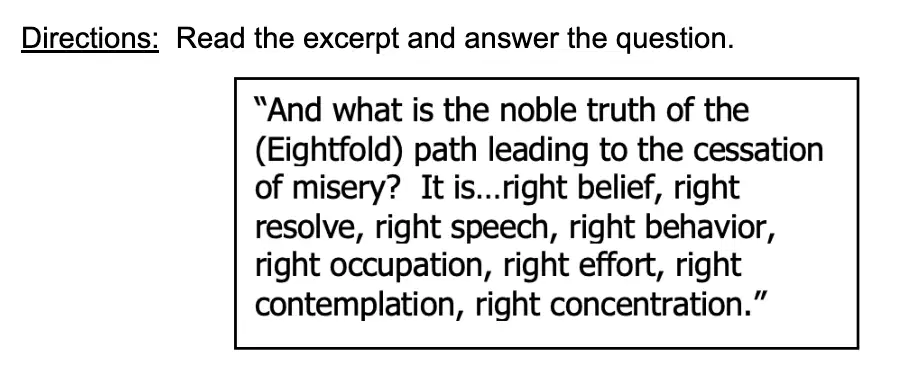
These words describe a teaching of which world religion?
a)
Polytheism
b)
Judaism
c)
Buddhism
d)
Hinduism
15.
Siddhartha Gautama is best known for -
a)
being a prophet that revealed the Ten Commandments
b)
being the founder of Buddhism
c)
creating the caste system
d)
introduced the concept of a round Earth
16.
In Buddhism, which means liberation of suffering and the cycle of birth and rebirth?
a)
Zen
b)
Nirvana
c)
Mantra
d)
Brahmin
17.
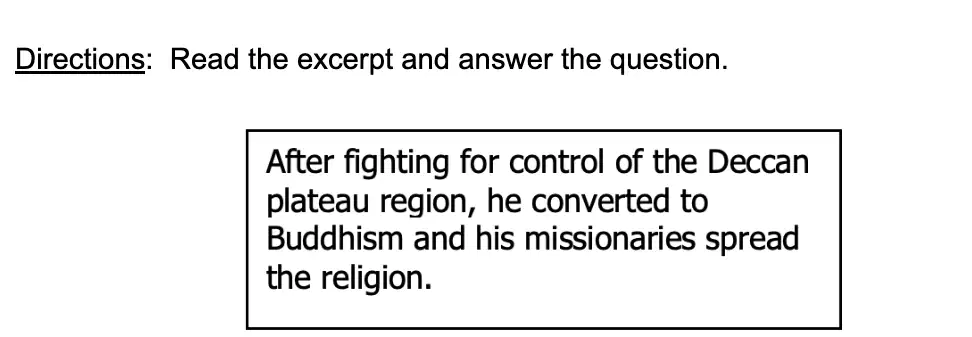
Which Mauryan leader was responsible for spreading Buddhism rom India to China and other parts of Asia?
a)
Brahma
b)
Asoka
c)
Moses
d)
Darius I
18.
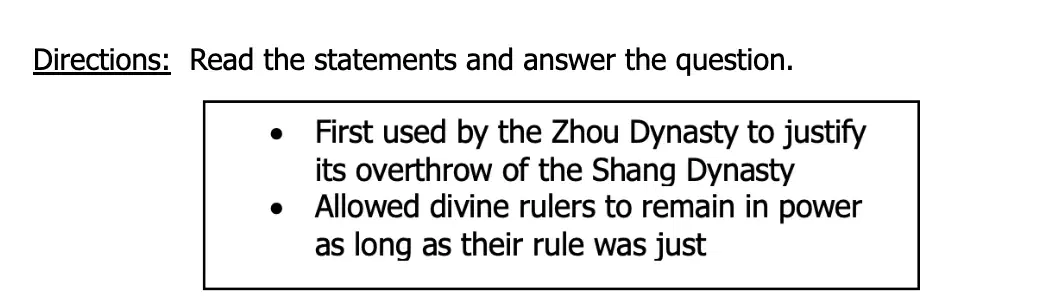
What was the Chinese philosophical concept being described?
a)
Yin and yang
b)
Code of Politeness
c)
Mandate of Heaven
d)
Eightfold Path to Enlightenment
19.
Which is a result from nomadic groups raiding early Chinese settlements from the north?
a)
Instituted a manor system
b)
Democratic elections
c)
The use of secret police
d)
Construction of a fortified wall
20.
Which regions were connected by the Silk Roads?
a)
East Asia and the Mediterranean basin
b)
Western Europe and East Africa
c)
West Africa and Southeast Asia
d)
Northern Europe and the Mediterranean basin
21.
Which are products from classical China?
a)
Papyrus
b)
Silk
c)
Porcelain
d)
Ivory
e)
Paper
22.
The rise, decline, and replacement of hereditary leaders in ancient China is referred to as -
a)
Dynastic cycle
b)
Caste system
c)
Monotheism
d)
Diaspora
23.
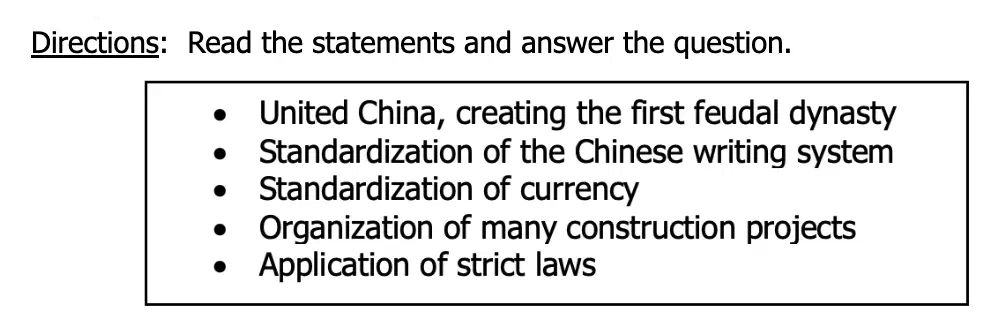
Who was responsible for the achievements listed?
a)
Confucius
b)
Asoka
c)
Moses
d)
Qin Shi Huangdi
24.
Which ancient system of writing is associated with China?
a)
Hieroglyphics
b)
Alphabet
c)
Oracle bone script
d)
Cuneiform
25.
What was the Chinese belief system that emphasized living in harmony with nature?
a)
Legalism
b)
Taoism
c)
Buddhism
d)
Confucianism
26.
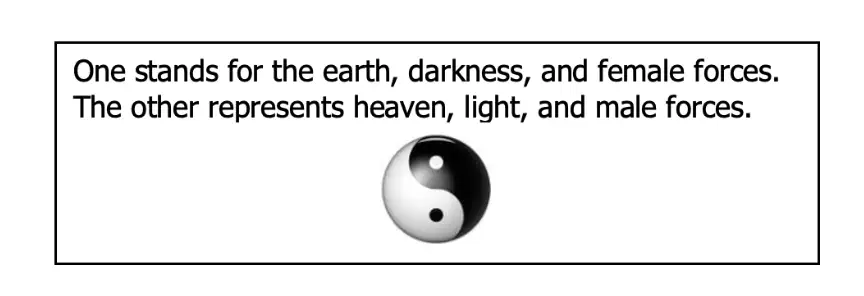
In both Confucianism and Taoism, the universe shows a balance between two opposite forces called-
a)
paths
b)
yin and yang
c)
cycles
d)
noble truths
27.
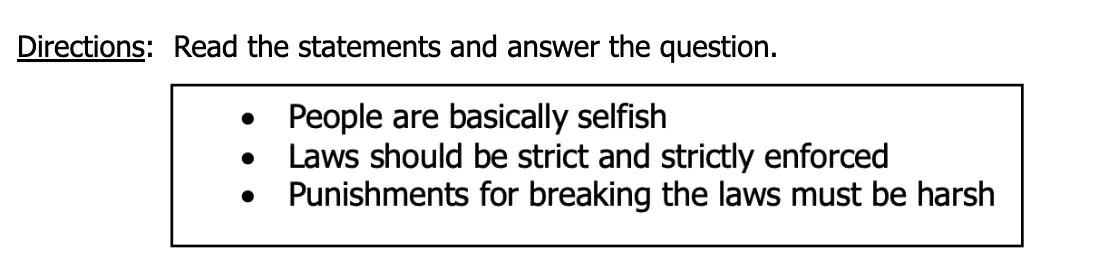
Which philosophy is being described?
a)
Confucianism
b)
Taoism
c)
Legalism
d)
Judaism
28.
Which represents the goal of Confucianism?
a)
Emphasizes learning, harmonious relationships, and respecting elders
b)
Emphasizes civic responsibility and participation in government
c)
Emphasizes a moral code by following the Ten Commandments
d)
Emphasizes an eightfold path to achieve freedom from suffering
29.
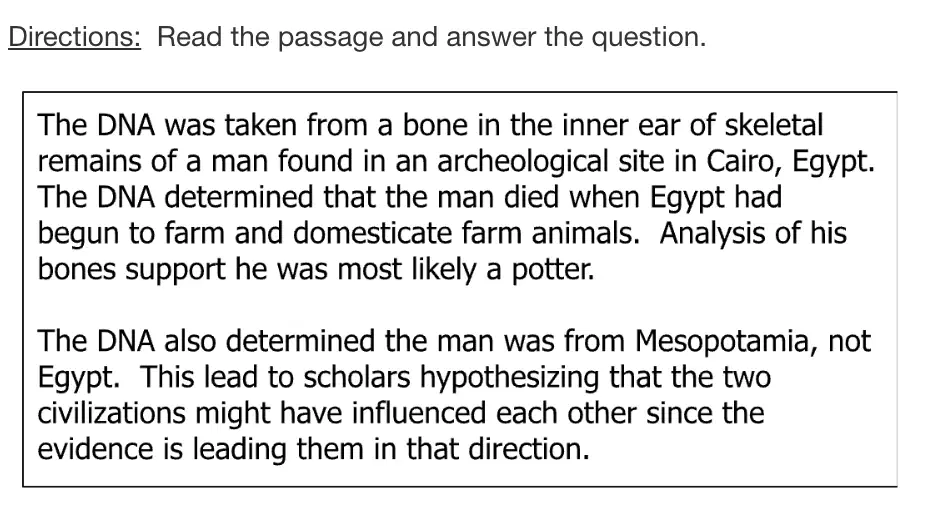
Based on the article, the man from the Cairo site lived during the
a)
Paleolithic Age
b)
Hunter-gatherer Era
c)
Neolithic Age
d)
Old Stone Age
30.
Which is a Paleolithic adaptation to their environment?
a)
Development of job specialization
b)
Advancements in record keeping
c)
Use of fire for warmth and cooking
d)
Development of villages and towns
31.

What is the best title for the list?
a)
Characteristics of the Neolithic Societies
b)
Methods in the Old Stone Age Era
c)
Trends in the Paleolithic Era
d)
Techniques of Hunters and Gatherers
32.
Which is a defining characteristic of the Paleolithic Era?
a)
The development of complex ideas
b)
The use of stone tools for farming
c)
Forming large settlements near rivers
d)
Hunting and gathering for subsistence
33.
The first simplified alphabet, containing only 22 letters, was created by the-
a)
Phoenicians
b)
Sumerians
c)
Egyptians
d)
Greeks
34.
Which early civilization used iron metallurgy to create iron weapons?
a)
Egyptians
b)
Mesopotamians
c)
Chinese
d)
Israelites
35.
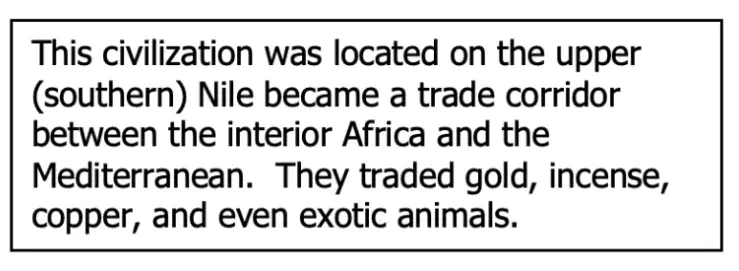
The excerpt best describes-
a)
Egypt
b)
Babylon
c)
Nubia
d)
Sumer
36.
The scattering or dispersal of the Jews beyond their homeland, especially after the Roman conquest of Judea is referred to as the -
a)
Sabbath
b)
Diaspora
c)
Covenant
d)
Pilgrimage
37.
Match the social castes with their correct places on the pyramid.
a)
Brahmins (priests and scholars)
b)
Kshatriyas (warriors and rulers)
c)
Vaishyas (farmers and merchants)
d)
Sudras (laborers and servants)
1
2
3
4
1)
2)
3)
4)
38.
a)
King Hammurabi of Babylon
1.
Hammurabi's Code
b)
Moses
2.
Ten Commandments
c)
Indo-Aryans of India
3.
Caste System
39.

This image represents which historical aspect?
a)
Geography
b)
Religion
c)
Social Structure
d)
Achievement
40.
Which leader unified China and began construction of the Great Wall?
a)
Qin Shi Huangdi
b)
Confucius
c)
Moses
d)
Asoka
100 %

