
 Worksheets
Afib & coagulation
Total questions: 74
Worksheet time: 43mins
a patient has premature atrial contractions( PAC,), which of the following could be causing it?
diuretics
allergies
Increased SNS, decreased PNS
stimulants, smoking
alcohol
a patient has premature atrial contractions( PAC,), which of the following is a good nonpharm?
less stress
more stress
reduce alcohol, smoking, caffeine
a patient has premature atrial contractions( PAC,), they are experiencing palpitations, SOB, dizziness , and fatigue. which of the following is a good treatment?
Digibind
metoprolol tartrate/succinate
Digoxin
diltiazem or verapamil
SVT( atrial tachycardia) a patient comes in with fluttering and palpitation, what could be the cause?
increased SNS activation
anorexia
digoxin toxicity
CVD
SVT( atrial tachycardia) a patient comes in with fluttering and palpitation, what is a non-pharm?
go running
reduce smoking, alcohol, caffeen
eat and rest
SVT( atrial tachycardia) a patient comes in with fluttering and palpitation, what is not recommended?
stopping alcohol
chronic oral anticoagulation due to low risk of stroke
IV adenosinem, betablocker, diltiazem, amiadarone
vagal maneuvers
SVT( atrial tachycardia) a patient comes in with fluttering and palpitation, what is a first line treatment
diltazem
adenosine
all IV adenosine betablocker, diltiazem, amiadarone
amiadarone
we cannot use adenosine for SVT(atrial vib) in which of the following patients?( Hint: Adenosine normally blocks SA or AV nodes for 10 seconds), so it may not block in people with accessory pathways)
old
wolff parkinson white syndrome( already tried vagal maneuver)
heart transplant
anorexic
Adenosine has to be given with
dextrose
NS saline
what is the purpose of a catheter ablation?
to destroy tissue causing arrythmias
to expand tissue
to treat GI upset
catheter ablations are preffered in which of the following conditions?
Wolff parkingnson white syndrome
MI
PAC
Wolff parkingnson white syndrome 1st line treatments ?
amiodarone, adenosine , digoxin, diltiazem,verapamil( if accessory path way is still present)
IV procainamide
IV ibutilide to restore NSR
Direct current cardioversion if hemodynamically compromised
Wolff parkingnson white syndrome 1st line treatments ?
amiodarone, adenosine , digoxin, diltiazem,verapamil( if accessory path way is still present)
IV procainamide
IV ibutilide to restore NSR
Direct current cardioversion if hemodynamically compromised
IV procainamide should be stopped if QRS widens ......orignial width and hypotension occurs or max of 17mg/kg
>50%
>70
IV procainamide is being used in a patient with WPWS but hey have renal /hepatic issues, what should we do?
cut their dose by 50%
increase dose by 50%
IV procainamide is being used in a patient with WPWS but they recently had a Myocardial infarction 6 months ago. what should we do?
cut their dose by 50%
increase dose by 50%
stop the dose, because this is contraindicated due to the cast trial
IV procainamide is being used in a patient with WPWS, they may experience
lupus like symptoms and agranulocytosi
N/V
hyperglyemia
a patient has WPWS, we don't have procainamide available, what can we give them instead?
metoprolol
Ibutilide
a patient has Afib chronically with ejection fraction <40%, and hypokalemia/hypomagnesmia which of the following is contractraindicated ?
Ibutilide
procainamide
an elderly patient with COPD and DM comes in with Afib, wha tis the best 1st line treatment?
procainamide
metoprol, esmolol
match the type of AFib to duration: Terminates spontaneously or with intervention <7 days , can reocur
longstanding persistent
Poroxysmal
permanent
persistent
match the type of AFib to duration: >7days
longstanding persistent
Poroxysmal
permanent
persistent
match the type of AFib to duration: >12days
longstanding persistent
Poroxysmal
permanent
persistent
match the type of AFib to duration: >patient or provider abanded further efforts to maintaain NSR
longstanding persistent
Poroxysmal
permanent
persistent
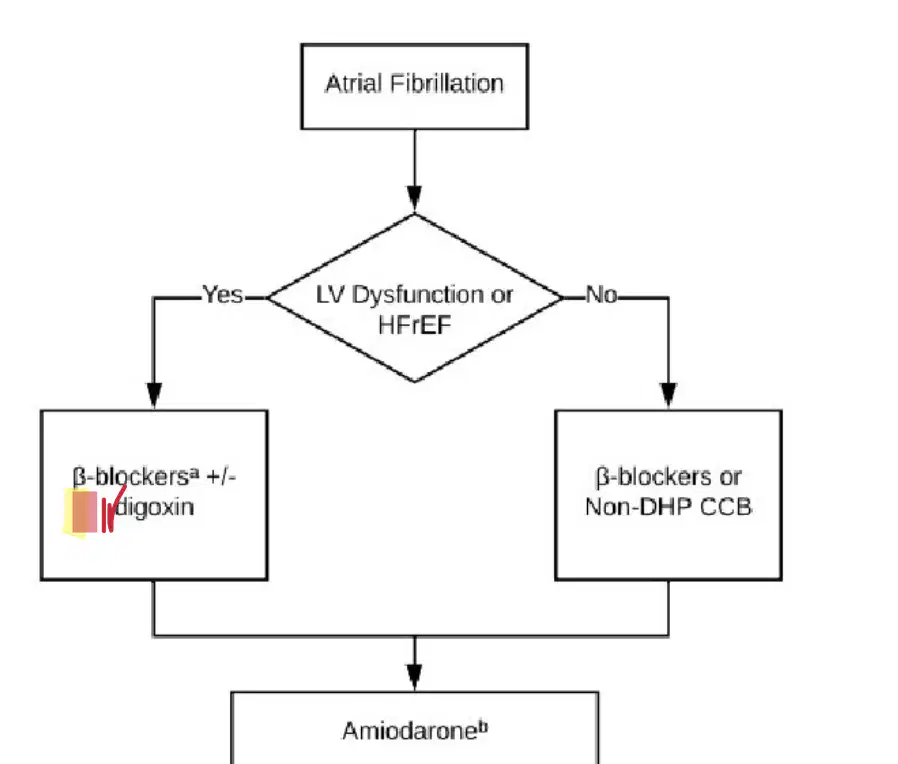
a patient has Afib with LV dysfunction or HFrEF, which of the following is a good first line treatment?
Metoprol + digoxin
metoprolol or Diltiazem
Amiodarone
a patient has Afib with LV dysfunction or HFrEF, which of the following is contraindicated
Metoprol + digoxin
metoprolol or Diltiazem
Amiodarone
if a patient has AFIb with acutely decompensated heart failure, we should not use
metoprolol and other betablockers
amiodarone
digoxin will increase vagal activity and reduce AV conduction: we must dose reduce the bolus by 50% in which of the following patients?
elderly
renal dysfunctions
those taking amiodarone, dronedarone, verapamil
all the above
what are signs of digoxin toxicity? ( ADRS are anorexiam, nausea, vomiting, bradycardia)
bidirectional VT
amyloidosis
hypokalemia, heart block
all the above
digoxin is good 1st line treatment for
afib
HF
both
amiodarone is good 2nd line treatment for
afib
HF
both
we check levels for digoxin 12-24 hrs after loading dose. what is the ideal AFib digoxin trough level?
<1.2 ng/ml
<3ng/ml
no loading dose for digoxin, when should we check trough levels?
12-24hrs
3-5 days
12-20 days
5-7
when we give digifab, what should we monitor for
K+
Ca++
Mg++
after we give digifab, what should we check for
no digoxin levels!!
digoxin levels
When we treat acute Afib, we are controlling for
rate
rythmm
which of the following is true about amiodaron DDIs?
increases levels of warfarin( so we have to reduce dose for warfarin)
increases levels of statins
both

in acute AFIb: if a patient is relatively stable, but not stable ( Normal HR) we will conduct .............to prevent going into VFIB
maneuver
defibrillation
cardioversion

if a patient has rythm control issues in an acute AFIb , but they have HF with LVEF <40%, which of the following drugs should they use?
flecainide
dofetilde
amiodarone
ibutilide
propefenone
procainamide
if a patient has rythm control issues in an acute AFIb , but they DOn't have HF , which of the following drugs should they use?
flecainide
dofetilde
amiodarone
ibutilide
propefenone
procainamide
if a patient has rythm control issues in an acute AFIb , but they DOn't have HF but have SHD( MI or structured heart disease), which of the following drugs should we avoid giving them??
flecainide
dofetilde
amiodarone
ibutilide
propefenone
during cardioversion, when should we always provide anticoagulation regardless of CHAD2VASC ?
Electrical cardioverting
medically cardioverting
always provide during cardioversion
what is the bigest risk of Afib( why we must do ECg before cardiovert)
there is no risk
STasis could cause blodvclot
IN AFab , how do we determine anticoagulation?
Cardioversion( at least 4 weeks post )
CHAD2VASC
valvular Afib
all the above
which of the following is true about the transition to oral amiodarone?
do not need loading dose
need loading dose due to duration of halflife
Dofetilide must be dose based on ( during Renal adjustment)?
Ideal body weight
Actual body weight
QTC prolongation, Torsades, Headaches, Chest pain are all side effects for which of the following drugs?
propefenone
flecainide
dofetilide
what is unique about dofetilide Per FDA?
check QTC every 2-3 hrs post each dose
have to be in hospital for 3 days and EKG monitoring
QTC has to be less than 440s, has to be monitored every 3 months after
monitor Scr,K/Mg
all the above
which of the following is contraindicated with dofetilide?
Chlorothalidone
ezetimibe
Hydrochlorothiazide
which of the following is contraindicated with dofetilide?
prochlorperazine
ezetimibe
Hydrochlorothiazide
ondensentron
which of the following is contraindicated with dofetilide?
dolutegravir,bictarvi
verapamil
ondensentron
ezetimibe
trimethoprim
which of the following is contraindicated with dofetilide?
ezetimibe
megestrol( for apetite)

Clas 1 drugs are usally are CONTRAINDICATED in MI( 6days-2 yrs) and other SHD like HF. both FLECAINIDE AND PROPEFENONE MUST be admin in hospital for initial loading dose for monitoring ( arrythmias). However, which of the following drugs also has betablocking activity?
flecainide
propafenone
ADRs for flecainide
blurred vision
QRS complex prolongation, HF worsening , ventricular arrythmias
dizziness
gynocomastia
AV block
ADRs for propefenone
blurred vision
QRS complex prolongation, HF worsening , ventricular arrythmias
dizziness
gynocomastia
AV block, bradycardia
to reduce risk of 1: 2 AV. node condution, propefenone and flecainide should be given with which of the following drugs
metoprolol
simvastatin
diltiazem
AV block, bradycardia

a patient with Afib - rythm issues needs to be transferred home and needs oral meds. which of the following 2 meds only come in oral form( cannot be used acutely for AFib)?
dofetilide
dronedarone
flecainide
sotalol
propefenone, amiadarone
a patient with Afib - rythm issues but has HEART FAILURE AND needs to be transferred home. which of the following will be first line meds to send them home with?
dofetilide
dronedarone
flecainide
sotalol
amiadarone
a patient with Afib - rythm issues but has CAD & needs to be transferred home. which of the following will be first line meds to send them home with?
dofetilide
dronedarone
flecainide
sotalol
amiadarone
a patient with Afib - rythm issues but has CAD or HF needs to be transferred home. which of the following is CONTRAINDICATED ?
dofetilide
dronedarone
flecainide,PROPEFENONE
sotalol
amiadarone
MATCH description to drug: must monitor LFTs at baseline every 6months, ECG/SCR due to ADRs of bradycardia, diarrhea, hepatotoxicity, pulmonary fibrosis, HF worsening, QTC prolongation and sister to amiodarone
dofetilide
dronedarone
flecainide,PROPEFENONE
sotalol
amiadarone
MATCH description to drug: has Class 2 & 3 action, must monitor ECG continuously due to ADRs AV block, bradycardia, worsening of HF, QTC prolongation, Torsades
dofetilide
dronedarone
flecainide,PROPEFENONE
sotalol
amiadarone
MATCH description to drug: contraindicated if Crcl is less than 40 and QTC is greater than 450ms
dofetilide
dronedarone
flecainide,PROPEFENONE
sotalol
amiadarone
what is unique about Sotalol compared to dofetilde dosing?
it can be used inc Crcl < 40
we can increase dose if patient is not bradycardic
if a patient can take flecainide, we must check their
Crcl
LFts
if a patient can take propefenone, we must check their
Crcl
Hepatic dosing
how do we treat a flutter( sawtooth Ecg)
Afib rythm control meds
Afib rate control meds
this favors rhythm control for Afib
older
younger
long history of Afib
short history of Afib
patient does not want it
this favors Rate control for Afib
older
younger
long history of Afib
short history of Afib
patient wants it
this favors Rhythm control for Afib
fewer symptoms
more symptoms
which of the following should we NOT give a patient who has mitral stenosis or mechanical heart valve(Afib)?
DOAC
Heparin
which of the following should we give to a patient who has NON-VALVULAR (Afib)?
WARFARIN
APIXABAN
on the HAS-BLED score: which scanario gives 1-2 points
Abnormal liver& renal
Older, history of strok, bleeding
labile INRs, HTN
drugs or alcohol
on the HAS-BLED score: which scanario gives 1 point
Abnormal liver& renal
Older, history of strok, bleeding
labile INRs, HTN
drugs or alcohol

