Wayground logo

Free Printable Worksheets

Font size

S
M
L
XL
Worksheets

Skill E Ecological Succession

Total questions: 20

Worksheet time: 10mins

Name
Class
Date
1.
What is ecological succession?
a)
The movement of species from one habitat to another
b)
A series of changes that occur in a community after a disturbance
c)
The process of predator-prey interactions and how those interactions impact population sizes
d)
The decrease in energy as it flows from one trophic level to the next
2.
What is the difference between primary and secondary succession?
a)
Primary succession occurs after wildfires; secondary succession occurs after floods
b)
Primary succession starts with soil; secondary succession starts with no soil
c)
Primary succession is caused by humans; secondary succession occurs naturally
d)
Primary succession begins when no soil remains; secondary succession begins when soil remains
e)
There is no difference between them
3.
What is an example of primary succession?
a)
A forest regrowing after wildfire
b)
A grassland returning after farming
c)
A glacier retreating and exposing bare rock
d)
A pond drying up and filling with plants
4.
Which is an example of secondary succession?
a)
A volcano creating a new island
b)
A flood washing away vegetation but leaving soil intact
c)
A desert forming where a rainforest once existed
d)
Lichens breaking rock down into soil
5.
What is a pioneer species?
a)
The first primary consumer to be able to move to an area after a disturbance
b)
The largest predator in an ecosystem after disturbance
c)
The first species to colonize an area after a disturbance
d)
A species that prevents succession from occurring
6.
Which organism is the most likely pioneer species in secondary succession?
a)
Lichen
b)
Oak tree
c)
Shrub
d)
Grass
7.
Which type of succession takes longer to occur and why?
a)
Secondary because pioneer species take longer to arrive
b)
Secondary because it has fewer species
c)
Primary because soil needs to form
d)
Primary because plants establish themselves slower than animals do
8.
In the years immediately following a fire the forest will experience
a)
Primary succession
b)
Secondary succession
c)
a climax community
d)
tertiary succession
9.
Pioneer species are vital to colonizing new land and starting a new ecosystem
a)
True
b)
False
10.
Mature hardwood & evergreen trees can be found in which stage of succession in a forest?
a)
pioneer species
b)
climax community
c)
tertiary consumers
d)
consumers
11.

Gradual, natural change in an ecosystem over time:

a)

Succession

b)

Movement

c)

Evolution

d)

Change

12.

After a volcano destroys the land, ________________ succession takes place.

a)

Secondary

b)

Primary

c)

Tertiary

d)

Important

13.

The first species to live in a land, after destruction, are:

a)

Oregon Trail species

b)

Primary consumers

c)

Pioneer species

14.

A new island is formed after a volcano erupts.

What is the order that things would grow?

a)

Tree, grass, moss

b)

Lichen, Grass, Shrub, Tree

c)

Lichen, Shrub, Moss, Tree

d)

Shrub, grass, moss, tree

15.

After an area was cleared for farmland 100 years ago, it has completely regrown large trees. This is an example of:

a)

Evolution

b)

Ecology

c)

Primary Succession

d)

Secondary Succession

16.

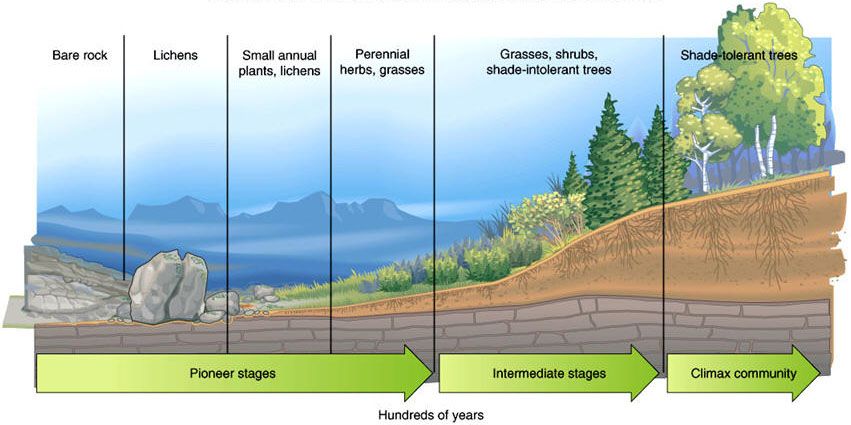
Primary or secondary ecological succession?

a)
b)
17.
What is the order of succession shown in this figure?
a)
A, B, C, D
b)
B, A, D, C
c)
C, D, A, B
d)
D, A, B, C
18.

What is the main difference between primary and secondary ecological succession?

a)

Primary begins WITHOUT soil; Secondary begins WITH soil

b)

Primary is the first state and secondary is the second stage

c)

Primary builds plant community; secondary builds animal community.

d)

Primary begins WITH soil; Secondary begins WITHOUT soil
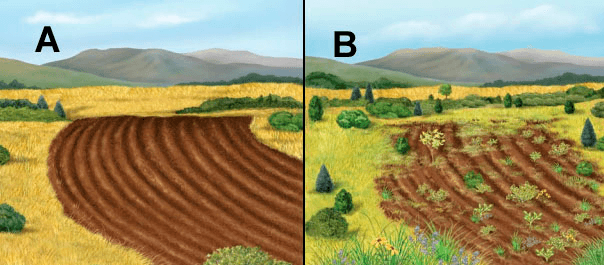
19.
What type of succession is shown going from figure A to figure B?
a)
primary succession
b)
ecological succession
c)
secondary succession
d)
intermediate
20.
The picture shows what type of succession?
a)
primary
b)
secondary
c)
tertiary
d)
quadanary