
NEW
Font size
 Worksheets
Analyzing Functions
Total questions: 50
Worksheet time: 2hrs 44mins

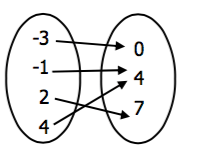
R: {0, 1, 2, -4}
R:{1, -3, -4}
R:{1, -3, -4}
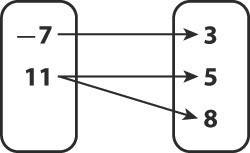

What is the range?
x≥0
y≥0
All real numbers
{0, 1, 2, 3, 4,...}


What is the Range of the situation?
0≤x ≤9
0<x<9
0<x<28
0≤y≤28
Speedy Boat Rental charges a $15 deposit fee plus $2 for each hour of use to rent a paddle boat. The equation: C=2h+15. If Frank wants to rent the boat from to 3 to 6 hours, what is the domain and range?
Domain: 3 < x < 6
Range: 21 < y< 27
Domain: 3 < x < 6
Range: 21 < y < 27
Domain: {3, 4, 5, 6}
Range: { 21, 23, 25 , 27}
Domain: { 21, 23, 25 , 27}
Range: {3, 4, 5, 6}
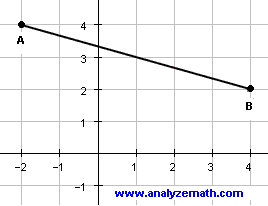
What is the domain of the graph shown?
{-2, -1, 0, 1, 2, 3, 4}
{2, 3, 4}
2 ≤ y ≤ 4
-2 ≤ x ≤ 4
-8 ≤ x < 8
-9 < x ≤ -4

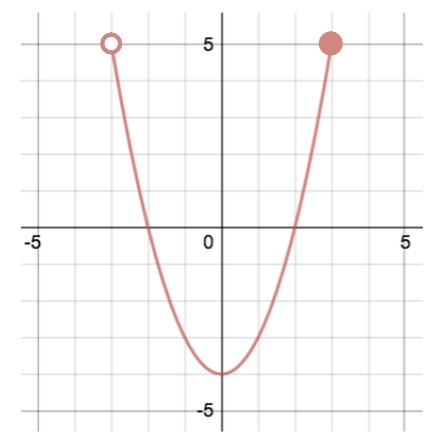


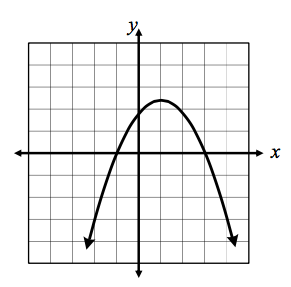
Which function family does this graph belong to?
Exponential
Linear
Cubic
Absolute Value

Which function family does this graph belong to?
Absolute Value
Cubic
Quadratic
Exponential

Name the parent function.
constant
quadratic
linear
exponential
What type of function is this?
y=3∣x+1∣+4
Linear Function
Quadratic Function
Absolute Value Function
Exponential Function

What is the range of the graph?
[2, ∞)
[1, ∞)
(−∞, ∞)
None of these

What function family is this graph from?
Reciprocal/Rational
Exponential/Logarithmic
Polynomial
Absolute Value


g(x) = 3 - x,
what is g(-4) + f(1)?

Use the graph to evaluate f(3)
1.5
5
3
8

Translation
Reflection
Rotation
Dilation

Translation
Reflection
Rotation
Dilation

Translation
Reflection
Rotation
Dilation

Translation
Reflection
Rotation
Dilation

Translation
Reflection
Rotation
Dilation

Translation
Reflection
Rotation
Dilation

Translation
Reflection
Rotation
Dilation
f(x) = IxI -5
y = (x - 3)2

Describe the transformation from the parent absolute value function:
y=∣x∣−5
Shift up 5 units
Shift down 5 units
Shift right 5 units
Shift left 5 units
Which function has a range of [0, ∞) ?
Linear
Quadratic
Square Root
Cubic
Cube Root


f(x) = x2
then the red must be...
Given f(x) = (x + 6)² - 2 , how did we transform from the parent function?
Horizontal shift left 6, vertical shift up 2
Horizontal shift left 6, vertical shift down 2
Horizontal shift right 6, vertical shift down 2
Horizontal shift right 6, vertical shift up 2
A student graphed f(x)=x and g(x)=f(x)+3 on the same coordinate grid. Which statement describes how the graphs of f and g are related?
The graph of f is shifted 3 units up to create the graph of g .
The graph of f is steeper than the graph of g .
The graph of f is shifted 3 units down to create the graph of g .
The graph of f is less steep than the graph of g .
The graph of f(x)=x2 was translated 4.5 units to the left to create the graph of function g . Which function represents g ?
g(x)=(x−4.5)2
g(x)=(x+4.5)2
g(x)=x2−4.5
g(x)=x2+4.5
The graph of f(x)=x2 was transformed to create the graph of g(x)=f(x)−9 . Which statement about the graphs is true?
The graph of g is a reflection of the graph of f across the x-axis.
The vertex of the graph of g is 9 units to the right of the vertex of the graph of f .
The graph of g is a reflection of the graph of f across the y-axis.
The vertex of the graph of g is 9 units below the vertex of the graph of f .
How does the graph of f(x) = -(x - 5)2 compare to the graph of the parent quadratic function?
5 units left
5 units right
5 units left and reflection in the x-axis
5 units right and reflection in the x-axis
Match the description with the transformation.
g(x)= -f(x) - 4
Reflected over x axis and up 4
Reflected over x axis and down 4
Reflected over y axis and right 4
Reflected over y axis and left 4
Given f(x) = f(-x), how did we transform from the parent function?
Reflection over the y-axis
Reflection over the x-axis
Moved down
got wider

