
 Worksheets
Job Analysis Quiz
Total questions: 93
Worksheet time: 47mins
According to Flippo, what does the process of investigating and collecting information regarding the duties and responsibilities of a specific job refer to?
Job analysis
Job rotation
Job enrichment
Job evaluation
Which of the following best describes Sikula's definition of job analysis?
A process of gathering all facts related to a job to ensure that work is fully divided.
A process of promoting employees to higher positions.
A process of evaluating employee performance.
A process of training employees for new skills.
What is one of the main efforts involved in job analysis as described in the material?
The effort to obtain information about a job
The effort to increase employee salaries
The effort to reduce working hours
The effort to hire new employees
Which of the following statements is true about the position of a person in an organizational structure?
It refers to their job title and responsibilities within the organization.
It refers to their salary and benefits.
It refers to their personal interests.
It refers to their educational background.
How do the definitions by Flippo and Sikula contribute to understanding job analysis in an organization? (DoK Level 3)
They emphasize the importance of collecting detailed information to ensure proper division of work and clarity of job responsibilities.
They focus on employee motivation and satisfaction.
They highlight the need for frequent job changes.
They suggest that job analysis is only necessary for new employees.
Which of the following best defines a "Job Description"?
A systematic record of tasks, responsibilities, and qualifications.
A record of the requirements a person must have to hold and perform a particular job.
A list of company policies and procedures.
A summary of employee benefits and compensation.
What is the main focus of a "Job Specification"?
Describing the daily tasks of a job.
Recording the requirements a person must have to hold and perform a particular job.
Listing the company’s mission and vision.
Outlining the company’s organizational structure.
How do "Job Description" and "Job Specification" differ in the context of job analysis?
Job Description focuses on tasks and responsibilities, while Job Specification focuses on the requirements needed to perform the job.
Job Description and Job Specification are identical in meaning.
Job Description is about company goals, while Job Specification is about employee salaries.
Job Description is only for managers, while Job Specification is for all employees.

Who are typically involved in understanding tasks and requirements of a job within an organization?
HR Manager, Company Owner, Consultant, All positions in the organization
Only the CEO
Only the employees
Only external consultants

Where does the process of understanding job tasks and requirements usually take place?
Only in government offices
Companies, Institutions, Organizations with a structure
Only in schools
Only in non-profit organizations

At what points in time is it important to understand the tasks and requirements of a job in an organization?
Only during annual reviews
At establishment, Organizational development, Specific periods
Only when hiring new employees
Only during financial audits

Why is it important to understand the tasks and requirements of a job in an organization?
To increase company profits only
To understand tasks and requirements of a job, and as a foundation for HRM activities
To reduce the number of employees
To avoid legal issues only
Suppose an organization is undergoing a period of rapid growth. Based on the information provided, what should the organization focus on regarding its job roles?
Ignore job roles until the growth stabilizes
Reassess and understand tasks and requirements of jobs as part of organizational development
Only focus on hiring more employees
Outsource all HR activities
Which of the following best describes "enlargement" in job design?
Vertical expansion of tasks
Horizontal expansion of tasks
Increasing employee salary
Reducing the number of tasks
Which of the following is NOT listed as a benefit of job analysis?
Workforce planning
Organizational design
Product marketing
Training and development
Job enrichment in job design refers to:
Horizontal expansion of tasks
Vertical expansion of tasks
Decreasing job responsibilities
Outsourcing job functions
How does job analysis contribute to management succession?
By reducing the number of employees
By identifying and preparing future leaders
By eliminating training programs
By focusing only on compensation
A company wants to improve its selection criteria for hiring. Which process would most directly support this goal?
Job analysis
Job enrichment
Workforce downsizing
Product development
Which of the following best describes the main purpose of Human Resource Planning (HRP)?
To increase company profits by reducing employee numbers
To plan and meet workforce needs in both quantity and quality
To focus only on hiring new employees
To eliminate training programs
Which of the following is NOT listed as an aspect of Human Resource Planning (HRP)?
Right quantity
Right quality
Right salary
Right position and timing
What is one of the main elements of Human Resource Planning (HRP)?
Determining organizational needs
Increasing product sales
Reducing marketing costs
Expanding office locations
How does Human Resource Planning (HRP) benefit society or the nation?
By reducing the number of jobs available
By creating more jobs and raising national income
By lowering employee satisfaction
By decreasing business growth
Supporting programs to fulfill organizational needs contributes to the effectiveness of Human Resource Planning (HRP) by:
Ensuring that only top management benefits from HRP.
Helping align workforce capabilities with organizational goals, improving efficiency and productivity.
Focusing solely on reducing costs.
Ignoring individual employee goals.
Which of the following best defines recruitment?
The process of searching for skilled workers from available labor sources
The process of training existing employees
The process of evaluating employee performance
The process of terminating unskilled workers
Which of the following is an example of an internal source of recruitment?
Promotions
Advertising
Agencies
Outsourcing
Which of the following is NOT an external source of recruitment?
Transfers
Advertising
Schools/colleges
Labor unions
What is one purpose of recruitment according to the material?
To bring in new ideas
To increase employee turnover
To reduce training costs
To eliminate all competition
Why might a company use both internal and external sources for recruitment? (DoK Level 3)
To access a wider pool of candidates and bring in new ideas while also utilizing existing talent
To reduce the number of employees
To avoid training new employees
To increase negative competition
What is the process of deciding to employ certain workers from a group of applicants called?
Recruitment
Selection
Orientation
Training
Which of the following is NOT listed as a method of selection?
Application Forms
Medical Examination
Job Rotation
Background Investigation
Which type of tests may be used as a method of selection?
Academic, practical, psychological
Only physical
Only written
Only oral
During an interview, which of the following should be avoided to ensure fairness?
Bias and prejudice
Creating a positive atmosphere
Being a good listener
Avoiding the “halo effect”
Why is it important to avoid the “halo effect” during an interview?
It ensures the interviewer remains objective and fair.
It helps the interviewer finish quickly.
It allows the interviewer to ask more questions.
It makes the interview more stressful.
Suppose you are conducting an interview for a job position. How would you apply the concept of creating a positive atmosphere, and why is it important?
By being welcoming and supportive, which helps candidates perform at their best.
By asking only difficult questions to test stress levels.
By ignoring the candidate’s responses.
By focusing only on the candidate’s weaknesses.
Which of the following best defines "training" as described in the context of Training & Development?
A short-term systematic process where non-managers learn specific technical knowledge.
A long-term process for managers to develop leadership skills.
A method for evaluating employee performance.
A process for hiring new employees.
Which of the following is NOT listed as an objective of Training & Development?
Increase employee salaries.
Increase productivity, quality, morale, safety, flexibility, efficiency.
Prevent obsolescence.
Improve safety.
Which of the following is a method used specifically for "development" rather than "training"?
Job rotation
On-the-job training
Apprenticeship
Simulation
According to the material, which method is NOT mentioned as a training method?
Job rotation
On-the-job
Vestibule
Demonstration
Why is preventing obsolescence considered an objective of Training & Development?
To ensure employees' skills remain current and relevant in a changing work environment.
To increase the number of employees in an organization.
To reduce the cost of training programs.
To improve the physical appearance of the workplace.
According to Flippo, what is a career?
A series of separate but related work activities that are continuous and meaningful to a person's life.
A single job held for a lifetime.
A random collection of unrelated jobs.
A temporary position in a company.
What does Cascio define a career as?
A sequence of promotions/mutations, as a clear systematic career path.
A single job held for a lifetime.
A random collection of unrelated jobs.
A temporary position in a company.
What are career goals?
The future position someone strives for.
The current job someone holds.
The salary someone wants to earn.
The skills someone already has.
What is career development?
Personal improvements to achieve career plans.
Finding a new job.
Earning a higher salary.
Changing industries frequently.
Which of the following is NOT a program related to career planning?
Ignoring employee needs.
Assessing career needs.
Providing career opportunities.
Matching employee needs with opportunities.
Which of the following is a pattern of career progression mentioned in the material?
Linear
Random
Circular
Unpredictable
Which of the following best describes the purpose of matching employee needs with opportunities in career planning?
To ensure employees are satisfied and can grow within the organization.
To reduce the number of employees.
To increase competition among employees.
To limit employee development.
What does HRP stand for in the context of business management?
Human Resource Planning
Human Rights Protection
High Risk Projects
Health Resource Program
Which of the following best describes the main purpose of HRP?
To align a company's human resources with its business needs
To increase employee salaries
To reduce the number of employees
To improve customer satisfaction
According to the core question of HRP, what should organizations consider for future preparation?
If they have the right people in the right places and what actions are needed for the future
If they have the highest profits
If they have the best marketing strategy
If they have the most advanced technology
Which of the following is NOT a focus of HRP as described in the material?
Forecasting future demand for human capital
Developing strategies to meet human capital demand
Ensuring the right number of people with the right skills are available at the right time
Increasing the number of company products
Why is it important for HRP to ensure the right number of people with the right skills are available at the right time? (DoK Level 3)
To maximize organizational efficiency and prepare for future business needs
To reduce the cost of office supplies
To improve the company’s social media presence
To increase the number of company holidays
What is the primary purpose of Human Resource Planning (HRP) in relation to an organization's business strategy?
To integrate with the organization's overall business strategy
To focus only on hiring new employees
To react to market changes after they occur
To manage only payroll and benefits
Which of the following best describes "Strategic Alignment" in HRP?
Linking the organization's mission and goals with its HR strategy in a proactive way
Focusing only on employee training programs
Reacting to problems as they arise
Ignoring the organization's mission and goals
According to the "Resource-Based View" (RBV), what is considered the most critical resource for a firm's sustained competitive advantage?
Its people
Its technology
Its financial assets
Its marketing strategy
How does HRP contribute to an organization's dynamic capabilities?
By ensuring the workforce has the skills to respond to new challenges
By maintaining a static workforce
By focusing only on current market needs
By reducing employee training
The Resource-Based View (RBV) supports the importance of HRP in maintaining a firm's competitive advantage because:
RBV emphasizes that unique and valuable resources, especially people, are crucial for sustained competitive advantage, making HRP essential for developing and maintaining these resources.
RBV suggests that only financial resources matter, so HRP is less important.
RBV focuses on external market trends, not internal resources.
RBV recommends outsourcing all HR functions.
Which of the following is considered an internal factor influencing Human Resource Planning (HRP)?
Economic conditions
Legal and political regulations
Organizational strategy
Demographic trends
What is an example of a technological change that can influence HRP?
Recession
Automation
Labor laws
Demographic shifts
Which external factor involves the talent pool available from other organizations?
Budget constraints
Competition
Technological changes
Organizational strategy
How might budget constraints impact HRP in an organization?
By changing workforce demographics
By limiting financial resources for hiring and training
By introducing new product lines
By increasing economic growth
A company is experiencing rapid economic growth. Which factor influencing HRP does this scenario best illustrate?
Technological changes
Economic conditions
Legal and political regulations
Budget constraints
If a business is expanding and adding new product lines, which internal factor is most directly involved?
Organizational strategy
Demographic trends
Competition
Legal regulations
Why are demographic trends important for HRP?
They determine the financial limitations on hiring.
They affect the availability of skills in the workforce.
They regulate labor laws.
They drive automation and AI adoption.
Which of the following best describes the impact of legal and political regulations on HRP?
They influence business goals and strategies.
They determine the level of competition in the market.
They set rules for labor laws and employment equity.
They drive technological changes in the organization.
Which of the following is NOT one of the four aspects of Human Resource Planning (HRP)?
The right quantity
The right quality
The right position and time
The right salary structure
Which aspect of HRP focuses on ensuring that employees are available at the correct location and moment?
The right quality
The right position and time
The right quantity
Pay attention to individual and organizational goals
Why is it important for HRP to pay attention to both individual and organizational goals?
To ensure only organizational goals are met
To balance employee satisfaction with company objectives
To focus solely on employee needs
To reduce the number of employees
List the four aspects of HRP as described in the material.
The right quantity, the right quality, the right position and time, pay attention to individual and organizational goals
The right salary, the right benefits, the right training, the right leadership
The right technology, the right market, the right product, the right price
The right communication, the right marketing, the right finance, the right logistics
Which regulation is mentioned in the context of HPR in Government?
Regulation of the Minister of Administrative and Bureaucratic Reform No. 1 of 2020
Regulation of the Minister of Finance No. 2 of 2019
Regulation of the Minister of Education No. 3 of 2021
Regulation of the Minister of Health No. 4 of 2018
What does "ANALISIS JABATAN (ANJAB) DAN ANALISIS BEBAN KERJA (ABK)" refer to in English?
Job Analysis and Workload Analysis
Financial Analysis and Budget Planning
Performance Review and Salary Assessment
Recruitment and Training Analysis
Which of the following is NOT mentioned as a component of HPR in Government in the provided material?
Job Analysis Map
Job Analysis and Workload Analysis
Regulation of the Minister of Administrative and Bureaucratic Reform No. 1 of 2020
Employee Satisfaction Survey
Suppose a government agency wants to optimize its workforce allocation. Which process from the material would be most relevant to apply?
Job Analysis and Workload Analysis
Employee Satisfaction Survey
Financial Audit
Public Relations Campaign
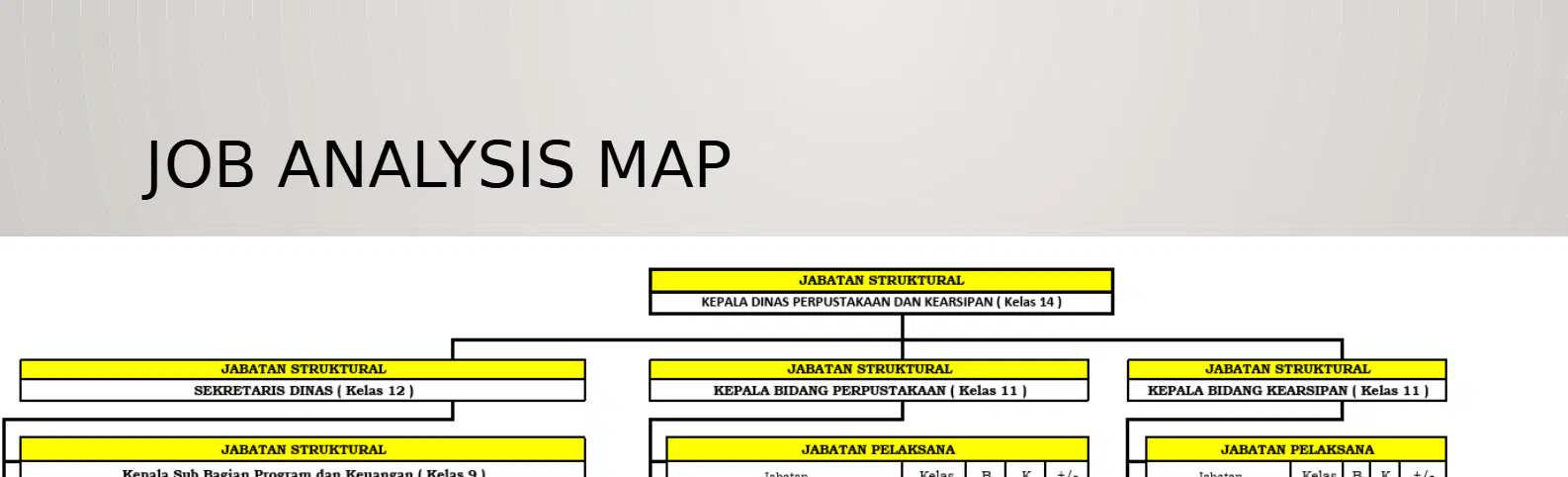
What is the title of the document shown in the image?
Job Analysis Map
Employee Performance Review
Organizational Budget Plan
Human Resource Development Plan
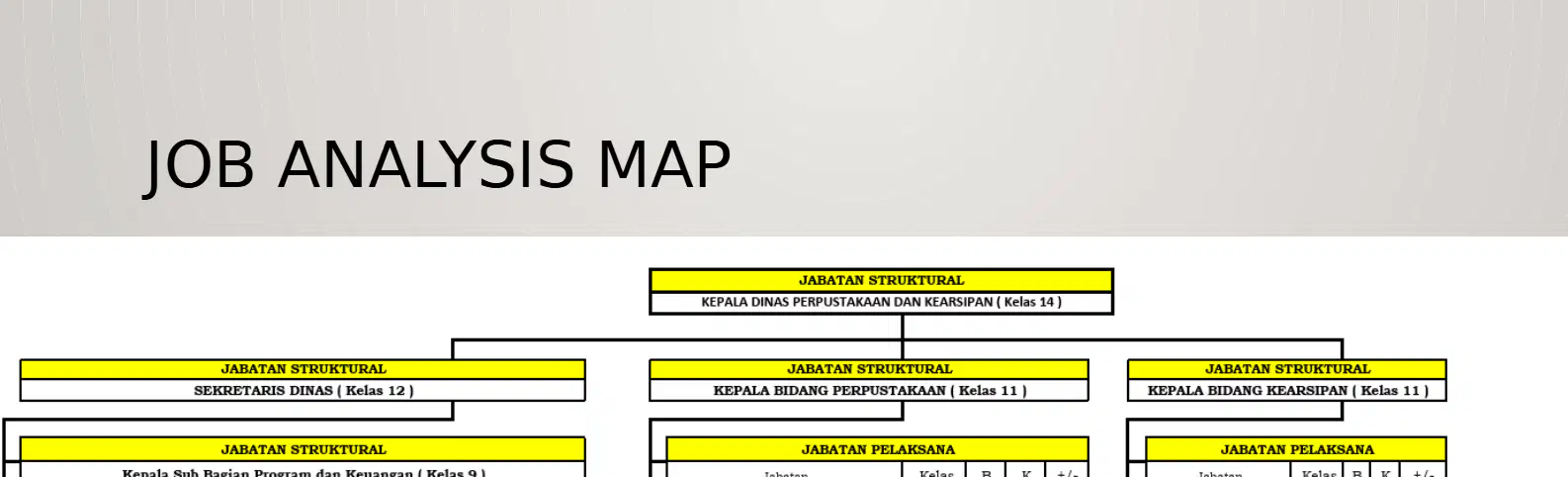
Which job class has the highest number of employees according to the 'JUMLAH PEGAWAI PER KELAS JABATAN' section?
Kelas 14
Kelas 11
Kelas 5
Kelas 6
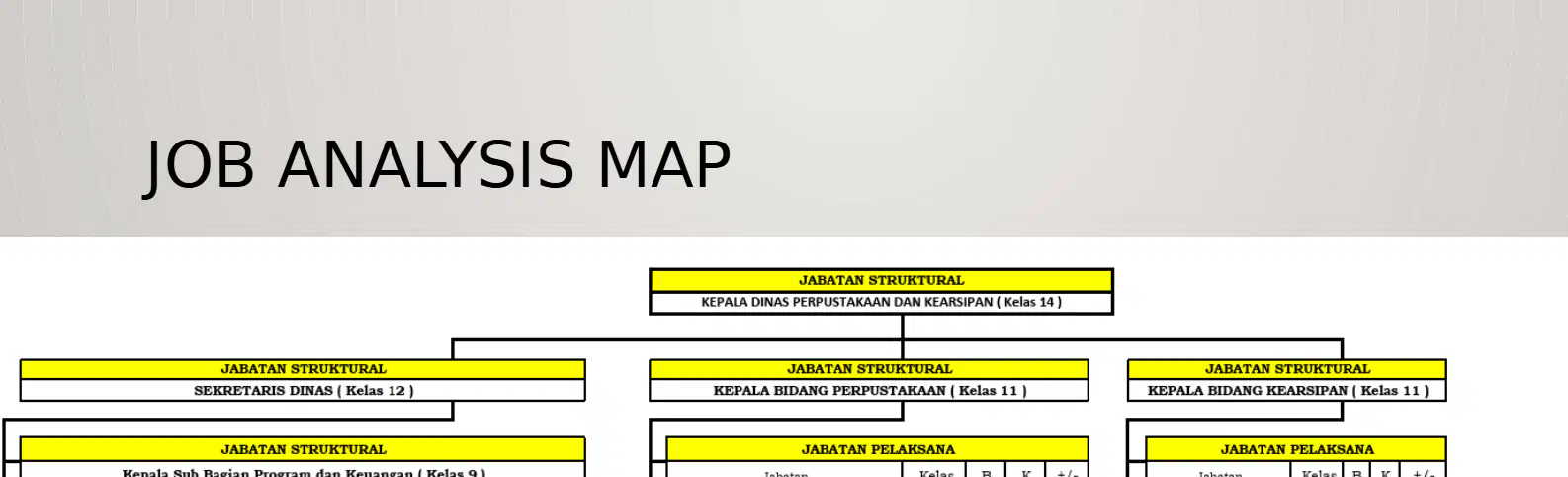
According to the map, which of the following is a 'Jabatan Struktural' (Structural Position)?
Pengelola Gaji
Kepala Dinas Perpustakaan dan Kearsipan
Pustakawan Madya
Pranata Komputer
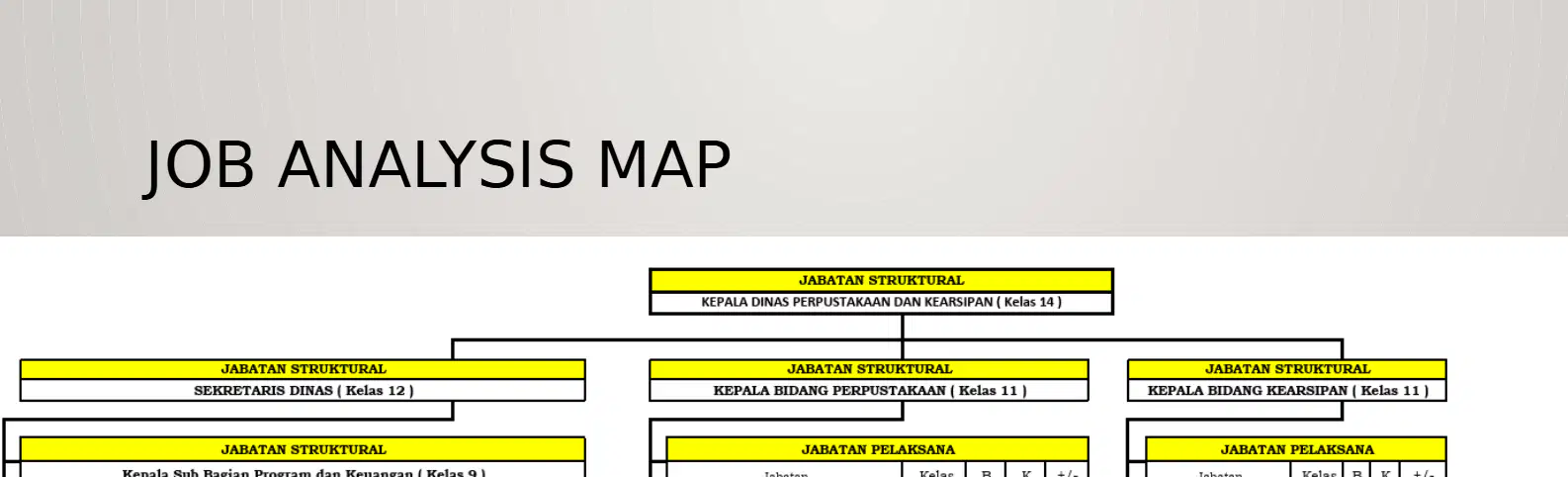
Which of the following positions is classified as 'Jabatan Fungsional' (Functional Position)?
Kepala Sub Bagian Umum, Kepegawaian dan Hukum
Pengelola Program dan Kegiatan
Pustakawan Madya
Bendahara
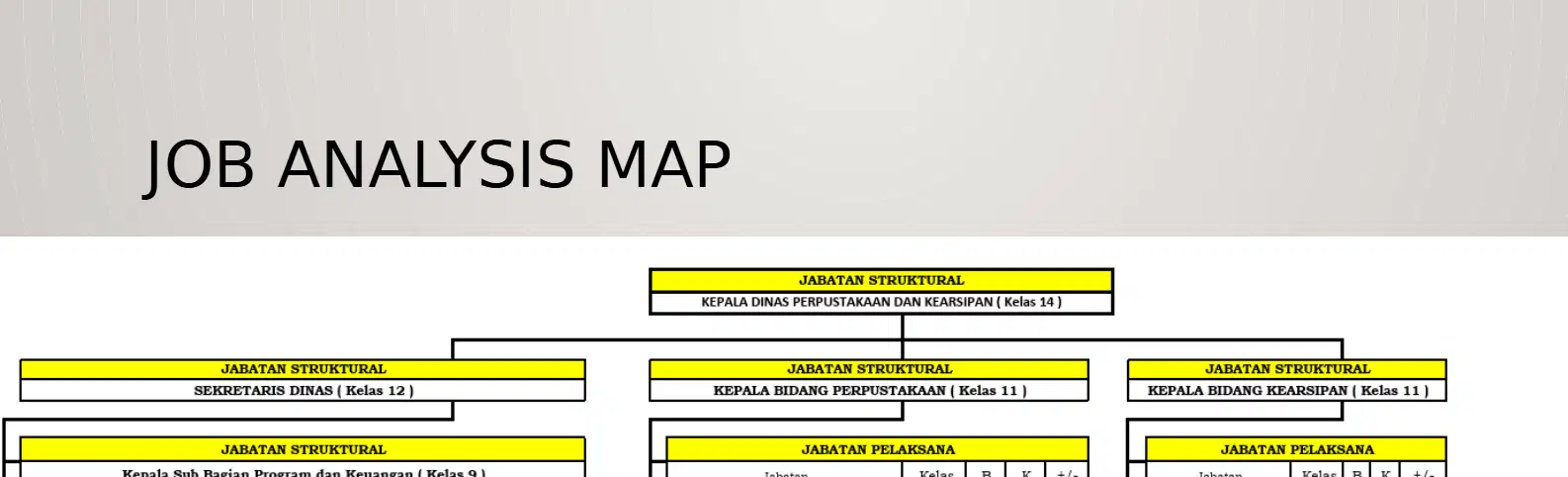
If you were to analyze the distribution of employees, what is the total number of employees listed in the 'JUMLAH PEGAWAI PER KELAS JABATAN' section?
20
24
18
30
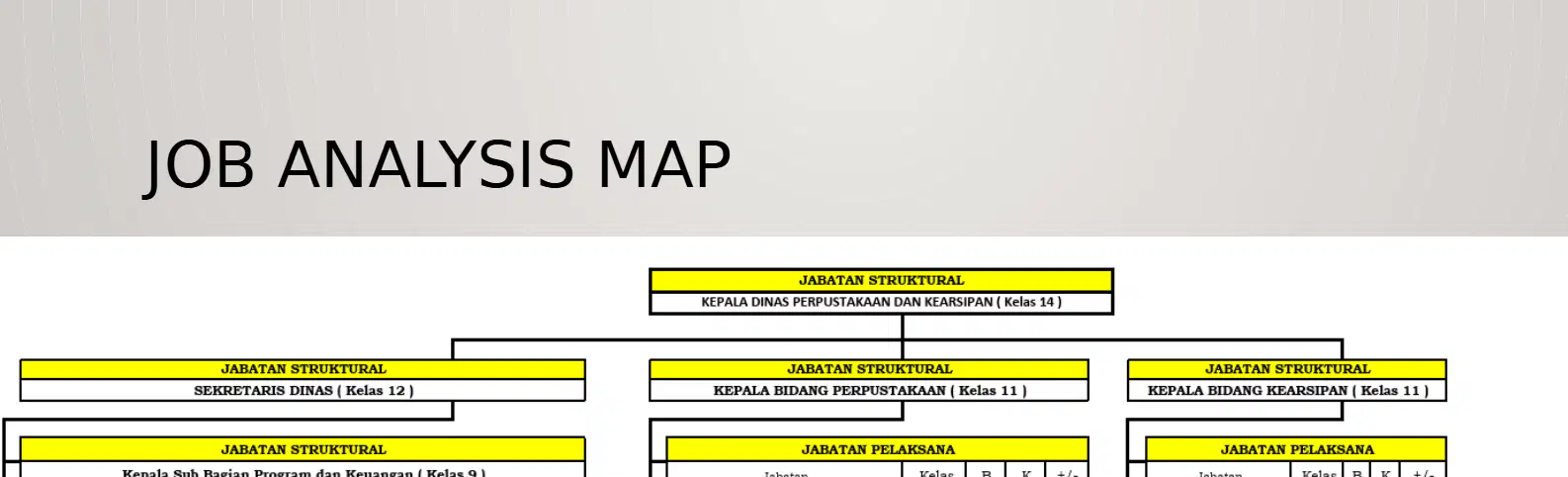
Based on the job analysis map, which position has a negative difference (-1) in the 'Jabatan Pelaksana' section under 'Kepala Sub Bagian Program dan Keuangan'?
Penata Laporan Keuangan
Pengelola Gaji
Pengelola Program dan Kegiatan
Pengadministrasi Keuangan
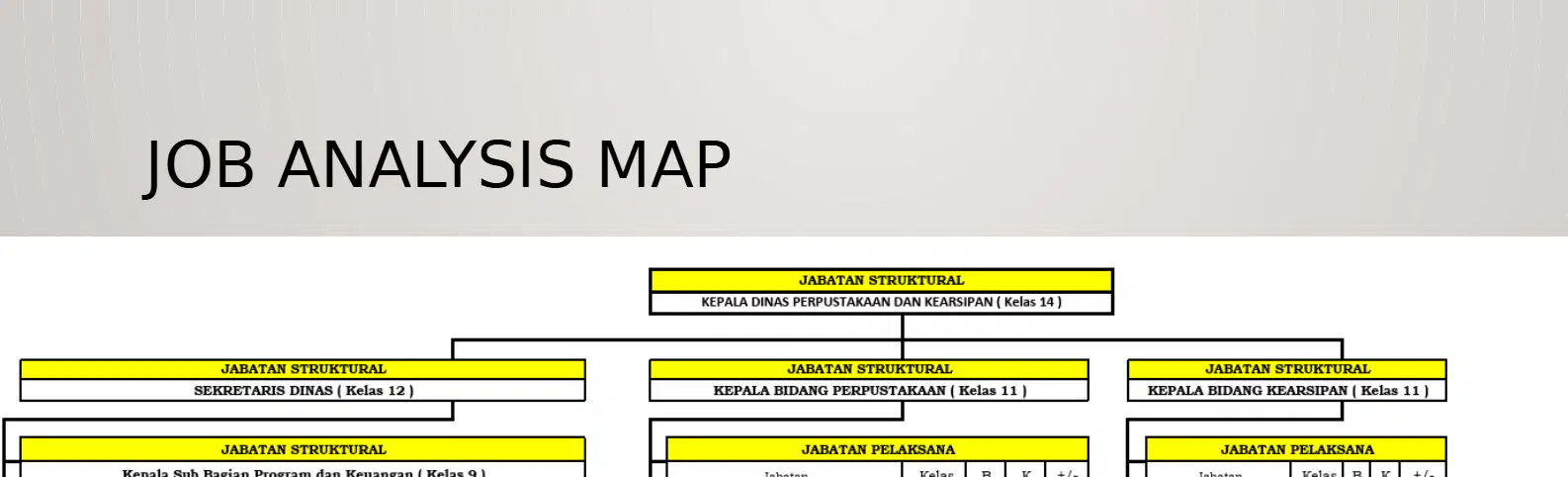
If you were tasked to recommend a position for someone interested in library management, which position from the map would be most suitable?
Pengelola Perpustakaan
Pranata Komputer
Bendahara
Pengadministrasi Keuangan
Which of the following best defines "Job Identity" according to the job analysis based on Permenpan 1 Tahun 2020?
The job title, work unit, and its position within the organizational structure.
The qualifications needed to fill the position.
The expected outputs or results of a position.
A list of all duties and responsibilities.
What does a "Job Description" include according to the job analysis base on Permenpan 1 Tahun 2020?
A list of all duties, responsibilities, and obligations that must be carried out by the job holder.
The expected outputs or results of a position.
The qualifications needed to fill the position.
The job title and work unit.
Which of the following is NOT typically included in a "Job Specification"?
The job title and work unit.
Education requirements.
Work experience.
Technical competence.
A company wants to ensure that employees understand the risks and consequences associated with their roles. Which component of job analysis should they focus on?
Job Results and Responsibilities
Job Description
Job Specification
Job Identity
Given a scenario where a manager needs to hire someone with specific technical skills and managerial competence, which part of the job analysis should they refer to for guidance?
Job Specification
Job Description
Job Results and Responsibilities
Job Identity
What is the main purpose of Workload Analysis (ABK)?
To determine the ideal number of employees needed for each task or function within a work unit.
To increase the number of employees in a company.
To reduce the number of tasks in a work unit.
To calculate company profits.
Which of the following is a goal of ABK?
To ensure work efficiency and effectiveness, preventing both overstaffing and understaffing.
To maximize the number of employees regardless of workload.
To minimize the number of tasks completed.
To increase overtime hours for employees.
Which of the following is NOT included in the content of ABK?
Work Volume
Completion Time
Effective Working Time
Employee Salary Calculation
What does "Work Volume" refer to in the context of ABK?
Measuring the number of tasks that must be completed within a specific period.
Calculating the salary of employees.
Determining the number of meetings held in a year.
Measuring the number of employees in a company.
How is the "Calculation of Employee Needs" determined in ABK?
By comparing the workload with the effective working time.
By counting the number of employees present.
By measuring the number of tasks completed in a day.
By evaluating employee satisfaction surveys.
If a company wants to avoid both overstaffing and understaffing, which process should it use?
Workload Analysis (ABK)
Salary Benchmarking
Employee Training
Performance Appraisal
A manager needs to calculate the productive working hours available per employee in one year. Which ABK content area does this task fall under?
Effective Working Time
Work Volume
Completion Time
Calculation of Employee Needs
Which step in ABK involves calculating the standard time required to complete one unit of a task?
Completion Time
Work Volume
Effective Working Time
Calculation of Employee Needs
A company finds that its employees are often idle or overworked. Which aspect of ABK should be reviewed to address this issue?
Calculation of Employee Needs
Employee Benefits
Office Layout
Marketing Strategy

