
 Worksheets
Lead up to American Revolution
Total questions: 90
Worksheet time: 1hrs 7mins

What geographic feature were the colonist forbidden from crossing by the Proclamation of 1763?
The Ohio River
The Everglades
The Appalachian Mountains
The Mississippi River
Following the French and Indian War, Britain had a large war debt, as well as experiencing increasing expenses managing their large empire.What did Great Britain do to recover some of the costs of defending the colonies?
Charge a fee
Impose Taxes
Ask for Donations
Steal it from France
· Sugar Act
· Stamp Act
· Townshend Act
How did the items above contribute to the start of the American Revolution?
Forced colonists to begin trading with surrounding Native tribes.
Colonists felt their rights had been violated.
Forced colonists to rely more heavily on slave labor.
Colonists felt betrayed by Great Britain for establishing new colonies.

Which cause of the American Revolution is demonstrated in the above political cartoon?
Mercantilism
No Representation
Tea Act
Sugar Act
What was the rallying cry of the Colonists who were upset with the British?
"USA!, USA!, USA!"
"More money, more problems!"
"God save the King!"
“No Taxation Without Representation!
It means to avoid something or disregard it for a certain reason. It is what the colonists were doing to British goods.
Avenge
Boycott
Partake
Endorse

What event was depicted in the engraving above?
The Boston Tea Party
The Boston Massacre
The Boston Red Sox
The Boston Sons of Liberty
This person was the founder of the Sons of Liberty...
Paul Revere
Samuel Adams
George Washington
Abigail Adams

What act of civil disobedience occurred in the painting above?
Lexington and Concord
The Battle of Yorktown
Paul Reveres Ride
The Boston Tea Party
This Act was in response to the Boston Tea Party, and closed Boston Harbor.
Stamp Act
Townshend Acts
Sugar Act
Intolerable Acts
What term is used to describe having to house British Solders right after the Boston Tea Party?
Quartering
Shacking
Providing
Supporting
What was a consequence of the British owing a lot of money after the French and Indian War?
The British reduced taxes on the colonists.
The British taxed Americans to pay for the war.
The British gave land to the colonists.
The British withdrew troops from America.
What was the colonists' reaction to the British taxing them on printed paper, glass, tea, and lead?
The colonists accepted the taxes without protest.
The colonists moved to Canada.
The colonists got upset and protested the new taxes.
The colonists started trading with other countries.
What actions did the British take after the Boston Tea Party?
They opened more ports for trade.
They closed the Boston port and imposed stricter rules.
They reduced taxes on tea.
They allowed colonists to govern themselves.
What document, written by Thomas Jefferson, was issued by the Second Continental Congress to announce (declare) our independence from Great Britain?
Declaration of Independence
U.S. Constitution
Treaty of Paris of 1763
Treaty of Paris of 1783
What was the first battle of the American Revolution (shot heard 'round the world)?
Battle of Bunker Hill
Battle of Lexington and Concord
Battle of Trenton
English philosopher who advocated the idea of a "social contract" in which government powers are derived from the consent of the governed and in which the government serves the people; also said people have natural rights to life, liberty and property.
Thomas Jefferson
John Locke
John Adams
George Washington
A movement during the late 1600s and 1700s in Europe where philosophers put forth the theory that both the physical world and human nature operated in an orderly way according to natural laws that were figured out by man using reason and logic.
Civil Rights Movement
Progressive Movement
Great Awakening
Enlightenment
(1754-1763) fought in the colonies between the English and the French for possession of the Ohio River Valley area. The English (Brittain) won making them the dominant power in North America at that time.
English Revolutionary War
8 years War
French and Indian War
Civil War
Causes for the American Revolution
The Enlightenment
The Great Awakening
Growing tensions over British rule that strictly regulated American colonies economic/business/trade choices.
All of these answers are causes for the American Revolution
Which of the following was a NEW DEVELOPMENT occurring immediately after the French and Indian War?
English settlers began to push west into Native Americans' territory.
British colonists decided to break with Britain and become independent.
English colonists began to question their place in the British Empire, as they felt they weren't respected as Englishmen.
Native Americans organized to violently repel invading English settlers.
Proclamation of 1763
Told the Colonists they could NOT settle EAST of the Appalachian Mountains
Told the Colonists they could NOT settle WEST of the Appalachian Mountains
The Stamp Act was a tax on all ________ goods
Wood
Plastic
Printed
The Quartering Act required _________?
Colonists to be Catholic
Colonists to house and feed soldiers
You to have a stamp on all paper goods
What was the major effect of the Boston Massacre?
A large amount of people died
The British took over Quebec
It caused many Colonists to join the Revolutionary cause
The First Continental Congress was called in order to...
consider ways of redressing colonial grievances against Britain.
become a legislative body.
write the Declaration of Independence.
decide which of Parliament's taxes the colonies would and would not pay.
By 1776, who ruled the American colonists?
English
French
Spanish
Italian
By the 1700s, how were the 13 colonies governed?
they each had their own government who made their own decisions
the 13 colonies had one government that made decisions for everyone
each colony vowed obedience to King George III
the colonies went to war with each other
How did Great Britain perceive the colonists around the world?
as a source of profit
as brothers and sisters
as strangers from another world
as independent Americans
This document announced that the colonies were free from Great Britain.
Constitution
Declaration of Independence
Declaratory Act
Bill of Rights

Why did most Native Americans side with the French
The French were going to let them keep their land
The French were nicer
The French gave them more money
The French were better traders
What Treaty ended the French and Indian War?
Treaty of British
Treaty of French and Indian War
Treaty of Native Americans
Treaty of Paris
What did the British get for winning the French and Indian War?
All the French governments money
For the French to have to come work for the British
Most of the French land in North America
All of the French Armies weapons
Which document was most crucial in changing the minds of Americans to support independence from Britain in 1776?
the Olive Branch Petition
John Locke's Two Treatises on Government
Thomas Paine's Common Sense
an account of the Battle of Lexington
What role did loyalists play in the American Revolution?
Loyalists were the leaders of the American Revolution and fought against the British monarchy.
Loyalists supported the British monarchy and opposed the American Revolution.
Loyalists were neutral and did not take any side in the American Revolution.
Loyalists supported the American Revolution and opposed the British monarchy.
How did the patriots contribute to the outcome of the American Revolution?
They advocated for increased taxation
They fought for independence and organized boycotts.
They supported the British monarchy
They remained neutral and did not take any action
A person who resides in a place governed by a parent country
Citizen
Colonist
Parliament
Patriot
A person who supported the British monarchy during the American Revolution
Citizen
Colonist
Loyalist
Patriot
A supporter of the American colonies during the Revolution
Patriot
Colonist
Loyalist
Revolution
An organized resistance against leadership or government
Rebellion
Democracy
Parliament
Loyalist
The overthrow of an established government
Revolution
Colonies
Democracy
Citizenship
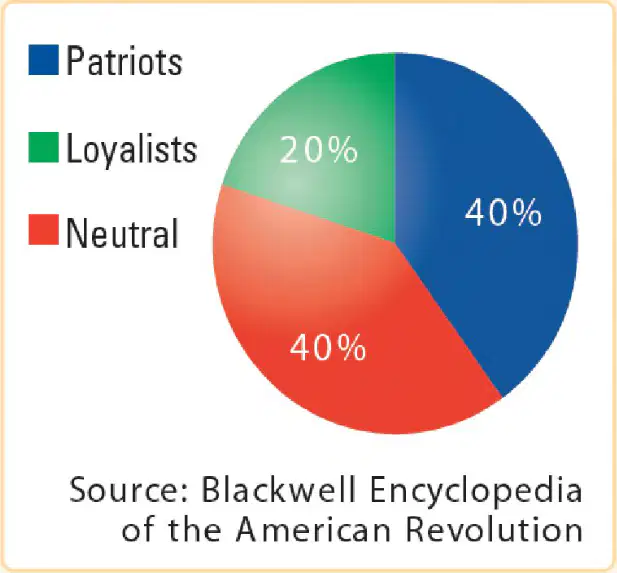
Which group is not mentioned in the pie chart?
Patriots
Loyalists
Neutrals
British
Which of the following groups had connections to the British government?
Quakers
Patriots
Loyalists
Native Americans
Which event is associated with British actions toward independence?
A) Treatment of Loyalists
B) Olive Branch Petition
C) Lexington & Concord
D) Economic arguments
or give me death!"
The person who said this is most likely a...
The person who said this is most likely a...
The person who said this
is most likely a...
The person who said this
is most likely a...
Colonist A is most likely a...
Colonist B is most likely a...
“Colonies profit from trade with Great Britain.”
Patriot
Loyalist
“England and the colonies have the same roots; we share traditions, history, and culture.”
Patriot
Loyalist
“It’s not practical for the colonies to have representation in England.”
Patriot
Loyalist
“People have natural rights governments can’t take away, like property.”
Patriot
Loyalist
“Since the colonies are separate from one another, they are not capable of governing themselves.”
Patriot
Loyalist
“Taxes are to pay for the French & Indian War which was fought to protect the colonies.”
Patriot
Loyalist
“The real threat is from the mobs, who don’t follow laws, injure people, and destroy property.”
Patriot
Loyalist
“The colonial system only benefits Britain, they don’t care about the colonies’ best interests.”
Patriot
Loyalist
Who was chosen to lead the first army of the United States?
General Howe
King George III
George Washington
Benjamin Franklin
What future American leader got his first military experience during the French & Indian War?
Thomas Jefferson
John Locke
George Washington
Thomas Paine
Whose writings were greatly reflected through the ideas expressed by Thomas Jefferson in the Declaration of Independence?
Benjamin Franklin and John Locke
John Locke and Thomas Paine
Benjamin Franklin and James Madison
John Adams an Thomas Paine
"We hold these truths to be self-evident , that all men are created equal...with unalienable rights...life, liberty, and the pursuit of happiness."
"That to secure these rights, governments are instituted among men, deriving their just powers from the consent of the governed..."
"That whenever any form of government becomes destructive...it is the right of the people to alter or abolish it, and to institute new government..."
Which document includes the quotes above to establish the birth of the United States of America?
Declaration of Independence
Olive Branch Petition
Articles of Confederation
Constitution of the United States of America

