wayground logo

Free Printable Worksheets

Font size

S
M
L
XL
Worksheets

US History Exam Semester 1

Total questions: 94

Worksheet time: 47mins

Name
Class
Date
1.
What is an "abolitionist?"
a)
a. A person who fought for the rights of indigenous people.
b)
b. A supporter of Mexican land rights in Texas.
c)
c. A financial donor to the cause of women's rights in the 19th century.
d)
d. An individual who worked to end the institution of slavery.
2.
What is popular sovereignty?
a)
a. The idea that the people have the right to elect their own sovereign in a traditional monarchy.
b)
b. The philosophy that the people have the right to determine for themselves the nature of their own government.
c)
c. Abraham Lincoln's term for abolitionism.
d)
d. The concept stating that if the South wanted to leave the Union, they should be allowed to leave, in peace.
3.
To "secede" is to--
a)
a. Leave the United States.
b)
b. Succeed in business, specifically in the South.
c)
c. Combine more than one plantation under one owner.
d)
d. Raise tariffs on imported goods, specifically from Spain.
4.
Who said and/or wrote the below statement?
a)
a. Elizabeth Cady Stanton, in The Declaration of Sentiments.
b)
b. Abraham Lincoln, in The Emancipation Proclamation.
c)
c. Frederick Douglas in his third debate.
d)
d. None of the above.
5.
Which of the following was NOT true of Jefferson Davis? --
a)
a. He was President of the Confederacy.
b)
b. He was a plantation owner.
c)
c. He served as a senator from Mississippi.
d)
d. All of the above statements are true.
6.
Clara Barton was most closely associated with--
a)
a. Healthcare for soldiers during the Civil War.
b)
b. Abolitionism before, during, and after the Civil War.
c)
c. Literature, as the author of Uncle Tom's Cabin.
d)
d. Women's rights, such as those discussed at the Seneca Falls Convention.
7.
Which of the following individuals believed that secession was not permitted by the U.S. Constitution?
a)
a. Jefferson Davis
b)
b. Abraham Lincoln
c)
c. Harriet Beecher Stowe
d)
d. Stonewall Jackson
8.
Abraham Lincoln once joked that the following person started the Civil War because of his/her writing.
a)
a. Harriet Beecher Stowe
b)
b. Ulysses S. Grant
c)
c. Clara Barton
d)
d. Frederick Douglass
9.
Which of the following events happened FIRST?
a)
a. The Gettysburg Address
b)
b. The Emancipation Proclamation
c)
c. The Battle of Antietam
d)
d. The secession of South Carolina from the Union.
10.
Which of the following is TRUE about tariffs in the 19th century?
a)
a. Southerners opposed tariffs because they believed tariffs would scare off foreign buyers of their goods and make the imported goods they needed more expensive.
b)
b. Northerners opposed tariffs because the economy of the North was dependent on other parts of the country for most of its agricultural needs.
c)
c. People in both the North and the South approved of tariffs because foreign imports were already too expensive.
d)
d. None of the above statements are true.
11.
Which of the following is TRUE about the differences between the North and the South prior to the Civil War?
a)
a. The North was more urban and industrialized.
b)
b. The people of the South needed more infrastructure, such as roads, canals, and railways.
c)
c. Southerners were strong supports of states' rights.
d)
d. All of the above statements are true.
12.
Which of the following is NOT TRUE of the North during the Civil War?
a)
a. Most of the battles were fought in Northern territory.
b)
b. It had a huge advantage in weapons and supplies.
c)
c. It had more railroads and were therefore able to get troops to the front quickly.
d)
d. It had a larger population and therefore more men available for military service.
13.
Which of the following is NOT TRUE of the Emancipation Proclamation?
a)
a. It had little immediate effect on the lives of enslaved peoples.
b)
b. With it, President Lincoln "freed" all the slaves in the rebelling Southern states.
c)
c. It gave the Union a moral purpose for fighting for victory.
d)
d. It made foreign countries less likely to send aid to the South.
e)
e. All of the above statements are true.
14.
New methods used in which of the following industries led to the expansion of railroads, locomotives, and tall buildings?
a)
a. Oil industry
b)
b. Steam industry
c)
c. Steel industry
d)
d. Coal industry
15.
What two methods did Henry Ford use to mass produce his cars and get them in the hands of more Americans?
a)
a. Assembly line & advertising
b)
b. Assembly line & interchangeable parts
c)
c. Advertising & interchangeable parts
d)
d. Advertising & eliminating political corruption
16.
During the Second Industrial Revolution, the working class moved to
a)
a. rural areas because they needed the work.
b)
b. urban areas because that’s where they could find jobs.
c)
c. rural areas because more farming was needed to sustain the larger population.
d)
d. urban areas because corrupt politicians forced them to move.
17.
Carnegie, J.P. Morgan, and Rockefeller owned major corporations during the Industrial Revolution. What did people sometimes call them?
a)
f. C & D only.
b)
a. Captains of Industry because they allowed the working class to work on ships.
c)
b. Robber Barons because even though they stole, they had royal titles in the United States.
d)
c. Captains of Industry because they positively affected the economy with their business leadership and philanthropy.
e)
d. Robber Barons because they used unethical business practices to gain personal wealth.
18.
Which of the following were major criticisms made by rising labor unions about working conditions at the turn of the century?
a)
a. Workers typically worked 10-12 hours per day 6 days per week.
b)
b. Many children worked in factories instead of going to school.
c)
c. Working class wages were not livable.
d)
d. All of the above.
19.
Which of the following was NOT invented during the Industrial Revolution?
a)
a. Televisions
b)
b. Light bulbs
c)
c. Automobiles
d)
d. Filming equipment
20.
Which of the following immigrant groups did NOT face heavy discrimination at the turn of the century?
a)
a. Immigrants from China
b)
b. Immigrants from Mexico
c)
c. Immigrants from Northern & Western Europe
d)
d. Immigrants from Southern & Eastern Europe
21.
Why did a large population of Black Americans move from the South to urban Northern cities in the early 1900s?
a)
a. They wanted to leave behind discriminatory Jim Crow (segregation) laws.
b)
b. They moved for greater job opportunities.
c)
c. They were forced to move by large plantation owners.
d)
d. All of the above.
e)
e. A & B only.
22.
What did the muckrakers do?
a)
a. Investigate and expose major abuses and issues during the Industrial Revolution.
b)
b. Investigate and expose major abuses and issues during the 1920s.
c)
c. Challenge politicians to adapt to the new technology being used.
d)
d. Advocate for women’s suffrage.
23.
In the 1920s, Americans became more dependent on _____ than ever before.
a)
a. credit
b)
b. inflation
c)
c. bank loans
d)
d. televisions
24.
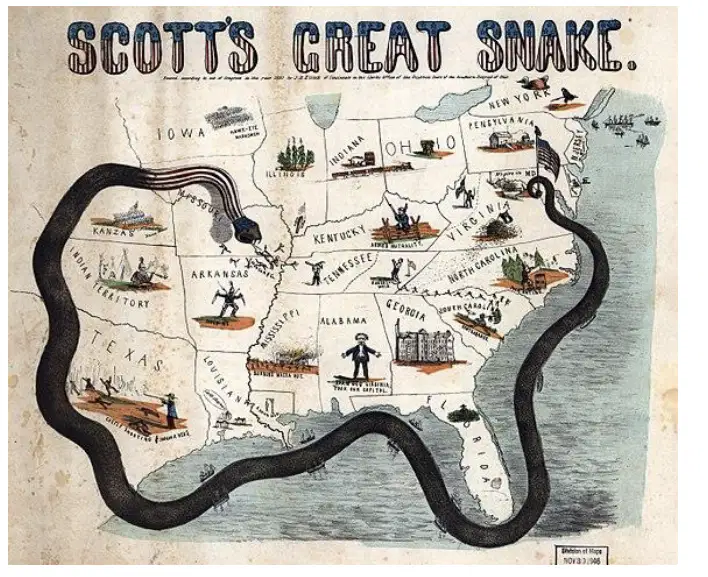
Using the below map and your knowledge from the unit, "Scott's Great Snake" was the--?
a)
a. route of the explorers who followed Lewis & Clark's old route to Arkansas.
b)
b. route Robert E. Lee took with his army and navy to attack Virginia.
c)
c. borders of the Confederate States of America in 1859.
d)
d. Union blockade of the South.
25.
Which of the following technologies was NOT popular in the 1920s?
a)
a. plastic
b)
b. radio
c)
c. automobiles
d)
d. computers
26.
Unlike the Progressive Presidents of the previous era, the Republican Presidents of the 1920s
a)
a. enforced anti-trust laws.
b)
b. did not enforce anti-trust laws.
c)
c. promoted government involvement in the economy.
d)
d. governed during a major recession.
27.
How did the Stock Market Crash of 1929 affect Americans?
a)
a. Many Americans immediately lost their jobs as nationwide unemployment grew.
b)
b. Many stockbrokers became rich at the expense of middle-class Americans.
c)
c. Many Americans lost their life savings due to over speculating in the stock market.
d)
d. Many Americans were not surprised at the crash because leading economists had predicted it.
28.
Why was Hoover increasingly unpopular as the Great Depression progressed during his presidency?
a)
a. He forced people to live in shantytowns nicknamed “Hoovervilles.”
b)
b. He gave inspiring speeches to help poor Americans but ignored the rich.
c)
c. He implemented the New Deal which was a catastrophic failure.
d)
d. He did not do enough to help desperate, unemployed Americans.
29.
What three areas of concern did FDR’s New Deal target?
a)
a. Relief, Recovery, Reform
b)
b. Kindness, Empathy, Compassion
c)
c. Equality, Equity, Enforcement
d)
d. Change, Challenge, Chance
30.
Which of the following were critics of FDR?
a)
a. Conservatives who believed he was expanding the power of the Presidency too broadly and intervening in the economy too much
b)
b. Liberals who believed he did not do enough to redistribute wealth
c)
c. Americans who were outraged at his plan to add 6 justices to the Supreme Court (court-packing)
d)
d. All of the above.
31.
During the Great Depression, what did FDR believe was the most urgent need for Americans?
a)
a. To establish trust in the stock market again
b)
b. To get Americans back to work through public works projects
c)
c. To create a large national debt
d)
d. To regulate the shantytowns
32.
True or False: FDR fundamentally changed the role of the government in regulating the American economy by expanding it exponentially.
a)
a. True
b)
b. False
33.
In Cinderella Man why was James Braddock not able to get work everyday?
a)
He broke his hand.
b)
He was not qualified for the available jobs.
c)
His wife felt they were to dangerous.
d)
There was not enough work for him
34.
What work did James Braddock do when he was not boxing?
a)
Machine opperator
b)
Dock worker
c)
Janitor
d)
Stock worker
35.
Why does Mae send the kids away in Cinderella Man?
a)
The family was kicked out of their home.
b)
They were not able to feed the kids
c)
The kids were getting sick
d)
The kids were not being good, they were not being quiet, they were not being hayve
36.
What did Mike Wilson from Cinderella Man want workers to do?
a)
Go on Government assistance
b)
Start a Union
c)
Start an uprising and overthrow the government
d)
Live in Hoovervilles
37.
The Radical Republicans were Congressional Republicans who -
a)
a. supported slavery.
b)
b. wanted the South to be punished for the Civil War.
c)
c. wanted to bring the South back quickly into the Union.
d)
d. Congressional Republicans who wanted to send Union troops to the South to suppress the rights of freed Blacks.
e)
e. All of the above.
38.
Why was Abraham Lincoln's Reconstruction Plan sometimes called "The 10% Plan?"
a)
a. It called for a 10% tax on Southern products to pay their Civil War debts.
b)
b. 10% of each Southern state's voters were required to pledge loyalty to the United States and support emancipation before that state was readmitted into the Union.
c)
c. Southern states would be required to provide employment for 10% of the freed Blacks in their population.
d)
d. None of the above
39.
The Wade-Davis Bill--
a)
a. Was drafted by Congressional Democrats in 1864.
b)
b. Stated that 50% of voters in Southern states must take the oath of allegiance to the United States.
c)
c. Passed both houses of Congress and was signed into law by President Lincoln.
d)
d. All of the above.
40.
The Freedmen's Bureau--
a)
a. Helped former enslaved people with school, jobs, and housing.
b)
b. Registered former slaves for the purpose of collecting their debts for Southern governments.
c)
c.Had as a major goal of assisting Black women start their own businesses and buy property
d)
d. Supported indigenous populations, specifically the Cherokee of Georgia.
41.
What was the Ku Klux Klan?
a)
a. A group of Southern Democrat politicians that supported the rights of freed Blacks.
b)
b. A group of Republican U.S. Senators that opposed returning to the Union.
c)
c. Former Confederate soldiers who terrorized Black people across the South.
d)
d. Former Union soldiers who opposed Southern re-entry into the Union.
42.
How was sharecropping similar to the old plantation system?
a)
a. Freed Black people ended up working plantations again for very little (if any) money.
b)
b. By becoming sharecroppers, freed Black people agreed to give up all of their new rights as promised by the 13th, 14th, and 15th Amendments.
c)
c. Plantations returned to producing massive amounts of rice and beans, which had always been their main products.
d)
d. Sharecropping was not similar at all to the old plantation system.
43.
What were the Black Codes?
a)
a. A written code system used by freed Blacks in the South to secretly communicate with and assist the Black slaves of Haiti who were planning a revolution against white French plantation owners.
b)
b. A code of conduct freed Black people created to ensure community-wide respect, fairness, and inclusion.
c)
c. Laws passed in the South that limited the rights of free Black people.
d)
d. Laws passed in the South that guaranteed the civil rights of all free Black people.
44.
On June 19th, 1865--
a)
a. The Emancipation Proclamation was two years old.
b)
b. The 13th Amendment had already been written.
c)
c. The Confederate Army had already surrendered.
d)
d. Union soldiers arrived in Texas and freed the last remaining 250,000 Black people who were still enslaved.
e)
e. All of the above.
45.
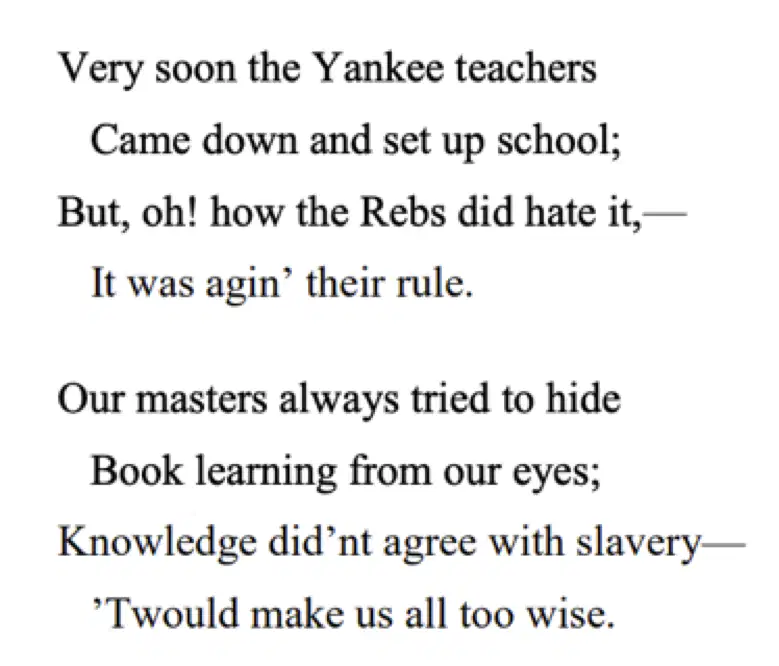
Who is MOST LIKELY to have written the poem below?
a)
a. Jefferson Davis, the former president of the Confederacy.
b)
b. Ulysses S. Grant, former Union general.
c)
c. Thomas A. Wilkins, a carpetbagger from Connecticut.
d)
d. Frances Ellen Watkins, the daughter of freed slaves.
46.
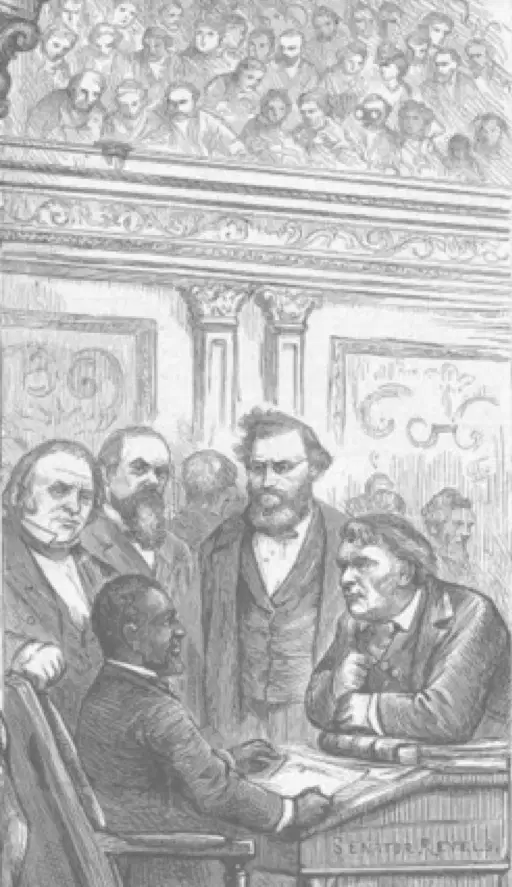
What is MOST LIKELY going on in the picture below?
a)
a. Hiram Revels, the first Black U.S. senator, is speaking with his white colleagues in the Senate chamber while a white crowd looks on from the gallery.
b)
b. Alfred P. Lowry, a freed Black man, is on trial in Tennessee for the murder of a white man.
c)
c. Confederate President Jefferson Davis speaks with his freed Black ally Chester W. Nimitz about the needs of the South's freed Black population.
47.
The "Corrupt Bargain" was--
a)
a. The term freed Black people used for the conditions under which they lived in the South.
b)
b. Union troops in the South controlled local election boards and fixed the results of the election of 1876 so that Rutherford B. Hayes, a Republican, won.
c)
c. The agreement between the Union and former Confederate states that Jefferson Davis would become U.S. vice president in order to foster unity.
d)
d. None of the above
48.
Which of the following is NOT true of the Compromise of 1877?
a)
a. An organization of free Blacks in the South agreed to send 100,000 Black men to join the Union army.
b)
b. All Union troops were pulled out of the South.
c)
c. Democrats in Congress agreed not to dispute the results of the election of 1876.
d)
d. It marked the end of Reconstruction.
49.
"Jim Crow" was--
a)
a. A nickname given to any free Black man running for political office in the South.
b)
b. The free Black man who started the social movement that founded the free Black country of Liberia in West Africa.
c)
c. The white former Confederate soldier who led a group of Southern whites in supporting the civil rights of free Black people.
d)
d. An era in which white supremacists took power across of the South, segregation became the norm, and Southern states found ways to strip free Black citizens of their new civil rights.
50.
Based on your knowledge from the unit, who is speaking in the excerpt below and what is the context?
a)
a. President Andrew Johnson, during his impeachment trial.
b)
b. Former Confederate President Robert E. Lee, defending Southern Black Codes.
c)
c. U.S. Supreme Court Justice John Marshall Harlan, dissenting to the outcome of Plessy v. Ferguson.
d)
d. Frances Ellen Watkins, at her swearing-in speech as the first Black woman to serve in Congress.
51.
According to Kennedy, he could recognize Klan members because they -
a)
a. always wore hoods.
b)
b. all had blonde hair and blue eyes.
c)
c. spoke only in secret code
d)
d. looked mean & frustrated.
52.
What were the little kids doing that reminded Kennedy of the Klan?
a)
a. Playing cops and robbers
b)
b. Using secret passwords
c)
c. Wearing hoods
d)
d. Trading cards
53.
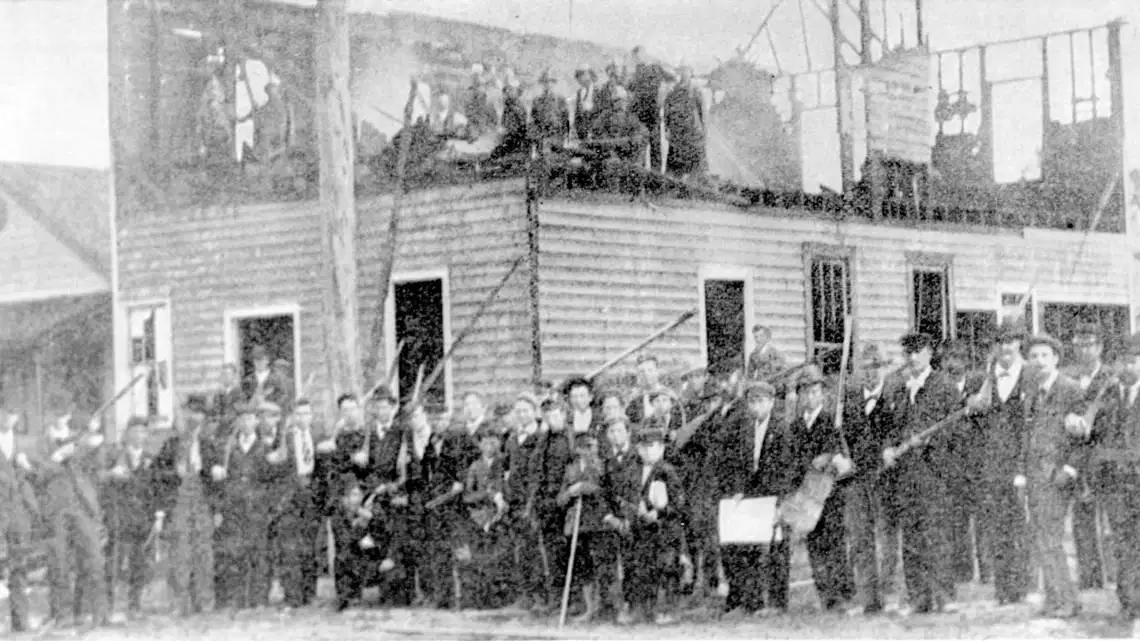
The violent actions in 1898 of a mob in Wilmington have been called an insurrection or coup because they -
a)
Committed acts of violence against innocent civilians.
b)
Overthrew the city government at gunpoint.
c)
Followed a democratic process.
d)
Limited the rights of free Black people in Wilmington.
54.
The Battle of Gettysburg was--
a)
a. fought in Southern territory.
b)
b. won by the North.
c)
c. Caused by General Robert E. Lee invading Massachusetts in 1863.
d)
d. the first battle of the Civil War.
55.
In which speech did President Lincoln state that the Civil War was necessary to preserve the Union and that America was one nation, not a collection of individual states?
a)
a. The Emancipation Proclamation
b)
b. The Dedication of Bull Run
c)
c. The Gettysburg Address
d)
d. His Third Inaugural Address
56.
What was the importance of the Appomattox Courthouse?
a)
a. It is where General Lee surrendered to General Grant, ending the Civil War.
b)
b. It is where General Lee accepted the position of general.
c)
c. It was the Union headquarters during the Battle of Gettysburg.
d)
d. It was the location of the first-ever military field hospital in the Union, started by Clara Barton.
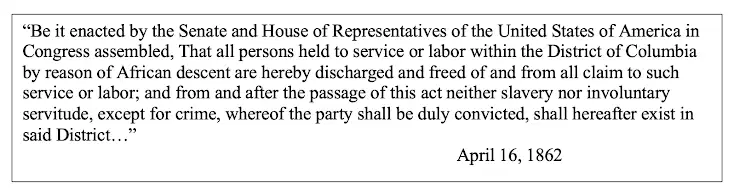
57.
What was the result of the below resolution from the United States Congress?
a)
a. Irish and Scottish indentured servants in the North were freed.
b)
b. Enslaved people of African heritage were freed in the District of Columbia.
c)
c. Workers in factories in the District of Columbia were paid more.
d)
d. None of the above.
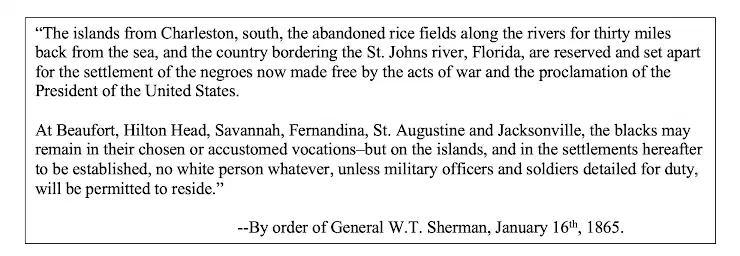
58.
The below excerpt describes a future for the freed Black people of the South that is MOST similar to--
a)
a. Scottish immigrant neighborhoods in Philadelphia.
b)
b. French-Canadian fur trading outposts in Vermont.
c)
c. Reservations created for indigenous peoples in the West.
d)
d. Chinese immigrant mining camps in California.
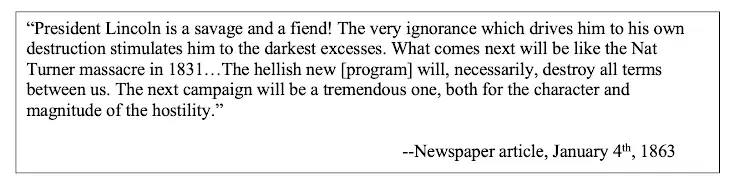
59.
Using your knowledge from the unit, identify which city below was MOST LIKELY to have a newspaper that published the below article in response to President Lincoln's Gettysburg Address.
a)
a. Boston, Massachusetts
b)
b. San Francisco, California
c)
c. Burlington, Vermont
d)
d. Richmond, Virginia
60.
In the below excerpt, President Lincoln was talking about--
a)
a. The free Black movement to return to Africa and establish their own independent country of Liberia.
b)
b. The fact that the Civil War was a fight between neighbors, brothers, sisters, and fellow Americans.
c)
c. The need to convert all freed Blacks to Christianity, because that was God's plan.
d)
d. None of the above
61.
Political bosses were considered corrupt because even though they gave immigrants aid and jobs, they expected what from immigrants?
a)
a. repayment
b)
b. taxes
c)
c. votes
d)
d. longer hours than non-immigrants
62.
Where did new immigrants at the turn of the century tend to settle?
a)
a. on the East Coast only
b)
b. in communities that shared their heritage
c)
c. in settlement houses
d)
d. in the downtown area of New York
63.
What amendment established prohibition?
a)
18
b)
19
c)
20
d)
21
64.
What amendment overturned prohibition?
a)
18
b)
19
c)
20
d)
21
65.
Which of the following best defines the idea known as “manifest destiny”?
a)
the act that offered plots of land in the west to American citizens or those intending to become citizens
b)
the belief that Americans were intended to settle all the land between the Atlantic and Pacific coasts
c)
the goal of seeking a life free from discrimination
d)
the idea that provided transportation for settlers moving west
66.
Which of the following was NOT part of the Homestead Act?
a)
Each person had to pay a small filing fee.
b)
Each person was eligible for 160 acres of land for free.
c)
Each person was given a plow and materials to build a house.
d)
Settlers had to live on and cultivate the land for five years.
67.
How did most settlers get the household goods and tools they needed?
a)
through Amazon, UPS, and the United States Postal Service
b)
through trading posts that were set up along the transcontinental railroad
c)
through catalog companies like Montgomery Ward and Sears Roebuck Co.
d)
through government surplus stores located throughout the Great Plains
68.
What group of settlers were called the Exodusters?
a)
Chinese laborers who worked on the transcontinental railroad
b)
freed slaves from the South
c)
Irish laborers who worked on the transcontinental railroad
d)
railroad magnates who were given federal land in exchange for building the transcontinental railroad
69.
What did nativists fear regarding immigrants?
a)
a. losing their jobs
b)
b. losing their lives
c)
c. that immigrants would do a better job than them in the factories
d)
d. that immigrants would support Native Americans
70.
In the Gentlemen’s Agreement between the U.S. and Japan, the two countries agreed that?
a)
a. Japan would send more immigrants to the U.S. to do migrant work.
b)
b. The West Coast would stop segregating schools.
c)
c. Japan would restrict immigration of laborers to the United States.
d)
d. A & B only.
e)
e. B & C only.
71.
The Immigration Acts of the late 1800s to early 1900s sought to stop or limit immigration from which of the following regions?
a)
e. B & C only.
b)
a. Western Europe
c)
b. Eastern Europe
d)
c. Asia
e)
d. All of the above.
72.
Why did the KKK resurface in the early 1900s?
a)
a. They were responding to the end of Jim Crow laws.
b)
b. They wanted to stop the “dangerous” ideologies of immigrants from ruining America (in their opinion).
c)
c. They did not resurface because they had a large presence from the Civil War to early 1900s.
d)
d. The KKK only targeted African Americans and wanted to stop them from voting in the early 1900s.
73.
The Palmer Raids revealed the widespread fear of
a)
a. communists & anarchists.
b)
b. the influence of the FBI.
c)
c. dictators.
d)
d. capitalism.
74.
True or False: xenophobia began in the United States when immigration surged in the 1900s.
a)
a. True
b)
b. False
75.
According to this poem, who does America welcome?
a)
e. All of the above.
b)
a. Poor immigrants
c)
b. People who underwent much hardship
d)
c. Large groups of overcrowded people
e)
d. People with no real home
76.
Why is it significant that this poem is inscribed on the Statue of Liberty?
a)
a. It sent a message to incoming immigrants that despite any hardship or rough background, they were welcomed and had ample opportunity in the United States.
b)
b. It sent the message that America sought to steal workers from other countries and use them to fuel the Industrial Revolution.
c)
c. It gives the explanation as to why France gifted the Statue of Liberty to the United States in the first place.
d)
d. It sent the message that America was raising an army of those rejected by other countries to help take over those countries.
77.
What happened at Fort Sumter?
a)
Confederates surrender ending the Civil War
b)
Union bombarded the fort and the Civil War began
c)
North surrender ending the Civil War
d)
Confederates bombarded the fort and the Civil War began
78.
What was a "Carpetbagger?"
a)
A Northerner who moved to the South during Reconstruction in order to make money
b)
A Southerner who remained to the South during Reconstruction in order to make money
c)
A Southerner who supported the Union.
d)
A Northerner who supported the South.
79.
What was a "Scalawag?"
a)
A Northerner who moved to the South during Reconstruction in order to make money
b)
A Southerner who remained to the South during Reconstruction in order to make money
c)
A Southerner who supported the Union.
d)
A Northerner who supported the South.
80.
What is the theme of Emma Lazarus’ famous poem?
a)
America is a place for conquering heroes
b)
America is a place for only certain people
c)
America is a place of nightmare's and dispair
d)
America is a place for hopes and dreams
81.
Where were immigrants processed on the East Coast in the early 1900's?
a)
Angel Island
b)
Mackinaw Island
c)
Ellis Island
d)
Elbert Island
82.
Where were immigrants processed on the West Coast in the early 1900's?
a)
Angel Island
b)
Mackinaw Island
c)
Ellis Island
d)
Elbert Island
83.
From the Presentation based on economies what decade would you choose to live during?
a)
1940's
b)
1960's
c)
1980's
d)
2010's
84.
What country did Sacco and Vanzetti immigrate from?
a)
Italy
b)
France
c)
Greece
d)
Spain
85.
What were the push and pull factors of immigrants from this country in the early 1900s?
a)
Jobs
b)
Opportunity
c)
Saftey
d)
All of the above
86.
What is something that happened during Ragtime or your Socratic seminar?
4 lines
87.
What did you learn about the economy in the decade you researched?
4 lines
88.

President of the Confederacy.

a)

Jefferson Davis

b)

Ulysses S. Grant

c)

Robert E. Lee

d)

Stonewall Jackson

89.

Famous for his leadership at the Battle of Bull Run.

a)

Jefferson Davis

b)

Ulysses S. Grant

c)

Robert E. Lee

d)

Stonewall Jackson

90.

Leader of the Union army.

a)

Jefferson Davis

b)

Ulysses S. Grant

c)

Robert E. Lee

d)

Stonewall Jackson

91.

Led the Army of Northern Virginia.

a)

Jefferson Davis

b)

Ulysses S. Grant

c)

Robert E. Lee

d)

Stonewall Jackson

92.

13th Amendment

a)

"All persons born or naturalized in the United States…are citizens of the United States."

b)

"The right of citizens of the United States to vote shall not be denied."

c)

"Neither slavery nor involuntary servitude…shall exist within the United States."

93.

14th Amendment

a)

"All persons born or naturalized in the United States…are citizens of the United States."

b)

"The right of citizens of the United States to vote shall not be denied."

c)

"Neither slavery nor involuntary servitude…shall exist within the United States."

94.

15th Amendment

a)

"All persons born or naturalized in the United States…are citizens of the United States."

b)

"The right of citizens of the United States to vote shall not be denied."

c)

"Neither slavery nor involuntary servitude…shall exist within the United States."