
 Worksheets
APUSH PERIOD 8 and some 9
Total questions: 95
Worksheet time: 3590secs
The court case that ended segregation in public schools
Brown v. Board
Plessy v. Ferguson
Miranda v. Arizona
Engel v. Vitale
Tinker v. DesMoines
LBJ's plan for increased domestic spending on anti-poverty & anti-racism programs
New Deal
New Frontier
Great Society
Welfare for All
Southern Strategy
Truman wanted to intervene in ________ to avoid what happened in China in 1949.
Vietnam
Korea
Greece
Turkey
Which of the following did NOT grow during the 1950s?
Middle Class
Opposition to the Vietnam War
Suburbs
Nuclear Arsenal
Counterculture
The overall strategy of the US during the Cold War
Truman Doctrine
Containment
Marshall Plan
Domino Theory
Which of the following is NOT true of McCarthyism?
It was a search for Communist infiltrators in the State Department
It mirrored the First Red Scare of the 1920s.
It resulted in the downfall of its namesake Senator.
It prolonged the simultaneous war in Korea.
What organization was formed to pursue world peace in 1945?
United Nations
NATO
Warsaw Pact
League of Nations
What effect did the Pentagon Papers have on society?
It increased the Credibility Gap
It exposed government corruption
It increased the pressure on Nixon to resign
It created the public know about government plans
Which of the following lead to Carter's downfall as a president?
Stagflation
Watergate
Iran-Contra
Bay of Pigs
Nixon's policy of relaxing tensions with the USSR
Detenté
Containment
Domino Theory
Brinksmanship
Which of the following is NOT associated with the extension of the civil rights movement?
Silent Majority
Stonewall Riots
AIM
Cesar Chavez
The Civil Rights process of registering black voters in Mississippi in 1964.
Freedom Summer
Freedom Rides
Sit-Ins
March on Selma
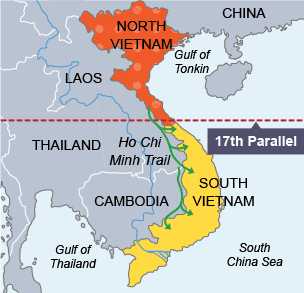
The controversial event that led to the US directly intervening in Vietnam.
Gulf of Tonkin
Tet Offensive
Operation Rolling Thunder
My Lai Massacre


"The United Nations cannot ... fulfill adequately its own responsibilities until the peace settlements have been made...".
"Above all else, we want to keep the United States prosperous and strong because we know that our prosperity is the best guarantee of peace."
"Communism has passed beyond the use of subversion ... and will now use armed invasion and war."
"As a result of these tragic conditions, a militant minority, exploiting human want and misery ... has made economic recovery impossible."
By "any means necessary". Malcom X was advocating the possible use of which of the following?
Thurgood Marshall
Homer Plessy
Rosa Parks
Emmit Till
Select the nations that were directly involved in the Cold War
United States
Germany
U.S.S.R.
Great Britain
All of the following events contributed to Cold War tensions EXCEPT
the United States airlift of food to the citizens of Berlin
massive economic support for western Europe through the Marshall Plan
rejection of the Treaty of Versailles by the isolationist Senate
unified support of the Greek monarchy in 1947
the establishment of the defensive North Atlantic Treaty Organization
George Kennan's policy of containment was based on
belief that the communists would win the Chinese civil war
an understanding with Britain regarding the post-World War II German government
a belief that the Soviet Union would try to expand the reach of communism
a desire to keep the Republicans from regaining the White House in the 1948 election
a need to decrease government spending in an effort to halt inflation
Although the Cold War rapidly escalated with the end of World War II, the 1950s were marked by a period of "peaceful coexistence." Tensions between the Soviet Union and United States were alleviated temporarily. Which of the following reinvigorated Cold War hostilities?
Berlin Airlift
Iran Hostage Crisis
Cuban Missile Crisis
U-2 Incident
Suez Crisis
"McCarthyism" spawned a hysteria that swept over the nation during the early Cold War. Accusations of links to Communism ruined numerous people and their careers. The decline of Senator Joseph McCarthy came after his televised hearings interrogating
the House Un-American Activities Committee
the Army
Edward R. Murrow
the State Department
the FBI
Which of the following countries was not a part of the Warsaw Pact?
Soviet Union
Albania
Czechoslovakia
West Germany
Hungary
Which of the following countries was not part of NATO?
France
East Germany
Austria
United States
Great Britain
The Allies had agreed to partition postwar Germany at the
Yalta Conference
Potsdam Conference
Tehran Conference
Casablanca Conference
Alger Hiss, who was accused in 1948 of having once been a member of a secret communist cell in the government, in 1945 had
served as an aide in the Department of Defense
served as an aide in the State Department
served as an aide in the U.S. Senate
served as an aide in the U.S. House of Representatives
served as an agent in the FBI
The National Security Council’s 1950 document known as NSC-68 held that
the U.S. must increase its defense spending
the U.S. must maintain strong relations with the U.S.S.R.
the U.S. exaggerated the military power of the U.S.S.R.
the U.S. would be secure from attack by the U.S.S.R.
As a result of the Marshall Plan
the U.S. experienced an economic downturn in 1948
the U.S.S.R. increased military engagements in Western Europe
there was a growing effort isolate the U.S. from the rest of the world
there was a strengthening of the economic relationship between the United States and Western Europe
An economic system that encourages citizens to own businesses and property is called
capitalism
communism
socialism
militarism
What was the name of the organization that hoped to promote peace and global cooperation following WWII?
League of Nations
North Atlantic Treaty Organization
Treaty of Versailles
United Nations

Who built the Berlin Wall?
Soviet Union
East Germany
West Germany
China
Nations that were aligned with, but also under the influence and pressure of, the Soviet Union were called
Proxy nations
NATO
Warsaw Pact
Satellite nations

The spreading of ideas or beliefs to gain support for a cause is called
totalitarianism
arms control
propaganda
diplomacy
LBJ's plan for increased domestic spending on anti-poverty & anti-racism programs
New Deal
New Frontier
Great Society
Welfare for All
Southern Strategy
the United States and
_________.
communism & socialism


Protest the Vietnam War
Vote at 18
drink alcohol
school prayer
Which of the following is not true about the Energy Crisis?
The US was the world’s leading oil producer.
The oil embargo was in response to the US supporting Israel in the Yom Kippur War.
Gas prices in the US quickly jumped 40% and heating oil prices increased 30%.
Americans found themselves parked for hours in mile-long lines at gas stations for much of the 1973-74 winter.
Federal agency created by Congress and President Nixon in 1970 to enforce environmental laws, conduct environmental research, and reduce human health and environmental risks from pollutants.
Environmental Protection Agency (EPA)
Environmental Regulatory Agency (ERA)
Factory Regulation Agency (FRA)
Industrial Waste Regulatory Agency (IWRA)
Constitutional amendment passed by Congress in 1972 that would require equal treatment of men and women under federal and state law but was defeated as time ran out for state ratification in 1982.
Equal Rights Amendment (ERA)
19th Amendment
16th Amendment
Non-Discrimination Amendment (NDA)
Passed in the wake of the Watergate scandal, the 1974 act gave citizens access to federal records.
Freedom of Information Act
Patriot Act
Open Records Act
Watergate Act
A cartel formed in 1960 by the Persian Gulf states and other oil-rich developing countries that allowed its members to exert greater control over the price of oil.
Organization of Petroleum Exporting Countries (OPEC)
North American Free Trade Agreement (NAFTA)
North Atlantic Treaty Organization (NATO)
Middle East Oil Countries (MEOC)
The 1973 Supreme Court ruling that the Constitution protects the right to abortion, which states cannot prohibit in the early stages of pregnancy.
Roe v. Wade
Plessy v. Ferguson
Miranda v. Arizona
Korematsu v. US
The once heavily industrialized regions of the Northeast and Midwest that went into decline after deindustrialization. By the 70s and 80s these regions were full of abandoned plants and distressed communities.
Rust Belt
Sun Belt
Corn Belt
Bible Belt
An economic term to describe the condition in which inflation and unemployment rise at the same time.
Stagflation
Inflation
Deflation
Recession
A law passed in 1973, which limited the president’s ability to deploy US forces without congressional approval, to fight the abuses of the Nixon administration.
War Power Act
Freedom of Information Act
Patriot Act
Checks and Balances Act
Term referring to the 1972 break-in at Democratic Party Headquarters in Washington, D.C., by men working for President Nixon’s reelection campaign, along with Nixon’s efforts to cover it up. This scandal led to President Nixon’s resignation.
Watergate
Chappaquiddick
Debategate
Iran-Contra Affair
The top goal of the Reagan presidency included
eliminating all social programs and balancing the federal budget
reducing the size of the federal government and increasing defense spending
using the federal government to enforce civil rights and reducing U.S. influence in Central America
increasing income tax rates and strengthening environmental regulations
In his 1985 State of the Union Address, Reagan articulated his foreign policy goals in what has come to be known as the Reagan Doctrine. Like Truman, Reagan pledged to
support anticommunist resistance movements, particularly in the Third World
sponsor covert military operations to overthrow communist regimes in Eastern Europe
ease tensions between the Soviet Union and the United States
broker peace agreement between Palestinians and the Israelis
During the 1990s, President George H.W. Bush
signed the welfare reform bill
persuaded Anwar Sadat and Menachem Begin to sing the Camp David Accords
sent troops to fight in the Persian Gulf War
raised taxes
Which of the following actions by the Clinton administration was most harmonious with Liberal Democrat values?
Military peacekeeping interventions in the Balkans and Somalia
Welfare benefit to encourage young mothers to reenter the work force
Free trade agreements such as NAFTA and GATT
The effort to pass a universal health care legislation in the Congress
Which of the following describes Sandra Day O'Connor?
She was the first woman appointed to the Supreme Court
O'Connor was the leader of NOW during the 1980s
She was among the first women to be appointed to a presidential cabinet post
She was a vocal opponent of Clarence Thomas's nomination to the Supreme Court
Which was true of Republicans in the 1980s?
They supported quotas to ensure equal employment opportunities
They opposed government inaction in social welfare issues
Their core was upper-middle class white Protestants
To save money, they wanted to cut defense spending

What did Reagan call the Soviet Union?
The Evil Empire
The Rebel Alliance
The Communist Cancer
Red Giant

Which of the following was considered a major blunder of the Reagan administration?
Election of 1984
His relationship with Gorbachev
Iran Contra
Involvement in Grenada

