
 Worksheets
Unit IV_CULTPOPGOVECON Massive Review!
Total questions: 100
Worksheet time: 55mins

What type of government is ruled by one person, usually the child of the previous ruler?
Monarchy
Oligarchy
Democracy
Theocracy

What type of government is characterized by the rule of a small number of elite people?
Oligarchy
Monarchy
Democracy
Parliamentary

What is a type of government in which all eligible members are able to vote on key issues and/or for elected representatives?
Democracy
Oligarchy
Monarchy
Dictatorship
Authoritarian

What is a form of government ruled by one person who usually seized power through unlawful means?
Dictatorship
Oligarchy
Democracy
Parliamentary

What is a form of government wherein the eligible voters elect representatives to pass and implement the laws?
Indirect Democracy, or Constitutional Republicanism
Direct Democracy
Oligarchy
Monarchy

What type of government is based primarily on religious principles?
Theocracy
Democracy
Monarchy
Oligarchy

What type of system is governed as a single power in which the central government is ultimately supreme and any administrative divisions (sub-national units) exercise only the powers that the central government chooses to delegate?
Unitary
Federal
Confederate
Parliamentary

In what government system is there a balance of powers between national and local levels?
Federal
Confederate
Unitary
Oligarchy

In what type of government does the state, usually headed by a single ruler, control every business and even the private lives of its citizens?
Totalitariansm
Unitary
Federal
Parliamentary

In what system of government do individual citizens make the laws directly by voting, without electing representatives?
Direct Democracy
Indirect Democracy, or Constitutional Republicanism
Anarchy
Monarchy
Oligarchy

What term describes the absence of any government?
Anarchy
Monarchy
Oligarchy
Democracy
Republic
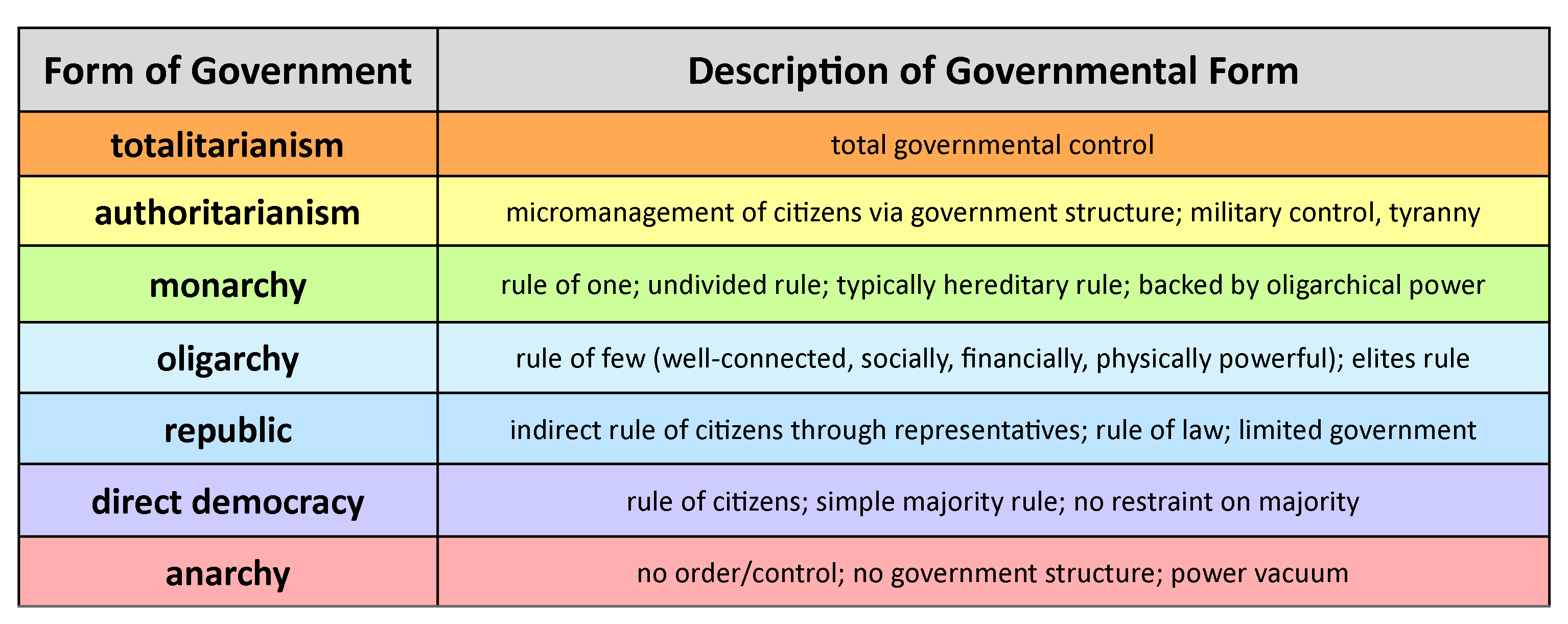
In what category of government do the majority of citizens have very little or no political input?
Authoritarian
Direct Democracy
Indirect Democracy
Republic

People elect representatives to make laws/decisions for them
Anarchy
Representative Democracy
Dictator
Monarchy

Ruler, king/queen/emperor/empress, etc.) is in power. Usually runs in the family (example: power transfers from father to son).
Theocracy
Democracy
Oligarchy
Monarchy

A government ruled by a small group of people
Theocracy
Oligarchy
Monarchy
Anarchy
Rule by a religious leader or religious principles
direct democracy
representative democracy
theocracy
oligarchy
Nobody is in control
theocracy
anarchy
monarchy
direct democracy
There is one person in power
dictatorship
direct democracy
theocracy
oligarchy
Citizens are directly voting/participating in the government everyday
dictatorship
theocracy
direct democracy
representative democracy
India has a government where there are elections. All eligible voters have a right to pick their leader.
dictatorship
direct democracy
representative democracy
theocracy
Iran has a government where their law code is based on a religious organization.
theocracy
direct democracy
oligarchy
anarchy
Great Britain has a Queen that is picked based on hereditary rule.
theocracy
monarchy
direct democracy
dictatorship
Pakistan's government is ran by a group of wealthy leaders.
oligarchy
theocracy
direct democracy
representative democracy
Marcel’s family have a farm, and on that farm they raise sheep and grow corn. This is something their family has done for hundreds of years – and sometimes, if they’re lucky, they can trade some of their corn for other supplies they need and save some money. Most people in his country practice some type of agriculture or farming. It’s just always been that way.
Market Economy
Command Economy
Traditional Economy
Mixed Economy
Addy grew up dreaming of opening a bakery, and through hard work and lots of practice she was finally able to realize her dream. But, although she was able to pick her career and the sort of store she opened, the government decides which resources she gets. Some weeks she can’t make certain things because she doesn’t have the supplies she needs. That worries her, because often the things she can’t make are the things that her consumers are demanding a greater supply of.
Traditional Economy
Command Economy
Mixed Economy
Market Economy
Four years ago a man took over Tyrone’s country. With the help of the military he stole country of a country and made major changes to the economy. All decisions are made by the ruler of Tyrone’s country. What is being produced, who gets which resources, and all major decisions are decided by the new ruler of Tyrone’s country?
Market Economy
Traditional Economy
Mixed Economy
Command Economy
Julia is an artist. She loves to create and sell decorative flower pots on etsy and at festivals. She is able to continue to do this because there are people online and at those festivals who buy her flower pots. If they didn’t she wouldn’t be able to afford to keep going.
Command Economy
Mixed Economy
Market Economy
Traditional Economy
The government makes all economic decisions.
Command
Traditional
Market
Mixed
A combination of more than one economic system.
Traditional
Mixed
Market
Command
Consumers who are willing to spend the money decide what is being produced.
Market
Command
Traditional
Mixed
Economic decisions are based on custom and heritage.
Traditional
Mixed
Market
Command
Which economy is family/agricultural based?
traditional
market
mixed
command
Which economy is privately owned so everyone can participate?
traditional
market
mixed
command
Which economy is government owned?
traditional
market
mixed
command
A sum of the goods and services a country produced each year
supply & demand
Gross Domestic Product (GDP)
standard of living
A higher GDP means a country is producing more stuff than other countries
yes
no
A lower GDP means a country is not producing more stuff than other countries
no
yes
The level of wealth and material comfort people have compared to others
supply & demand
Gross Domestic Product (GDP)
standard of living
If the standard of living is higher, it means a country is more wealthy than others
no
yes
If the standard of living is lower, it means a country is more poor than others
yes
no
China and the US are the top producing countries in the world.
no
yes
something a country sells to another country
import
export
something a country buys from another country
import
export
Goal: We should create a classless society by fighting to abolish class distinctions so that we can distribute resources equally.
Communism
Capitalism
The government owns businesses
Communism
Capitalism
Competition improves society
Communism
Capitalism
No social classes
Communism
Capitalism
Most people work for the government
Communism
Capitalism
You can work for WHOEVER you want
Communism
Capitalism
There are social classes
Communism
Capitalism
Individuals can own businesses
Communism
Capitalism
"The workers will rise up and overthrow the privileged class."
Communism
Capitalism
"Private property will cease to exist. The people will own the means of production"
Communism
Capitalism
"Leave it alone" "Let go"
Communism
Capitalism / Laissez Faire
The approximate population of the world today is..
7.6 Million
6.7 Billion
6.7 Million
7.6 Billion
What is the world's most populous country?
India
China
U.S.
Mexico
Which of the following is the world's fastest growing country?
India
China
U.S.
Mexico
One reason the world is growing so quickly is because...
The world has infinite resources for everyone
Birth rate is higher than death rate
There are more and more places for people to live
Death rate is higher than birth rate
The average number of people per square mile is...
Birth rate
Land area
Population density
too many
Most of the world's population lives in...
North America
Europe
Africa
Asia
People leaving a country is called
Immigration
Emigration
Mass migration
Urbanization
A person forced to flee their country due to war, violence, or natural disaster is called a...
Immigrant
A runner
Refugee
An illegal alien
Things that attract people to a new place are called
Push factors
Pull factors
An example of a pull factor is...
A natural disaster
Lack of access to education
Lack of resources
A new job opportunity
Something that makes people want to leave where they are is called a...
Push factor
Pull factor
An example of a push factor is...
A new job
A better school
Natural disaster
Better health care
The movement of people from rural areas into cities is called..
Industrialization
Urbanization
Globalization
City moving

This population pyramid shows...
Rapid growth
Slow growth
Negative growth

This population pyramid shows...
Rapid growth
Slow growth
Negative growth

This population pyramid shows...
Rapid growth
Slow growth
Negative growth
Countries with a rapidly growing population are..
Developed
Developing
All of the following are characteristics of a developing countries EXCEPT...
A large rural population
A low life expectancy
Lack of access to education
Advanced technology
A country with slow or negative growth is usually...
Developed
Developing
All of the following are characteristics of a developed country EXCEPT...
A large urban population
A large rural population
Access to education
Advanced technology
What element of culture ties all the other elements together?
Government
Religion
Language
Art
The Himalayan Mountains are an example of a _________ boundary between China and India
Cultural
Natural
Geometric
Random
The Himalayan Mountains were created by the ____________ of two tectonic plates.
separation
collision
sliding
Birth Rate > Death Rate
Natural Increase
Zero Population Growth
Negative Population Growth
Birth Rate < Death Rate
Natural Increase
Zero Population Growth
Negative Population Growth
Birth Rate = Death Rate
Natural Increase
Zero Population Growth
Negative Population Growth
Which country is an example of a newly industrialized country?
The United States
Germany
China
Japan
Which country is an example of a less developed or developing country?
Haiti
The United States
China
France
Which country is an example of a more developed country?
Egypt
China
Haiti
Norway
Three factors that are used to rank countries in the Human Development Index are
Breakfast, Lunch, Dinner
Plants, Animals, People
Weather, Climate, Latitude
Life Expectancy, Education and Income

