wayground logo

Free Printable Worksheets

Font size

S
M
L
XL
Worksheets

WG - Final Exam

Total questions: 90

Worksheet time: 45mins
Name
Class
Date
1.

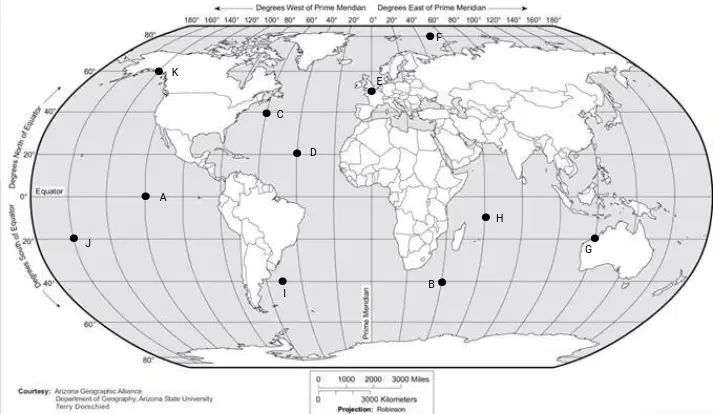
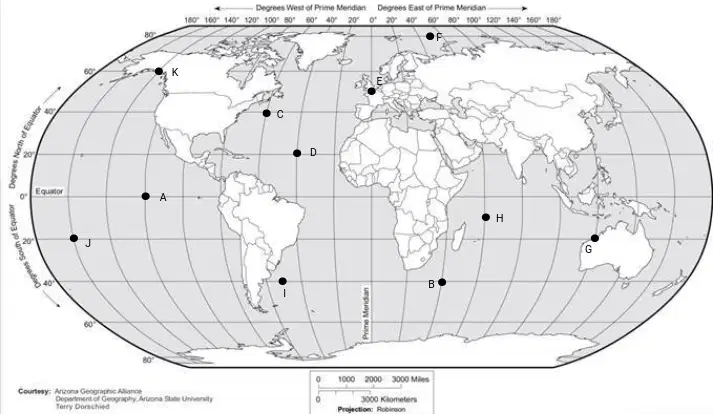
List the coordinates for Letter A.

(a)  
2.

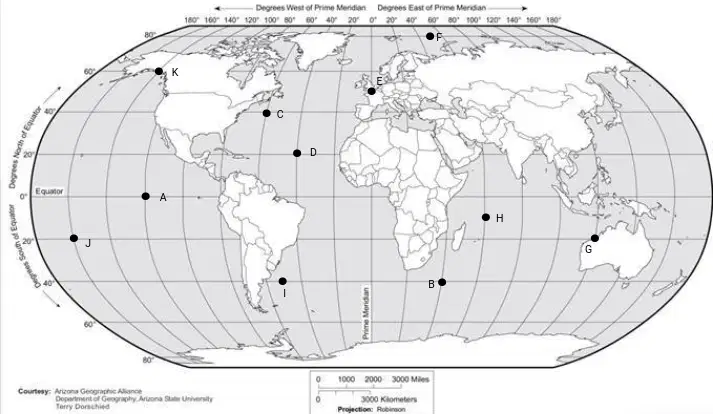
List the coordinates for Letter B.

(a)  
3.

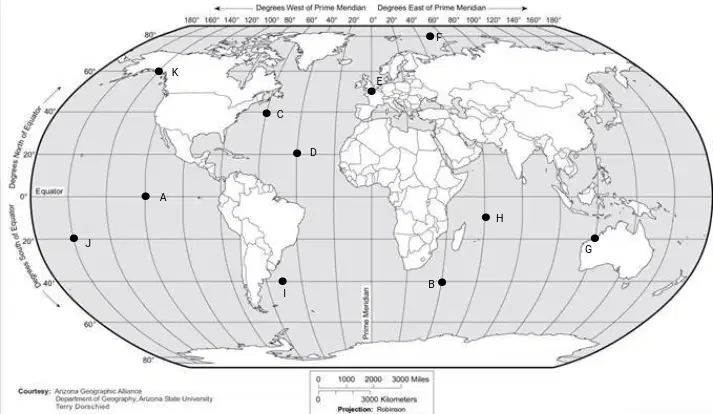
List the coordinates for Letter C.

(a)  
4.

List the coordinates for Letter D.

(a)  

5.

List the coordinates for Letter E

(a)  

6.

List the coordinates for Letter F

(a)  

7.

List the coordinates for Letter G

(a)  
8.
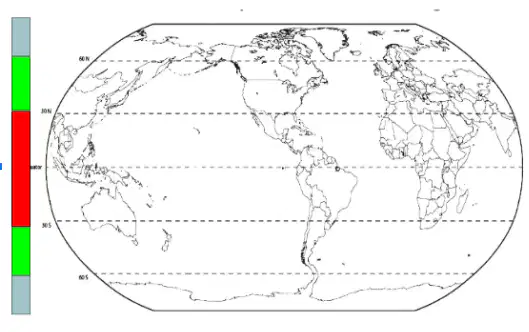
Which of the following best defines Geography?
a)
The study of people, places, things, and ideas involving locations and relationships.
b)
The study of the human mind and its functions, especially those affecting behavior in a given context.
c)
The study of the processes and phenomena of the atmosphere, especially as a means of forecasting the weather.
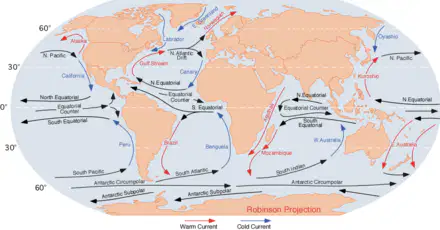
d)
The analysis of economic systems and financial markets.
9.
T/F: All maps are distorted and will never be as accurate as the globe in portraying size and direction.
a)
True
b)
False
10.

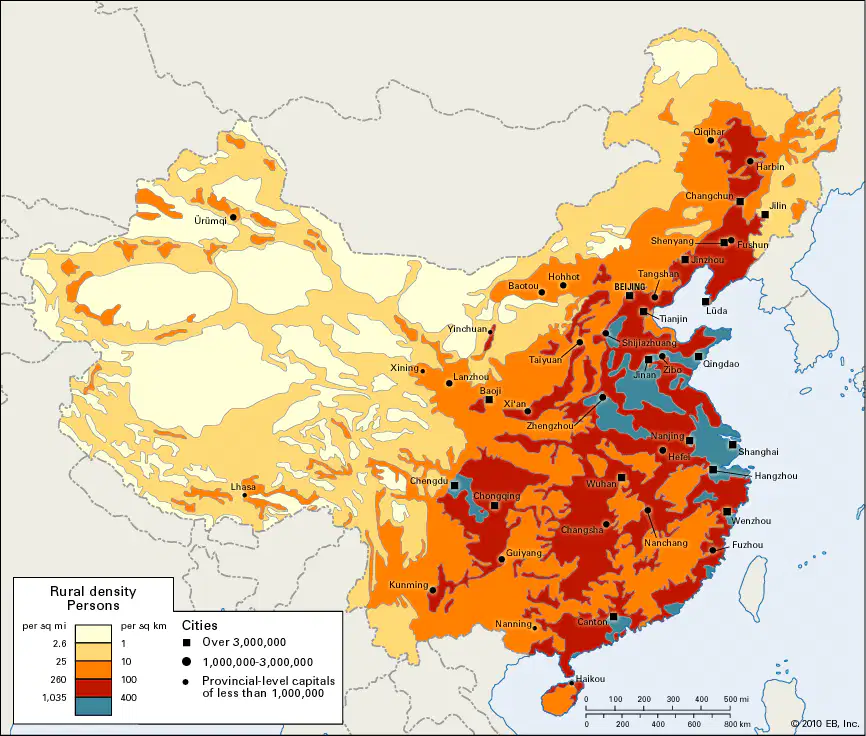
Which type of map would show human patterns of settlement, such as the one pictured?
a)
Physical Map
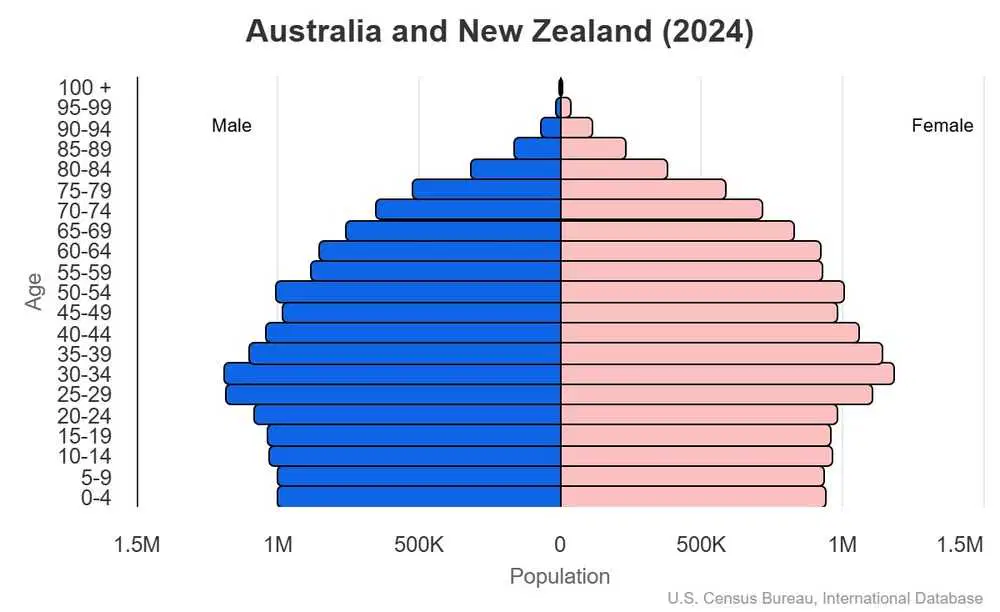
b)
Political Map
c)
Thematic Map
11.
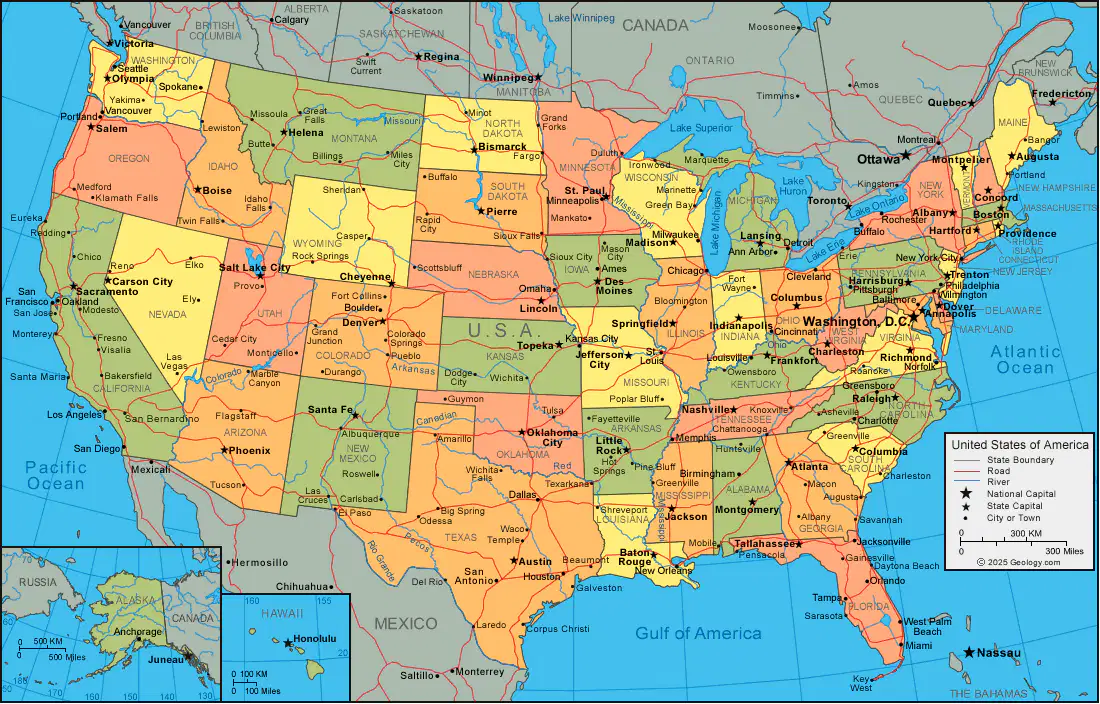
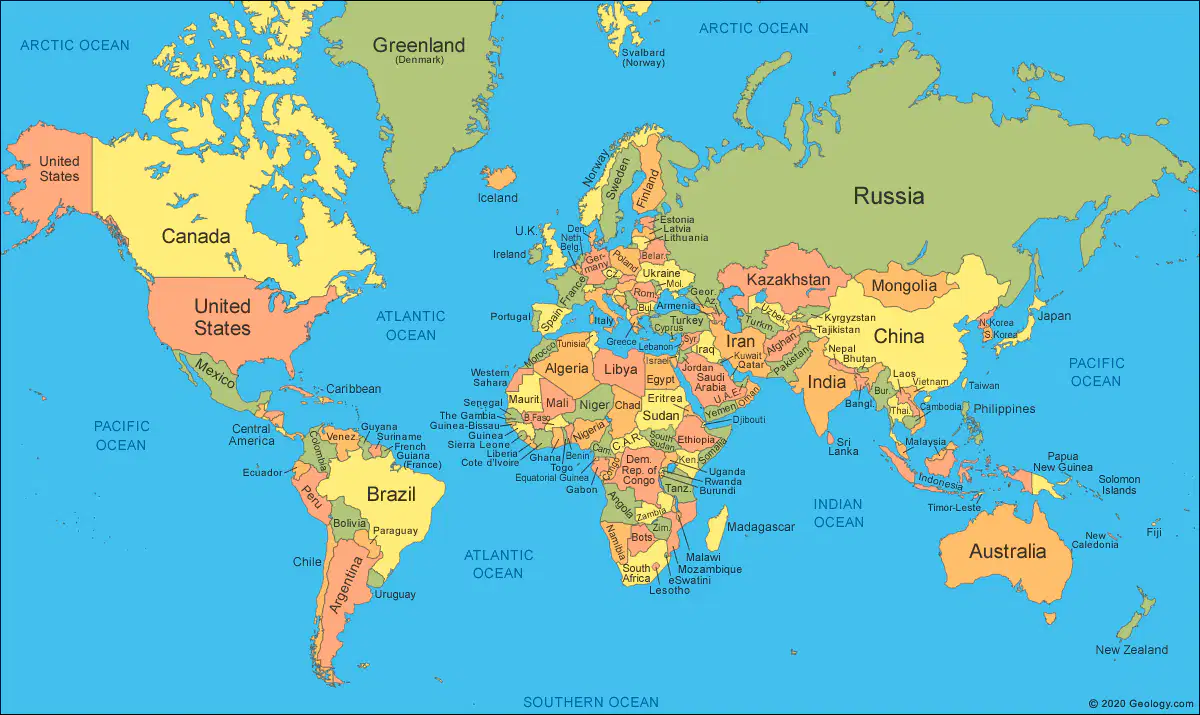
Which type of map would focus on the boundaries of governmental and administrative areas, such as the one pictured below?
a)
Physical Map
b)
Political Map
c)
Thematic Map
12.
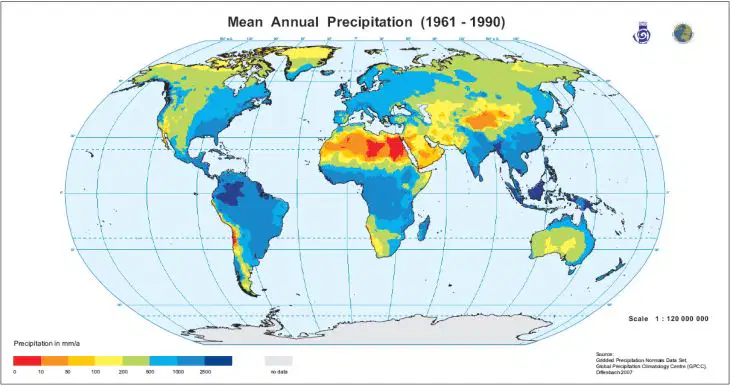
Which type of map would show the annual precipitation, such as the one pictured below?
a)
Physical Map
b)
Political Map
c)
Thematic Map
13.
Which type of map would show the physical terrain and include variations of elevation, such as the one pictured below?
a)
Physical Map
b)
Political Map
c)
Thematic Map
14.
Which type of map focuses on the human-made borders, such as the one pictured below?
a)
Physical Map
b)
Political Map
c)
Thematic Map
15.

What is the significance of the International Date Line in terms of timekeeping?

a)

It determines the start and end of the workweek worldwide.

b)

It is the point where the date changes by one day when crossed.

c)

It marks the division between the tropics and polar regions.

d)

It is the location of the Prime Meridian.

16.

Students are working on a marine research project and needs to detect underwater objects and map the ocean floor. Which technology should they use?

a)

SONAR

b)

Global Positioning Systems

c)

Geographic Information Systems

d)

A compass

17.

Which of the following best describes the main function of GPS technology?

a)

It provides precise location information using signals from satellites.

b)

It analyzes geographic data for environmental studies.

c)

It measures atmospheric conditions for weather forecasting.

d)

It records historical events at specific locations.
18.

You are hiking in a remote forest and want to find your exact location to navigate back to the campsite. Which of the following best describes the main function of the GPS device you are using?

a)

It provides precise location information using signals from satellites.

b)

It analyzes geographic data for environmental studies.

c)

It measures atmospheric conditions for weather forecasting.

d)

It records historical events at specific locations.
19.
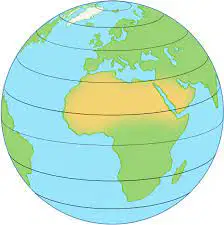
The lines on the map below are lines of _____________. They measure North and South.
a)
Latitude
b)
Longitude
20.
Which of the following defines Absolute Location?
a)
The exact global address from the latitude and longitude lines.
b)
The reference point to identify one place in relation to another.
c)
A description of a place’s physical and human characteristics.
d)
The general area where a place is found within a larger region.
21.
Which of the following is an example of Relative Location?
a)
Indian Creek Middle School is located at 41.77° N, 88.77° W.
b)
Indian Creek High School is directly south of the Casey's in Shabbona.
c)
Indian Creek Elementary school's address is 301 W. Cherokee. Shabbona, IL 60550.
d)
All of the above.
22.
The Continental Drift Theory believes:
a)
Continents are fixed in their positions and do not move.
b)
The core is the reason the Earth experiences tornadoes.
c)
The Earth’s crust is static and does not change over time.
d)
Continents were once joined and slowly drifted apart.
23.
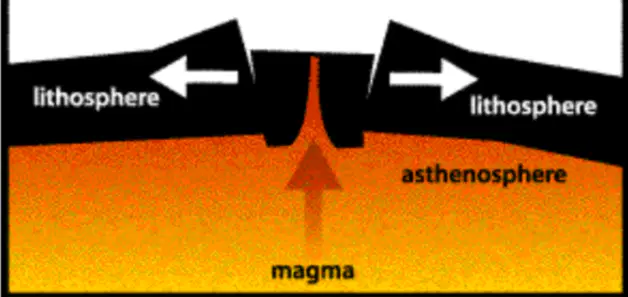
What type of plate boundary is shown in the image below?
a)
Divergent
b)
Transform
c)
Convergent
24.
How were the Hawaiian Islands formed?
a)
By the collision of two oceanic plates in the Pacific.
b)
By the Pacific Plate moving over a hot spot.
c)
By the subduction of the Pacific Plate beneath part of North America.
d)
By volcanic activity from continental drift.
25.
What geological process primarily occurs at the Mid-Atlantic Ridge?
a)
Subduction of oceanic plates
b)
Continental collision
c)
Erosion of existing landforms
d)
Formation of new oceanic crust
26.
Weathering is defined as:
a)
The movement of soil and rock particles to other locations by wind, water, or ice.
b)
The process of breaking down or dissolving rocks and minerals on the Earth’s surface.
c)
The formation of new rocks from cooled magma or lava.
d)
The chemical alteration of minerals due to high temperatures and pressures.
27.

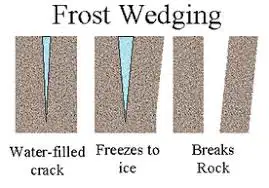
Which type of weathering involves the breaking of rocks due to the freezing and expansion of water in cracks?

a)

Physical

b)

Chemical

28.
The creation of caves through carbon dioxide and moisture mixing and dissolving limestone rock is known as which type of weathering?
a)
Physical
b)
Chemical
29.

Let's pretend you moved to a coastal town where the only available water source is the ocean. What is the primary purpose of the desalination plant in his town?

a)

To convert saltwater into freshwater.

b)

To generate electricity.

c)

To add minerals to water.

d)

To increase agricultural productivity.
30.
What percentage of water on Earth is freshwater vs saltwater?
a)
10% freshwater and 90% saltwater
b)
50% freshwater and 50% saltwater
c)
1% freshwater and 99% saltwater
d)
3% freshwater and 97% saltwater
31.
Which statement best explains the difference between weather and climate?
a)
Weather describes long-term patterns of temperature and precipitation, while climate refers to daily atmospheric conditions.
b)
Weather and climate both describe only the temperature of a region.
c)
Weather describes short-term atmospheric conditions, while climate refers to long-term patterns and averages.
d)
Climate includes daily changes in temperature and precipitation, while weather is measured over decades.
32.
The Earth's spinning on its axis once every 24 hours, which creates day and night, is known as:
a)
Earth's Revolution
b)
Earth's Rotation
c)
Earth's Equinox
d)
Earth's Geocentric Movement
33.
How long does it take for the earth to complete a full revolution?
a)
24 hours
b)
365 1/4 days
c)
300 days
d)
30 hours
34.
What would happen if Earth had no atmosphere?
a)
All bodies of water would evaporate, and the surface would become inhospitable.
b)
Sound would travel more efficiently, allowing for clearer communication.
c)
The temperature on Earth would remain stable and support life.
d)
Plants would thrive due to increased sunlight exposure.
35.
Which best describes the equinox?
a)
The equinox is the day when the Northern Hemisphere receives the most daylight of the year.
b)
The equinox is the day when the Northern Hemisphere receives the least daylight of the year.
c)
The equinox is the day when day and night are approximately equal in length everywhere on Earth.
d)
The equinox is the point when Earth is closest to the Sun.
36.
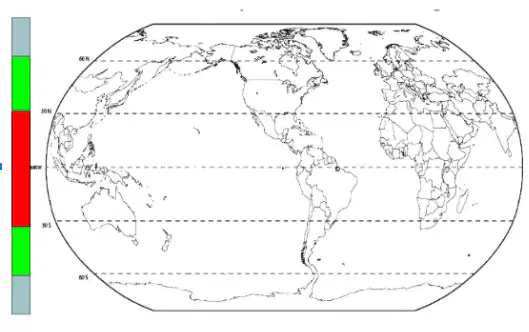
Where are High Latitude Zones located?
a)
Red: 30° N - 30° S
b)
Green: 30° N - 60° N & 30° S - 60° S
c)
Blue: 60° N- 90° N & 60° S - 90° S
37.
Where are Mid-Latitude Zones located?
a)
Red: 30° N - 30° S
b)
Green: 30° N - 60° N & 30° S - 60° S
c)
Blue: 60° N- 90° N & 60° S - 90° S
38.
Where are Low Latitude Zones located?
a)
Red: 30° N - 30° S
b)
Green: 30° N - 60° N & 30° S - 60° S
c)
Blue: 60° N- 90° N & 60° S - 90° S
39.
How does the increase of elevation typically affect temperature in a given region?
a)
Temperature increases with elevation by 3.5 degrees per 1,000 feet
b)
Temperature remains constant regardless of elevation
c)
Temperature fluctuates randomly with elevation
d)
Temperature decreases with elevation by 3.5 degrees per 1,000 feet
40.
Which best defines winds? What causes winds?
a)
The weather patterns in high elevation areas that cause air to remain stagnant due to warm temperatures.
b)
The movement of air from areas of high pressure to low pressure due to uneven heating of the Earth's surface.
c)
A type of precipitation that occurs during storms that causes thunder and lightning to occur.
d)
The rotation of Earth on its axis caused by the moon’s gravitational pull on the atmosphere.
41.
Why might agriculture be less successful on the leeward side of mountains compared to the windward side?
a)
Higher temperatures lead to better crop growth.
b)
It is an el nino year every year on the windward side
c)
The lack of moisture limits crop production.
d)
Soil quality is better due to erosion from winds.
42.
Which best describes the Doldrums?
a)
A route ships took to be able to increase their speed due to the wind and ocean currents.
b)
A windless band that historically has made travel difficult for wind-powered sailing ships.
c)
An area near Antarctica that is treacherous for ships due to the high waves.
d)
An area in North America known to have a surplus amount of gold.
43.
Which reason explains why there are hurricanes prevalent along the east coast of the United States vs the west coast?
a)
The geographic shape of the coastline.
b)
The presence of warm ocean currents in the Atlantic.
c)
The difference in population density between each coast.
d)
The influence of mountain ranges on weather patterns.
44.
Which side of a mountain typically receives more precipitation?
a)
Leeward side
b)
Both sides equally
c)
Windward side
45.
Which best describes the Deciduous Forest biome.
a)
Features trees that lose their leaves at the end of each growing season.
b)
A hot and humid climate with abundant rainfall throughout the year.
c)
Extreme arid conditions with low precipitation and high temperatures.
d)
Vast expanses of grasses with few trees.
46.
Which best describes the Desert biome?
a)
Especially cold temperatures with long, harsh winters and short, cool summers.
b)
Combination of grasslands and scattered trees with wet and dry seasons.
c)
Extreme arid conditions with low precipitation and high temperatures.
d)
Includes both saltwater and freshwater environments.
47.

Which best describes the Tundra Biome?

a)

Features trees that lose their leaves at the end of each growing season.

b)
Combination of grasslands and scattered trees with wet and dry seasons.
c)

Frigid temperatures, permafrost (permanently frozen soil), and a short growing season.

d)
Includes both saltwater and freshwater environments.
48.
Which of the following best defines culture?
a)
The study of how humans have divided up the Earth's surface for management & control.
b)
Different ways of thinking, believing, and living, expressed in common elements or features.
c)
People on earth all having the same way of thinking, believing, and living.
d)
The study of the spatial distribution of economic activity and economic development.
49.
Which of the following best describes cultural diffusion?
a)
The isolation of cultures from one another.
b)
The spread of goods, technology, and ideas from one group to another.
c)
The creation of new languages.
d)
The establishment of trade barriers and isolation.
50.
Stage 1 of the demographic transition model can be described as having:
a)
High birth rates, high death rates, neutral population growth
b)
Low birth rates, low death rates, neutral population growth
c)
Low birth rates, low death rates, increasing population growth
d)
High birth rates, low death rates, increasing population growth
51.
Which best describes stage 1 of the demographic transition model?
a)
Improving health care and farming practices that lower the rate of mortality; newly developing nation.
b)
Advanced technology, practices in medicine, and sanitation that cause low mortality.
c)
Older population that limits the growth of the country.
d)
Limited technology, poor practices in medicine, lack of sanitation that cause high mortality.
52.
Stage 2 of the demographic transition model can be described as having:
a)
High birth rates, high death rates, neutral population growth
b)
High birth rates, low death rates, increasing population growth
c)
Low birth rates, low death rates, neutral population growth
d)
Low birth rates, low death rates, increasing population growth
53.
Stage 4 of the demographic transition model can be described as having:
a)
High birth rates, high death rates, neutral population growth
b)
High birth rates, low death rates, increasing population growth
c)
Low birth rates, low death rates, neutral population growth
d)
Low birth rates, low death rates, increasing population growth
54.
Which best describes stage 4 of the demographic transition model?
a)
Advanced technology, practices in medicine, and sanitation that cause low mortality.
b)
The pre-industrial stage of the demographic transition model.
c)
Developing country with large families to help on farmland, mostly subsistence farming.
d)
A traditional economy with trading and bartering of goods and services.
55.
Which of the following best describes a population pyramid? (pictured below)
a)
Including information about the population density in a particular city.
b)
Including information about the age and gender distribution of a country.
c)
Including information about the political votes from the previous four years.
d)
Including information about voters and the political party they support.
56.
A high number of youth in the population can cause which of the following?
a)
Resource shortages due to their inability to work and support themselves.
b)
A surplus amount of goods and resources for its residents.
c)
A decline in population in the next 50 years.
d)
Difficulty finding a job due to the job market being oversaturated with workers.
57.
Which of the following are people least likely to settle near?
a)
In areas with water nearby (lakes/rivers).
b)
In areas with little rainfall and no nearby water.
c)
In areas secure from political threats.
d)
In areas with plentiful food and a comfortable climate.
58.
Which best describes an oligarchy?
a)
A political system where power is held by a single individual.
b)
A form of government in which power resides with a small group of individuals or families.
c)
A system where the majority rules through direct democracy.
d)
A political structure characterized by the absence of any governing authority.
59.
Which type of government is ruled by religious leaders?
a)
Democracy
b)
Theocracy
c)
Oligarchy
d)
Monarchy
60.
Which of the following best describes a representative democracy?
a)
A system in which citizens elect officials to make laws and govern on their behalf.
b)
A government ruled by a single leader who holds unlimited power.
c)
A society where religious leaders control all political decisions.
d)
A system ruled by a king, queen, or emperor who typically holds inherited power.
61.
Which of the following best describes a monarchy?
a)
A system where all citizens vote directly on every law.
b)
A government controlled by a small group of powerful individuals.
c)
A system ruled by a king, queen, or emperor who typically holds inherited power.
d)
A society where religious leaders control all political decisions.
62.
Which of the following is an example of a primary economic activity?
a)
Processing wheat into bread
b)
Mining iron ore from the ground
c)
Offering financial planning services
d)
Conducting medical research
63.
Which level of economic activity involves manufacturing raw materials into finished goods?
a)
Primary
b)
Secondary
c)
Tertiary
d)
Quaternary
64.
Which job would be classified as a secondary economic activity?
a)
Cashier at a grocery store
b)
Auto assembly line worker
c)
Farmer harvesting soybeans
d)
Lab technician studying diseases
65.
Which of the following best represents a tertiary economic activity?
a)
Providing legal services
b)
Refining petroleum
c)
Growing corn on a farm
d)
Designing new computer software
66.
Quaternary economic activities primarily involve:
a)
Producing and assembling consumer goods
b)
Creating, analyzing, and sharing information or research
c)
Providing personal and professional services
d)
Extracting natural resources
67.
The division of the Mississippi River between states, such as Illinois and Iowa, is known as which type of boundary?
a)
Natural
b)
Cultural
c)
Political
68.
The division of the U.S. into 50 states, all in which have their own state legislatures, is know as which type of boundary?
a)
Natural
b)
Cultural
c)
Political
69.
Which of the following best describes a command economy?
a)
An economy where customs and traditions shape what people produce.
b)
An economy where supply and demand determine prices and production.
c)
An economy where government officials make most economic decisions.
d)
An economy where individuals and businesses are free from all government rules.
70.
Which of the following is an example of a traditional economy?
a)
A society where people hunt, fish, and barter using long-held customs
b)
A government that sets quotas for every industry
c)
A nation where private companies innovate new technologies
d)
A country that regulates business only in times of crisis
71.
Which of the following best describes a mixed economy?
a)
A system combining private enterprise with some government regulation
b)
A system in which all decisions are made by the central government
c)
A system where people follow the economic patterns of their ancestors
d)
A system entirely controlled by private businesses without regulation
72.
Which combination of factors best explains why the Northeast and Great Lakes regions have high population density?
a)
Subarctic climate and isolation
b)
Historic industrial centers and major commercial hubs
c)
Limited resources and low economic activity
d)
Large deserts and high elevations
73.
Which pair of regions both have low population density due to harsh climates or limited water availability?
a)
Pacific Coast and Great Lakes
b)
Northeast and Southeast
c)
Great Basin and Interior Alaska
d)
Southern California and Florida
74.
What impact did the Transcontinental Railroad have on the United States? (1860s)
a)
It had no significant economic impact.
b)
It increased tensions between the North and South.
c)
It led to the decline of urban areas in the East.
d)
It facilitated westward expansion and settlement.
75.

Which of the following is a key feature of Geographic Information Systems (GIS)?

a)

Real-time traffic updates

b)

Layering of spatial data

c)

Satellite imagery

d)

Weather forecasting

76.

Which of the following is an example of a push factor in human migration?

a)

Job opportunities in another country.

b)

Family reunification in a different region.

c)

Desire to experience a new culture.

d)

War or conflict in the home country.

77.

Which best describes the concept of urbanization?

a)

The increase in the number of people living in cities.

b)

The movement of people from cities to rural areas.

c)

The study of physical landforms.

d)

The process of creating new agricultural land.

78.

Which of the following is a primary reason why early cities were often established near rivers?

a)

Rivers provided a source of fresh water and transportation.

b)

Rivers attracted dangerous wildlife, making settlements safer.

c)

Rivers were barriers to trade and communication.

d)

Rivers made the land less fertile for agriculture.

79.

Which factor most often influences the location of a new city settlement?

a)

Availability of natural resources such as water and fertile land.

b)

Distance from other cities.

c)

Presence of ancient ruins.

d)

Random selection by government officials.

80.

Which of the following is the largest mountain range in the United States?

a)

Rocky Mountains

b)

Appalachian Mountains

c)

Ozark Mountains

d)

Sierra Nevada

81.

What type of landform is the Great Plains region best known for?

a)

Flat, grassy plains

b)

High mountains

c)

Coastal wetlands

d)

Deep canyons

82.

Which of the following is an example of a primary economic activity?

a)

Farming

b)

Software development

c)

Car manufacturing

d)

Banking

83.

Which sector is mainly involved in processing raw materials into finished goods?

a)

Quaternary sector

b)

Tertiary sector

c)

Secondary sector

d)

Primary sector

84.

Which of the following best describes the quaternary sector?

a)

Extraction of natural resources

b)

Manufacturing and construction

c)

Providing services such as retail and transport

d)

Knowledge-based activities like research and information technology

85.

Which of the following best describes a command economy?

a)

Economic decisions are made by individuals and businesses based on supply and demand.

b)

Economic decisions are made by international organizations.

c)

Economic decisions are based on customs, traditions, and beliefs passed down through generations.

d)

Economic decisions are made by the government, which controls production and distribution.

86.

In a traditional economy, what is the primary factor that determines how resources are allocated?

a)

Government planning

b)

Technological innovation

c)

Market competition

d)

Customs and traditions

87.

Which of the following is a key characteristic of a free-market economy?

a)

Prices are set by the government.

b)

Production is based on cultural traditions.

c)

Individuals and businesses freely exchange goods and services with minimal government intervention.

d)

All resources are owned collectively by the community.

88.

In a capitalist economy, how are prices for goods and services primarily determined?

a)

By the collective decision of workers

b)

By supply and demand in the market

c)

By international organizations

d)

By government planning and regulation

89.

Which of the following is a common criticism of socialism?

a)

It leads to excessive income inequality.

b)

It can reduce individual incentives to innovate and work hard.

c)

It relies entirely on private investment for public services.

d)

It results in too much competition among businesses.

90.

Which of the following is an example of cultural diffusion?

a)

The migration of animals during winter

b)

The formation of new mountain ranges

c)

The spread of pizza from Italy to the United States

d)

The rotation of the Earth around the Sun