
NEW
Font size
 Worksheets
HUMN 1101 Chapter 1 Study Guide
Total questions: 48
Worksheet time: 24mins
Which major cultural development is the primary distinction between the Paleolithic and Neolithic periods?
The discovery and use of fire for cooking and warmth.
The development of permanent settled life based on agriculture.
The creation of life-sized figurative sculptures from stone.
The practice of painting naturalist images of animals inside caves.
The exaggeration of the breasts, belly, and hips on the Paleolithic 'Venus figurines' like the Venus of Willendorf is primarily interpreted as a symbol of which concept?
The high social status of women as political and religious leaders.
A specific, named goddess of love and beauty from their pantheon.
The importance of fertility and successful childbearing to nomadic hunter-gatherer groups.
A realistic portraiture of the average physical form of women in the era.
The construction and astronomical alignment of Neolithic monuments like Stonehenge suggest that the religious beliefs of this culture were closely tied to which aspect of their new agricultural life?
An emphasis on warfare and the worship of a supreme warrior god.
The cycles of the sun, moon, seasons, and Earth's elemental forces.
The veneration of deceased kings and the construction of monumental tombs.
A complete rejection of all earlier Paleolithic spiritual practices.
The architectural technique shown in the structure of Stonehenge, characterized by vertical supports holding horizontal beams, is known as:
Mortise-and-tenon construction
Post-and-lintel construction
Corbeled vaulting
Arches and buttresses
A key defining feature that marks the difference between 'Prehistory' and the emergence of the first 'Civilizations' is the invention of:
Metallurgy, marking the transition from the Stone Age to the Bronze Age.
Institutional government and codified moral codes.
Permanent settlement in urban living areas.
Written language, which allowed for the creation of written historical records.
What is the material and process used to create the cuneiform script tablets in ancient Mesopotamia?
Carving pictographic symbols into hardened basalt steles.
Painting simplified signs onto sheets of papyrus reed.
Pressing cut reeds to make wedge-shaped marks in wet clay that was later baked.
Inscribing characters onto tortoise shells used for divination rituals.
The decorative technique of the Standard of Ur involves creating images by carefully arranging small pieces of colored materials (shell, lapis lazuli, red limestone). This art form is defined as:
Mosaic
Fresco
Relief
Encaustic
A ziggurat is primarily an expression of Mesopotamian polytheism because:
It was used as a burial place for the monarch, connecting the king to the divine realm.
Its tiered structure aligned perfectly with the position of the sun on the solstices.
The shrine at the very top was believed to be the home of a deity, who would descend and ascend from the sky.
It was the first structure built using advanced Bronze Age metallurgy techniques.
The central theme of the Epic of Gilgamesh is the hero's struggle to find:
The secret to immortality, which the gods reserved for themselves.
The long-lost clay tablets containing the story of the flood.
His close friend Enkidu, the bull-man, whom he wants to rescue from the underworld.
The location of the ziggurat where the god Marduk lives.
The Stele of Hammurabi uses relief sculpture at the top to depict the king receiving the law code from the sun god Shamash. The function of this relief is to convey that:
Hammurabi authored the laws and enforced them entirely through his own personal authority.
The laws are a divine decree and are thus the infallible law of the gods, not merely the king's will.
The transition from the Bronze Age to the Iron Age primarily demonstrates a civilization’s mastery of which technology?
The construction of massive stone megalithic monuments.
Higher-temperature furnaces and more advanced metallurgical techniques.
The creation of glazed-brick architectural structures, such as the Ishtar Gate.
The creation of written documents on cuneiform clay tablets.
Which civilization or empire is associated with the rise of Monotheism through the dualistic religion of Zoroastrianism?
Ancient Egypt under the reign of Akhenaten.
The Akkadian Empire of Mesopotamia.
The Persian Empire during the time of Darius I.
The Indus Valley Civilization and its early Vedic Era.
On the Palette of King Narmer, the king is depicted as significantly larger than the other figures, and he wears the distinct crowns of both Upper and Lower Egypt. This artistic convention is called:
Naturalism
Composite Profile
Hieroglyphs
In ancient Egyptian theocracy, the pharaoh's divine power was tied to his role in the afterlife. The purpose of his elaborate mummification and tomb was to ensure:
His body and soul were ready to achieve Nirvana and escape the cycle of rebirth.
His soul could travel through the inner tunnels of the pyramid to join specific constellations.
His name would be forgotten in history, preserving the secrecy of the dynasty.
The next monarch would not be able to loot the tomb for its valuable resources.
The visual convention in Egyptian art where the head, legs, and feet of a person are shown in profile, but the torso, arms, and shoulders are shown frontally, is known as the:
Composite Profile
Hieratic Scale
Fresco Style
Canon of Proportion
The ancient Egyptian writing material called papyrus was created by weaving together thin strips of which type of plant fiber?
Palm fronds grown near the fertile silt of the annual flood.
Flax linen, used for wrapping mummies, treated with animal hide glue.
The stems of the Cyperus papyrus reed soaked and pressed into sheets.
Crushed wood pulp, similar to the process used later in China.
The Nok Culture of Western Africa, which emerged during the Iron Age, is primarily known for its masterful use of which medium in creating figurative sculptures and early portraiture?
Lost-wax casting with bronze.
Carving massive heads from basalt.
Megalithic structures arranged for ritual worship.
Firing clay to create distinctive terracotta sculptures.
The colossal stone heads created by the Olmec civilization are primarily made from which volcanic stone found along the Gulf Coast of Mexico?
Limestone
Lapis Lazuli
Basalt
Slate Schist
In Hinduism, what is the concept that dictates the spiritual purity of one's current life, thereby determining the physical form of the soul (Atman) in its next life within the cycle of rebirth (Samsara)?
Vedas
Brahman
Nirvana
Karma
The core principle of Daoism is the Dao, or 'the Way,' which the philosophy of Lao Zi emphasizes can only be understood by achieving harmony with:
The mandate of Heaven and the will of the dynastic king.
The vital energy, Qi (chee), that connects the heavens, Earth, and mankind.
The natural order and spontaneous flow of the universe.
The dualistic war between Ahura Mazda and Angra Mainyu.
________ is the academic study of human society and culture, encompassing disciplines like language, religion, philosophy, literature, music, and the visual arts.
Culture
Biology
Mathematics
Physics
Paleolithic Culture: The earliest period (ca. 3,000,000 – 10,000 BCE) characterized by nomadic life, tool use, and the manipulation of fire. Art included cave paintings, likely with spiritual significance involving ________.
totems and shamans
agriculture and irrigation
written language and alphabets
metal tools and weapons
Neolithic Culture: The period (ca. 8000 – 2000 BCE) defined by the development of ________, leading to permanent settlements and monumental architecture.
agriculture
metalworking
writing
navigation
________ is an artistic style that aims to depict the natural world, particularly figures and animals, as accurately as possible..
Naturalism
Cubism
Surrealism
Impressionism
What is the fundamental architectural technique that uses upright vertical elements (posts) to support a horizontal crosspiece (lintel), found in Neolithic structures such as Stonehenge?
Post-and-Lintel
Corbel Arch
Flying Buttress
Cantilever
A complex society with organized government, established beliefs/moral codes, urban living areas, and a written language. The earliest examples are the River Valley Civilizations (Mesopotamia, Egypt, Indus Valley, China). What is this called?
Civilization
Nomadism
Tribe
Colony
What are the two early writing systems, one of which is the wedge-shaped script of Mesopotamia?
Cuneiform & Hieroglyphs
Latin & Cyrillic
Phoenician & Greek
Runic & Brahmi
What is the working of metals called, which was significant during the Bronze/Iron Age?
Metallurgy
Pottery
Weaving
Carpentry
Located in the 'Fertile Crescent' (modern Iraq), home to the Sumerians and Babylonians. Art forms included Mosaic (e.g., Standard of Ur). What is this ancient region called?
Mesopotamia
Persia
Phoenicia
Egypt
A massive, stepped, mud-brick temple platform in Mesopotamia believed to be the dwelling place of the gods (indicative of Polytheism) is called a _______.
Ziggurat
Pyramid
Stupa
Obelisk
Epic is a long narrative poem about a legendary hero. The most famous example from Mesopotamia is the _______.
Epic of Gilgamesh
Iliad
Mahabharata
Aeneid
A comprehensive set of laws codified by Babylonian Monarch Hammurabi, famous for the Principle of Talion ("eye for an eye"), is known as _______.
Hammurabi’s Law Code
Code of Justinian
Twelve Tables
Magna Carta
A system of government where a deity or religious authority is the supreme ruler; in Egypt, the pharaoh was believed to have divine power. This system is called _______.
Theocracy
Democracy
Monarchy
Oligarchy
A sequence of rulers from the same family. Egyptian history is often divided by these ruling families, known as _______.
Dynasty
Empire
Colony
Republic
Papyrus is the early paper-like writing material made from the Nile plant. This material is called _______.
Papyrus
Parchment
Vellum
Bamboo
The Nok Culture (Western Africa, Iron Age) is known for its distinctive ________ sculptures.
Terracotta
Marble
Bronze
Wood
Olmecs: The earliest major Mesoamerican civilization (ca. 1600 BCE), famous for their monumental ________ carved from basalt.
Colossal Heads
Obsidian Masks
Pyramid Temples
Jade Figurines
Caste System is the rigid social hierarchy introduced by the ________ during the Vedic Era.
Aryans
Mughals
British
Guptas
______ is the oldest existing world religion.
Hinduism
Christianity
Islam
Buddhism
Daoism is an ancient Chinese philosophy focused on living in harmony with the ________ (universal natural principle).
Dao
Karma
Nirvana
Samsara
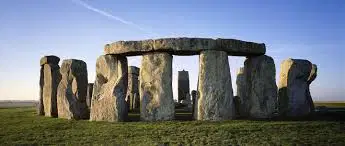
Stonehenge, built during the Neolithic period (ca. 3000–1800 BCE, England), is a monument built with megaliths using post-and-lintel construction; it is believed to be a ________ for seasonal cycles or a funerary site.
celestial observatory
marketplace
military fortress
residential palace
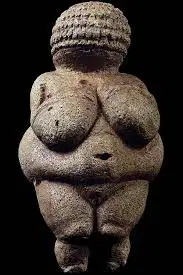
The Venus of Willendorf, from the Paleolithic period (ca. 25,000–20,000 BCE, Austria), is a small limestone figure with exaggerated reproductive features, symbolizing ________ and childbearing for nomadic peoples.
fertility
warfare
leadership
agriculture
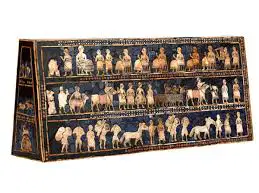
The Standard of Ur (War/Peace Sides), from the Sumerian period (ca. 2700 BCE, Ur, Iraq), is a wooden box decorated with mosaic inlay depicting scenes of war and peace; it utilizes ________ scale to denote the ruler's importance.
hieratic
naturalistic
proportional
linear
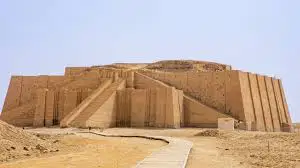
The Ziggurat at Ur, from the Third Dynasty of Ur (ca. 2150–2050 BCE, Ur, Iraq), is the best-preserved example of a tiered temple platform, reflecting ________ polytheistic cosmology.
Mesopotamian
Egyptian
Greek
Persian
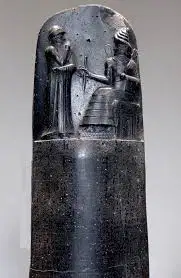
What is the Stele of Hammurabi?
A carved stone slab containing Hammurabi’s Law Code in cuneiform; features a high relief sculpture of the king receiving the law from the god Shamash.
Monumental tombs for the pharaohs (Khufu, Khafre, Menkaure), representing the Ben Ben (primordial mound).
Massive basalt sculptures, possibly portraits of powerful rulers, showing the earliest monumental art of Mesoamerica.
Commemorates the unification of Upper and Lower Egypt under King Narmer; an early example of Egyptian hieroglyphs and the use of hieratic scale.
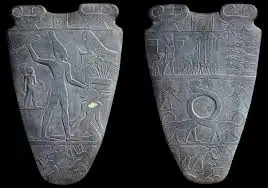
The Palette of King Narmer is significant because it:
Shows the earliest monumental art of Mesoamerica.
Commemorates the unification of Upper and Lower Egypt under King Narmer; an early example of Egyptian hieroglyphs and the use of hieratic scale.
Contains Hammurabi’s Law Code in cuneiform.
Represents the Ben Ben (primordial mound).
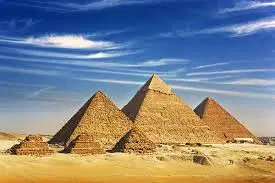
Fill in the blank: The Great Pyramids of Giza are monumental tombs for the pharaohs (Khufu, Khafre, Menkaure), representing the ________ (primordial mounds).
Ben Ben
Obelisk
Sphinx
Papyrus
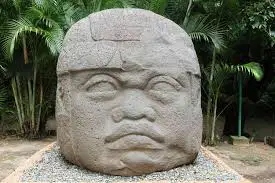
The Olmec Colossal Heads are massive basalt sculptures, possibly portraits of powerful rulers, showing the earliest monumental art of ________.
Mesoamerica
Mesopotamia
Africa
Europe

