
NEW
Font size
 Worksheets
Quiz on Jose Rizal's Life and Works
Total questions: 50
Worksheet time: 25mins
What is one of the primary focuses of studying Jose Rizal's life within the context of 19th century Philippines?
To memorize historical dates
To articulate his life and its context
To learn about European history
To study ancient civilizations
Which novels by Jose Rizal are emphasized for analysis in this course?
Don Quixote and War and Peace
Noli Me Tangere and El Filibusterismo
The Great Gatsby and Moby Dick
Pride and Prejudice and Wuthering Heights
What skill is developed by manipulating Rizal’s ideas into various themes?
Basic arithmetic
Theme manipulation
Language translation
Historical memorization
What is the importance of embodying a critical reading of primary sources in the study of Rizal?
To memorize facts
To develop critical reading skills
To learn a new language
To write poetry
How does studying Rizal's life and works help students in terms of values?
It helps them memorize dates
It applies values derived from his life
It teaches them to draw
It helps them learn a new language
What appreciation is perfected through the study of Rizal’s life?
Appreciation for mathematics
Appreciation for education and love of country
Appreciation for culinary arts
Appreciation for sports
What is one of the outcomes of internalizing Rizal's advocacies?
Learning to play an instrument
Giving value to the life of every Filipino and to his fatherland
Becoming a professional athlete
Learning a new language

Which law mandates the study of the life and works of Rizal?
R.A. 1425 otherwise known as “Rizal Law”
House Bill No. 5561
Senate Bill No. 438
Senate Bill No. 1425
When was the Rizal Law established?
12th June 1956
12th June 1965
12th July 1956
12th July 1965
Who was the senator responsible for the Rizal Law?
Senator Carlo M. Recto
Senator Jose P. Laurel
Senator Manuel L. Quezon
Senator Sergio Osmeña

What role did Jose P. Laurel play in relation to Jose Rizal's legacy?
He co-wrote a law emphasizing Rizal's contribution to nationalism.
He was a student of Jose Rizal.
He opposed Rizal's ideals.
He was unrelated to Rizal's legacy.
Why is it important for Filipinos, especially the youth, to learn about Jose Rizal?
To understand the ideals for which Rizal died.
To memorize historical dates.
To learn about foreign cultures.
To study ancient languages.
What does the Rizal Law require in the curricula of schools and universities?
Inclusion of modern technology courses
Inclusion of Jose Rizal's works and writings
Removal of history subjects
Addition of foreign language courses
Which novels by Jose Rizal are specifically mentioned in the Rizal Law?
Noli Me Tangere and El Filibusterismo
Don Quixote and Les Misérables
War and Peace and Crime and Punishment
The Great Gatsby and To Kill a Mockingbird
When did the Rizal Law become effective?
August 16, 1956
July 4, 1946
September 21, 1972
June 12, 1898
What is the main purpose of the Rizal Law (R.A. 1425) as stated in its preamble?
To promote economic growth
To encourage technological advancement
To re-dedicate to the ideals of freedom and nationalism
To establish new educational institutions
According to the preamble of the Rizal Law, why is there a need for re-dedication to certain ideals?
Due to technological advancements
More than any other period in history
To improve international relations
To increase economic stability

What is the main purpose of the Rizal Law (R.A. 1425) as stated in the text?
To regulate educational institutions
To promote economic growth
To enhance technological advancements
To improve healthcare systems
According to the Rizal Law, what are schools enjoined to develop?
Economic strategies
Moral character and civic conscience
Technological skills
Artistic talents
What does the Rizal Law (R.A. 1425) require schools to include in their curricula?
Courses on the life and works of Rizal
Courses on Philippine history
Courses on world literature
Courses on modern technology
According to the Rizal Law, what are schools required to have an adequate number of copies of?
El Filibusterismo and Noli Me Tangere
The Bible and the Quran
Shakespeare's works
Modern science textbooks
What is the primary purpose of the Batas Rizal (R.A. 1425)?
To promote economic growth
To rekindle the flame of nationalism in the hearts of the Filipino, particularly the youth
To establish new educational institutions
To enhance technological advancements
According to the Rizal Law, what should we avoid forgetting?
The achievements of foreign leaders
The contributions of our patriots and their fight for freedom
The history of other countries
The economic policies of the past

Which of the following was a reason given against proclaiming Dr. Jose Rizal as a national hero?
He was the illegitimate son of Adolf Hitler.
He was regarded as an "American-made hero."
He was a leader in the revolution against colonizers.
He was a famous scientist.
Who headed the First Philippine Commission formed by the United States?
William Howard C. Taft
Theodore Roosevelt
Woodrow Wilson
Franklin D. Roosevelt
What was one of the alleged strategies behind declaring Dr. Jose Rizal as a national hero?
To promote scientific achievements
To hinder nationalistic feelings
To encourage artistic expression
To support economic growth
During whose reign did the political unrest in Spanish politics start in the Philippines?
King Charles V
King Ferdinand VII
King Philip II
King Alfonso XIII
What was one result of Spanish political instability in the Philippines?
Stable colonial policies
Frequent shifts of colonial policies
Fixed terms of government officials
Economic prosperity
What aspects need to be analyzed to understand Jose Rizal in the context of the 19th century?
Economic, social, political, and cultural changes
Only economic changes
Only political changes
Only cultural changes
Which century is being referred to for understanding the context of Jose Rizal?
18th century
19th century
20th century
21st century

What was one of the key factors in the economic development related to trade?
The rise of the monopolies
The decline of the Galleon Trade
The closure of the Suez Canal
The restriction of Manila Ports to World Trade
Which event opened Manila Ports to World Trade?
The opening of the Suez Canal
The rise of the monopolies
The growth of the export industry
The Galleon Trade
What was a significant outcome of the opening of the Suez Canal?
The decline of the export industry
The restriction of Manila Ports
The growth of the export industry
The end of the Galleon Trade
What was the Galleon Trade also known as in New Spain?
La Nao de la China
La Nao de la India
La Nao de la España
La Nao de la América
What type of monopoly was the Galleon Trade?
Private monopoly
Government monopoly
Corporate monopoly
Open market
How many galleons were used in the Galleon Trade?
One
Two
Three
Four
How long did the Spanish trading ships link the Philippines with Mexico?
One century
Two and a half centuries
Three centuries
Four centuries
When was the Suez Canal opened to navigation?
November 17, 1869
December 25, 1870
January 1, 1865
March 15, 1872
What was the initial depth of the Suez Canal when it opened?
25 feet
50 feet
100 feet
75 feet
Which two regions benefited from the Suez Canal for trading?
Spain and the Philippines
France and India
Egypt and China
Italy and Japan
What was the width of the Suez Canal at the surface when it first opened?
200 to 300 feet
100 to 150 feet
50 to 100 feet
400 to 500 feet
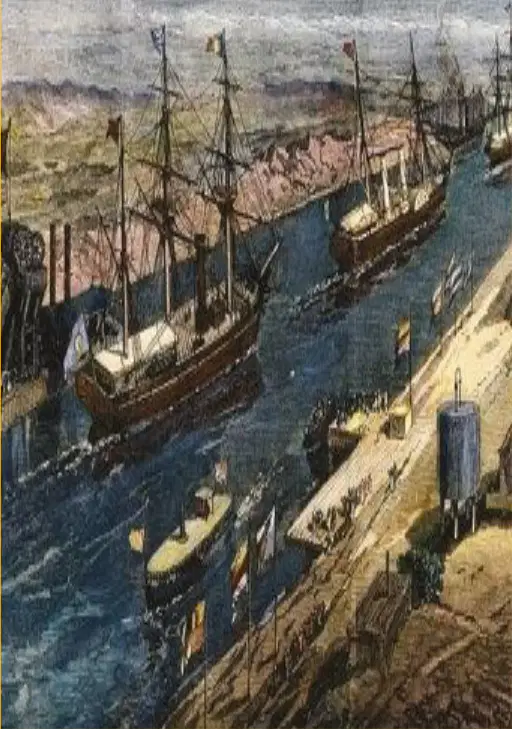
Image of ships navigating through the Suez Canal.
Suez Canal
Panama Canal
English Channel
Strait of Gibraltar
What was one of the main reasons for the integration of the Philippines into an international commercial system?
The decline of European markets
The growing number of foreign merchants in Manila
The isolation of North America
The closure of Asian ports
How did non-Spanish Europeans manage to reside in Manila despite restrictions?
By forming alliances with local tribes
By flying the flags of Asian States or conniving with local officials
By establishing their own colonies
By converting to local religions
In what year did the crown abolish the Royal Company of the Philippines?
1824
1834
1844
1854
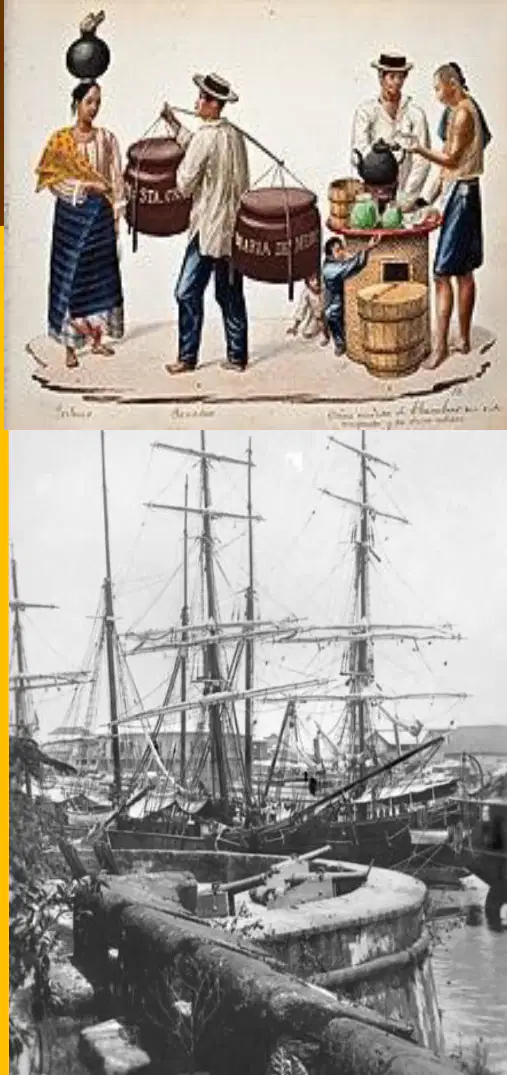
By the late 19th Century, which three crops dominated Philippine exports?
Tobacco, abaca, and sugar
Rice, corn, and coffee
Cotton, tea, and rubber
Wheat, barley, and oats
When was the government monopoly on tobacco abolished in the Philippines?
1880
1850
1900
1870
What material was considered the best for ropes and cordage due to worldwide shipping growth?
Philippine abaca
Philippine sugar
Philippine tobacco
Philippine rice
When did sugar alternate with abaca as the islands' most important export?
After 1850
After 1880
After 1900
After 1800
How early was sugarcane produced and refined using crude methods in the Philippines?
Beginning of the 18th century
Beginning of the 19th century
Beginning of the 20th century
Beginning of the 17th century

