
NEW
Font size
 Worksheets
Revolutions - Study Guide
Total questions: 27
Worksheet time: 14mins
Which group made up the 2nd Estate of France?
The Clergy
The Middle Class
The Nobility
Bourgeoisie
What spurred the creole to drive for independence in Latin America?
Loss of money through taxes
The creation of a no trade zone
The uprising of slaves
Fear of indigenous/native population
Which group made up the 1st Estate in Pre-Revolution France?
Peasants
Nobles
Clergy
King
All the following are true about the Haitian Revolution Except:
A. Napoleon wanted to free the slaves
B. Successful sugar cane operation
C. Discovered by Columbus
D. L'Ouverture led the rebellion
Which of these directly challenged the authority of Britain's King George III?
the passage of the Navigation Acts
the Glorious Revolution
the Declaration of Independence
the writing of the Constitution
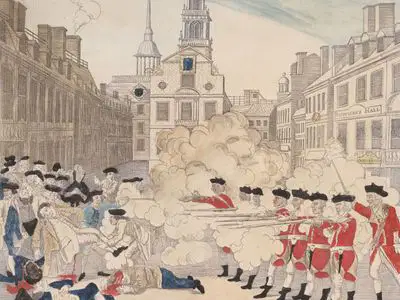
What is most likely the reason this engraving of the Boston Massacre by Paul Revere inflamed public opinion against the British?
It shows the colonists as unarmed victims of an attack.
It shows that the colonists provoked the British soldiers.
It shows the colonists firing on the soldiers.
It shows that the colonists are outnumbered.
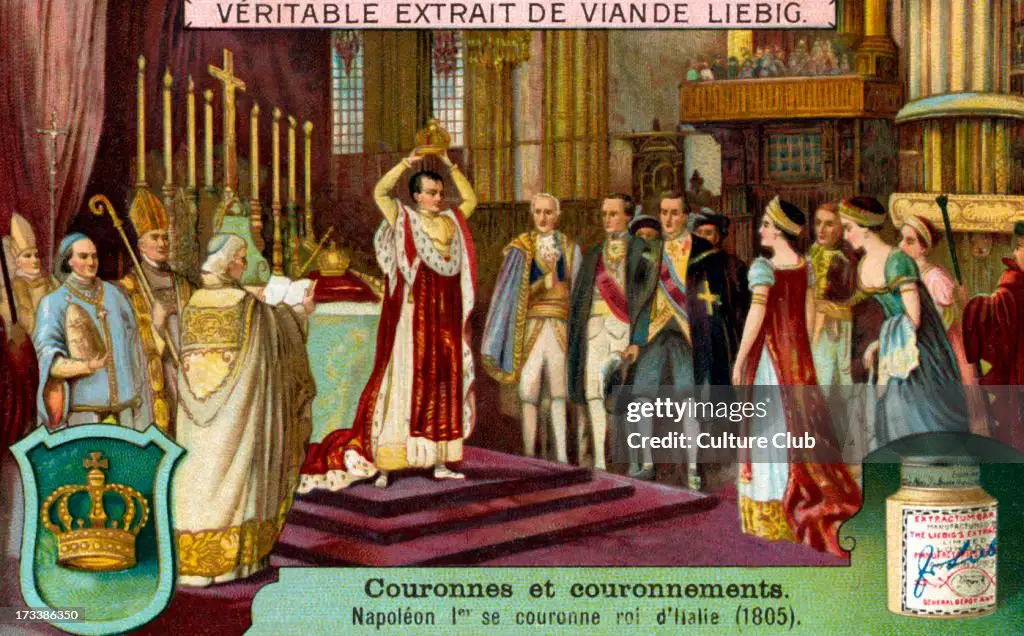
What is significant about the event depicted in the image?
A. Napoleon is acknowledging that his power comes from the people of France.
B. Napoleon is relinquishing his authority to the Church.
C. Napoleon is asserting that he is the source of his own authority.
D. Napoleon is rejecting the notion of absolute monarchy.
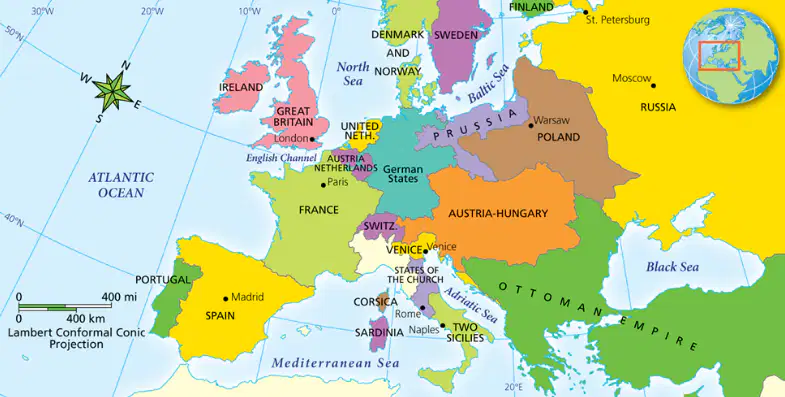
Based on the map, why would the rulers of European countries be fearful of events in France during both the Revolution’s radical phase and the Directory?
French radicals executed supporters of the revolution, and the Directory declared war on Prussia and Spain.
French radicals used the Committee of Public Safety to spread propaganda, and Robespierre headed to the Directory.
French radicals were allied with the United States, and the Directory prevented emigres form leaving.
France bordered many European nations, which feared that radical ideas would spread and threaten other governments.
What was a cause of the French Revolution?
There was a wide gap between the privileges of the lowest class that paid most of the taxes and the wealthy nobility who paid no taxes.
France's royal treasury was in debt because it could not collect enough tax money from the Second Estate.
The First Estate and Third Estate could not agree about how to reform the economy.
Land was unequally distributed among peasants, nobility, and the Church, which set off the 'Flour War.'
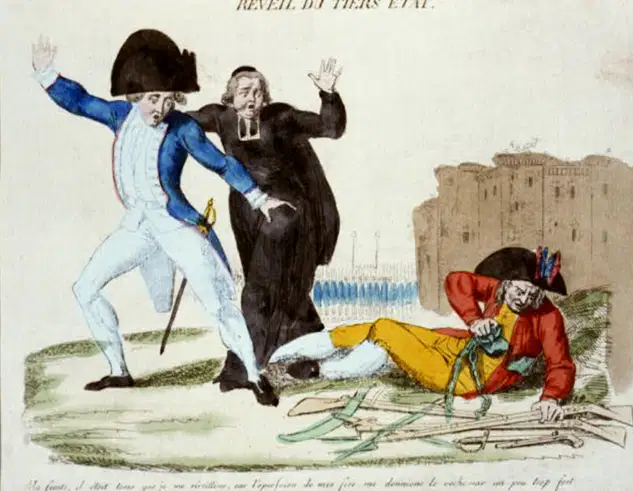
Which statement accurately interprets this portrayal of the First, Second, and Third Estates in France?
The privileged fear the anger of the underprivileged
The middle class is the force that holds the society together
The nobility is the force that holds society together
The monarchy fears the anger of the people
Which describes Simon Bolivar?
Daring leader of many independence movements in South America
Creole leader who joined the struggle for freedom in Argentina
Leader of the Haitian Revolution
Priest who called for freedom in Mexico
Which describes Toussaint L'ouverture?
Daring leader of many independence movements in South America
Creole leader who joined the struggle for freedom in Argentina
Leader of the Haitian Revolution
Priest who called for freedom in Mexico
Which describes Miguel Hidalgo?
Daring leader of many independence movements in South America
Creole leader who joined the struggle for freedom in Argentina
Leader of the Haitian Revolution
Priest who called for freedom in Mexico
Which describes Jose de San Martin?
Daring leader of many independence movements in South America
Creole leader who joined the struggle for freedom in Argentina
Leader of the Haitian Revolution
Priest who called for freedom in Mexico
"Terror is justice prompt, severe and inflexible; it is then an emanation of virtue; it is less a distinct principle than a natural consequence of the general principle of democracy, applied to the most pressing wants of the country."
- Maximilien Robespierre, 1794
The viewpoint expressed in this quotation was most directly put into action through the
Napoleonic Code
Guillotine
New French Constitution
The Three Estates
"General Famine and General Winter, rather than Russian bullets, have conquered the Grand Army."
- French General Michel Ney
What was an immediate result of the event described in this quotation?
Napoleon established his empire in Europe
Napoleon's enemies began fighting with France
The French Monarchy was restored
Napoleon was sent into exile
Who were the "creole elites" in the Latin American colonies?
Direct descendants of Spanish settlers
Descendants of slaves
Descendants of American settlers
Descendants of Native people
“The only representatives of the people of these colonies are persons chosen therein by themselves; and that no taxes ever have been, or can be constitutionally imposed on them but by their respective legislatures.”
-Statement by the Stamp Act Congress, 1765
What is a valid conclusion that can be drawn from this quotation?
Colonial legislatures should be appointed by the King
Only elected representatives should have the power to tax
The English King should have the power to tax colonists
Colonists should be opposed to all taxation
The French people welcomed Napoleon because ...
they hoped he would help the economy
he completely went against the Revolution
He was related to Louis XVI and Marie Antoinette
they hoped he would bring order after the chaos of the Revolution
In the Estates-General, which estate was composed of all the members of the land who enjoyed no special privilege?
First Estate
Second Estate
Third Estate
Fourth Estate
Which of the following accurately depicts the objects of the Latin American Revolutions?
Creoles wanted power, while other groups wanted freedom
Napoleon wanted to control all Latin American for himself
Creoles wanted freedom and equality, while other groups wanted power
Napoleon wanted to free Latin America
What is unique about the Haitian Revolution
Only successful Revolution
Only successful slave revolt in history
Only successful sugar cane plantations
Only successful colony
What is the name of the French military leader who took over the French government around the late 1700s?
Minister Talleyrand
Joshua Probst
Joshua Varga
Napoleon Bonaparte
Who was the king of France at the start of the French Revolution?
Louis XIV
Louis XV
Louis XVI
Napoleon Bonaparte

