
 Worksheets
National Education Policy 2020
Total questions: 99
Worksheet time: 50mins
According to the National Education Policy 2020, which of the following is emphasized as a key aspect of the policy?
Rootedness and pride in Indian culture
Education as a public service
Substantial investment in a strong, vibrant public education system
All of the above
Fill in the blank: The National Education Policy 2020 envisions an education system rooted in ______ ethos that contributes directly to transforming India into an equitable and vibrant knowledge society.
Indian
Western
Colonial
European
The vision of the National Education Policy 2020 is to develop which values among students?
Scientific temper, creativity, and ethical values
Only academic excellence
Focus on rote learning
Emphasis on competition only
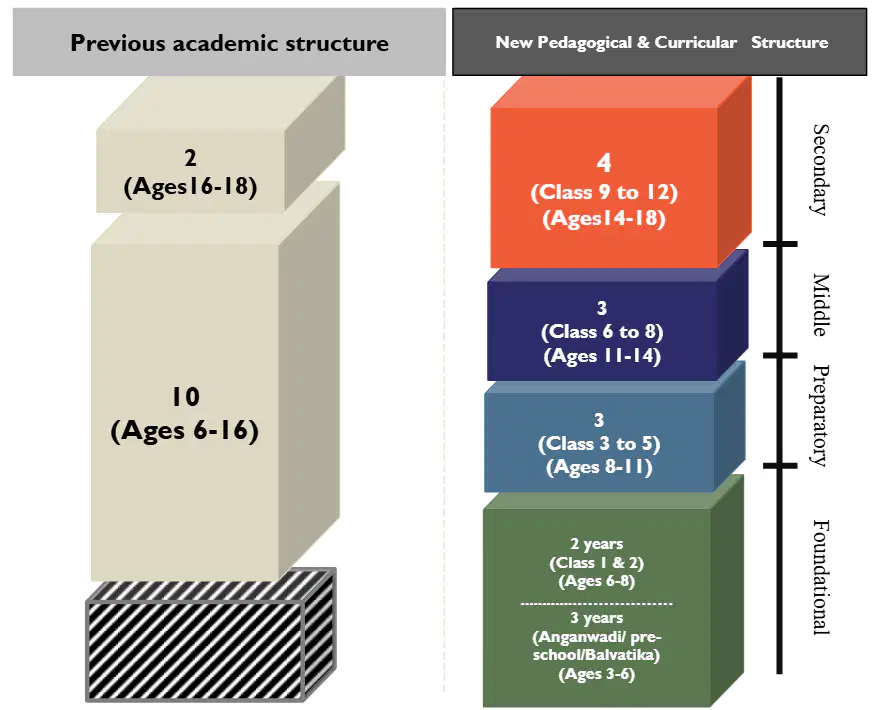
According to the National Education Policy 2020, what is the new pedagogical and curricular structure for school education?
5+3+3+4 structure covering ages 3-18
10+2 structure covering ages 6-18
6+4+2 structure covering ages 4-18
8+2+2 structure covering ages 5-19
According to the National Education Policy 2020, what is the age group that is not covered in the 10+2 structure as Class 1 begins at age 6?
Children in the age group 3-6
Children in the age group 6-8
Children in the age group 8-10
Children in the age group 10-12
What is the main aim of including Early Childhood Care and Education (ECCE) from age 3 in the new 5+3+3+4 structure?
Promoting better overall learning, development, and well-being.
Reducing the number of school years required for graduation.
Focusing only on academic achievements from an early age.
Delaying the start of formal education until age 6.
Over 85% of a child’s cumulative brain development occurs prior to the age of:
3
5
6
8
Quality ECCE is currently available to all young children, particularly those from socio-economically disadvantaged backgrounds.
True
False
List any two domains of development that ECCE aims to optimize according to the National Education Policy 2020.
Physical and motor development, cognitive development.
Financial and economic development, political development.
Technological and digital development, industrial development.
Environmental and ecological development, agricultural development.
Who will develop the National Curricular and Pedagogical Framework for Early Childhood Care and Education (NCPFECCE) for children up to the age of 8?
NCERT
NITI Aayog
CBSE
UGC
Which of the following is NOT a type of early-childhood education institution mentioned in the policy?
Stand-alone Anganwadis
Anganwadis co-located with primary schools
Pre-primary sections in secondary schools
Stand-alone pre-schools
What is the purpose of strengthening Anganwadi Centres as per the National Education Policy 2020?
To provide high-quality infrastructure, play equipment, and well-trained Anganwadi workers/teachers, and to create a child-friendly and enriched learning environment.
To increase the number of Anganwadi Centres in urban areas only.
To focus solely on nutritional support for children without any educational component.
To replace Anganwadi Centres with private pre-schools across the country.
According to the National Education Policy 2020, what is the minimum qualification required for Anganwadi workers/teachers to receive a 6-month certificate programme in ECCE?
10+2 and above
Graduation
8th pass
Post Graduation
Anganwadi workers/teachers with lower educational qualifications shall be given a one-year diploma programme covering early literacy, numeracy, and other relevant aspects of ECCE.
True
False
Which organizations will jointly carry out the planning and implementation of early childhood care and education curriculum according to the National Education Policy 2020?
Ministries of HRD, Women and Child Development (WCD), Health and Family Welfare (HFW), and Tribal Affairs
Ministries of Finance, Defence, and External Affairs
Ministries of Agriculture, Railways, and Commerce
Ministries of Environment, Tourism, and Sports
What is the highest priority of the education system as per the National Education Policy 2020?
To achieve universal foundational literacy and numeracy in primary school by 2025.
To introduce vocational training from class 1.
To make board exams tougher and more competitive.
To implement only online education in all schools.
By which grade should every student attain foundational literacy and numeracy according to the National Education Policy 2020?
Grade 3
Grade 1
Grade 5
Grade 8
The National Mission on Foundational Literacy and Numeracy will be set up by the Ministry of Human Resource Development (MHRD) on priority.
True
False
According to the National Education Policy 2020, what will be given increased focus on the curricular side?
Foundational literacy and numeracy
Advanced robotics and AI
Classical dance and music only
International sports training
What is the pupil-teacher ratio (PTR) aimed for in areas having large numbers of socio-economically disadvantaged students, as per the National Education Policy 2020?
30:1
25:1
20:1
15:1
The National Education Policy 2020 recommends the development of an interim 3-month play-based 'school preparation module' for all Grade 1 students.
True
False
What platform will provide a national repository of high-quality resources on foundational literacy and numeracy, according to the National Education Policy 2020?
Digital Infrastructure for Knowledge Sharing (DIKSHA)
National Repository of Open Educational Resources (NROER)
e-Pathshala
SWAYAM
According to the National Education Policy 2020, what activity is considered extremely effective for learning foundational literacy and numeracy?
Group lectures
One-on-one peer tutoring
Online courses
Homework assignments
The National Education Policy 2020 suggests that enjoyable and inspirational books for students at all levels will be developed, including through high-quality translation.
True
False
According to the National Education Policy 2020, what is one way to help children study cognitively demanding subjects more productively?
Skipping breakfast
Providing a simple but energizing breakfast in addition to midday meals
Reducing school hours
Increasing homework
According to the National Education Policy 2020, what is one of the primary goals of the schooling system?
To ensure children are enrolled in and are attending school
To provide free meals to students
To reduce the number of teachers
To increase the number of private schools
Fill in the blank: The Gross Enrolment Ratio (GER) for Grades 6-8 was ______, while for Grades 9-10 and 11-12 it was only 79.3% and 56.5%, respectively.
90.9%
72.4%
65.8%
83.1%
As per the 75th round household survey by NSSO in 2017-18, what was the number of out of school children in the age group of 6 to 17 years?
1.5 crore
2.1 crore
3.22 crore
4.5 crore
The two overall initiatives mentioned in the National Education Policy 2020 to bring children who have dropped out back to school and prevent further dropout are:
Tracking and facilitating multiple pathways to learning; strengthening existing alternative and innovative education centres
Increasing school fees and reducing teacher training
Focusing only on urban education and ignoring rural areas
Eliminating midday meal schemes and reducing school hours
The National Education Policy 2020 emphasizes the importance of trained and qualified social workers and civil society organizations in ensuring school-age children are attending and learning in school.
True
False
What is the goal for Gross Enrolment Ratio (GER) in preschool to secondary level by 2030 according to the National Education Policy 2020?
100%
75%
85%
90%
According to the National Education Policy 2020, what will be required to ensure quality in the retention of students, especially girls and students from socio-economically disadvantaged groups?
Provision of safe and inclusive school environments
Reduction in the number of teachers
Increase in examination frequency
Limiting access to scholarships
According to the National Education Policy 2020, what is the new curricular and pedagogical structure for school education in India?
5+3+3+4 design
10+2 design
6+4+2 design
8+4 design
Which stage in the new 5+3+3+4 design covers ages 3-8?
Foundational Stage
Preparatory Stage
Middle Stage
Secondary Stage
How many years does the Secondary Stage cover in the new school curriculum structure?
4 years
2 years
5 years
6 years
The Foundational Stage in the new curriculum consists of: Choose the correct option.
2 years of pre-school + 3 years of primary school
3 years of pre-school + 2 years of primary school
4 years of primary school only
5 years of secondary school
The Middle Stage in the new curriculum structure covers Grades 6-8 and focuses on more abstract concepts in each subject.
True
False
What is the main focus of the Foundational Stage according to the National Education Policy 2020?
Flexible, multilevel, play/activity-based learning and the curriculum and pedagogy of ECCE.
Emphasis on rote memorization and standardized testing.
Specialization in vocational training from an early age.
Focus on advanced scientific research and technology integration.
According to the National Education Policy 2020, what is the key overall thrust of curriculum and pedagogy reform across all stages?
The key overall thrust is to move the education system towards real understanding and towards learning how to learn, and away from the culture of rote learning.
The key overall thrust is to increase the number of examinations and assessments at all stages.
The key overall thrust is to focus primarily on memorization of facts and figures.
The key overall thrust is to maintain the traditional methods of teaching without any changes.
What will be reduced in each subject to make space for critical thinking and more holistic, inquiry-based, discovery-based, discussion-based, and analysis-based learning according to the National Education Policy 2020?
Curriculum content will be reduced in each subject to its core essentials.
The number of teachers will be reduced in each subject.
The duration of school hours will be reduced in each subject.
The use of technology will be reduced in each subject.
Which of the following is NOT mentioned as a form of experiential learning in the National Education Policy 2020?
Hands-on learning
Arts-integrated education
Sports-integrated education
Memorization of facts
The National Education Policy 2020 emphasizes the integration of art and culture in education to create joyful classrooms and imbibe the Indian ethos.
True
False
Fill in the blank: Sports-integration in the National Education Policy 2020 aims to help students adopt fitness as a lifelong attitude and to achieve related life skills such as ________, teamwork, responsibility, and citizenship.
self-discipline
creativity
punctuality
leadership
What is the purpose of reducing curriculum content according to the National Education Policy 2020?
To make space for critical thinking, inquiry-based, discovery-based, discussion-based, and analysis-based learning.
To increase the number of textbooks students have to study.
To focus only on rote memorization and repetitive tasks.
To reduce the importance of extracurricular activities in schools.
According to the National Education Policy 2020, what is a new distinguishing feature of secondary school education?
Strict separation of subjects
Holistic development and a wide choice of subjects and courses year to year
Focus only on science and mathematics
Elimination of physical education
Fill in the blank: The medium of instruction will be the home language/mother tongue/local language/regional language until at least Grade __, but preferably till Grade 8 and beyond.
5
3
6
10
According to the National Education Policy 2020, there will be a hard separation among 'curricular', 'extracurricular', or 'co-curricular' subjects in secondary school.
True
False
What is the main benefit of multilingualism in early childhood education as mentioned in the National Education Policy 2020?
It confuses children
It has great cognitive benefits and helps children pick up languages quickly
It delays learning
It is only beneficial for adults
According to the National Education Policy 2020, what will be encouraged to ensure high-quality language learning for all students?
Use of only English textbooks
Bilingual teaching-learning materials and interactive teaching in all languages
No use of technology
Limiting language teachers
According to the National Education Policy 2020, what is the minimum number of Indian languages that students must learn under the three-language formula?
At least two of the three languages are native to India.
All three languages must be foreign languages.
Only one language is required.
Students can choose any language, including non-Indian languages.
True or False: The three-language formula allows for the imposition of any language on any State.
True
False
What is the main purpose of preparing high-quality bilingual textbooks and teaching-learning materials for science and mathematics, as mentioned in the National Education Policy 2020?
So that students are enabled to think and speak about the two subjects both in their home language/mother tongue and in English.
To reduce the number of science and mathematics classes in schools.
To promote only English as the medium of instruction for all subjects.
To replace traditional textbooks with only digital content.
Which initiative is mentioned in the National Education Policy 2020 for students in Grades 6-8 to learn about the unity of Indian languages?
Swachh Bharat
Ek Bharat Shreshtha Bharat
Digital India
Make in India
According to the National Education Policy 2020, which classical language is highlighted for its vast literature and importance, and is to be offered at all levels of school and higher education?
Sanskrit
Tamil
Pali
Persian
Name any two classical languages of India mentioned in the National Education Policy 2020 besides Sanskrit.
Tamil, Telugu, Kannada, Malayalam, Odia
Hindi, Punjabi, Gujarati, Marathi, Assamese
Bengali, Urdu, Kashmiri, Konkani, Manipuri
English, French, German, Spanish, Russian
According to the National Education Policy 2020, which of the following languages will be widely available in schools as options for students to learn?
A) Tamil, Telugu, Kannada, Malayalam, Odia, Pali, Persian, and Prakrit
B) Only English and Hindi
C) Only Sanskrit
D) Only regional languages
All students in schools, public or private, will have the option of learning at least two years of a classical language of India and its associated literature in Grades 6-12.
True
False
Which foreign languages are mentioned in the National Education Policy 2020 as being offered at the secondary level?
Korean, Japanese, Thai, French, German, Spanish, Portuguese, and Russian
Only French and German
Only Spanish and Portuguese
Only English and Hindi
Fill in the blank: The teaching of all languages will be enhanced through innovative and experiential methods, including through ________ and apps, by weaving in the cultural aspects of the languages.
gamification
memorization
translation
dictation
Which sign language will be standardized across the country according to the National Education Policy 2020?
Indian Sign Language (ISL)
American Sign Language (ASL)
British Sign Language (BSL)
French Sign Language (LSF)
Which of the following are skills or capacities that should be learned by all students according to the National Education Policy 2020?
Critical thinking, problem-solving, communication skills
Cooking, gardening, painting
Driving, swimming, cycling
Singing, dancing, acting
Mathematics and mathematical thinking will be given increased emphasis throughout the school years, starting with the foundational stage.
True
False
According to the National Education Policy 2020, what kind of vocational crafts will students in Grades 6-8 experience as part of their curriculum?
Carpentry, electric work, metal work, gardening, pottery making
Only computer programming
Only mathematics
Only sports
As per the National Education Policy 2020, all students will participate in a ___-day bagless period sometime during Grades 6-8 where they intern with local vocational experts.
10
5
15
20
The main aim of including 'Knowledge of India' in the curriculum as per the National Education Policy 2020 is:
to promote awareness and appreciation of India’s rich heritage and culture
to focus only on modern scientific advancements
to encourage rote memorization of historical dates
to limit the study of global cultures
Which of the following values are emphasized in the National Education Policy 2020 for ethical and moral development?
Seva, ahimsa, swachhata, satya, nishkam karma, shanti
Only competition
Only academic excellence
Only sportsmanship
The National Education Policy 2020 encourages the inclusion of Indian Knowledge Systems in subjects like mathematics, astronomy, philosophy, and yoga.
True
False
According to the National Education Policy 2020, it is important for curriculum and pedagogy to be rooted in the Indian and local context because:
it helps preserve cultural heritage and makes education more relevant to students' lives.
it allows for easier adoption of foreign educational models.
it focuses only on global competitiveness.
it reduces the need for teacher training.
According to the National Education Policy 2020, who will undertake the formulation of the new and comprehensive National Curriculum Framework for School Education (NCFSE)?
NCERT
NITI Aayog
University Grants Commission (UGC)
Central Board of Secondary Education (CBSE)
How often will the NCFSE document be revisited and updated, as per the National Education Policy 2020?
Every 5-10 years
Every year
Every 15-20 years
Every 2 years
The main aim of reducing content and increasing flexibility in school curriculum, as mentioned in the National Education Policy 2020, is:
to promote critical thinking and holistic learning
to shorten the duration of school education
to reduce the number of teachers required
to focus only on vocational training
Which two ways are mentioned in the National Education Policy 2020 to provide quality textbooks at the lowest possible cost?
Encouraging the use of technology and promoting open-source materials
Increasing textbook prices and limiting access
Reducing the number of subjects and increasing page count
Focusing only on private publishers and ignoring digital formats
The primary purpose of assessment in the culture of schooling as per the National Education Policy 2020 is:
to promote rote memorization
to facilitate holistic development and learning
to increase competition among students
to focus solely on academic achievement
The progress card for all students, according to the National Education Policy 2020, will be:
holistic, multidimensional, and progress-based
focused only on academic marks
limited to annual examinations
based solely on teacher's remarks
According to the National Education Policy 2020, what is the purpose of the holistic progress card?
To actively involve parents in their children’s holistic education and development, and provide teachers and parents with valuable information on how to support each student in and out of the classroom.
To assess only the academic performance of students through standardized tests.
To rank students based on their examination scores.
To provide a summary of school infrastructure and resources.
The National Education Policy 2020 suggests that Board exams and entrance exams at the secondary school level are doing much harm by replacing valuable time for true learning with excessive exam coaching and preparation.
True
False
What is one of the key reforms to Board exams mentioned in the National Education Policy 2020?
Board exams will be redesigned to encourage holistic development and will test primarily core capacities/competencies rather than months of coaching and memorization.
Board exams will be conducted twice a year for all subjects.
Board exams will be based solely on multiple-choice questions.
Board exams will no longer be required for graduation.
According to the National Education Policy 2020, how many times can students take Board Exams in a given school year?
Up to two occasions: one main examination and one for improvement, if desired.
Only once in the entire school year.
As many times as the student wishes without any restriction.
Up to three times: one main and two improvement exams.
Which organization will prepare guidelines for the transformation in the assessment system as per the National Education Policy 2020?
NCERT, in consultation with major stakeholders such as SCERTs, Boards of Assessment (BoAs), and the proposed new National Assessment Centre.
University Grants Commission (UGC)
All India Council for Technical Education (AICTE)
Central Board of Secondary Education (CBSE)
What will the Grade 3 examination primarily test, according to the National Education Policy 2020?
Basic literacy, numeracy, and other foundational skills.
Advanced scientific research skills.
Professional workplace communication.
Specialized technical knowledge.
According to the National Education Policy 2020, what is the purpose of setting up the National Assessment Centre, PARAKH?
To set norms, standards, and guidelines for student assessment and evaluation for all recognized school boards of India, and to promote best practices and equivalence of academic standards.
To conduct entrance examinations for higher education institutions across India.
To provide scholarships to meritorious students from economically weaker sections.
To oversee the recruitment of teachers in government schools.
What is the full form of PARAKH as mentioned in the National Education Policy 2020?
Performance Assessment, Review, and Analysis of Knowledge for Holistic Development
Programme for Assessment, Research, and Knowledge Harmonization
Panel for Academic Review and Knowledge Handling
Performance Analysis and Review for Academic Knowledge
The National Testing Agency (NTA) will conduct entrance exams for undergraduate and graduate admissions and fellowships in higher education institutions, as per the National Education Policy 2020.
True
False
Which of the following is NOT an example of a club or circle encouraged for gifted students as per the National Education Policy 2020?
Science Circles
Chess Circles
Cooking Circles
Drama Circles
According to the National Education Policy 2020, what will the NCERT and NCTE develop for the education of gifted children?
Guidelines for the education of gifted children
Special schools for gifted children only
Scholarship programs for all students
Mandatory sports curriculum for gifted children
What is the aim of conducting Olympiads and competitions in various subjects across the country, as stated in the National Education Policy 2020?
To ensure that all students may participate at all levels for which they qualify, with clear coordination and progression from school to local to state to national levels.
To limit participation to only the top-performing students in each school.
To promote only sports-related competitions at the national level.
To focus solely on international competitions, ignoring local and state levels.
According to the National Education Policy 2020, why is the role of teachers considered crucial for the future of the nation?
Teachers shape the future of children and the nation by passing on knowledge, skills, and ethics, and are highly respected in society.
Teachers are responsible only for administrative tasks in schools.
Teachers are required to follow a fixed curriculum without any flexibility.
Teachers are mainly involved in extracurricular activities rather than academics.
What is one of the main goals for the motivation and empowerment of teachers as mentioned in the National Education Policy 2020?
To ensure the best possible future for children and the nation.
To increase administrative workload for teachers.
To limit teachers' professional development opportunities.
To reduce the number of teachers in schools.
Which of the following is a key incentive for teaching in rural schools according to the National Education Policy 2020?
Free transportation
Provision of local housing near or on the school premises
Higher salaries only
Free meals
The National Education Policy 2020 suggests that teacher transfers should be frequent to provide variety in educational environments.
True
False
What is the purpose of strengthening Teacher Eligibility Tests (TETs) as per the National Education Policy 2020?
To inculcate better test material, assess comfort and proficiency in teaching, and ensure teachers can converse in local languages.
To increase the number of teachers in schools without any assessment.
To reduce the duration of teacher training programs.
To focus only on subject knowledge and ignore teaching skills.
According to the National Education Policy 2020, how can the sharing of teachers across schools be facilitated?
By recruiting teachers to a school or school complex and considering the grouping-of-schools adopted by State/UT governments.
By allowing teachers to work only within their own school boundaries.
By assigning teachers based on student preferences alone.
By limiting teacher movement to only urban schools.
According to the National Education Policy 2020, schools will be encouraged to hire local eminent persons or experts as 'master instructors' in various subjects.
True
False
What is the primary goal of overhauling the service environment and culture of schools as per the National Education Policy 2020?
To increase administrative work for teachers
To maximize the ability of teachers to do their jobs effectively and ensure vibrant, caring, and inclusive communities
To reduce the number of teachers
To focus only on academic results
Fill in the blank: The first requirement in ensuring a positive service environment in schools is to ensure ______ and pleasant service conditions at schools, including safe infrastructure and resources for all students and teachers.
decent
strict
temporary
expensive
According to the National Education Policy 2020, the creation of school complexes could help in building vibrant teacher communities.
True
False
Who will be more involved in the governance of schools/school complexes according to the National Education Policy 2020?
Only teachers
Only students
Parents and other key local stakeholders
Only principals
To prevent teachers from spending too much time on non-teaching activities, what will the National Education Policy 2020 ensure?
Teachers will do more administrative work
Teachers will not be engaged in work not directly related to teaching
Teachers will have less teaching time
Teachers will focus on sports
Fill in the blank: Teachers will be given more ______ in choosing aspects of pedagogy, so that they may teach in the manner they find most effective for the students in their classrooms.
autonomy
discipline
equipment
punishment

