wayground logo

Free Printable Worksheets

Font size

S
M
L
XL
Worksheets

Geologic Time Scale

Total questions: 44

Worksheet time: 34mins

Name
Class
Date
1.

A fossil representative of a species that existed on Earth for a short length of time, was abundant, and inhabited many locations

a)

Soft bodied fossil

b)

old fossil

c)

Index fossil

2.

A method used by geologists to fill in the missing gaps in an area's rock records by matching rocks and fossils from separate locations

a)

correlation

b)

unconformity

c)

relative age

3.

A surface where rock has eroded away, producing a break, or gap in the rock record

a)

correlation

b)

unconformity

c)

relative age

4.

The numerical age, in years, of a rock or an object

a)

absolute age

b)

relative age

c)

old age

5.

the preserved remains or evidence of past living organisms

a)

bones

b)

shells

c)

fossils

6.

a chart that divides Earth's history into different time units based on changes in the rocks and fossils

a)

Geologic Time Scale

b)

Hardness Scale

c)

Times table

7.

The age of rocks and geologic features compared with other nearby rocks and features

a)

absolute age

b)

relative age

c)

correlation

8.

a layer of rock

a)

strata

b)

folds

c)

hills

9.

a scientists that studies the Earth and rocks

a)

Seismologist

b)

geologist

c)

paleotologist

10.
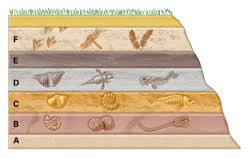
Which rock layer contains the newest fossils?
a)
F
b)
E
c)
B
d)
C
11.
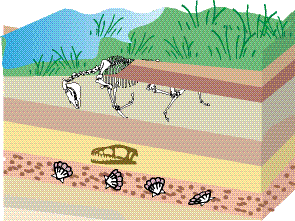
According to the law of superposition, the oldest fossils are found 
a)
At the top of the rock layers
b)
Near the bottom of the rock layers
c)
In the middle of the rock layers
d)
Somewhat near the surface
12.
The best index fossils have which two traits?
a)
widespread geographically, long lifespan
b)
widespread geographically, short lifespan
c)
specific place, long lifespan
d)
specific place, short lifespan
13.
Which of the following organisms formed last on Earth?
a)
Jellyfish
b)
Shark
c)
Lizards
d)
Horses
14.
To be considered an index fossil, it had to have lived for a relatively short period of time.
a)
True
b)
False
15.
According to the law of superposition, which layer is the youngest?
a)
A
b)
B
c)
C
16.
Which fossil makes the best index fossil?
a)
Fossil 1
b)
Fossil 2
c)
Fossil 3
d)
None follow all of the rules
17.
Does the picture represent relative or absolute dating?
a)
relative
b)
absolute
18.

What is the best reason that fossil #4 is NOT a good index fossil?

a)

It is not widespread

b)

it is not short-lived (in numerous layers)

c)

It is in half of the outcrops

19.
Index fossils CAN tell us the age of a rock layer.
a)
True
b)
False
20.

If you found an index fossil in a layer of rock in Montana and a similar fossil in a layer of rock in Texas, you would know that:

a)

the fossils and rock layers are the same age

b)

the fossils from Montana are older

c)

the fossils from England are older

d)

none of the above

21.

Which layer is older, Fault E or Intrusion D?

a)

Fault E

b)

Intrusion D

22.

Which layer is the oldest?

a)

A

b)

B

c)

C

d)

D

23.

Which fossil could be classified as an index fossil?

a)
b)
c)
d)
24.

Erosion is a major cause of ___________________________ by erasing entire rock layers.

a)

Relative Age of Rock

b)

Law of Superposition

c)

Cross Cutting Relationships

d)

Absolute Age of Rock

e)

Unconformity

25.

This is a surface where the rock has eroded away, producing a break, or gap, in the rock record.

a)

unfonformity

b)

inconsistancy

c)

uniformity

d)

correlation

26.

This is when geologists match rocks and fossils from separate locations.

a)

correlation

b)

key beds

c)

unconformity

d)

uniformity

27.

The Law of Superposition helps scientists to determine what?

a)

The absolute age of rock layers

b)

The age of fossils

c)

The relative age of rock layers

d)

the super powers of squirrels

28.
According to the law of superposition, the oldest fossils are found 
a)
At the top of the rock layers
b)
Near the bottom of the rock layers
c)
In the middle of the rock layers
d)
Somewhat near the surface
29.

The Law of Superposition helps scientists to determine what?

a)

The absolute age of rock layers

b)

The age of fossils

c)

The relative age of rock layers

d)

the super powers of squirrels

30.
According to the law of superposition, the oldest fossils are found 
a)
At the top of the rock layers
b)
Near the bottom of the rock layers
c)
In the middle of the rock layers
d)
Somewhat near the surface
31.
Which rock layer in the diagram seems to be the oldest?
a)
F
b)
E
c)
B
d)
A
32.
According to the law of superposition, which layer is the youngest?
a)
A
b)
B
c)
C
33.
Which rock layer most likely contains fossils of the most recently evolved organisms?
a)
4
b)
3
c)
1
d)
2
34.
Which of the following orders the rock layers accurately from youngest to oldest?
a)
1, 2, 3, 4, 5
b)
5, 4, 3, 2, 1
c)
2, 3, 4, 5, 1
d)
1, 2, 3, 5, 4
35.
Which fossil is relatively the oldest?
a)
Trilobite
b)
Ammonite
c)
Crinoid
d)
Gastropod
36.
Which animal is the youngest in site 1?
a)
bird
b)
ammonite 
c)
shell
37.
Put the layers in order from oldest to youngest.
a)
a, b, c, d, e
b)
b, c, d, a, e
c)
b, c, d, e, a 
d)
e, d, c, b, a
38.
According to the law of superposition, which layer is the youngest?
a)
A
b)
B
c)
C
39.
An organism that no longer exists on Earth is called
a)
Decayed
b)
Evolved
c)
Extinct
d)
Preserved
40.
Index fossils help determine relative age through correlating rock layers.
a)
True
b)
False
41.
How old do Paleontologists believe the Earth is?
a)
2015 years old
b)
3.6 billion years old
c)
4.6 billion years old
d)
4.6 million years old
42.
To be considered an index fossil, it had to have lived for a relatively short period of time.
a)
True
b)
False
43.

What is the best reason that fossil #4 is NOT a good index fossil?

a)

It is not widespread

b)

it is not short-lived (in numerous layers)

c)

It is in half of the outcrops

44.
Which fossil makes the best index fossil?
a)
Fossil 1
b)
Fossil 2
c)
Fossil 3
d)
None follow all of the rules