
Font size
 Worksheets
Plant Biochem - Principles till Photorespiration
Total questions: 45
Worksheet time: 26mins
What is false regarding the basic principles of plants
metabolism follows principles of chemistry and physics
plants reproduce to pass their genes and information to descendants which changes between different gnerations
Plants must survive in their own environment
Plants have limited purpose or decision making capacity
Plants have a means of storing and using information
Which statement is false regarding the unifying principles of plants
are primary producers using solar energy
Aside from certain species ALL parts of the plant are non motile
Reinforced to support their mass and grow according to external stimuli (e.g. sunlight/gravity, tropism)
Terrestrial plants can move minerals and water from soil to photosynthetic sites and also lose water by evaporation while evolving mechanisms to avoid dessication
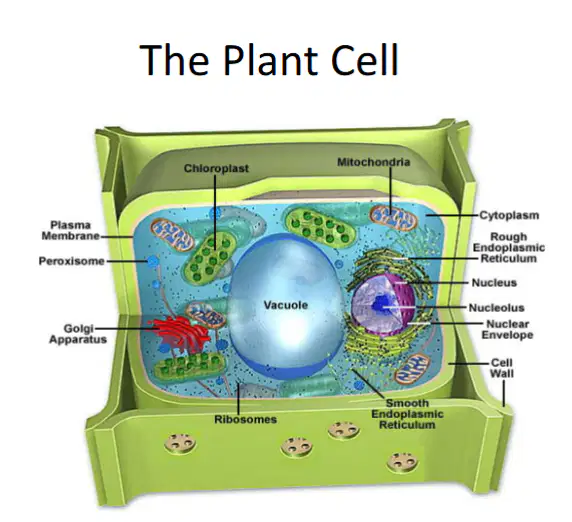
Which specialized plant cell type is incorrectly described
Shoot/Root tips - Cell division to create new protoplasm
Epidermal gland cells - protection, may use hormones
Vascular cells: - Transport water only
Petal cells - Produce scents to attract pollinators
Root epidermal cells: To collect water and minerals
What structure is described:
Protection against osmotic or mechanical rupture, create channels for transport and communication
Cell Wall
Cell Membrane
Chloroplast
Vacuoles
What structure is described:
Site of Calvin Cycle reactions and source of energy for plants during the day
Cell Wall
Cell Membrane
Chloroplast
Vacuoles
What structure is described:
This structure is also present in animal cells, but in plant cells these are larger and have a central location in the cell
Cell Wall
Cell Membrane
Chloroplast
Vacuoles
What structure is described:
This structure is also present in animal cells, has embedded proteins which have various functions ranging from transport to communication
Cell Wall
Cell Membrane
Chloroplast
Vacuoles
Plant energy source during dark conditions
Mitochondria
Chloroplasts
Both
Neither
What separates two adjacent cell walls
primary cell wall
secondary cell wall
hemicellulose
middle lamella
What features of pectin make it less stable compared to cellulose
highly branched
shorter and amorphous structure
electrostatic repulsion
lack of cross linkages
The secondary cell wall has more _____ and _____ which make it more rigid than the primary cell wall
Cellulose and hemicellulose
hemicellulose and lignin
pectin and lignin
cellulose and lignin
What structures in cell walls aid in its transport function
plasmodesmata
desmotubule
middle lamella
stroma
_____ is attraction between water molecules, _______ is attraction of water to other molecules like solid surfaces
adhesion, cohesion
cohesion, adhesion
cohesion, cohesion
adhesion, adhesion
Major source of water loss in plants
respiration
transpiration
photosynthesis
catabolism
anabolism
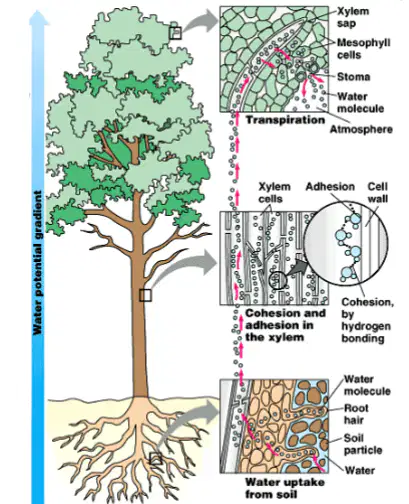
This form of water transport is driven by random thermal motion
Bulk Flow
Diffusion
Vesicles
Endocytosis
Lack of _______ due to excessive loss of water can result in _______
turgor pressure, plasmolysis
bulk flow, dehydration
osmotic flux, metabolic stasis
nutrition, starvation
What is the overall reaction for light reactions
2NADP+ + 2H2O + xADP + xPi -> 2NADPH + 2H+ + O2 + xATP +
H2O
2NADP+ + 2H2O + xATP + xPi -> 2NADPH + 2H+ + O2 + xADP +
H2O
12NADPH + 18ATP + 6CO2 -> C6H12O6 + 12NADP+ + 18ADP +
18Pi
18NADPH + 12ATP + 6CO2 -> C6H12O6 + 18NADP+ + 12ADP +
18Pi
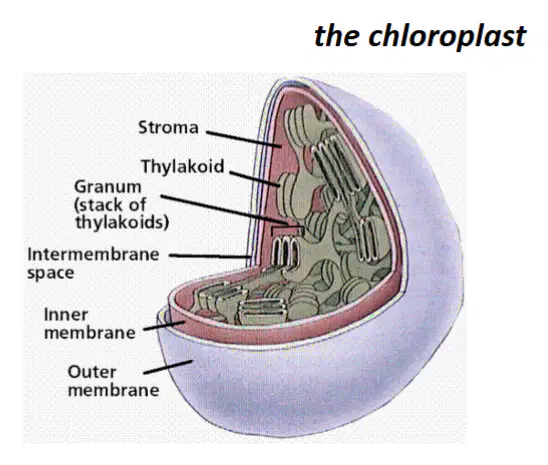
What does this describe:
Highly structured internal system of membranes containing chlorophyll and associated proteins for photosynthesis
stroma
thylakoid
lumen
envelope
Chlorophyll is similar to porphyrin-like groups in hemoglobin and the cytochromes. This is through the tetrapyrrole ring with _____ in the center
Fe2+
Fe3+
Mg2+
Cu2+
This form of chlorophyll has higher absorption in the 600nm range
a
b
c
all of the above
Which pathway for excited chlorophyll is not described accurately
LOSS OF LIGHT: re-emit a photon and return to its
ground state (fluorescence)
LOSS AS HEAT: return to its ground state by directly
converting its excitation energy into heat accompanied with
emission of a photon
RESONANCE ENERGY TRANSFER: participate in
energy transfer
PHOTOCHEMISTRY: use its energy to cause chemical
reactions to occur
Light reactions happen in the
thylakoid
stroma
lumen
grana
These set of reactions are also collectively known as the calvin cycle
light dependent reactions
light independent reactions
respiration
transpiration
Which complexes generate ATP (by generating a proton gradient) in the light reactions
O2 evolving complex
P680
Cytochrome b6f complex
P700
Which complex passes on its energy to FeS proteins
O2 evolving complex
P680
Cytochrome b6f complex
P700
Photosystem 2 contains ________
P680
oxygen evolving complex
cythochrome b6f
P 700
Which are plastoquinones
Qa
Qb
Pheophytin
PS I
PS II
How is NADPH produced in the light reactions used?
to pump protons and generate a proton gradient from the lumen to the stroma
to reduce CO2 in the Calvin Cycle
To regenerate FeS proteins
as a substrate for the light reaction
In generating a proton gradient, which section has a lower pH
thylakoid lumen
chloroplast stroma
Which protein complex(es) are not accurately described
Photosystem II
oxidizes H2O to O2 in the thylakoid lumen and in the process releases protons into
the lumen
Cytb6f
receives electrons from PSII and delivers them to PSI; also transports additional
protons into the lumen from the stroma
Photosystem I
produces ATP as protons diffuse back through it from the lumen into the stroma
ATP synthase
reduces NADP+ to NADPH in the stroma by the action of ferredoxin and FNR
Starting from RuBP what are the main steps of the calvin cycle (in order)
regeneration, carboxylation, reduction
reduction, regeneration, carboxylation
carboxylation, reduction, regeneration
reduction, carboxylation, regeneration
carboxylation, regeneration, reduction
What enzyme carboxylates RuBP
RUBISCO
3 PGA
NADP-glyceraldehyde-3-phosphate dehydrogenase
RuBP dehydrogenase
In the reduction portion of the calvin cycle, _ ATP is consumed and _ NADP+ is produced to ultimately produce one molecule of glucose
6,6
6,12
12,6
12,12
3,3
How many G3Ps are used to regenerate 3RuBP, (answer as a number only)
(a)
How many ATP is consumed to regenerate 3 molecules of RuBP
(a)
How many cycles of the calvin cycle is needed to produce one molecule of glucose (answer as a number only)
(a)
Which segment of the calvin cycle takes the longest
Carboxylation
Reduction
Regeneration
what two functions can RUBISCO perform on RuBP
carboxylation
oxygenation
reduction
oxidation
reshuffling
What are the products of RuBP and oxygen in the enzymatic oxygenation of RUBISCO
PGA and Phosphoglycolate
2PGA
2PGA and phosphoglycolate
2Phosphoglycolate
What is phosphoglycolate converted to in photorespiration
glycolate
glyoxylate
glucose
phosphoglycerate
Where does photorespiration occur
thylakoid
stroma
mitochondria
chlorplasts
peroxisomes
What amino acids CANNOT be synthesized from intermediates of photorespiration
Glycine
Serine
Tryptophan
Lysine
Aspartate
What is not an explanation on usefulness of photorespiration
it prevents the plant being overloaded with glucose
To pass on excess light energy
to produce some amino acids
To offer balance of redox potential
Which plants are less sensitive to photorespiration
C1
C2
C3
C4
What is NOT a method of processing photosynthates?
synthesis of new cellular components
export as sucrose to other parts of the plant
conversion to hexose phosphates
release into soil matrices in exchange for essential vitamins and minerals

