
 Worksheets
Q12025, Economics Final Exam
Total questions: 120
Worksheet time: 3600secs
One example of an entrepreneur is...
a writer who is hired by a film studio to adapt a novel into a screenplay
a lawyer in a high profile law firm that specializes in business law
an Olympic ice skater who later decides to join a professional ice show
an artist who runs a business painting murals in office buildings and restaurants
What does opportunity cost refer to?
The money spent on a product
The value of the next best alternative given up when making a choice
The total cost of producing a product
What role does price play in a market with scarce goods?
It ensures everyone gets the same amount of goods
It acts as a rationing device allocating goods to those willing to pay
It lowers demand so goods are never scarce
It signals producers to adjust supply
Which of the following lists would an economist consider to be land?
Factories, office buildings, assembly lines, workers
Farm fields, tractors, pesticides, fertilizers
Dams, bridges, rock quarries, oil wells
Iron ore, natural gas, fertile soil, water
In a command economy, who makes most economic decisions?
Individual consumers and producers
Government planners
Local communities
Market forces
In a market economy, what primarily determines what goods and services are produced?
Government Orders
Consumers demand and supply
Religious leaders
Historical Customs
What is a key feature of a mixed economy?
All resources are owned by the government
Economic decisions are made solely by tradition
Combines elements of both market and command economies
There is no government involvement
Which economic system relies heavily on customs, traditions, and beliefs to make economic decisions?
Market Economy
Command Economy
Traditional Economy
Mixed Economy
An outward shift of a production possibilities curve can be caused by...
Planting a more profitable farm crop
Improving technology
Using idle resources
Changing consumer preferences
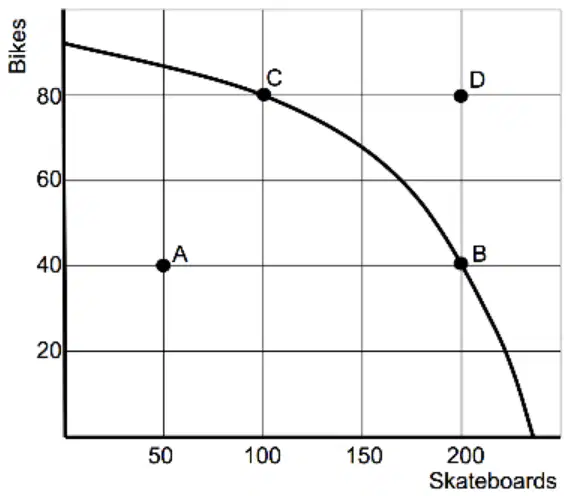
Given the graph, which of the following is true?
This business doesn’t have enough resources to produce 60 bikes and 100 skateboards.
The opportunity cost of each skateboard is constant.
This business should produce more bikes.
Combination A results in an inefficient use of resources.
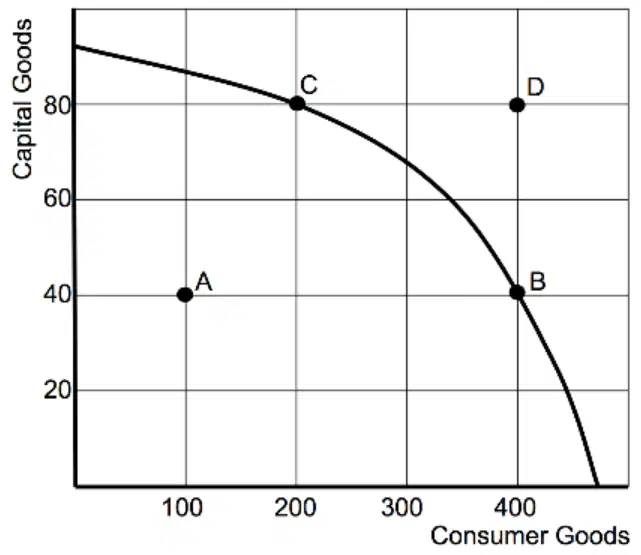
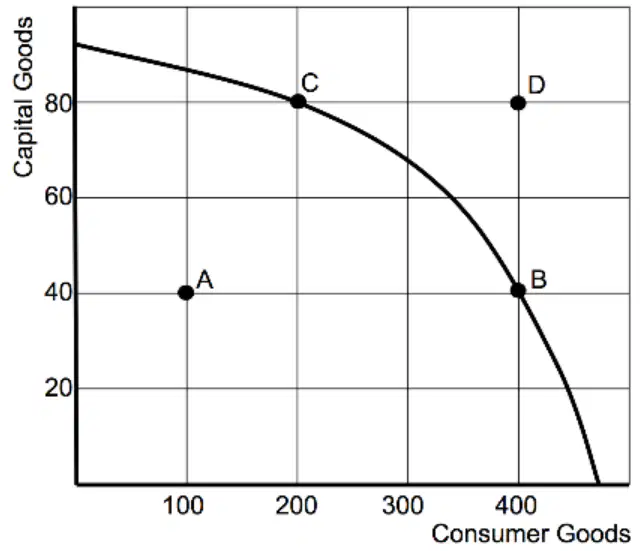
On the graph, the opportunity cost of moving from combination B to combination C is?
20 capital goods
100 capital goods
400 capital goods
200 consumer goods
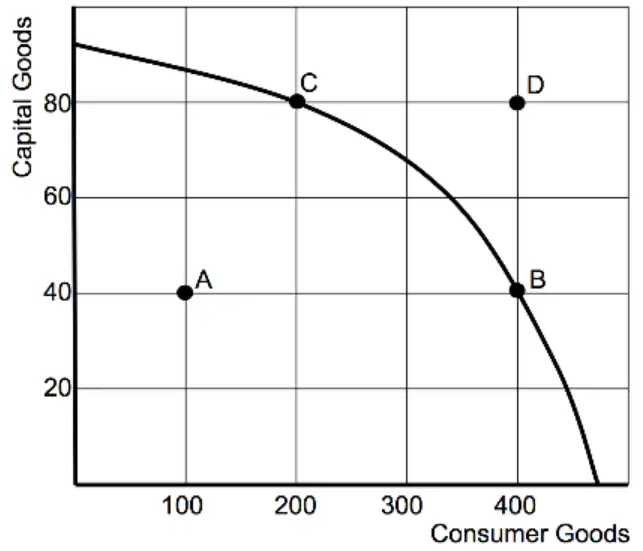
On the graph, which combination represents an efficient use of resources?
Only point A
Only point B
Point B and C
Points A and D
Marginal analysis suggests that an individual will consume one additional unit of a good if the...
Additional benefit is greater than the additional cost
Total benefits is less than the total cost
Total benefit is great than the total cost
Additional benefit is less than the additional cost
Marginal benefit is:
The total happiness from all units consumed
The cost of producing one unit
The additional benefit from consuming one more unit
The price set by the government
Which of the following best describes opportunity cost?
It is the cost of producing those goods most desired by a given economy.
It is the cost of the input mix that will lead to the greatest rate of growth for a given company.
It is the amount of one product that must be given up in order to produce an additional unit of another product.
It is the use of the least-cost method of production.
Which of the following best describes the opportunity cost for a student who chooses to quit a full-time job to go to college?
Paying state and federal income taxes
Loss of current wages and benefits
Having a higher level of education
Paying for housing and meals
Which of the following best explains why workers with the same degree may earn different salaries?
All employers follow a national pay scale.
Differences in location, industry demand, and job performance.
Employers must base pay on gender.
Salaries are set by state law.
Which of the following illustrates the signaling argument about higher education and income?
A. employers the applicant has valuable qualities.
Education directly increases productivity.
Students in college learn time management skills.
Taxes are higher on college graduates.
A regressive tax is considered less fair than a progressive tax because:
It only applies to high-income earners.
It charges a higher percentage of income for low earners.
It encourages workers to earn more.
It only applies to property taxes.
If property values rise in a community, which group is most negatively affected?
A family selling their home.
A renter who pays fixed monthly rent.
A homeowner on a fixed income who plans to stay in their house.
A real estate agent earning commission on sales.
Which type of account is least liquid?
Checking account
Money market account
Certificate of Deposit (CD)
Cash
If a customer reports multiple small, unexplained charges on their account, the most responsible first step is to:
Ignore them until the monthly statement arrives.
Report them to the bank immediately.
Cancel all accounts and withdraw all funds.
Wait to see if they stop.
Which of the following would be most helpful for avoiding overspending while shopping online?
Debit card
Price tracking tools
Applying for more credit cards
Using payday loans
Which statement best explains why FDIC insurance builds consumer confidence in the banking system?
It guarantees loans are always approved.
It ensures deposits are safe up to $250,000.
It prevents interest rates from rising.
It lowers banking fees for all customers.
Which of the following is most likely to increase a person’s credit score over time?
Paying bills late but keeping balances low.
Making on-time payments and keeping credit use low.
Applying for several credit cards at once.
Using only cash.
If a borrower has a $240,000 mortgage at 7% interest and refinances to 3%, the main financial benefit is:
Lower monthly payments and total interest.
Paying off the house faster automatically.
Avoiding property taxes.
Elimination of mortgage insurance.
Which credit factor is weighted most heavily in a FICO score?
Types of credit used
Length of history
Payment history
New credit
Why is it risky to apply for multiple credit cards in a short time?
Each inquiry lowers your score and signals possible financial distress.
It automatically increases your credit score.
It eliminates your payment history.
It decreases lender competition.
According to the 50/30/20 rule, which category includes rent, utilities, and groceries?
A. Wants
B. Needs
C. Savings
D. Debt only
What is the primary advantage of a savings account compared to keeping cash at home?
Easier to spend
Earns interest
Higher risk
More liquid than cash
Which of the following is an example of diversification?
Investing only in one company’s stock.
Buying a mix of stocks, bonds, and mutual funds.
Keeping all money in a savings account.
Borrowing money to buy collectibles.
Why is the Rule of 72 useful to investors?
It shows how taxes affect investment returns.
It estimates how long money takes to double at a given interest rate.
It guarantees risk-free returns
It predicts stock market performance.
Which of the following best explains the substitution effect?
As income increases, people buy more luxury goods
As prices change, consumers switch to relatively cheaper alternatives
As population grows, demand increases
As technology improves, supply increases
When a new shopping mall opens in a town, the demand for goods at existing stores will most likely:
Increase due to more consumers in the area
Remain unchanged
Become more elastic
Decrease due to increased competition
When a bakery installs new ovens that can bake twice as many loaves per hour, this represents:
An increase in demand for bread
A movement along the supply curve
An increase in supply of bread
A decrease in the cost of bread
A government tax on cigarette producers will cause the supply curve for cigarettes to:
Shift left
Shift right
Become more elastic
Remain unchanged
Which market structure is characterized by many small firms selling identical products?
Monopoly
Oligopoly
Perfect competition
Monopolistic competition
Coffee shops like Starbucks, Dunkin', and local cafes compete in monopolistic competition because they:
Sell identical products
Sell similar but differentiated products
Are the only sellers in their markets
Can easily prevent other firms from entering
In an oligopoly, firms are mutually interdependent, which means:
Each firm's decisions affect and are affected by competitors' decisions
They must get government approval for price changes
They all charge the same price by law
They cannot earn profits
Compared to perfect competition, monopolies typically
Charge lower prices and produce more output
Charge the same prices but produce less output
Charge higher prices and produce less output
Cannot make any profit
Market equilibrium occurs when:
Quantity supplied equals quantity demanded
Supply equals demand
Price is at its lowest point
Government sets the price
A price floor set above equilibrium will result in:
A surplus
A shortage
No change in quantity
Lower prices
Which product most likely has inelastic demand and why?
Gasoline because people need it for daily transportation and there are few substitutes
Concert tickets because they're entertainment
Restaurant meals because people can cook at home
Jewelry because it's expensive
When quantity demanded exceeds quantity supplied at the current price, the market will experience:
A shortage, and price will tend to rise
A surplus, and price will tend to fall
Equilibrium
Government intervention
In the circular flow model, when households buy groceries, this represents:
A flow in the factor market
A flow in the product market
A government transfer payment
A business investment
The Law of Diminishing Marginal Returns explains why:
Adding more workers always increases productivity
fixed resources are better than variable resources
Businesses should never hire additional workers
Adding more workers initially increases productivity but eventually decreases it
A restaurant has 4 tables (fixed resource). With 1 server, they serve 20 customers/hour. With 2 servers, they serve 45 customers/hour. The marginal product of the second server is:
20 customers/hour
45 customers/hour
25 customers/hour
65 customers/hour
If consumers demand more electric cars, what will happen to the demand for electric car factory workers?
It will increase because more workers are needed to meet demand
It will decrease because cars are expensive
It will remain unchanged
It depends on the workers' wages
Which component is NOT part of the GDP formula C + I + G + (X-M)?
Unemployment rate
Consumer spending
Investment
Government spending
Which combination of economic indicators would most clearly signal economic expansion?
Falling GDP, rising unemployment, deflation
Rising GDP, falling unemployment, controlled inflation
Stable GDP, high unemployment, hyperinflation
Rising GDP, rising unemployment, deflation
Why are discouraged workers not counted in the official unemployment rate?
They are employed part-time
They are students
They have stopped actively seeking work
They are retired
A city's air quality deteriorates because factories pollute without paying for cleanup costs. Based on the market failures discussed in your notes, why would government regulation be justified?
The factories are earning too much profit
There are too many competing businesses
The pollution creates negative externalities that the market doesn't address
The government wants to control all business activities
Expansionary fiscal policy involves:
Decreasing taxes and increasing spending
Increasing taxes and decreasing spending
Only changing interest rates
Eliminating government spending
During a major election year, politicians pressure the Federal Reserve to lower interest rates to boost the economy before voting begins. Why is the Fed's independence from Congress and the President important in this situation?
It ensures the Fed will always lower rates when requested
It allows the Fed to make decisions based on economic conditions rather than political timing
It prevents the Fed from considering any political factors
It guarantees that interest rates will never change during elections
A small country wants to increase trade with other nations but faces high tariffs on its exports. Based on your notes, joining which organization would most likely help this country access international markets?
The European Union (EU)
The United States-Mexico-Canada Agreement (USMCA)
The World Trade Organization (WTO)
The Federal Reserve System
Protectionist policies are designed to:
Eliminate all trade barriers
Increase imports
Protect domestic industries from foreign competition
Strengthen foreign currencies
A quota limits:
The price of imported goods
The number of countries that can trade
The quantity of goods that can be imported
The exchange rate between currencies
Liberal/Progressive economic ideology typically favors:
Limited government intervention
Eliminating all regulations
Only private sector solutions
More government intervention in the economy
Conservative economic ideology generally favors:
Limited government intervention in free markets
Extensive government control of all industries
High taxes on all businesses
Government ownership of major companies
The debate over raising the minimum wage from $7.25 per hour reflects disagreement about:
Whether minimum wage laws should exist at all
Balancing worker benefits with potential economic costs
The role of state versus federal government
Whether businesses have the right to set wages
According to the concept of the Invisible Hand, what drives the allocation of resources in a free-market economy?
Central government planning
Charity and goodwill
Self-Interested individuals seeking profit
Random chance and luck
The primary focus of microeconomics is examining...
Families and how they make money
Firms and how they make profits
Individual units within the overall economy
Government actions
Which statement best explains why all countries face the problem of scarcity?
Governments spend too much money
Increases in inflation have an impact on economic choices
Changes in demand and supply occur
Peoples wants are greater than their resources
The materials used to make all goods and services are referred to as the...
production possibilities
factors of production
production trade-offs
opportunity costs
What is a key feature of a mixed economy?
All resources are owned by the government
Economic decisions are made solely by tradition
Combines elements of both market and command economies
There is no government involvement
Which economic system relies heavily on customs, traditions, and beliefs to make economic decisions?
Market Economy
Command Economy
Traditional Economy
Mixed Economy
In a market economy, what primarily determines what goods and services are produced?
Government Orders
Consumers demand and supply
Religious leaders
Historical Customs
In a command economy, who makes most economic decisions?
Individual consumers and producers
Government planners
Local communities
Market forces
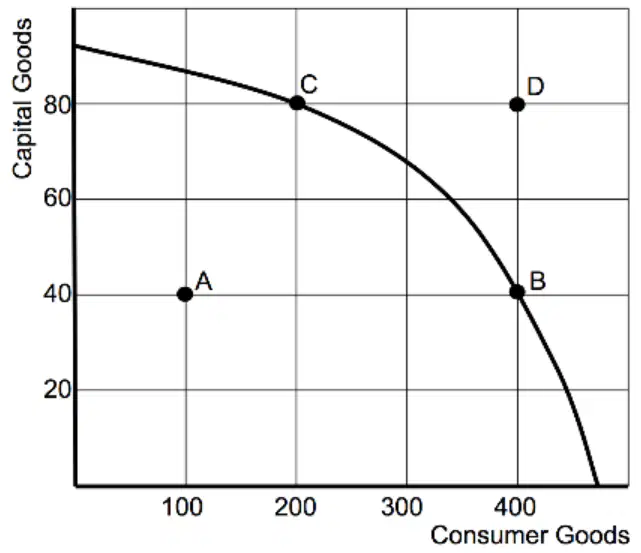
On the graph, the opportunity cost of moving from combination B to combination C is?
20 capital goods
100 capital goods
400 capital goods
200 consumer goods
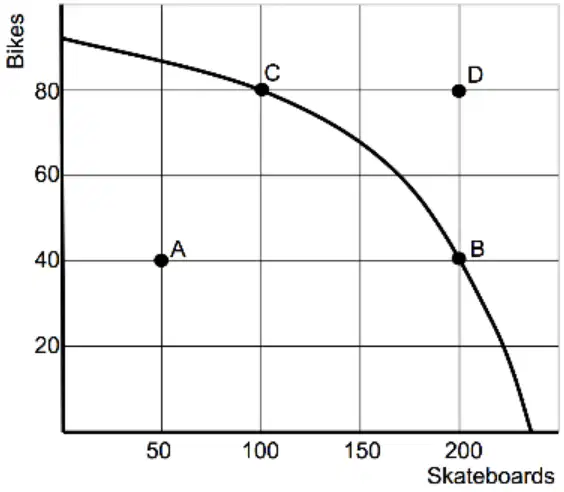
On the graph, the opportunity cost of moving from combination C to combination B is?
40 bikes
80 bikes
40 skateboards
100 skateboards
On the graph, which combination represents an efficient use of resources?
Only point A
Only point B
Point B and C
Points A and D
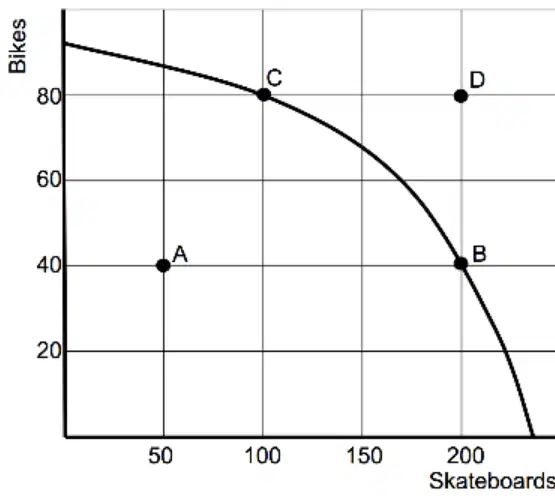
Given the graph, which of the following is true?
This business doesn’t have enough resources to produce 60 bikes and 100 skateboards.
The opportunity cost of each skateboard is constant.
This business should produce more bikes
Combination A results in an inefficient use of resources.
Marginal benefit is:
The total happiness from all units consumed
The cost of producing one unit
The additional benefit from consuming one more unit
The price set by the government
Which of the following best describes opportunity cost?
It is the cost of producing those goods most desired by a given economy.
It is the cost of the input mix that will lead to the greatest rate of growth for a given company.
It is the amount of one product that must be given up in order to produce an additional unit of another product.
It is the use of the least-cost method of production.
Marginal analysis suggests that an individual will consume one additional unit of a good if the...
Additional benefit is greater than the additional cost
Total benefits is less than the total cost
Total benefit is great than the total cost
Additional benefit is less than the additional cost
Marginal cost is:
The total cost of all units produced
The additional cost of producing one more unit
The benefit received from producing one unit
The fixed cost of production
Which of the following best explains why individuals with higher levels of education often earn more income?
They usually work fewer hours.
They have more productivity and skills.
Employers must legally pay them more.
They are exempt from income taxes.
Which soft skill would most directly help an employee manage multiple projects with deadlines?
Time management
Technical knowledge
Wage negotiation
Education level
Which of the following is an example of a progressive tax?
Flat sales tax of 7% on all items
Property tax based on home value
Federal income tax rates that increase as income rises
Gasoline tax added per gallon
An independent contractor differs from a salaried employee because contractors:
Are always paid more
Do not have to pay taxes
Work under one-time agreements instead of permanent employment
Automatically receive benefits such as health insurance
What is the maximum amount the FDIC insures per depositor, per bank?
$100,000
$250,000
$500,000
Unlimited
Which is a disadvantage of commercial banks compared to credit unions?
More ATMs
More advanced technology
Higher fees
Wider range of products
Why is it important to monitor financial accounts regularly?
To avoid paying income tax
To prevent fraud and errors
To qualify for a credit union
To receive government insurance
Which of the following fees is most likely charged if you spend more money than you have in your checking account?
Overdraft fee
ATM fee
Monthly maintenance fee
Minimum balance fee
Which of the following is not part of the “Three C’s of Credit”?
Character
Capacity
Collateral
Cash
Which factor has the greatest impact on your FICO credit score?
Length of credit history
Types of credit used
Payment history
New credit
Which of the following is a risk of credit card use?
Rewards and cashback
Higher level of security than cash
Debt accumulation and interest charges
Building good credit score
A borrower with a low credit score is most likely to:
Get lower interest rates on loans
Have difficulty accessing credit
Automatically qualify for all loans
Be exempt from paying fees
Which rule suggests dividing income into 50% needs, 30% wants, and 20% savings/debt repayment?
Rule of 72
50/30/20 Rule
Law of Supply and Demand
FDIC Rule
Which of the following is a type of insurance that provides income if you cannot work?
Life insurance
Property insurance
Disability insurance
Auto insurance
Which type of life insurance lasts only for a set period of years?
Term life insurance
Whole life insurance
Disability insurance
Property insurance
What is the primary advantage of a savings account compared to keeping cash at home?
Easier to spend
Earns interest
Higher risk
More liquid than cash
Which of the following best explains the substitution effect?
As income increases, people buy more luxury goods
As prices change, consumers switch to relatively cheaper alternatives
As population grows, demand increases
As technology improves, supply increases
If the price of coffee increases significantly, what would likely happen to the demand for tea (assuming tea and coffee are substitutes)?
Demand for tea would decrease
Demand for tea would increase
Demand for tea would remain unchanged
Supply of tea would decrease
If a new apartment building opens near a Starbucks, what would happen to the demand for Starbucks coffee?
Demand would shift left
Demand would shift right
Supply would shift left
No change would occur
According to the Law of Diminishing Marginal Utility, as you consume more units of a product:
Each additional unit provides more satisfaction
Each additional unit provides the same satisfaction
Each additional unit provides less additional satisfaction
Total satisfaction decreases
Which of the following best describes monopolistic competition?
One firm controls the entire market
A few large firms dominate the market
Many firms sell identical products
Many firms sell differentiated products with some control over price
In which market structure do firms have the most control over price?
Perfect competition
Monopolistic competition
Oligopoly
Monopoly
What is a key characteristic of an oligopoly?
Many small firms
Identical products only
Few large producers with mutual interdependence
No barriers to entry
High barriers to entry are most characteristic of:
Both oligopoly and monopoly
Perfect competition
Monopolistic competition
All market structures equally
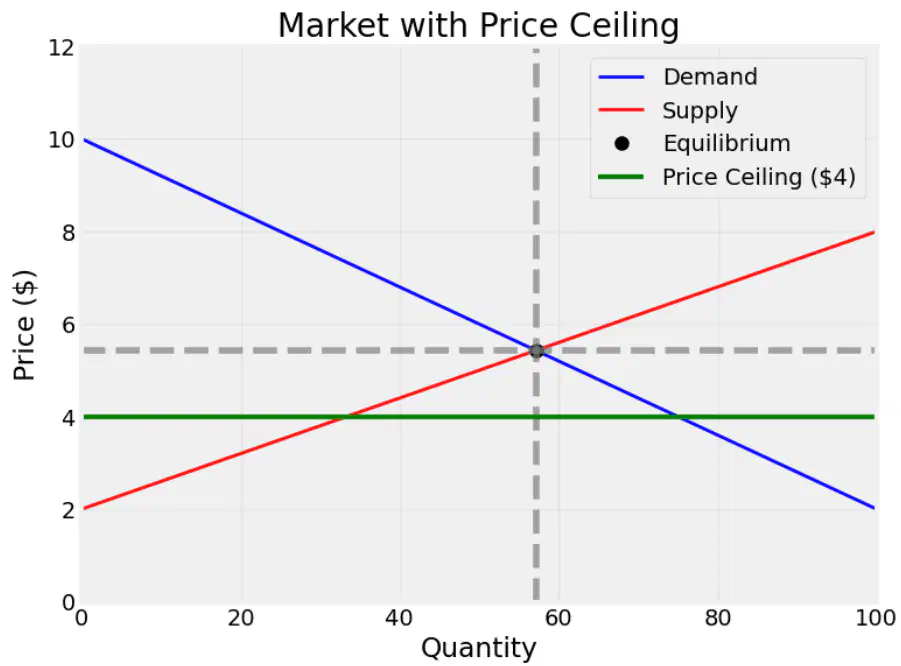
At the $4 price ceiling, approximately how much quantity is demanded vs. supplied?
A. Demand: 75, Supply: 33
B. Demand: 60, Supply: 40
C. Demand: 50, Supply: 50
D. Demand: 40, Supply: 60
If demand for a product is inelastic and price increases, what happens to total revenue?
Total revenue decreases
Total revenue increases
Total revenue stays the same
Cannot be determined
The Law of Diminishing Marginal Returns explains why:
A. Adding more workers always increases productivity
B. Fixed resources are better than variable resources
C. Businesses should never hire additional workers
D. Adding more workers initially increases productivity but eventually decreases it
If the price of robots (substitute for assembly line workers) decreases significantly, what happens to the demand for assembly line workers?
Demand increases
Supply increases
No change occurs
Demand decreases
A lemonade stand has one table and pitcher (fixed resources). The owner notices that with 1 worker, 20 cups are sold per hour. With 2 workers, 45 cups are sold per hour. With 3 workers, 63 cups are sold per hour. This scenario demonstrates the Law of Diminishing Marginal Returns because:
The 3rd worker produces fewer additional cups than the 2nd worker
Total production decreases with each worker
Fixed costs are increasing
The workers are getting paid less
In the factor market (resource market), which of the following is true?
A. Households are buyers and businesses are sellers
B. Only money flows, not resources
C. Government controls all transactions
D. Businesses are buyers and households are sellers
The labor force includes
All people over age 16
Only people with full-time jobs
Employed and unemployed people actively seeking work
Students and retirees
Which economic indicators would you expect to see at the trough of the business cycle?
A. High GDP growth and low unemployment
B. Peak employment and rising prices
C. Stable prices and moderate growth
D. Low GDP and high unemployment
During which phase of the business cycle does GDP rise and unemployment fall?
Peak
Contraction
Trough
Expansion
The Federal Reserve System operates:
Under direct control of Congress
Independently from Congress and the President
As part of the executive branch
Only during economic emergencies
Fiscal policy involves government use of
Spending and taxation
Interest rates and money supply
International trade agreements
Banking regulations
Expansionary fiscal policy involves:
Decreasing taxes and increasing spending
Increasing taxes and decreasing spending
Only changing interest rates
Eliminating government spending
The main purpose of the USMCA trade agreement is to:
Increase trade barriers between member countries
Facilitate free trade between the United States, Mexico, and Canada
Control exchange rates in North America
Regulate domestic economic policies
The World Trade Organization (WTO) primarily works to:
Increase trade barriers
Control exchange rates
Reduce trade barriers between member countries
Regulate domestic economies
When the U.S. dollar is strong, American exports become
Less expensive for foreign buyers
More expensive for foreign buyers
Unaffected by exchange rates
Banned from international markets
Unintended consequences of economic policies:
Never occur with good planning
Are unplanned side effects that should be considered
Should be ignored by policymakers
Only affect foreign countries
Economists who oppose minimum wage increases typically argue that:
Workers don't deserve higher pay
Higher labor costs may lead employers to reduce hiring or automate jobs
The government should control all wages
Only large corporations benefit from wage increases
Conservative economic ideology generally favors:
Limited government intervention in free markets
Extensive government control of all industries
High taxes on all businesses
Government ownership of major companies
Market equilibrium occurs when:
Quantity supplied equals quantity demanded
Supply equals demand
Price is at its lowest point
Government sets the price
When quantity supplied exceeds quantity demanded, this creates a:
Surplus
Shortage
Equilibrium
Price ceiling

