
 Worksheets
Triumph of Parliament in England
Total questions: 51
Worksheet time: 26mins
Who was the ruler of England known for his conflict with Parliament, leading to the English Civil War?
James I
Charles I
Oliver Cromwell
William III
What is the term for a government where the monarch's powers are limited by a constitution?
Absolute monarchy
Constitutional government
Oligarchy
Theocracy
Which document is known for establishing certain rights and limiting the powers of the monarchy in England?
Magna Carta
English Bill of Rights
Petition of Right
Habeas Corpus Act
What does the term "suppressed" mean in the context of academic vocabulary?
To encourage openly
To keep from being revealed
To share widely
To celebrate publicly
Who was the leader of the Commonwealth of England after the execution of Charles I?
James I
Charles II
Oliver Cromwell
William III
What does the term "tolerate" mean in the context of academic vocabulary?
To accept and share beliefs
To respect others' beliefs without sharing them
To reject others' beliefs
To enforce one's own beliefs
What is the role of a "prime minister" in a government?
Head of the state
Head of the government
Head of the judiciary
Head of the military
What does the term "justification" mean in the context of academic vocabulary?
The act of hiding information
The state of being just, right, or reasonable
The process of making laws
The act of punishing wrongdoing
Which term refers to a form of government where a small group of people have control?
Democracy
Oligarchy
Monarchy
Republic
Who was the first monarch of the Stuart dynasty in England?
James I
Charles I
Henry VIII
Elizabeth I
How was James I similar to and different from Elizabeth I?
Both were monarchs of England, but James I was more tolerant of religious diversity.
Both were monarchs of England, but Elizabeth I was more tolerant of religious diversity.
James I was a monarch of Scotland, while Elizabeth I was a monarch of France.
James I and Elizabeth I had no similarities.
Why did Parliament react so negatively to James I’s speech about divine right?
They supported the idea of divine right.
They believed in the separation of church and state.
They feared it would lead to absolute monarchy.
They were indifferent to his speech.
How are the Long Parliament and the imposition of the Anglican prayer book connected?
Both were efforts to strengthen the monarchy.
Both were efforts to limit the power of the monarchy.
The Long Parliament supported the prayer book.
The prayer book was unrelated to the Long Parliament.
What are some reasons for the Roundhead victory in the English Civil War?
Superior naval power
Better leadership and organization
Larger population
Foreign alliances
Why did European monarchs respond as they did to the death of Charles I?
They were indifferent to his death
They saw it as a threat to their own power
They supported the execution
They were unaware of the event
What happened in Ireland during the Commonwealth period, and why?
Ireland gained independence
Ireland was colonized by France
Ireland faced military conquest and colonization
Ireland formed an alliance with Scotland
How do the Levellers and James I’s statement about divine right reflect different ideas about the rights of human beings?
Both support absolute monarchy
Both advocate for democracy
The Levellers supports equality, while James I supports monarchy
Both reject the idea of divine right
Describe the causes of the Glorious Revolution.
Economic prosperity
Religious conflicts and political power struggles
Agricultural advancements
Scientific discoveries
What was the English Bill of Rights? What was its impact?
A document limiting the power of the monarchy and establishing parliamentary sovereignty
A trade agreement with France
A military alliance with Spain
A religious treaty with the Vatican
Describe the differences between the Tories and the Whigs.
Tories supported the monarchy, Whigs supported parliamentary power
Tories were farmers, Whigs were industrialists
Tories were pacifists, Whigs were militarists
Tories were isolationists, Whigs were expansionists
What was the makeup of George I’s cabinet? What purpose did they serve?
A group of military leaders advising on defense
A council of nobles managing foreign affairs
A team of ministers responsible for government policy and administration
A committee of scientists overseeing technological development

Which document was the result of the Glorious Revolution that limited the power of the monarchy and guaranteed more natural rights?
Declaration of Independence
Declaration of Rights of Man and the Citizen
Magna Carta
English Bill of Rights
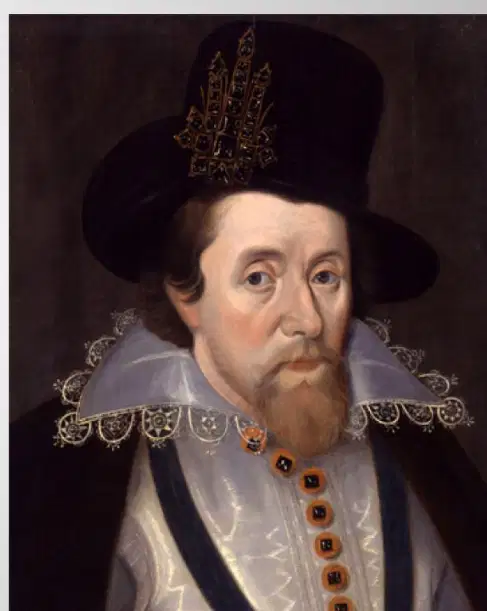
What was one of the effects of James I's reign on the relationship between the monarchy and the legislative body?
Strengthened parliamentary power
Introduced tensions
Established a new constitution
Unified religious practices
What belief did Charles I continue from his father?
Democracy
Absolute monarchy
Constitutional monarchy
Republic
What action did Charles I take regarding Parliament?
He expanded its powers
He dissolved it multiple times
He ignored it completely
He never interacted with it
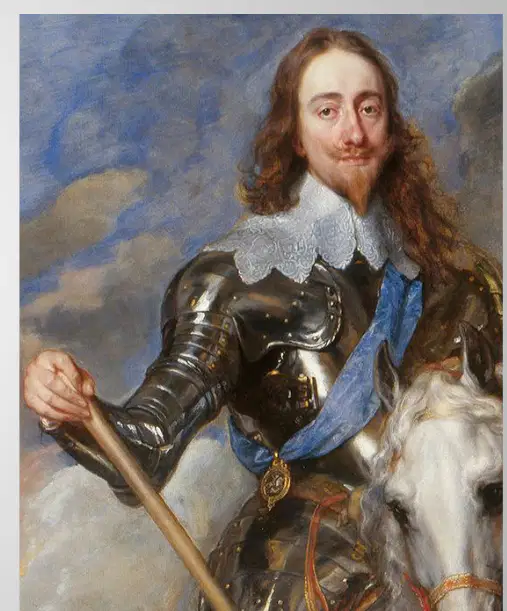
What tensions did Charles I increase during his reign?
Economic and social tensions
Religious and political tensions
Cultural and educational tensions
Military and diplomatic tensions
Who emerged as a key military leader during the English Civil War?
Charles I
Oliver Cromwell
William Shakespeare
King George III
What was the outcome for Charles I in 1649?
He was exiled
He was executed
He became king
He retired peacefully
Who established a republican government during the Commonwealth Period?
Charles I
Oliver Cromwell
James II
William III
What title did Oliver Cromwell hold during his rule?
King
Prime Minister
Lord Protector
President
Which of the following was a significant action taken by Oliver Cromwell?
Restored the monarchy
Implemented significant political reforms
Abolished the parliament
Established a new religion
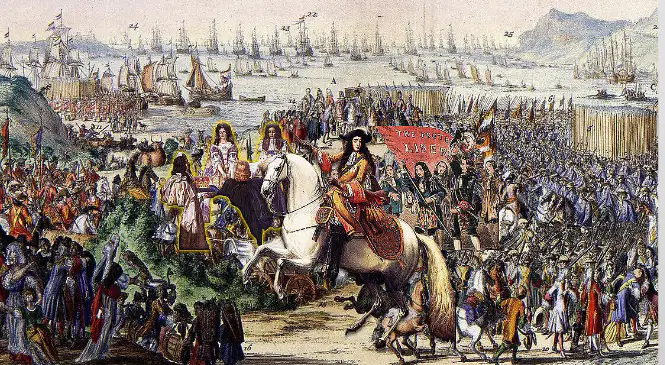
What significant precedent was established by the Glorious Revolution?
Absolute monarchy
Parliamentary power
Military dictatorship
Religious rule
Define "constitutional government."
A government ruled by a single leader
A government with unlimited power
A government limited by laws and a constitution
A government based on religious laws
What was one of the key features of the English Bill of Rights?
It increased monarchical powers.
It established key civil liberties.
It abolished parliamentary elections.
It allowed the monarch to suspend laws.
Which of the following was required by the English Bill of Rights?
Irregular parliamentary elections
Regular parliamentary elections
No parliamentary elections
Elections only during emergencies
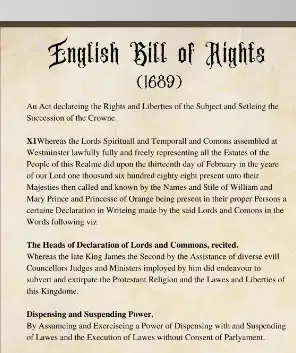
What did the English Bill of Rights prevent the monarch from doing?
Increasing taxes without consent
Suspending laws
Declaring war unilaterally
Changing the line of succession
What is the name of the group of parliamentary advisors that was made up of the leaders of the majority party in the House of Commons?
Congress
Senate
Cabinet
Assembly
What role developed as the leader of the cabinet and House of Commons in England?
President
Prime Minister
Governor
Senator
What type of governance did political institutions in England gradually shift towards?
Monarchical governance
Parliamentary governance
Federal governance
Direct democracy
What significant power did Parliament gain during the transition to a constitutional monarchy?
Judicial power
Executive power
Legislative power
Military power
What was one of the key areas of understanding in the lesson?
Tudor-Stuart relations
Industrial Revolution
World War II
Renaissance Art
Which development was discussed in this lesson?
Parliamentary/Political development
Technological development
Economic development
Cultural development
What is the main difference between an absolute monarchy and a limited monarchy?
Absolute monarchy has a constitution, limited monarchy does not.
Absolute monarchy has no legal limits on the monarch's power, limited monarchy does.
Limited monarchy is ruled by a dictator, absolute monarchy is not.
Limited monarchy has no parliament, absolute monarchy does.
What was the significance of the Glorious Revolution?
It led to the establishment of a totalitarian regime.
It resulted in the peaceful transfer of power and the strengthening of parliamentary democracy.
It caused a civil war that lasted for decades.
It was a failed attempt to overthrow the government.
How can political power shift peacefully?
Through violent uprisings.
By ignoring the will of the people.
Through democratic elections and legal reforms.
By abolishing all forms of government.
Which event marked the beginning of the end for absolute monarchy in England?
The signing of the Magna Carta
The execution of Charles I
The start of the Industrial Revolution
The defeat of the Spanish Armada
What was a major consequence of the English Civil War?
The restoration of absolute monarchy
The establishment of a republic under Oliver Cromwell
The end of parliamentary government
The unification of England and Scotland
Who were the main supporters of parliamentary power during the Stuart period?
The Royalists
The Cavaliers
The Whigs
The Tories
Which event marked the beginning of constitutional monarchy in England?
The Act of Union
The Restoration
The English Civil War
The Glorious Revolution
What was a key feature of the English Bill of Rights of 1689?
It established a theocracy
It abolished the monarchy
It limited the powers of the monarchy and affirmed parliamentary authority
It allowed the monarch to rule without Parliament
Who succeeded Oliver Cromwell as leader after his death?
James II
Charles II
Richard Cromwell
William III

