
 Worksheets
Fossils, Rocks, Geological Principles & Time
Total questions: 20
Worksheet time: 10mins
In the study of fossils and relative dating, which type of fossil is created when the original organic material of an organism is gradually replaced by minerals, resulting in a stone-like replica of the original organism?
Mold
Petrified
Trace
Preserved
Carbon Film

Examine the geologic cross-section shown in the image. Using the principles of relative dating (such as the Law of Superposition, the Law of Cross-Cutting Relationships, and the Law of Original Horizontality), determine the correct sequence of events from youngest to oldest. Which of the following lists correctly orders the rock layers and the fault from the most recent event to the oldest formation?
fault, limestone, siltstone, basalt
basalt, fault, siltstone, limestone
limestone, siltstone, fault, basalt
siltstone, fault, basalt, limestone
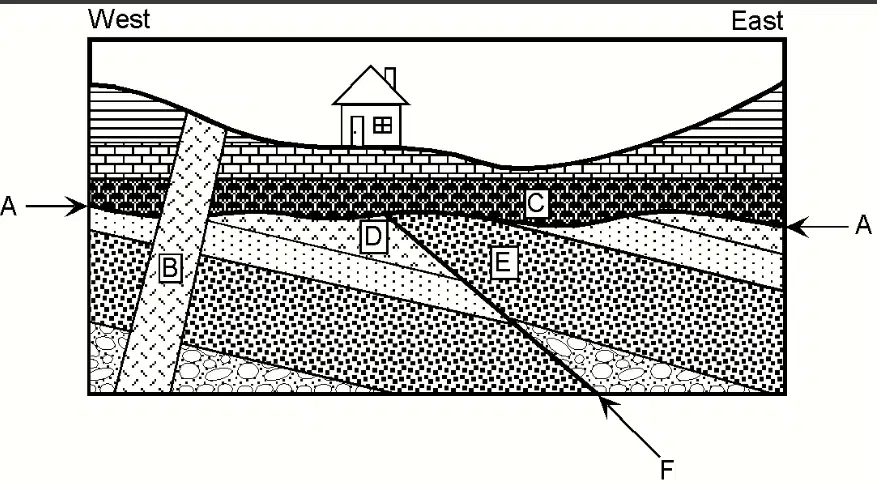
In the context of the geologic cross-section shown in the diagram, feature F is labeled and cuts across several rock layers. Based on principles of relative dating, such as the law of cross-cutting relationships, what is the most accurate classification for feature F?
intrusion
inclusion
fossil
fault line
Mrs. Quinn rocks

The image below shows a fossilized impression of an animal's footprint preserved in rock. Fossils like these provide important clues about the behavior and movement of ancient organisms, even though the actual organism is not preserved. Based on the appearance and characteristics of this fossil, what type of fossil is represented in the image?
Carbon film
Imprint fossil
Trace Fossil
Eon Fossil
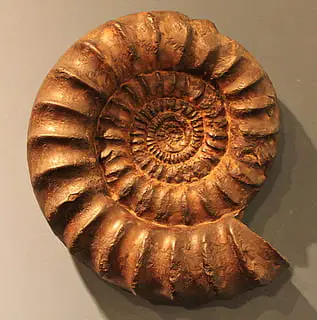
Examine the fossil shown in the image below. This type of fossil forms when minerals fill in the cavity left by an organism, creating a three-dimensional replica of its shape. What is the correct classification for this fossil?
Mold Fossil
Cast Fossil
Shell
Brown fossil
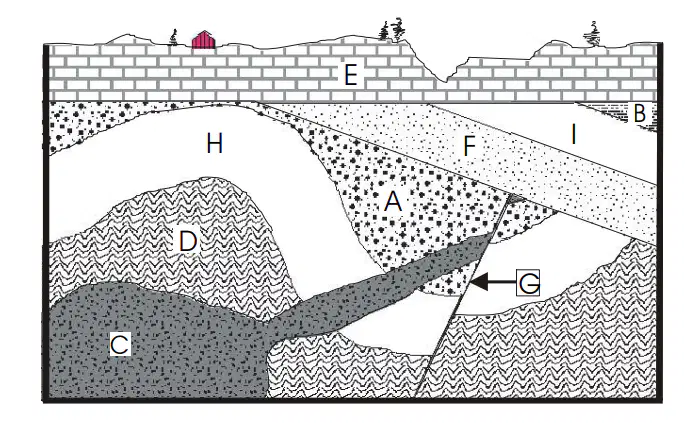
Examine the geologic cross-section shown in the image. Using the principles of relative dating (such as the Law of Superposition, Cross-Cutting Relationships, and Inclusions), determine the correct chronological order of the rock layers and geologic features from oldest to youngest. List your answer using all lowercase letters, separated by commas, with no extra spaces. What is the correct sequence?
(a)

In the context of relative dating in geology, consider the image showing several smaller rocks or crystals embedded within a larger surrounding rock. Which geologic principle explains why the smaller rocks or crystals found inside the larger rock must be older than the rock that surrounds them?
Inclusions
Superposition
Original Horizontality
Cast Fossil
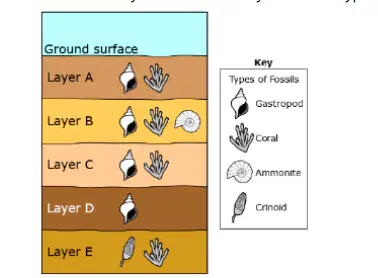
The diagram illustrates a cross section of sedimentary rock layers, each containing different types of fossils. The key identifies the fossils found in each layer. Using the principles of relative dating and fossil succession, select the three statements that are best supported by the information in the cross section.
Layer C is below Layer B, so Layer C is older.
Layer A is at the top, so it is the youngest rock layer.
There is no coral fossil in Layer D, so corals must have become extinct.
The ammonite fossil is above the crinoid fossil, so the crinoid is older.
The gastropod fossils are above the crinoid fossil, so gastropods evolved from crinoids.
Which of the following correctly lists the major geologic time divisions in order from the largest to the smallest?
period, eon, era, epoch, age
eon, period, epoch, age, era
eon, era, period, epoch, age
age, epoch, period, era, eon
In the context of geologic time scales, which of the two below represents a shorter division of time?
Epoch
Era
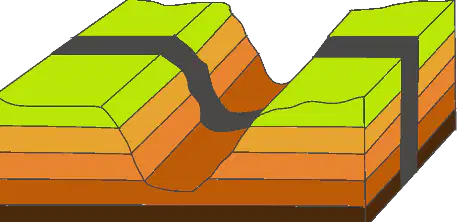
When observing a canyon where a river has cut through several layers of sedimentary rock, which geological principle explains why the same sequence of rock layers can be found on both sides of the canyon, indicating that these layers were originally continuous before the canyon formed?
Superposition
Lateral Consistency
Horizontal Consistency
The Grand Canyon paradox

Examine the geological cross-section shown in the image. Each labeled feature (A, B, C, D, F) represents a different rock layer or geological event. Using the principles of relative dating, such as the Law of Superposition and cross-cutting relationships, determine which of the labeled features is the youngest geological event or layer. Which labeled geological feature is the oldest?
F
A
B
C
D
In the context of geological time periods, the term 'Zoic' is derived from a Latin word. What does this word specifically refer to?
Fish
Fossil
Time
Animal
The prefix "Cen" is derived from the Latin word "caenum." In the context of geological time periods, what does this prefix indicate about the age of the era it describes?
Recent
Middle
Ancient
Animal
The prefix "Paleo-" is commonly used in scientific terms such as "Paleontology" and "Paleolithic." From which Latin word does this prefix originate, and what does it mean?
Recent
Diet
Fossilized
Ancient
Which type of fossil, often formed from footprints, burrows, or other evidence left by ancient organisms, provides scientists with important clues about the activity, movement, or behavior of those organisms in their environments?
Trace Fossil
Mold Fossil
Cast Fossil
Petrified Fossil
Which of the following best describes an unconformity in the context of relative dating?
A mineral deposit within a rock layer
A gap in the geologic record where rock layers have been eroded or not deposited
A layer of rock that is older than the layers above and below it
A fossil found in multiple rock layers
What is the term for a fossil that is used to define and identify geologic periods because it is widespread, abundant, and limited to a short span of geologic time?
Trace fossil
Petrified fossil
Index fossil
Cast fossil
Which of the following best describes the process by which an organism's remains are compressed, leaving a thin residue of carbon on rock, often preserving fine details?
Trace fossilization
Cast fossilization
Carbon film fossilization
Preserved remains

