
 Worksheets
Econ Final Review
Total questions: 50
Worksheet time: 25mins
Name
Class
Date
1.
The study of economics is all about the choices made by - check all that apply
a)
Individuals
b)
Businesses
c)
Governments
d)
Computerized Robots
2.
In
2002,
the
Maryland
General
Assembly
voted
to
purchase
undeveloped
land
on
the
Chesapeake
Bay
before
a
construction
company
could
purchase it.
The
state
plans
to
use
the
land
as
a
park
for
recreational
activities
instead
of
letting
it become developed.
What is the opportunity cost?
a)
A Park
b)
A New Development
c)
Recreational Activities
d)
A Construction Company
e)
To use it for commercial purposes
3.
The fundamental economic problem facing all societies that results from a combination of scarce resources and people’s virtually unlimited wants.
a)
Salary
b)
Dividends
c)
Scarcity
d)
Rational Decision
4.
If a person's net for the month is $2,800 a month, how much does he need to budget on Housing?
a)
$ 280
b)
$ 336
c)
$ 840
d)
$ 1,000
5.
What is the cost that stays the same each month, such as rent or a car payment?
a)
Budget
b)
Fixed Expenses
c)
Variable Expenses
d)
Savings
6.
If a person makes $1,000 a month. How much Social Security and Medicare is taken out?
a)
$14.50 Social Security and $62.00 Medicare
b)
$100 Social Security and $100 Medicare
c)
$100 Social Security and $50 Medicare
d)
$62.00 Social Security and $14.50 Medicare
7.

Based on the pay stub; How often does the person get paid?
a)
Monthly
b)
Bi-Monthly
c)
Weekly
d)
It does not say
8.
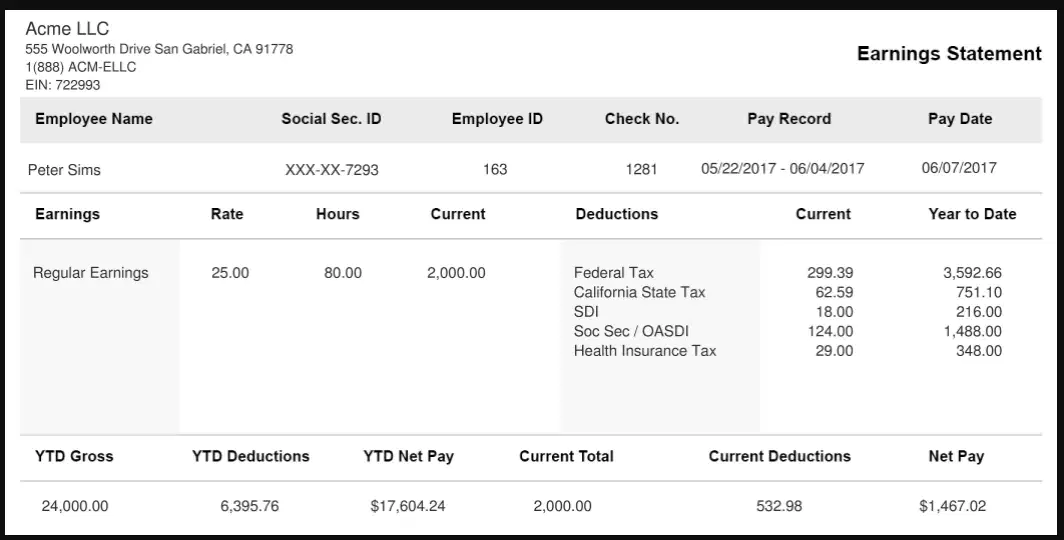
Based on the pay stub; What is this persons gross pay for this pay period?
a)
$25.00
b)
$80.00
c)
$1,467.02
d)
$2000.00
9.
Tools, machines, and buildings used to produce goods and services are examples of:
a)
a) Capital
b)
b) Labor
c)
c) Land
d)
d) Entrepreneurship
10.
The general idea of calculating net worth is:
a)
liabilities x assets
b)
assets - liabilities
c)
net income - gross income
d)
gross income - net income
11.
Which financial institution often requires collateral, such as a car title, for short-term loans?
a)
a) Bank
b)
b) Credit union
c)
c) Payday lender
d)
d) Title pawn lender
12.
A tax that increases in percentage as income rises is called a:
a)
a) Progressive tax
b)
b) Regressive tax
c)
c) Proportional tax
d)
d) Sales tax
13.
A tax applied to the transfer of wealth from a deceased person’s estate is:
a)
a) Capital gains tax
b)
b) Sales tax
c)
c) Estate tax
d)
d) Proportional tax
14.
Which tax is typically regressive?
a)
a) Income tax
b)
b) Sales tax
c)
c) Estate tax
d)
d) Capital gains tax
15.
What does taxation allow governments to fund?
a)
a) Only private businesses
b)
b) International trade
c)
c) Public services like schools and defense
d)
d) Personal savings accounts
16.
Which type of credit allows you to borrow repeatedly up to a limit?
a)
a) Installment credit
b)
b) Revolving credit
c)
c) Mortgage credit
d)
d) Educational loan
17.
Which type of credit requires fixed monthly payments until paid off?
a)
a) Revolving credit
b)
b) Installment credit
c)
c) Line of credit
d)
d) Credit card
18.
Which credit bureau is NOT one of the three major ones?
a)
a) Experian
b)
b) TransUnion
c)
c) Equifax
d)
d) Federal Reserve
19.
Which of the following is a cause of bankruptcy?
a)
a) High income
b)
b) Job loss
c)
c) Overpaying taxes
d)
d) Having good credit history
20.
Filing for Chapter 13 bankruptcy involves:
a)
a) Selling assets to erase debts
b)
b) A repayment plan of 3–5 years
c)
c) No effect on credit score
d)
d) Receiving government subsidies
21.
A high credit score usually results in:
a)
a) Lower interest rates on loans
b)
b) Higher monthly taxes
c)
c) Bankruptcy protections
d)
d) Automatic government aid
22.
Which type of retirement plan is available to teachers and nonprofit employees?
a)
a) 401(k)
b)
b) 403(b)
c)
c) Traditional IRA
d)
d) Roth IRA
23.
Principal refers to:
a)
a) The interest rate charged
b)
b) The original amount of money borrowed or saved
c)
c) A tax-free retirement account
d)
d) A bank loan officer
24.
If someone only pays the minimum balance on a credit card, what is the most likely result?
a)
a) Debt will shrink quickly
b)
b) Interest will accumulate over time
c)
c) APR will be reduced
d)
d) Loan will be forgiven
25.
A mutual fund provides diversification by:
a)
a) Focusing on one stock
b)
b) Investing in a wide range of assets
c)
c) Only investing in bonds
d)
d) Guaranteeing returns
26.
A person invests heavily in cryptocurrency because “everyone else is doing it.” This best demonstrates:
a)
a) Rational investing
b)
b) Diversification
c)
c) Speculative bubble behavior
d)
d) APR calculation
27.
A person invests only in tech stocks. What risk do they face?
a)
a) Diversification reduces losses
b)
b) Sector downturn could heavily impact portfolio
c)
c) Inflation will increase value
d)
d) APR will balance out
28.
Imagine you have $1,000 to invest. Compare putting it into a savings account at 2% vs. a stock with high volatility. Which is safer and why?
a)
a) Savings account, because it guarantees a small return
b)
b) Stock, because it always grows faster
c)
c) Stock, because it avoids inflation
d)
d) Savings account, because it avoids all risk
29.
Which of the following is an example of collateral for a loan?
a)
a) Credit score
b)
b) Car title
c)
c) Interest rate
d)
d) APR
30.
A person invests in both stocks and bonds. This is an example of:
a)
a) Speculation
b)
b) Diversification
c)
c) Simple interest
d)
d) Inflation protection
31.
What is the main purpose of insurance?
a)
A) To make quick money
b)
B) To protect from financial loss
c)
C) To avoid paying taxes
d)
D) To increase spending power
32.
What does a premium refer to in insurance?
a)
A) The total coverage limit
b)
B) The amount you pay regularly to keep insurance active
c)
C) The cost after filing a claim
d)
D) The deductible amount
33.
What is a deductible?
a)
A) The amount your insurance company pays before you do
b)
B) The maximum your insurance will cover
c)
C) The amount you pay out-of-pocket before insurance coverage begins
d)
D) The cost of maintaining your policy
34.
Which of the following is required by law in most states?
a)
A) Life insurance
b)
B) Flood insurance
c)
C) Auto insurance
d)
D) Disability insurance
35.
Why do insurance rates vary between people?
a)
A) Random chance
b)
B) Government regulation
c)
C) Differences in risk factors like age, health, and location
d)
D) Company size
36.
What primarily determines how much a worker earns in the marketplace?
a)
A) The number of jobs available in their town
b)
B) Supply and demand for their skills
c)
C) Their social media presence
d)
D) Their personal expenses
37.
What is a hard skill?
a)
A) A personality trait
b)
B) A teachable, measurable ability
c)
C) The ability to work with others
d)
D) A leadership quality
38.
Which factor most often leads to higher lifetime earnings?
a)
A) Lower education
b)
B) Higher education and training
c)
C) Social media popularity
d)
D) Shorter working hours
39.
What is a social media footprint?
a)
A) The size of a person’s online following
b)
B) A record of your online posts and activities
c)
C) A company’s social media strategy
d)
D) An app for managing social networks
40.
How can social media positively impact your career?
a)
A) By posting random personal updates
b)
B) By sharing professional and positive content
c)
C) By arguing online
d)
D) By keeping all accounts private
41.
What is the main goal of consumer protection laws?
a)
A) To increase taxes
b)
B) To help businesses avoid regulation
c)
C) To ensure fairness and prevent fraud
d)
D) To promote spending
42.
Which agency insures bank deposits up to $250,000?
a)
A) FTC
b)
B) CFPB
c)
C) FDIC
d)
D) SEC
43.
What does the FTC do?
a)
A) Regulates interest rates
b)
B) Fights false advertising and scams
c)
C) Collects taxes
d)
D) Manages bank loans
44.
Which law requires lenders to clearly explain loan costs and terms?
a)
A) Dodd-Frank Act
b)
B) Fair Credit Reporting Act
c)
C) Truth in Lending Act
d)
D) Equal Housing Act
45.
If you want to file a complaint against a business for unfair treatment, which option is not appropriate?
a)
A) Contacting the Better Business Bureau
b)
B) Writing directly to the business
c)
C) Filing through a government website
d)
D) Posting a negative review on a personal blog
46.
What is identity theft?
a)
A) Losing your ID card
b)
B) Using someone’s personal information without permission
c)
C) A computer virus
d)
D) Forgetting a password
47.
Which is a common method of identity theft?
a)
A) Shredding old bills
b)
B) Phishing emails asking for personal information
c)
C) Using strong passwords
d)
D) Freezing your credit
48.
What should you do first if you are a victim of identity theft?
a)
A) Post about it online
b)
B) Ignore it
c)
C) Contact your bank and the police
d)
D) Open a new credit card immediately
49.
What is a Ponzi scheme?
a)
A) A plan to sell products online
b)
B) A scam that pays returns from new investors’ money instead of profits
c)
C) A type of loan
d)
D) A legal investment option
50.
Which of the following is a good way to protect yourself online?
a)
A) Use public Wi-Fi for banking
b)
B) Use strong, unique passwords
c)
C) Share personal details freely
d)
D) Reuse the same password for convenience
100 %

