wayground logo

Free Printable Worksheets

Font size

S
M
L
XL
Worksheets

Chemical Reactions Review

Total questions: 48

Worksheet time: 50mins

Name
Class
Date
1.
How many oxygen atoms are represented by 2Pb(SO4)2?
a)
2
b)
4
c)
8
d)
16
2.
A solid produce from two aqueous solution in a chemical reaction is known as a(n)...
a)
precipitate
b)
oxide
c)
salt
d)
hydrocarbon
3.
Classify the following chemical reaction: HCl(aq) + NaOH(aq) --> NaCl + H₂O(l)
a)
Double Replacement
b)
Combustion
c)
Single Replacement
d)
Decomposition
4.
Which of the following statements about the reaction below is NOT TRUE? N2 (g) + 3H2(g) ⇌ 2NH3(g) + energy
a)
It is endothermic
b)
Overall, it realses energy.
c)
It is in equilibrium
d)
It is reversible
5.
To balance a chemical equation, it may be necessary to change the substances’...
a)
subscripts
b)
superscrirpts
c)
coefficients
d)
formulas
6.
Which of the following statements best describes the following reaction? MgCl2 + I2 --> MgI2 + Cl2
a)
It's a single replacement reaction
b)
It is a synthesis reaction
c)
It is a decomposition reaction
d)
The reaction will not only occur
7.
Which of the following would not be considered evidence of a chemical reaction?
a)
Formation of a precipitate
b)
State of matter change
c)
Production of a gas
d)
Sudden release of light
8.
Which of the following statements is true about chemical equilibrium?
a)
The reaction has reached its end.
b)
The forward and reverse reactions occur at the same rate.
c)
The concentration of reactants is higher than the concentration of products.
d)
The amount of reactants and products is the same.
9.
In a chemical equation, “dissolved in water” is represented by which of the following symbols?
a)
(s)
b)
(l)
c)
(g)
d)
(aq)
10.
Two students conduct several tests to determine the identity of an unknown metal. They noted that it was powdery white, conducted both heat and electricity, and had a density of 10.49 g/cm3. It did not react with water but, with nitric acid it released a gas. What evidence above supports a chemical change in this unknown?
a)
It conducts heat.
b)
It reacts with nitric acid to produce a gas.
c)
It has a density of 10.49 g/cm3.
d)
It is powdery white.
11.
According to Le Chatelier’s principle, if the pressure of the following reaction at equilibrium is increased, what will happen? 3Fe(s) + 4H2O(g) ⇌ Fe3O4(s) + 4H2(g)
a)
The forward reaction will be favored.
b)
The reverse reaction will be favored.
c)
The reaction rate will increase.
d)
No change will occur.
12.
Which of the following best represents the general equation for a synthesis reaction?
a)
AB --> A + B
b)
C. AX + B --> BX + A
c)
A + B -->AB
d)
AX + BY --> AY + BX
13.
Which of the following statements best describes the following reaction? Na2S + 2Li --> Li2S + 2Na
a)
It is a single replacement reaction.
b)
It is a synthesis reaction.
c)
It is a decomposition reaction.
d)
The reaction will not occur.
14.
According to Le Chatelier’s principle, if the pressure of the following reaction at equilibrium is decreased, what will happen? 2NO(g) +O2(g) ⇌ 2NO2(g)
a)
The forward reaction will be favored.
b)
The reverse reaction will be favored.
c)
The reaction rate will increase
d)
No change will occur
15.
Which of the following is the best example of a chemical reaction?
a)
Converting liquid water into ice
b)
Placing metal in an acid to create a gas
c)
Dissolving a powdery substance into water
d)
Filling a balloon with helium
16.
According to Le Chatelier’s principle, if the temperature of an exothermic reaction at equilibrium is increased, what will happen?
a)
The forward reaction will be favored.
b)
The reaction rate will increase.
c)
The reverse reaction will be favored.
d)
No change will occur.
17.
Balance and classify the following reaction Fe(s) + O2(g) --> FeO(s)
a)
2Fe(s) + O2 (g) --> 2FeO (s)
b)
4Fe(s) + 2O2 (g) --> 4FeO (s)
c)
3Fe(s) + 2O2 (g) --> 3FeO (s)
d)

It's already balanced

18.
Classify the following chemical reaction: Fe(s) + O2(g) --> FeO(s)
a)
synthesis
b)
decomposition
c)
single replacement
d)
double replacement
e)
combustion
19.
Balance and classify the following reaction COCl2(g) + H2O(l) --> HCl(aq) + CO2(g)
a)
2COCl2(g) + 2H2O(l) --> 2HCl(aq) + 2CO2(g)
b)
COCl2(g) + H2O(l) --> HCl(aq) + CO2(g)
c)
COCl2 + H2O → 2HCl + CO2
d)
It's already balanced.
20.
Classify the following reaction COCl2(g) + H2O(l) --> HCl(aq) + CO2(g)
a)
synthesis
b)
decomposition
c)
single replacement
d)
double replacement
e)
combustion
21.
Balance and classify the following reaction NH4NO3(s) --> N2O(g) + H2O(g)
a)
2NH4NO3(s) --> 2N2O(g) + 4H2O(g)
b)
NH4NO3(l) → N2O(g) +2H2O (g)
c)
NH4NO3(s) --> N2O(g) + H2O(g)
d)
It's already balanced.
22.
Classify the following reaction NH4NO3(s) --> N2O(g) + H2O(g)
a)
synthesis
b)
decomposition
c)
single replacement
d)
double replacement
e)
combustion
23.
Balance and classify the following reactions. BaCl2(aq) + KIO3(aq) --> Ba(IO3)2(s) + KCl(aq)
a)
2BaCl2(aq) + 3KIO3(aq) --> 2Ba(IO3)2(s) + 3KCl(aq)
b)
BaCl2 + 2KIO3 → 2KCl + Ba(IO3)2
c)
4BaCl2(aq) + 2KIO3(aq) --> 4Ba(IO3)2(s) + 2KCl(aq)
d)
It's already balanced
24.
Classify the following reaction BaCl2(aq) + KIO3(aq) --> Ba(IO3)2(s) + KCl(aq)
a)
synthesis
b)
decomposition
c)
single replacement
d)
double replacement
e)
combustion
25.
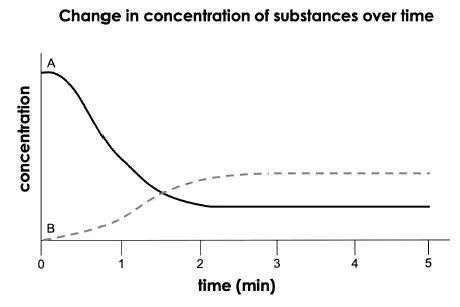
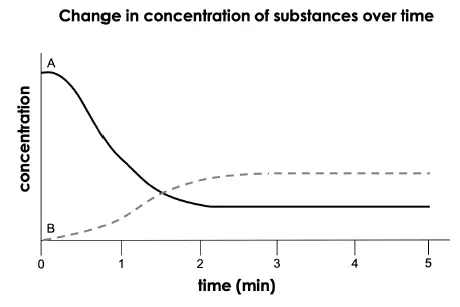
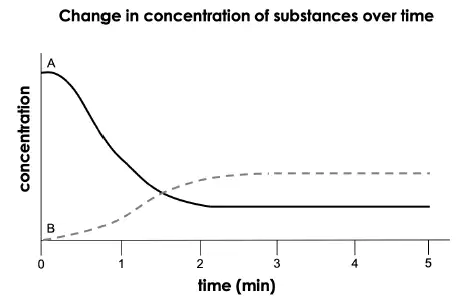
Substance A is a _______.
a)
reactant
b)
product
c)
equilibrium
d)
concentration
26.
Substance B is a _______.
a)
reactant
b)
product
c)
equilibrium
d)
concentration
27.
About how long did it take for the reaction to reach equilibrium?
a)
1 minute
b)
1.5 minutes
c)
3 minutes
d)
5 minutes
28.
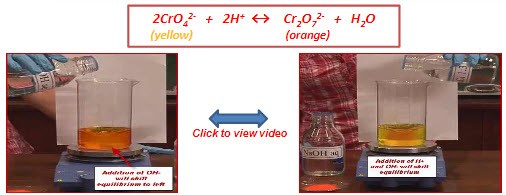
Equilibrium for 2CrO42- + 2H+ → Cr2O72- + H2O. What happen when H+ ion are added to the system?
a)
Position of equilibrium will shift to left
b)
Color of system will turn from orange to yellow
c)
Kc will be higher
d)
Equilibrium will shift to right to decrease the added H+ ion
29.
For CoCI42- +6H2O →Co(H2O)62+ + 4CI-. What happen when CI- ions are added?
a)
Position of equilibrium will shift to right
b)
Color of system will turn from blue to pink
c)
Concentration of reactants and products remain unchanged
d)
Equilibrium shift to left to reduce the added CI- ions
30.
For N2O4 (colorless) → 2NO2 (brown). What happens when pressure is increased?
a)
Position of equilibrium will shift to right
b)
Color of system will turn from colorless to brown
c)

Equilibrium will not change

d)
Position of equilibrium will not change
31.
For N2O4 (colorless)→ 2NO2 (brown). By reducing pressure, equilibrium is shift to right. WHY?
a)
Shift to the right will increase the rate of reaction
b)
Color of system will turn from colorless to brown.
c)
More particles on the right, so Kc will increase
d)
More particles on the right, so pressure can increase again
32.
For N2 + 3H2 →2NH3 . When pressure is increased the equilibrium shift to right. Why?
a)
To increase the amount of products
b)
To reduce the pressure, as right has less number of molecule
c)
Kc will increase when it is shifted to the right
d)
So it will increase the rate of reaction
33.
CoCI42- +6H2O →Co(H2O)62+ + 4CI- (ΔH = -ve) What will happen when temperature is increased?
a)
Position of equilibrium will shift to left
b)
Position of equilibrium will shift to right
c)
No change in position of equilibrium
d)
Equlibrium will not be affected
34.
For N2O4 → NO2 (ΔH = +ve). What will happen when temperature is increased?
a)
Position of equilibrium will shift to left
b)
Position of equilibrium will shift to right
c)
No change in position of equilibrium
d)
Equlibrium will not be affected
35.
N2O→ NO2 (ΔH = +ve). Why when temperature is increased position of equilibrium is shifted to RIGHT?
a)
Forward reaction is endothermic, thus reducing the temp
b)
Forward reaction is exothermic, thus reducing the temp
c)
Forward reaction is endothermic, thus increasing the temp
d)
Forward reaction is exothermic, thus increasing the temp
36.

For the reaction 2SO2 + O2 → 2SO3 (ΔH = -ve). What will happen when the concentration of O2 is increased?

a)

Position of equilibrium will shift to right

b)

Position of equilibrium will shift to left

c)

No change in position of equilibrium

d)

Equilibrium will not be affected

37.

For the reaction H2 + I2 → 2HI (ΔH = +ve). What effect does decreasing the temperature have on the equilibrium?

a)

Position of equilibrium will shift to right

b)

Position of equilibrium will shift to left

c)

No change in position of equilibrium

d)

Equilibrium will not be affected

38.

For the reaction C(s) + CO2(g) → 2CO(g) (ΔH = +ve). What happens when pressure is decreased?

a)

Position of equilibrium will shift to right

b)

Position of equilibrium will shift to left

c)

No change in position of equilibrium

d)

Equilibrium will not be affected

39.
For the reaction...
heat  +  N2(g)  +  O2(g)  <−>  2NO(g)
If the heat is removed to the chemical system, the equilibrium will _______.
a)
shift to the left
b)
shift to the right
c)
not shift
40.

What is Le Chatelier's Principle used for in chemistry?

a)
Balancing chemical equations
b)
Predicting the effect of a change in conditions on a chemical equilibrium
c)
Measuring the rate of a chemical reaction
d)
Identifying the elements in a compound
41.

According to Le Chatelier's principle, what factors cause predictable changes to a system in equilibrium?

a)
Changes in temperature, pressure, or concentration of reactants or products
b)

Changes in the shape of the reaction vessel

c)
Changes in the phase of the reactants or products
d)
Changes in color, odor, or taste of the products
42.
For the reaction...
SO2 + O2 <=>  SO3
If the equilibrium position shifts to the right, the concentration of O2 will ___________.
a)
increase
b)
decrease
c)
remain the same
d)
double
43.

2SO2(g)+O2(g) ⇌ 2SO3(g) + Heat


Increasing the temperature will...

a)

shift equilibrium right

b)

shift equilibrium left

c)

increase pressure

d)

have no change

44.

2SO2(g)+O2(g) ⇌ 2SO3(g) + Heat


Adding SO2(g) will

a)

shift equilibrium right

b)

shift equilibrium left

c)

increase rate of reaction

d)

have no change

45.

During equilibrium, the amount of the products and the amount of the reactants are __________.

a)

equal

b)

constant (unchanging)

c)

constantly increasing

d)

constantly decreasing

46.
Define chemical equilibrium.
a)
A reaction is reversible.
b)
The concentration of the reactants is equal to the concentration of the products.
c)
The rate of a forward reaction is equal to the rate of the reverse reaction.
d)
The reaction stops and no further change in concentration occurs.
47.

For the reaction...

SO2 + O2 ⇌ SO3

If the concentration of SO2 is increased, the equilibrium of the reaction will shift ___________.

a)

left

b)

right

c)

left and right

d)

neither left or right

48.
Which of the following is NOT true at equilibrium?
a)
The forward and reverse reactions proceed at the same rate.
b)
The concentrations of reactants and products do not change.
c)
The concentration of the reactants is equal to the concentration of the products.
d)
The forward and reverse reactions continue to occur.