
 Worksheets
Intro to Theater Final Review
Total questions: 46
Worksheet time: 36mins
Name
Class
Date
1.
The essential 4 Elements of Theatre are ...
a)
Story
b)
Actors
c)
Audience - Live
d)
Performance Space
e)
Director
2.
The term audience etiquette refers to ____________________________________________________.
a)
the part of the performance for loud applause.
b)
behaviors expected from a live audience
3.
Which rules listed below are examples of how you should behave in a live production? Multiple should be selected.
a)
Arrive on time. Doors are locked after the show starts.
b)
Avoid food or drink that is distracting.
c)
Take pictures and videos to compliment the actors.
d)
Applaud after songs and at the end of scenes.
e)
Stay seated until intermission.
4.
The definition for curtain call is ______________________.
a)
the behaviors expected of an audience during a live performance.
b)
the part of the performance when the actors come out on stage to acknowledge the audience’s presence, a time for loud applause
c)
when the stage manager calls for the curtain to rise up.
5.
What statement best describes the responsibilities of a producer?
a)
Casting the show, directing rehearsals and planning movement for actors
b)
Providing funding for a production and making financial decisions
c)
Calling the Show and Directing the show opening night
6.
What statement best describes the responsibilities of a director?
a)
Casting the show, directing rehearsals and planning movement for actors
b)
Providing funding for a production and making financial decisions
c)
Calling the Show and Directing the show opening night
7.
What statement best describes the responsibilities of a stage manager?
a)
Casting the show, directing rehearsals and planning movement for actors
b)
Providing funding for a production and making financial decisions
c)
Calling the Show and Directing the show opening night
8.
What type of rehearsal is it where actors are learning their movement?
a)
Blocking
b)
Full Run
c)
Technical Rehearsal
d)
Dress Rehearsal
9.
What type of rehearsal is it when a show is run with costumes, lights, sound and prop on a completed stage with a set in front of a select audience?
a)
Blocking
b)
Full Run
c)
Technical Rehearsal
d)
Dress Rehearsal
10.
What are the responsibilities of the house manager?
a)
Draws the materials for their chosen area, choosing what materials will make up the play
b)
Alerts the crew of upcoming cues
c)
Supervises the ushers, make sure programs are available and communicates when the audience is seated
11.
What are the responsibilities of the technical designer?
a)
Draws the materials for their chosen area, choosing what materials will make up the play
b)
Alerts the crew of upcoming cues
c)
Supervises the ushers, make sure programs are available and communicates when the audience is seated
12.
What needs to be included in the exposition of a play? Multiple answers should be selected.
a)
Setting up the world of the play
b)
Design Choices
c)
Characters Background
d)
Plot breakdown of the entire conflict
13.
What is considered the rising action of a play?
a)
Turning point in the action of the play, where characters are forced to change
b)
The short and important part of the play where the main characters react to the change.
c)
The longest part of the play where important characters are introduced to the conflict.
d)
The beginning of the conflict, what starts the problem.
14.
What is considered the inciting incident of a play?
a)
Turning point in the action of the play, where characters are forced to change
b)
The short and important part of the play where the main characters react to the change.
c)
The longest part of the play where important characters are introduced to the conflict.
d)
The beginning of the conflict, what starts the problem.
15.
What is considered the climax of a play?
a)
Turning point in the action of the play, where characters are forced to change
b)
The short and important part of the play where the main characters react to the change.
c)
The longest part of the play where important characters are introduced to the conflict.
d)
The beginning of the conflict, what starts the problem.
16.
How do the protagonist and antagonist relate to the conflict of a play?
a)
The protagonist is the character the audience watches, experiencing the conflict created by the antagonist.
b)
The antagonist is the the character the audience watches, experiencing the conflict caused by the protagonist.
17.
What is the difference between a theme and a moral
a)
A moral is the basic idea that brings purpose in a play and the theme is the lesson taught by the play
b)
A moral is the lesson taught by the play and the theme is basic idea that brings purpose to a play
18.
What is the difference between atmosphere and mood?
a)
Atmosphere is the emotional response to the text of the play; Mood is the environment created by the the staging, lighting, set and costumes.
b)
Mood is the emotional response to the text of the play; Atmosphere is the environment created by the the staging, lighting, set and costumes.
19.
An example of a theme in a story is
a)
Good vs. Evil
b)
No one is really truly good or truly evil
c)
Upbeat, Fantasy, Fairy Tale
20.
An example of a moral in a story is
a)
Good vs. Evil
b)
No one is really truly good or truly evil
c)
Upbeat, Fantasy, Fairy Tale
21.
The scene description is .... (select the options that are true)
a)
written at the beginning of a scene in italics
b)
written throughout the scene in Italics
c)
Includes details about the setting and everything we see on stage
d)
Includes details about the plot and the characters backstory
22.
Dialogue is....(select the options that are TRUE)
a)
Written in Italics and Parenthesis
b)
Written in plain text
c)
Said out loud by the actor
d)
Actions performed by the actor
23.
What needs to be included in the character description? (select the answers that are true)
a)
Physical Appearance and Age
b)
Character backstory
c)
Any connections with other characters (mom, brother, ext.)
d)
Any plot that the character does
e)
Personality of the character
24.
Where do you find the atmosphere (The lights, costumes, set) of the play in a script?
a)
Dialogue
b)
Stage Directions
c)
The Title
d)
The character descriptions
25.
Stage Directions are....(select the options that are TRUE)
a)
Written in Italics and Parenthesis
b)
Written in plain text
c)
Said out loud by the actor
d)
Actions performed by the actor
26.
What should be described in the setting of a play?
a)
All character are given a description of what they are wearing, what the personality is and what props they hold.
b)
A summary of the location is given listing the location of the furniture on stage and where the actors are at the beginning of each scene.
27.
Which statement best describes a hand prop?
a)
A stationary object that is used to create the set.
b)
A object that is small and used directly by actors.
c)
An object that shows the style and details of the characters and the location.
28.
Which statement best describes a decorative prop?
a)
A stationary object that is used to create the set.
b)
A object that is small and used directly by actors.
c)
An object that shows the style and details of the characters and the location.
29.
Which statement best describes a set prop?
a)
A stationary object that is used to create the set.
b)
A object that is small and used directly by actors.
c)
An object that shows the style and details of the characters and the location.
30.
What are the responsibilities of a prop master? Multiple answers should be selected.
a)
Obtaining and Organizing all props
b)
Pulling a prop from storage, Borrowing props, and Buying props
c)
Sketching the set design that goes with the world of the play
31.
How do placement and preset props relate to each other
a)
Placement considers which props should be preset on stage before the scene begins and placed on tables offstage left and right for the actors to carry on.
b)
Preset props are placed on tables off stage left and right.
32.
Read the following setting and select the correct prop plot for the third prop listed:
The salon is southern and full of charm. On the left there is a full length mirror with pink trim around the edges. Gently taped to the mirror are magazine cut outs of hairstyles. The salon chair is lavender with steel accents, it is located directly in front of the mirror. The silver hot iron is plugged into the wall on the brown table next to the mirror.
Remember you are selecting the third prop listed!
a)
Salon chair, set prop, lavender with steel accents, located in front of the mirror
b)
Hot Iron, hand prop, plugged in and silver, on the table next to the mirror
c)
Mirror, decorative prop, full length/pink trim, located on the left
33.
Read the following script and identify the hand props:
(The Fairy Godmother appears stage left from behind the tall wooden shelf and spins moving a blue wand from her cape)
Fairy Godmother: A ball you say?
(Cinderella drops the small wooden bucket and looks at the giant white carriage)
a)
Carriage and Shelf
b)
Wand and Bucket
34.
Fill in the blanks. All stage directions are from _________________ perspective. This is why they are backwards for the _________________.
a)
actor's; audience
b)
audience's; actors
35.
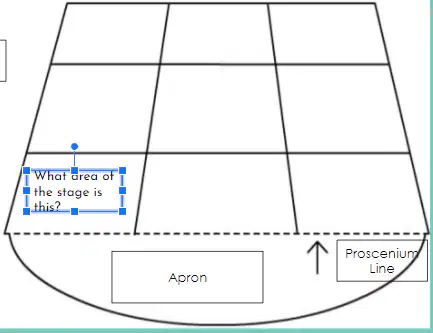
Looking at the picture: Identify what stage area is represented.
a)
Down Right
b)
Down Left
c)
Up Left
d)
Up Right
36.
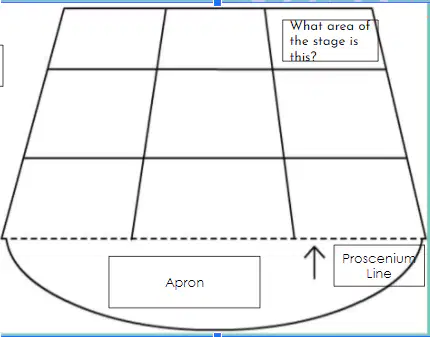
Looking at the picture: Identify what stage area is represented.
a)
Down Right
b)
Down Left
c)
Up Left
d)
Up Right
37.
True / False: Researching the Time Period is encouraged but not required for Prop, Costume and Set Design
a)
True - Not every play needs it
b)
False - every play requires it
38.
Check off the four questions a set designer answers before designing the set.
a)
What locations does the play take place?
b)
What time period in history does the play take place?
c)
What is the mood of the script and what colors and textures represent that mood?
d)
What furniture and set pieces need to be seen?
e)
What time of day does the scene take place?
39.
What three things are considered when designing the set?
a)
Large set pieces upstage
b)
exits near downstage
c)
exits near the wings
d)
Consider Sightlines
e)
What the costumes are doing
40.
Select which items are considered set pieces
a)
Walls, Windows, and Doors
b)
Pots and pans, Carpets, lamps, and notebooks
41.
Which is not a reason set design is important?
a)
The set tells the audience where the story takes place
b)
The set gives an organized placement of props
c)
The set gives clues about the characters in the story
d)
The design of the set gives the audience an idea of the time period.
42.
What are the three things a costume designer considers while building the costumes?
a)
Choice of Fabric, Mood, Decorations / Trim
b)
The actor's designs, The director's designs, and the lighting designer
c)
Set, Lights, and Sound
d)
Influence from the movie, the director and the actors
43.
Which term refers to the designers choice to match a character's allegiance to other characters in the play?
a)
Mood Rendering
b)
Color Coding
c)
Foil
d)
The four traits
44.
The three goals of a costume designer are
a)
Give the Audience a hint at who the character is
b)
Help Establish the Setting and Time period
c)
Reinforce mood and atmosphere
d)
Honor the integrity of the movie version
e)
Help with the moral of the story
45.
A costume parade is ...
a)
the costumer and director view the completed costumes on a lit stage
b)
Everyone walks across the stage in costume
c)
a publicity event to showcase the costumes in public.
46.
Select the 3 musical we watched this semester
a)
Hairspray
b)
Hamilton
c)
Dreamgirls
d)
In The Heights
e)
Shrek The Musical
100 %

