wayground logo

Free Printable Worksheets

Font size

S
M
L
XL
Worksheets

Test: Periodic Table

Total questions: 50

Worksheet time: 51mins

Name
Class
Date
1.
Which subatomic particle has a negative charge?
a)
electron
b)
alpha particles
c)
neutron
d)
proton
2.
Which of the following is unique for any given element?
a)
the number of neutrons
b)
the charge on the electrons
c)
the number of protons
d)
the mass of a neutron
3.

What do the number of protons tell us about an element?

a)
mass number
b)
balanced charge
c)
atomic number
d)
isotope
4.
To find the number of neutrons in an atom, you would subtract
a)
mass number from atomic number.
b)
atomic number from mass number.
c)
atomic number from electron number.
d)
isotope number from atomic number
5.
Which statement is true about oxygen-17 and oxygen-18?
a)
They do not have the same number of protons.
b)
Their atoms have an identical mass.
c)
They are isotopes of oxygen.
d)
They have the same mass number.
6.
In Niels Bohr’s model of the atom, electrons move
a)
like balls rolling down a hill.
b)
like planets orbiting the sun.
c)
like popcorn in a popcorn popper.
d)
like beach balls on water waves.
7.
What can you assume has happened if an electron moves to a higher energy level?
a)
The atom has become more stable
b)
The electron has lost energy.
c)
The electron has gained energy.
d)
The atom has lost an electron.
8.
As you move from left to right across a period, the number of valence electrons
a)
increases
b)
increases and then decreases
c)
stays the same
d)
decreases
9.
The usefulness of the Mendeleev’s periodic table was confirmed by
a)
the discovery of subatomic particles
b)
it’s immediate acceptance by other scientists
c)

the discovery of elements with predicted properties
d)
the discovery of the nucleus
10.
The group number is also the same as an elements’
a)
atomic number
b)
number of valence electrons
c)
atomic radius
d)
number of neutrons
11.
Which of the following Group 1A elements is the most reactive?
a)
Cs (Cesium)
b)
K (potassium)
c)
Li (Lithium)
d)
Na (Sodium)
12.
Categories of elements that run horizontally across a the periodic table are known as
a)
periods
b)
families
c)
groups
d)
gases
13.
Any element in the oxygen family will have ______ valence electrons.
a)
4
b)
6
c)
5
d)
7
14.
Group 7A (Halogens) of the periodic table contains the
a)
most reactive nonmetals
b)
most reactive metals
c)
least rreactive nonmetals
d)
least reactive metals
15.
Group 2A metals are known as the
a)
alkali metals
b)
alkaline earth metals
c)
halogens
d)
transition metals
16.
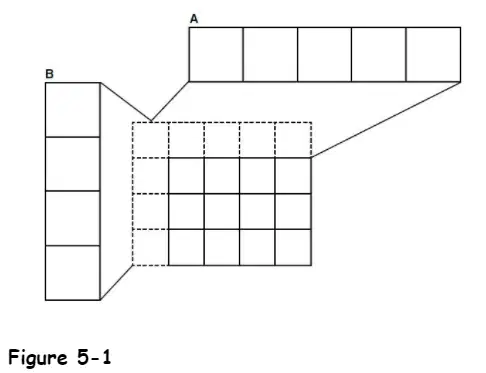
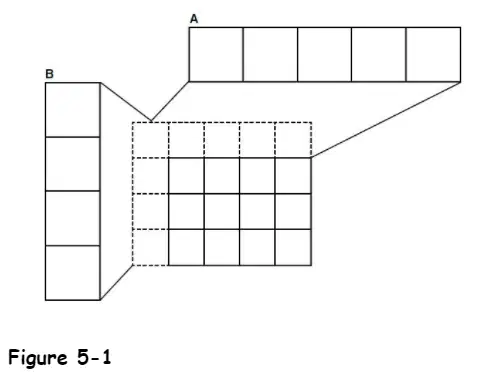
Figure 5-1 shows a portion of a blank periodic table. Identify the segments labeled A and B.
a)
A and B are both periods.
b)
and B are both groups.
c)
A is a group and B is a period.
d)
A is a period and B is a group.
17.
Which list of elements contains only metals?
a)
carbon, iodine, tin
b)
tin, copper, cesium
c)
helium, iron, copper
d)
iodine, carbon, argon
18.
Two highly reactive elements in Period 2 are the metal lithium and the _______
a)
metalloid arsenic.
b)
nonmetal selenium.
c)
nonmetal fluorine.
d)
nonmetal krypton.
19.
Compared with Group 2A elements, Group 6A elements have
a)
more atoms in the ground state.
b)
more isotopes.
c)
fewer valence electrons.
d)
more valence electrons.
20.

A member of the boron family (Group 3A) has three valence electrons, while a member of the nitrogen family has ___________ valence electrons.

a)
none
b)
five
c)
four
d)
three
21.
Which halogen is most likely to react?
a)
Cl (chlorine)
b)
I (iodine)
c)
F (fluorine)
d)
Br (bromine)
22.
Neutrons and ____________________ have almost the same mass.
a)
Protons
b)

Electrons

c)

Isotopes

d)

Mass Number

23.
Protons and ____________________ are found in the nucleus of an atom.
a)
neutrons
b)

electrons

c)

protons

d)

isotopes

24.

If an element has 11 protons, its ____________________ is also 11.

a)

atomic number

b)

atomic mass

c)

isotope number

d)

mass number

25.
When all the electrons in an atom are in orbitals with the lowest possible energy, the atom is in its ____________________ state.
a)
ground
b)

excited

c)

mass

d)

isotope

26.
Elements can be classified as metals, nonmetals, and ____________________.
a)
metalloids
b)

noble gases

c)

transition metals

d)

alkali metals

27.
Element 3, lithium, has one valence electron, and element 4, beryllium, has two valence electrons. Element 5, boron, has ____________________ valence electrons.
4 lines
28.
Hydrogen does not have the typical properties of a metal. However, hydrogen is located above Group 1A because it has one _________________________.
a)

valence electron

b)

orbital

c)

isotope

d)

proton

29.

Which of the subatomic particles has the least mass?

a)
electrons
b)

protons

c)

neutrons

d)

isotopes

30.
If an atom has 34 protons and 40 neutrons, what is its mass number?
4 lines
31.

Element X has 5 valence electrons

Element Y has 1 valence electrons

Element Z has 5 valence electrons

Which two of these elements are most likely to have similar properties?

a)

X, Z

b)

X, Y

c)

Y, Z

d)

None

32.

Sodium chloride is a compound of sodium and chlorine. To which family does each element belong?

sodium - (a)  

chlorine - (b)  
Choose from the below words
alkali metal
halogen
alkaline earth metal
noble gas
33.
In which segment of Figure 5-1, A or B will properties of the elements vary the most?
a)
A
b)

B

34.
Period 5 of the periodic table begins with element 37 and ends with element 54. Consider the following elements from row 5: strontium (element 38), cadmium (element 48), and iodine (element 53). Which of these elements is most likely to be a transition metal?
a)

strontium

b)

cadmium

c)

iodine

d)

rubidium

35.

On the periodic table, there are two numbers in the block for the element K: 19 and 39.098. What are these two numbers, and what do they represent? (remember to label what is what)

19 - (a)  

39.098 - (b)  

Choose from the below words
atomic number
atomic mass

isotope

symbol

mass number

36.

Suppose you are looking at elements in the periodic table in this order: element 23, element 24, element 25, element 26, and so on. Which term correctly describes those elements?

a)
period
b)

group

c)

family

d)

column

37.

Selenium has six valence electrons, while rubidium has one valence electron. Identify each element as a metal, metalloid, or a nonmetal. (remember to label)

a)

Selenium

1.

nonmetal

b)

Rubidium

2.

metal

c)

Germanium

3.

metalloid

38.

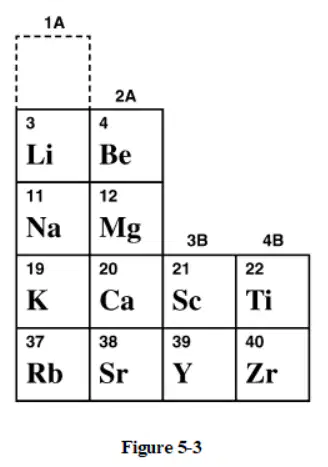
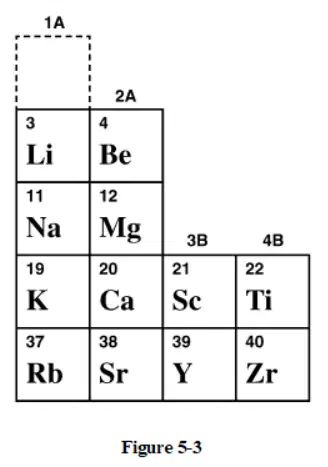
Are these elements in Figure 5-3 as all metals, all metalloids, or all nonmetals?

a)

metals

b)

metalloids

c)

nonmetals

d)

noble gases

39.
What do the numbers in the boxes in Figure 5-3 represent?
a)
protons
b)

electrons

c)

neutrons

d)

isotopes

40.
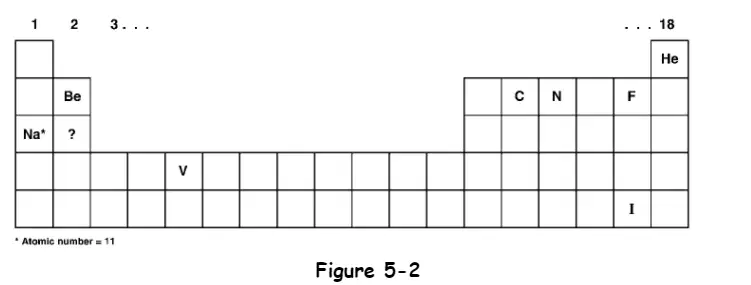
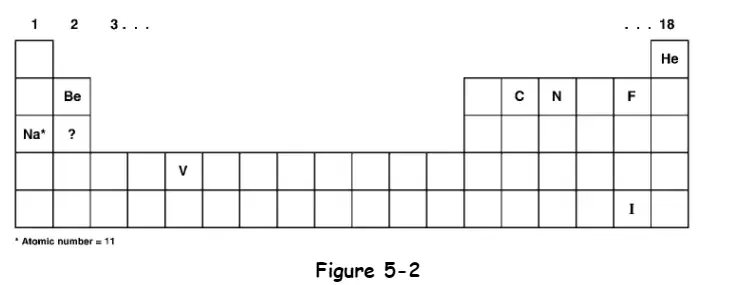
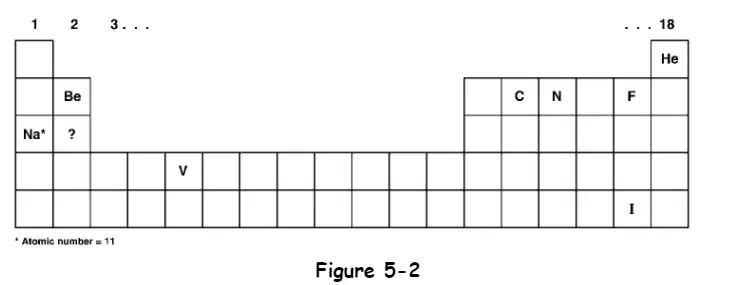
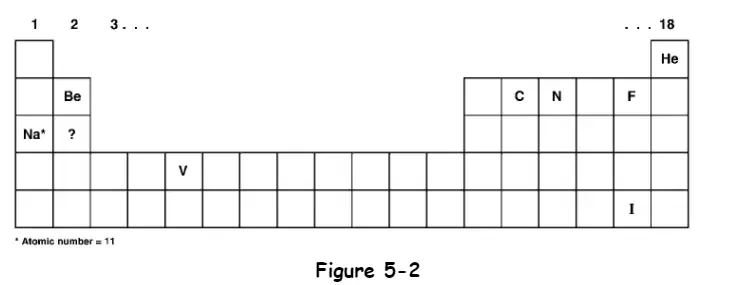
Just using only the atomic symbols (Letters) below in boxes in Figure 5-2, List the elements that are in the same period.
a)
Be, C, N, F
b)

Be, He

c)

Na, V, I

d)

Be, V, C, N

41.
Which element in Figure 5-2 is a transition metal?
a)
V
b)

Be

c)

Na

d)

C

e)

I

42.
Which element in Figure 5-2 is a noble gas?
a)
He
b)

Na

c)

Be

d)

C

e)

F

43.

Find the block labeled "?" in Figure 5-2. Identify the atomic number.

4 lines
44.

Find the block labeled "?" in Figure 5-2. How many valence electrons does the element have?

4 lines
45.

Find the block labeled "?" in Figure 5-2. Which element listed on the table will have similar properties?
4 lines
46.

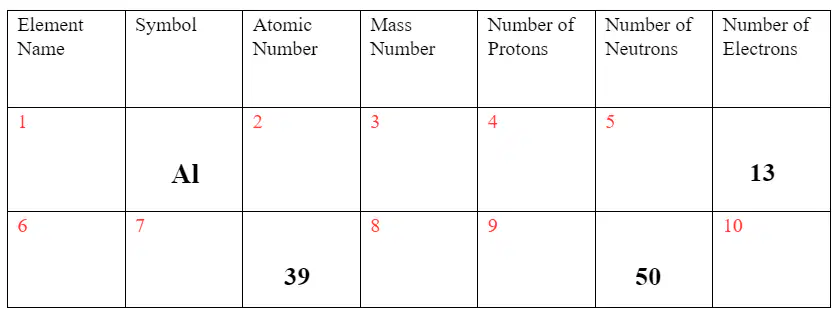
Looking at Figure 5-3, provide the missing information for the 2nd row (1-5).

For example:

11 - Florine

12 - F

13 - 9

14 - 19

15 - 10

4 lines
47.

Looking at Figure 5-3, provide the missing information for the 2nd row (6-10).

For example:

11 - Florine

12 - F

13 - 9

14 - 19

15 - 10

4 lines
48.
How did the results of JJ Thomson's experiment change how scientists thought about atoms? (Hint think about what his model is)
4 lines
49.
What did Rutherford conclude about the location of positive charge in the atom?
4 lines
50.

Why is the element gallium (Ga) important to Mendeleev?

4 lines