wayground logo

Free Printable Worksheets

Font size

S
M
L
XL
Worksheets

APGov Unit 1 Test

Total questions: 50

Worksheet time: 31mins

Name
Class
Date
1.

In a DEMOCRACY, which of the following is supposed to drive the government's policy agenda?

a)
Issues that candidates talk about on the campaign trail to get elected
b)
Issues brought to the forefront by prominent special interest groups
c)

Broad issues that are asked about in nationwide public opinion polls

d)
Issues that attract the serious attention of public officials and other political actors
2.
Which of the following describes the social contract theory as advanced by John Locke?
a)
It is an agreement between political actors to maintain their grip on power
b)
It is an agreement between economic elites to maintain a stable economy
c)
It is an agreement in which the government outlines socially acceptable norms of political behavior
d)
It is an agreement in which the government promises to protect the natural rights of people
3.
Which of the following is a basic characteristic of the pluralist theory of democracy?
a)

Politics is best understood as competition among many groups of people with shared interests

b)

Interests are closely controlled by representatives of the public at large

c)

Political decisions are influenced by influential leaders who are motivated by having more say

d)

Politics is best understood as competition among party leaders

4.
What type of legislature did the United States have under the Articles of Confederation?
a)
Two chambers with each state receiving equal representation
b)
Two chambers with membership based on a state’s population
c)
A single chamber with membership based on a state’s population
d)
A single chamber with each state receiving equal representation
5.
Which of the following was a significant problem under the Articles of Confederation?
a)
National government was too strong compared to the states
b)
Congress lacked the authority to regulate interstate commerce
c)
It kept exclusive use of British currency even after the war
d)
Congress imposed excessive taxes on states and their citizens
6.
The Articles of Confederation required ____ consent from the states to approve amendments to the document.
a)
13/13
b)
7/13
c)
10/13
d)
9/13
7.
The importance of Shays Rebellion to the development of the Constitution of the United States Constitution was that it:
a)
Demonstrated the intensity of anti ratification sentiment within the thirteen states
b)
Convinced the delegates attending the Constitutional Convention to accept the Connecticut Plan
c)
Revealed the necessity of both adding the Bill of Rights to the Constitution and creating a new system of checks and balances
d)
Indicated that a strong, constitutionally designed national government was needed to protect property and maintain order
8.
While working at the Constitutional Convention , which aspect of the new government most concerned James Madison?
a)
Maintaining elitists' control
b)
Tyranny of the majority
c)
Military weaknesses
d)
Abolishing slavery
9.
In The Federalist #10, James Madison contended that government should:
a)
Permit many factions so they can compete
b)
Deny citizens access to competitive faction
c)
Limit the number of political factions
d)
Regulate factions through taxation
10.
What did the Connecticut (Great) Compromise help to establish?
a)
The Presidency and the Cabinet
b)
Supreme Court and independent judiciary
c)
Shared powers under federalism
d)
The Senate and House of Representatives
11.
What was the main fear of the Anti-Federalists during the Constitutional Convention and subsequent debate?
a)
Strong state governments would infringe on individual liberties
b)
A weak national government would undermine the survival of the United States
c)
A strong national government would infringe on the rights of states
d)
State government policies would favor the wealthy elites who wrote them
12.
Which of the following clauses in the Constitution justifies the “implied powers doctrine”?
a)
The executive power clause
b)
The debts and engagements clause
c)
The privileges and immunities clause
d)
The necessary and proper clause
13.
The Framers of the Constitution designed which of the following to be LEAST responsive to public opinion?
a)
The electoral college
b)
The office of the president
c)
The courts
d)
Congress
14.

How is a constitutional amendment RATIFIED?

a)
Either by three-fifths of Congress or by executive signature
b)
Either by three-fourths of state legislatures or by special state conventions in three-fourths of the states
c)
Either by three-fourths of state governors or by three-fourths of the U.S. Senate
d)
Either by a majority of state legislatures or by special state conventions in a majority of the states
15.
Which of the following is true under the system of checks and balances?
a)
The House of Representatives appoints justices to the Supreme Court and the Senate approves the appointments
b)
The Senate must ratify treaties negotiated by the President before they become law
c)
A bill becomes a law when the House and the Senate pass it, and the Supreme Court declares it Constitutional
d)
The Supreme Court can remove members of Congress, and Congress can impeach the President
16.
Which clause in the Constitution ensures that judicial rulings and legal contracts made in one state will be binding and enforceable in another?
a)
Due process clause
b)
Commerce clause
c)
Equal protection clause
d)
Full faith and credit clause
17.
Which clause of the U.S. Constitution did the Supreme Court interpret in McCulloch v. Maryland as allowing Congress to create a national bank, despite Maryland’s protest?
a)
Full faith and credit clause
b)
Necessary and proper clause
c)
Commerce clause
d)
Due process clause
18.
The reserved powers of the state governments can best be described as those powers:
a)
Not specifically granted to the national government or denied to the states
b)
Exercised by both national and state governments
c)
Granted to states as part of the implied powers doctrine
d)
Listed specifically in the Tenth Amendment
19.
In Gibbons v. Ogden, the Supreme Court held that Congress has broad authority to regulate:
a)
Interstate commerce
b)
Permits and licenses
c)
Creation of new banks
d)
Reserve interest rates
20.
Of the following, which has been used most to expand the power of the national government?
a)

The Privileges & Immunities clause of the Constitution

b)

The Commerce Clause of the Constitution

c)

The Full Faith & Credit of the Constitution

d)

The 10th Amendment

21.
Which type of grant is given to a state by the federal government with only general spending guidelines?
a)
Block
b)
Project
c)
Formula
d)
Business
22.
In United States v. Lopez, the U.S. Supreme Court scrutinized and ultimately denied Congress’ use of which of the following powers as related to the possession of firearms in public schools?
a)
Supremacy clause
b)
Full faith and credit clause
c)
Necessary and proper clause
d)
Commerce clause
23.
The supremacy clause in the Constitution states that:
a)
Only Congress may declare war
b)
Federal law takes precedence over state law when the laws conflict
c)
The federal government has the right to regulate interstate commerce
d)
The Supreme Court has the power to overturn decisions of lower courts
24.

Which type of grants typically allocate federal dollars based on eligible population that meets requirements?
a)
Emergency Aid
b)
Business
c)
Formula
d)
Block
25.
Many local school districts complained that the No Child Left Behind Act did not provide enough federal funding to implement the law in the states. If this is the case, the law is an example of a(n):
a)
Unfunded mandate
b)
Block grant
c)
Formula grant
d)
Categorical grant
26.
The goal of the privileges and immunities clause is to keep states from discriminating against which of the following?
a)
Poor or struggling citizens
b)
Citizens of other states
c)
Minors and immigrants
d)
Citizens in minority groups
27.
Why was McCulloch v. Maryland an important case in terms of federalism?
a)
It confirmed Congress as the most powerful political entity in the nation under the Constitution
b)
It reinforced the idea of national supremacy, altering the relationship between federal and state governments
c)
It ruled that taxation was an enumerated, rather than a concurrent power
d)
It gave the federal government power over the nation's financial institutions and budget
28.
Which of the following best explains a mandate?
a)
An order from the federal government relating to states maintaining a balanced budget
b)
An order from a state government forcing other states to comply with an initiative
c)
An order from the federal government requiring states to take a certain action
d)
An order from a state government requiring a federal action
29.
Which of the following is an example of a shared (concurrent) power between states and the federal government?
a)
Creating marriage laws
b)
Power to tax
c)
Establishing post offices
d)
Controlling the money supply
30.
Consider the following excerpt from the Declaration of Independence (1776): "...We hold these truths to be self-evident, that all men are created equal, that they are endowed by their Creator with certain unalienable Rights, that among these are Life, Liberty and the pursuit of Happiness. -- That to secure these rights, Governments are instituted among Men, deriving their just powers from the consent of the governed..." - Thomas Jefferson Based on the quotation above and your own knowledge, with which of the following statements would John Locke most likely agree?
a)
Divine right monarchies were best suited to protect the natural rights of the people
b)
A formal declaration of wrongdoing is the only proper way to assert the right of revolution when necessary
c)
Only by implementing a system of checks and balances can humans prevent abuse of power by governments
d)
Legitimate governments get their power from the people and work to protect their natural rights
31.
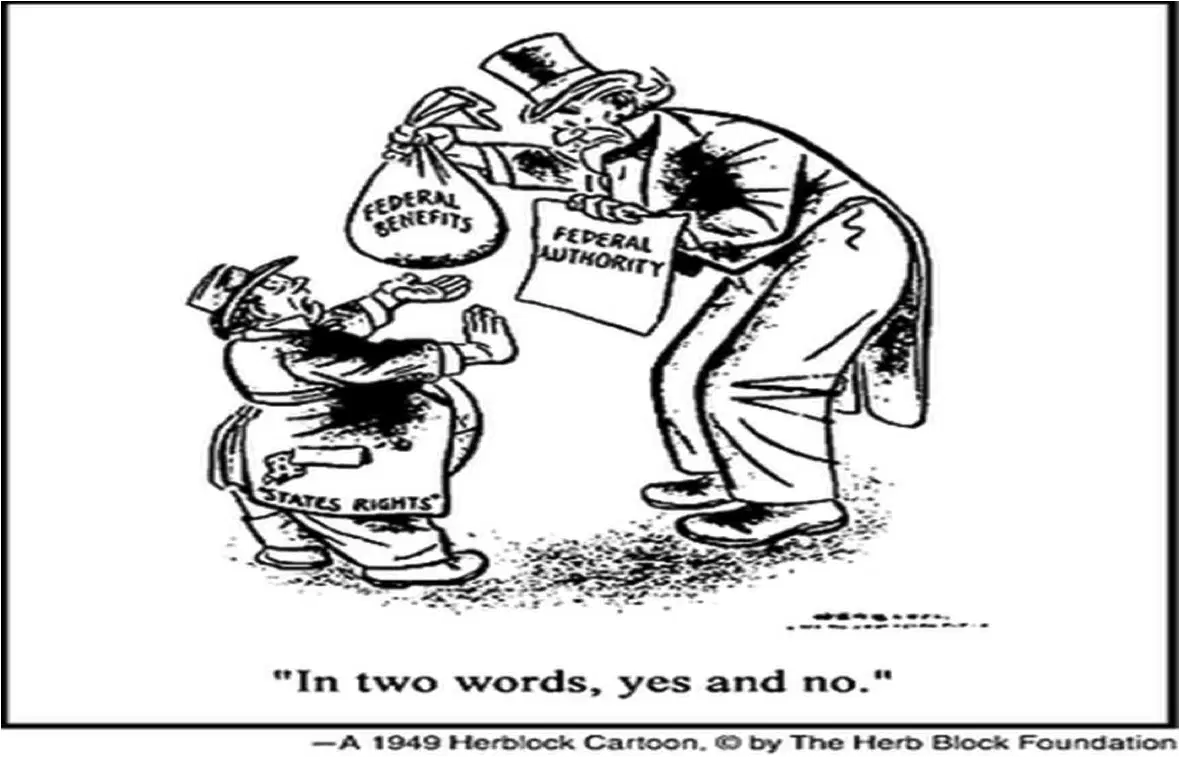
Which of the following policies would the states most likely prefer according to the political cartoon #1?
a)
Block grants
b)
Federal mandates
c)
Categorical grants
d)
Regulatory preemption
32.
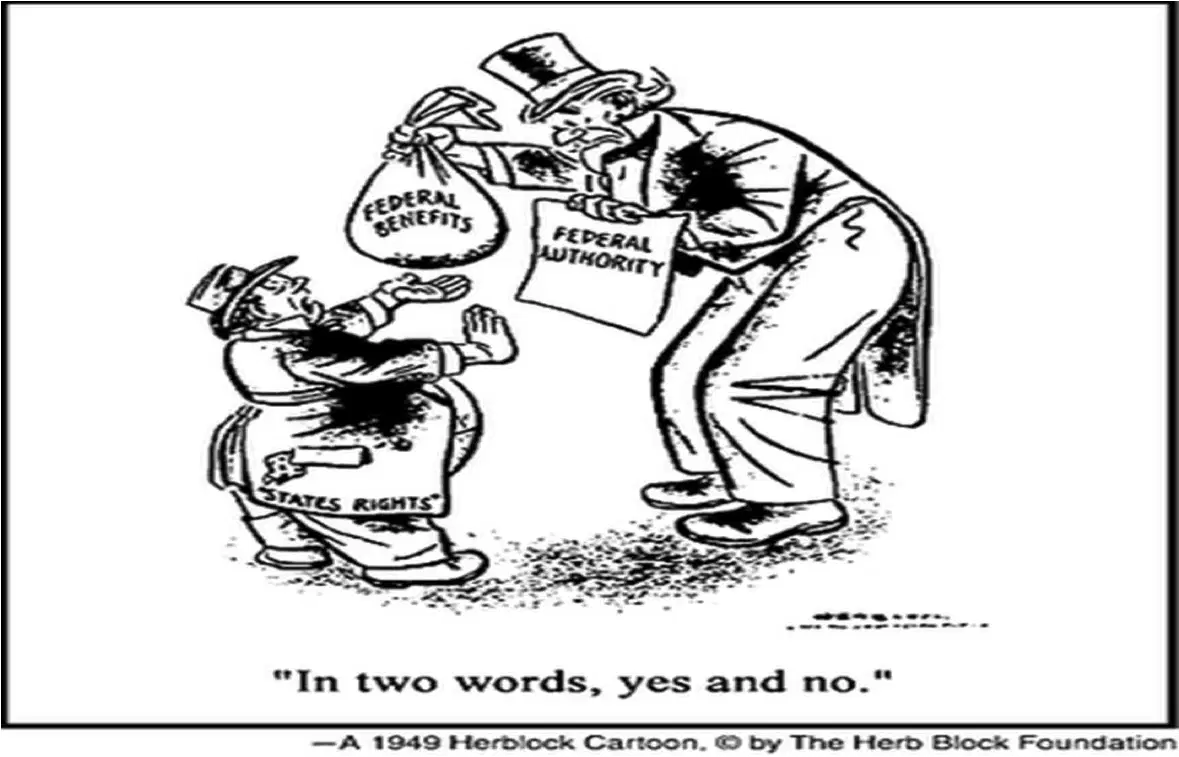
Which of the following is the most accurate interpretation of the political cartoon #1?
a)
State governments are unwilling to share their budgetary surpluses with other states
b)
State governments have used the 10th amendment to override the federal government's mandates
c)
The fiscal irresponsibility of state governments has led to increased federal regulation on their budgetary priorities
d)
State governments prefer federal funding but do not want federal oversight over how the money is spent
33.

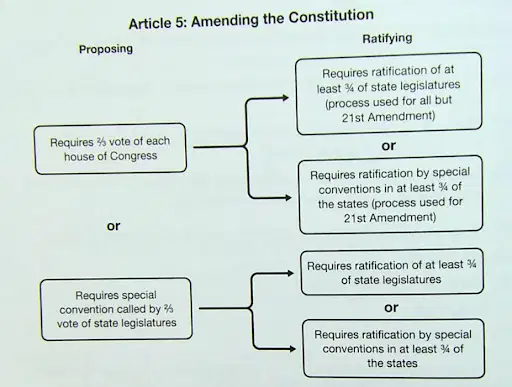
Which of the following conclusions is best supported by the chart ?

a)
Once a proposed amendment passes the first found of approval, there are four ways it can be ratified
b)
Amendments are proposed more often by Congress than by special conventions
c)
Only a few amendments were ratified by special conventions in at least 34 of the states
d)
Amending the Constitution is a relatively easy process
34.

Based on the chart :Which of the following is the correct pairing of powers found in the Articles of Confederation and powers found in the Constitution?
a)
A
b)
B
c)
C
d)
D
35.

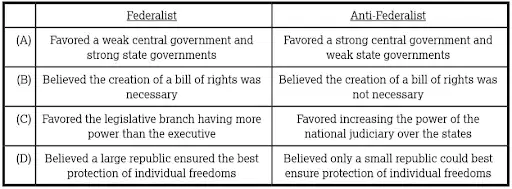
Based on the chart: Which of the following is an accurate comparison of Federalist and Anti-Federalist views on government?
a)
A
b)
B
c)
C
d)
D
36.

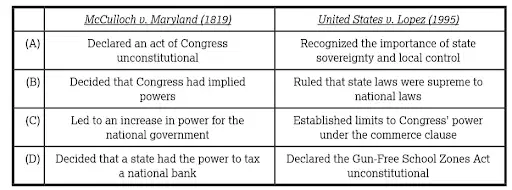
Based on the chart: Which of the following is an accurate comparison of the two court cases?
a)
A
b)
B
c)
C
d)
D
37.

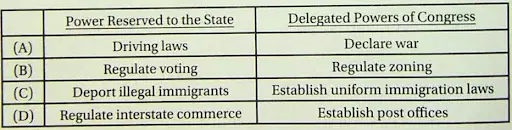
Bassed on the chart: Which of the following pairs accurately shows an example of how some powers are reserved to the states and other powers are given to the federal government?
a)
A
b)
B
c)
C
d)
D
38.

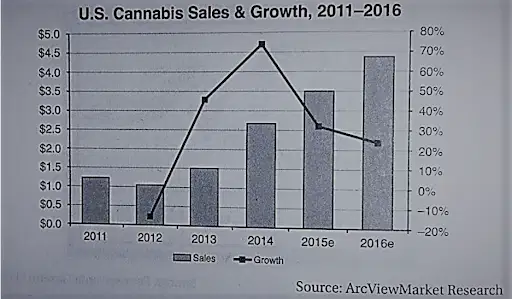
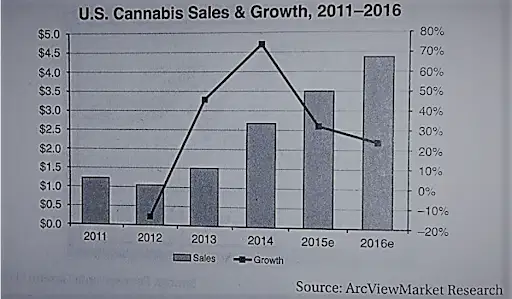
What is a true statement based off the data?
a)
Sales and growth of marijuana have increased between 2012 and 2016
b)
Sales of marijuana increased at the same rate growth increased between 2012 and 2014
c)
Sales of marijuana decreased in the years that growth decreased
d)
Growth of marijuana has decreased between 2014 and 2016, while sales have increased
39.

What could be the cause for the trends shown on the chart?

a)
As more states legalized marijuana, sales increased
b)
There was in increase in illegal use of marijuana in the United States
c)
States did not tax the use of marijuana
d)
Medical use of marijuana was made illegal by the federal government
40.

Which amendment granted Women's suffrage?

a)
3
b)
4
c)
6
d)
13
e)
19
41.

Which amendment is about: Speedy public trial by jury, know charges, witnesses, evidence, lawyer

a)
3
b)
4
c)
6
d)
13
e)
19
42.

Which amendment said Congress pay raises don’t take effect right away

a)
8
b)
9
c)
12
d)
26
e)
27
43.

Which amendment said Washington D.C. gets 3 Electoral College votes

a)
1
b)
10
c)
17
d)
23
e)
24
44.

Which amendment said Presidents begin terms on Jan 20th, Congress Jan 3rd

a)
2
b)
7
c)
15
d)
20
e)
25
45.

Which amendment said Former slaves can vote

a)
2
b)
7
c)
15
d)
20
e)
25
46.

Which amendment sets a Plan of succession if President dies or leaves office

a)
2
b)
7
c)
15
d)
20
e)
25
47.

Which amendment is about Citizenship, incorporation, due process, equal protection of law

a)
5
b)
9
c)
14
d)
16
e)
22
48.

"This spirit, unfortunately, is inseparable from our nature, having its root in the strongest passions of the

human mind. It exists under different shapes in all governments, more or less stifled, controlled, or repressed;

but, in those of the popular form, it is seen in its greatest rankness, and is truly their worst enemy.

The alternate domination of one faction over another, sharpened by the spirit of revenge, natural to party dissension, which in different ages and countries has perpetrated the most horrid enormities, is itself a frightful despotism. But this leads at length to a more formal and permanent despotism. The disorders and miseries which result gradually incline the minds of men to seek security and repose in the absolute power of an individual; and sooner or later the chief of some prevailing faction, more able or more fortunate than his competitors, turns this disposition to the purposes of his own elevation, on the ruins of public liberty.

Without looking forward to an extremity of this kind (which nevertheless ought not to be entirely out of sight), the common and continual mischiefs of the spirit of party are sufficient to make it the interest and duty of a wise people to discourage and restrain it. . . .

It is important, likewise, that the habits of thinking in a free country should inspire caution in those entrusted with its administration to confine themselves within their respective constitutional spheres, avoiding in the exercise of the powers of one department to encroach upon another. The spirit of encroachment tends to consolidate the powers of all the departments in one, and thus to create, whatever the form of government, a real despotism."

- George Washington

48.

Which of the following best summarizes the excerpt from

Washington's Farewell Address?

a)

Washington Takes Negative View of Checks and Balances

b)

Washington Boasts of the Potential of the New Republic

c)

Washington Endorses a Stronger Executive Branch

d)

Washington Warns of Dangerous Party Factions

49.

"In many places, classrooms are overcrowded and curricula are outdated. Most of our qualified teachers are underpaid, and many of our paid teachers are unqualified. So we must give every child a place to sit and a teacher to learn from. Poverty must not be a bar to learning, and learning must offer an escape from poverty.

But more classrooms and more teachers are not enough. We must seek an educational system which grows in excellence as it grows in size. This means better training for our teachers. It means preparing youth to enjoy their hours of leisure as well as their hours of labor. It means exploring new techniques of teaching, to find new ways to stimulate the love of learning and the capacity for creation. . . .

. . . While our Government has many programs directed at those issues, I do not pretend that we have the full answer to those problems.

But I do promise this: We are going to assemble the best thought and the broadest knowledge from all over the world to find those answers for America. I intend to establish working groups to prepare a series of White House conferences and meetings . . . on the quality of education, and on other emerging challenges. And from these meetings and from this inspiration and from these studies we will begin to set our course toward the Great Society.

The solution to these problems does not rest on a massive program in Washington, nor can it rely solely on the strained resources of local authority. They require us to create new concepts of cooperation, a creative federalism, between the National Capital and the leaders of local communities."

- President Lyndon B. Johnson


49.

By using the phrase "creative federalism," President Johnson is most likely referring to which of the following features of the American system?

a)

The balance of power between the states and federal government has been trending toward more federal regulation and less state control

b)

Congress may use the commerce clause to address problems in public schools such as lack of resources and school safety

c)

The relationship between the federal and state governments evolves over time and is flexible enough to permit new forms of interaction

d)

National policymaking is constrained by the sharing of power between the three branches of government

50.


I go further, and affirm that bills of rights, in the sense and in the extent in which they are contended for, are not only unnecessary in the proposed constitution, but would even be dangerous. They would contain various exceptions to powers which are not granted; and on this very account, would afford a colourable pretext to claim more than were granted. For why declare that things shall not be done which there is no power to do? Why for instance, should it be said, that the liberty of the press shall not be restrained, when no power is given by which restrictions may be imposed? I will not contend that such a provision would confer a regulating power; but it is evident that it would furnish, to men disposed to usurp, a plausible pretense for claiming that power.

— Alexander Hamilton


50.

Which of the following constitutional provisions limits the power of the national government in Hamilton's argument?

a)

Faithful execution of the laws in Article II

b)

Enumerated powers in Article I

c)

Judicial review in Article III

d)

Supremacy Clause in Article VI