wayground logo

Free Printable Worksheets

Font size

S
M
L
XL
Worksheets

World History Midterm Exam

Total questions: 58

Worksheet time: 29mins

Name
Class
Date
1.
1. What does the term "Renaissance" mean?
a)
A) Rebirth
b)
B) Revolution
c)
C) Revelation
d)
D) Revival
2.
2. Where did the Renaissance begin?
a)
A) England
b)
B) France
c)
C) Italy
d)
D) Germany
3.
3. Which family was a powerful patron of the arts in Florence during the Renaissance?
a)
A) Habsburgs
b)
B) Tudors
c)
C) Medici
d)
D) Borgia
4.
4. Which of the following is a characteristic of Renaissance art?
a)
A. Abstract forms and minimalism
b)
B. Flat, two-dimensional figures
c)
C. Use of perspective and realistic proportions
d)
D. Depictions of only religious figures
5.
5. Which artist painted the ceiling of the Sistine Chapel?
a)
A) Leonardo da Vinci
b)
B) Raphael
c)
C) Donatello
d)
D) Michelangelo
6.
6. What was the subject of Leonardo da Vinci's famous notebook sketches?
a)
A. Religious stories
b)
B. Human anatomy, engineering, and nature
c)
C. Portraits of rulers
d)
D. Scientific formulas
7.
7. Which book, written by Niccolò Machiavelli, is a guide for rulers on how to maintain power?
a)
A. Utopia
b)
B. The Prince
c)
C. In Praise of Folly
d)
D. The Divine Comedy
8.
8. Which artist painted The School of Athens, representing classical philosophers?
a)
A) Michelangelo
b)
B) Raphael
c)
C) Botticelli
d)
D) Leonardo da Vinci
9.
9. What event is traditionally seen as the start of the Protestant Reformation?
a)
A. The Peace of Augsburg
b)
B. The Diet of Worms
c)
C. The posting of the 95 Theses by Martin Luther
d)
D. The signing of the Edict of Nantes
10.
10. What was the major goal of the Catholic Counter-Reformation?
a)
A) To punish heretics
b)
B) To encourage people to leave Protestantism
c)
C) To reform the Catholic Church and stop the spread of Protestantism
d)
D) To spread Catholicism to new lands
11.
11. Which English monarch broke with the Catholic Church and established the Church of England?
a)
A. Henry VII
b)
B. Elizabeth I
c)
C. Henry VIII
d)
D. Mary I
12.
12. The Council of Trent was convened to:
a)
A. Negotiate with Protestant leaders
b)
B. Address issues of church doctrine and reform
c)
C. Establish new scientific principles
d)
D. Create alliances with European monarchs
13.
13. How did the invention of the printing press by Johannes Gutenberg contribute to the spread of Renaissance ideas?
a)
A. It allowed books to be written only in Latin, limiting access to scholars
b)
B. It facilitated the mass production of written material, making knowledge more accessible
c)
C. It was primarily used by the Catholic Church to limit the distribution of humanist texts
d)
D. It was a minor invention during the Renaissance and had little impact
14.
14. What made Leonardo da Vinci an ideal "Renaissance man"?
a)
A. His focus on only artistic endeavors
b)
B. His expertise across multiple disciplines including art, science, anatomy, and engineering
c)
C. His political power and religious reforms
d)
D. His specialization in creating religious works
15.
15. John Calvin’s concept of predestination proposed that:
a)
A. Salvation could be earned through good works
b)
B. God had already determined who would be saved and who would be damned, regardless of human action
c)
C. The Pope had the final say on a person's salvation
d)
D. The Church could grant forgiveness to anyone, regardless of their sins
16.
16. Society of Jesus, or Jesuits, focused on:
a)
A. Preaching Calvinist doctrine across Europe
b)
B. Promoting the authority of Protestant monarchs
c)
C. Spreading Catholic education, missionary work, and defending Catholicism against Protestantism
d)
D. Reforming the papacy to align with Protestant reforms
17.
22. What Renaissance value is best exemplified in The School of Athens?
a)
A. Religious devotion to Christian themes
b)
B. Emphasis on Gothic architecture and medieval beliefs
c)
C. The celebration of classical antiquity like the Greeks and Romans
d)
D. Depiction of contemporary political rulers
18.
23. How does The Last Supper by Leonardo da Vinci reflect the Renaissance techniques of perspective and composition?
a)
A. By portraying the figures in flat, two-dimensional forms
b)
B. By using mathematical perspective to create depth and focus the viewer’s attention on Christ
c)
C. By isolating religious figures from each other to emphasize solitude
d)
D. By using bright, unnatural colors to distinguish between divine and human figures
19.
25. If accused, why would people confess to a crime of heresy that they didn’t commit during the Spanish Inquisition?
a)
A. They were promised rewards by the Inquisition for confessing
b)
B. They feared torture and severe punishment if they didn’t confess
c)
C. They genuinely believed they were guilty after intense interrogation
d)
D. Confessing allowed them to avoid execution and receive a lighter sentence
20.
26. Spanish explorers
a)
Conquistador
b)
Encomienda
c)
Atlantic Slave Trade
d)
Triangular Trade
e)
Capitalism
21.
27. The buying and selling of Africans for work in the Americas
a)
Atlantic Slave Trade
b)
Conquistador
c)
Encomienda
d)
Triangular Trade
e)
Capitalism
22.
28. Over one trade route, Europeans transported manufactured goods to the west coast of Africa. There, traders exchanged these goods for captured Africans. The Africans were then transported across the Atlantic and sold in the West Indies.
a)
Triangular Trade
b)
Conquistador
c)
Encomienda
d)
Atlantic Slave Trade
e)
Capitalism
23.
29. The voyage that brought captured Africans to the West Indies and later to North and South America.
a)
Middle Passage
b)
Conquistador
c)
Encomienda
d)
Atlantic Slave Trade
e)
Triangular Trade
24.
30. The global transfer of foods, plants and animals during the colonization of the Americas
a)
Columbian Exchange
b)
Conquistador
c)
Encomienda
d)
Atlantic Slave Trade
e)
Triangular Trade
25.
31. Economic system based on private ownership and the investment of resources, such as money for profit
a)
Capitalism
b)
Conquistador
c)
Encomienda
d)
Atlantic Slave Trade
e)
Triangular Trade
26.
32. Landed in San Salvador and claimed it for Spain on October 12, 1492
a)
Christopher Columbus
b)
John Cabot
c)
Vasco de Gama
d)
Amerigo Vespucci
e)
Ferdinand Magellan
27.
33. Achieved the first circumnavigation of the Earth
a)
Ferdinand Magellan
b)
Christopher Columbus
c)
John Cabot
d)
Vasco de Gama
e)
Amerigo Vespucci
28.
34. The first Englishman to explore the Pacific Ocean. He discovered San Francisco and claimed it for England.
a)
Sir Francis Drake
b)
Christopher Columbus
c)
John Cabot
d)
Vasco de Gama
e)
Amerigo Vespucci
29.
35. Was the first explorer to realize he wasn't in Asia, but a new continent he called "the new world".
a)
Amerigo Vespucci
b)
Christopher Columbus
c)
John Cabot
d)
Vasco de Gama
e)
Ferdinand Magellan
30.
36. His 1497 voyage to the coast of North America under the commission of Henry VII, King of England is the earliest known European exploration of coastal North America
a)
John Cabot
b)
Christopher Columbus
c)
Vasco de Gama
d)
Amerigo Vespucci
e)
Ferdinand Magellan
31.
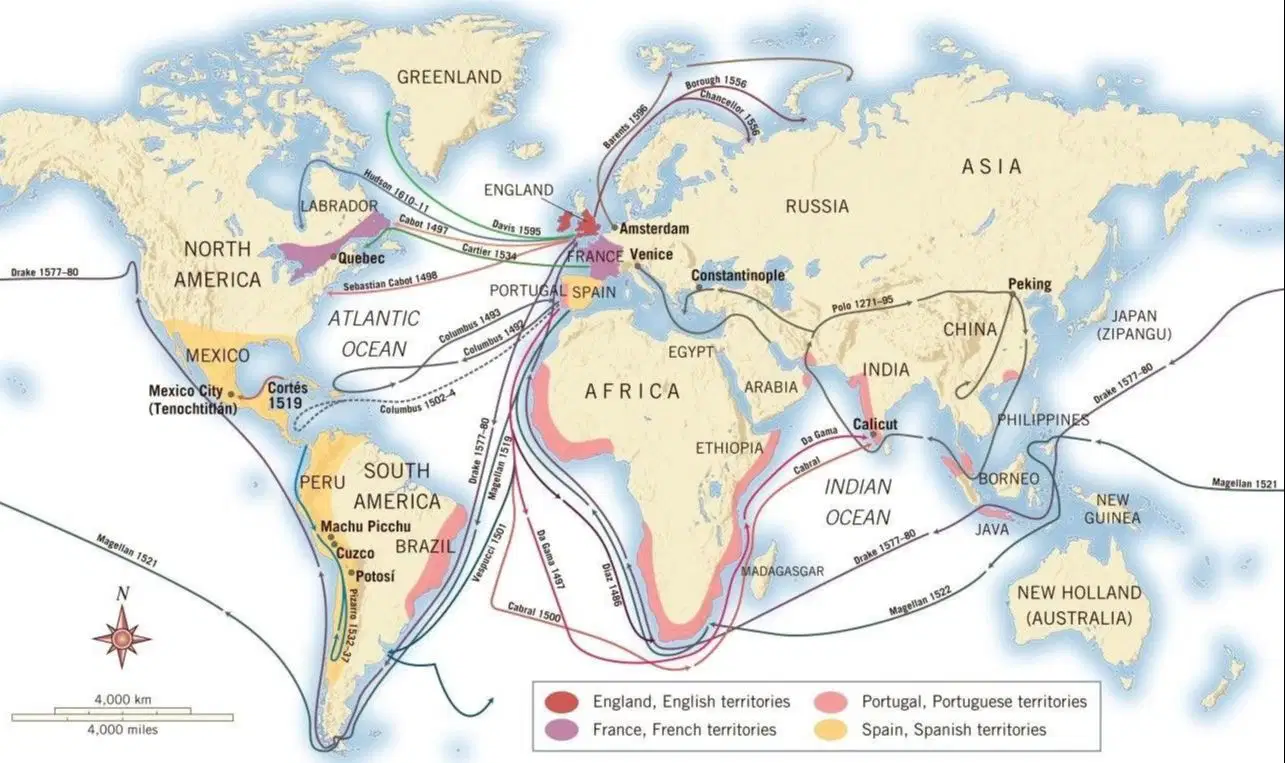
41.Which explorer's route is represented by the path crossing the Pacific Ocean and reaching the Philippines in 1521?
a)
A. Vasco da Gama
b)
B. Ferdinand Magellan
c)
C. Christopher Columbus
d)
D. Francis Drake
32.
42. The black line that begins in Spain and crosses the Atlantic to reach the Americas in 1492 represents which explorer’s voyage?
a)
A. John Cabot
b)
B. Vasco Núñez de Balboa
c)
C. Christopher Columbus
d)
D. Hernán Cortés
33.
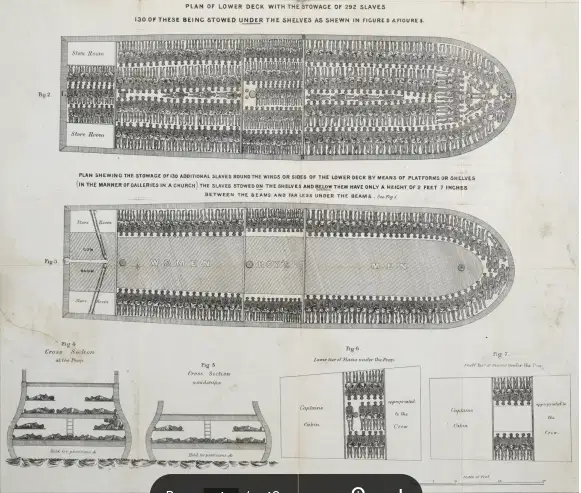
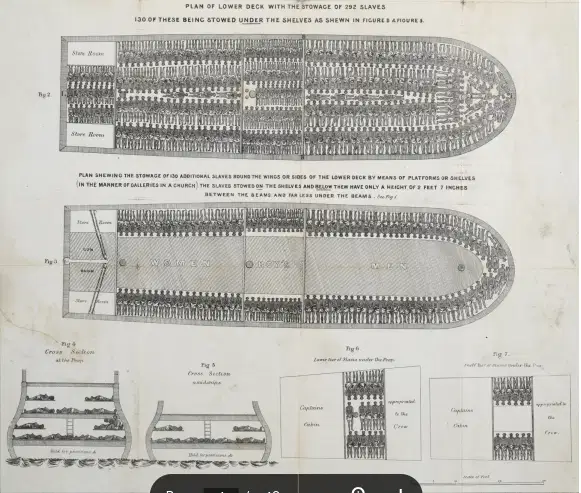
43. What does the image primarily depict?
a)
A. A merchant ship carrying spices from Asia to Europe
b)
B. A ship layout designed for transporting enslaved Africans during the Middle Passage
c)
C. A naval warship from the Age of Exploration
d)
D. A passenger ship for European settlers traveling to the Americas
34.
44. Why were enslaved individuals packed so tightly in the ship's cargo hold, as shown in the diagram?
a)
A. To maximize the ship’s speed during the journey
b)
B. To reduce the cost of transportation per individual
c)
C. To ensure their comfort and well-being during the voyage
d)
D. To make space for additional goods and livestock
35.
45. This theory is the theory that God placed earth in the middle of the universe
a)
Heliocentric theory
b)
Geocentric theory
c)
Scientific Method
d)
Planet Earth Theory
36.
46. This is the theory that earth revolves around the sun. This theory was proven correct
a)
Heliocentric theory
b)
Geocentric theory
c)
Planet Earth Theory
d)
Revolving theory
37.
47. Who developed the heliocentric theory?
a)
Copernicus
b)
Isaac Newton
c)
Edward Jenner
d)
Andreas Vesalius
38.
48. Despite his genius, he lived the last years of his life under house arrest because his scientific findings did not go along with the church authorities & interpretation of the Bible.
a)
Isaac Newton
b)
Edward Jenner
c)
Galileo
d)
Mozart
39.
49. This is the process of steps for gathering and testing new theories
a)
Scientific theory
b)
Scientific ideas
c)
Scientists Vaccine
d)
Scientific Method
40.
50. Who explained the "law of gravity"
a)
Galileo
b)
Isaac Newton
c)
Voltaire
d)
Copernicus
41.
51. This political thinker believed that all humans are naturally selfish, and evil. He argued that strong government is necessary to control human behavior. To avoid chaos, he said, people enter into a social contract
a)
John Locke
b)
Thomas Hobbes
c)
Rousseau
d)
Voltaire
42.
52. This political thinker had a more positive view. He thought that government gets power from the people and that government must protect people’s “natural rights”
a)
John Locke
b)
Thomas Hobbes
c)
Rousseau
d)
Mary Wollstonecraft
43.
53. This enlightened thinker proposed separation of powers would keep any individual or group from gaining total control of government. He supported a division in powers (like U.S.)
a)
Voltaire
b)
Rousseau
c)
Montesquieu
d)
John Locke
44.
54. This philosopher's masterful use of satire got him into frequent trouble with the clergy, the aristocracy, and the government of France. Despite serving two prison terms and being exiled, he never stopped fighting for tolerance, reason, freedom of religion, and freedom of speech.
a)
Voltaire
b)
John Locke
c)
Thomas Hobbes
d)
Mary Wollstonecraft
45.
55. This philosophe favored individual freedoms and a direct democracy. He believed in government being freely formed by the people and guided by “general will”
a)
Voltaire
b)
Thomas Hobbes
c)
Rousseau
d)
Montesquieu
46.
56. People have to hand over the right to a leader by giving power to a monarch
a)
Political Contract
b)
Social Status
c)
Social Contract
d)
Contract Politics
47.
57. These people were thinkers of new ideas for government. They were French social critics in the mid 1700s. They wrote essays and novels on politics and society
a)
Politicians
b)
Critics
c)
Philanthropists
d)
Philosophes
48.
58. These were gathering of enlightenment thinkers who would discuss new ideas and theories
a)
Discussions
b)
Salons
c)
Meetings of the minds
d)
Enlightened Thinkers
49.
“The sun is the center of the universe, and the Earth moves around it. This discovery challenges the traditional geocentric view of the universe.” – From On the Revolutions of the Heavenly Spheres by Nicolaus Copernicus 59. What traditional belief did Copernicus’s heliocentric theory directly challenge?
a)
A. The theory of evolution.
b)
B. The geocentric model supported by the Church.
c)
C. The laws of gravity proposed by Isaac Newton.
d)
D. The theory of relativity.
50.
“The telescope has opened new worlds for discovery, revealing celestial bodies never seen by the naked eye.” – Galileo Galilei 60. What was a major contribution of Galileo’s use of the telescope?
a)
A. Proving the existence of atoms.
b)
B. Confirming Copernicus’s heliocentric theory.
c)
C. Inventing the microscope for biological studies.
d)
D. Discovering the laws of motion.
51.
“To explain all nature is too difficult a task for any one man or even for any one age. ’Tis much better to do a little with certainty and leave the rest for others that come after you.” – Isaac Newton 61. What does this quote reveal about Newton’s perspective on scientific progress?
a)
A. It requires collaboration across generations.
b)
B. It should focus on immediate discoveries.
c)
C. It is the responsibility of a single scientist.
d)
D. It has no limits to what can be discovered.
52.
“Scientific experiments and observations must be reproducible and verified by others.” – Francis Bacon 62. Which scientific principle is Francis Bacon advocating in this quote?
a)
A. The scientific method.
b)
B. Deductive reasoning.
c)
C. Ethical experimentation.
d)
D. The law of conservation of mass.
53.
63. Mozart and Beethoven are famous
a)
a. Cartographers
b)
b. Scientists
c)
c. Enlightened Despots
d)
d. Classical composers
54.
64. This brilliant French physicist, mathematician and philosopher is coined with saying “I think, therefore I am”, as his rationale that everything must be examined and proven before being stated as true.
a)
A. Galileo Galilei
b)
B. René Descartes
c)
C. Johannes Kepler
d)
D. Nicolaus Copernicus
55.
65. What NEW idea did William Harvey teach about the human heart?
a)
A. The heart never changes
b)
B. The heart works like a mechanical pump
c)
C. The heart is a holy or divine thing
d)
D. The heart is a total mystery
56.
66. What was the NEW and special key to finding knowledge during the Scientific Revolution?
a)
A. Testing ideas with experiments and using math
b)
B. Only reading religious books
c)
C. Just believing old, traditional answers
d)
D. Saying that using your brain to think was wrong
57.

Explain how the invention of the printing press by Johannes Gutenberg in the 15th century changed the course of history. In your response, discuss the impact of the printing press on the spread of knowledge, religion, and culture in Europe. Be sure to include examples of how this invention influenced major historical events such as the Renaissance, the Reformation, and the Scientific Revolution.

4 lines
58.

In 1979, Pope John Paul II ordered an investigation of the Catholic Church’s treatment of Galileo. Pope John Paul II admitted that the Church’s treatment of Galileo was wrong.In 1633, Galileo was called before the inquisition. How did the church rule in this manner? Why did they decide that and how did Galileo respond? Why was it easier for the Church to admit Galileo was right in 1979, than it was in 1633?  Based on this controversy, how was the historical context of the 17th century different from 1979?

4 lines