
 Worksheets
PHYSICS REVIEW QUIZ - WEEK THREE - 2024
Total questions: 51
Worksheet time: 26mins
A car accelerates from rest at 3 m/s² for 8 seconds. What is the final velocity of the car?
11 m/s
24 m/s
32 m/s
27 m/s
An object is thrown vertically upward with an initial velocity of 20 m/s. How high will it go before falling back down?
40 m
100 m
20 m
50 m
A ball rolls off the edge of a 30-meter-high cliff with an initial horizontal velocity of 10 m/s. How long does it take to reach the ground?
1.53 s
2.00 s
2.47 s
4.56 s
A train is moving at a constant velocity of 72 km/h. How far does it travel in 2.5 hours?
120 km
140 km
180 km
200 km
A stone is dropped from the top of a tower, taking 4 seconds to reach the ground. What is the approximate height of the tower?
40 m
80 m
100 m
160 m
A rocket accelerates at 20 m/s² for 5 seconds. What is its final velocity?
80 m/s
100 m/s
140 m/s
160 m/s
A car travels at a constant speed of 15 m/s. How long will it take to cover a distance of 450 meters?
15 s
30 s
45 s
60 s
An airplane accelerates at -5 m/s² when landing. If its initial speed is 240 m/s, how long will it take to come to a complete stop?
24 s
48 s
36 s
60 s
15 m/s
12.2 m/s
9.0 m/s
18 m/s
As a student arrives late for a physics quiz, they decelerate in the hallway from an initial speed of 5 m/s to a stop at their desk. They cover 25 meters while doing so. The student's acceleration in m/s^2 is?
-5.0
-2.0
-0.5
None of these.
What is the definition of velocity?
Vector for how fast something moves
Vector for how quickly somethings speeds up
Scalar for how fast something moves
Scalar for how quickly something speeds up
What is the definition of speed?
Vector for how fast something moves
Vector for how quickly somethings speeds up
Scalar for how fast something moves
Scalar for how quickly something speeds up
What is the definition of acceleration?
Change in velocity over time
Time taken to reach maximum speed
How quickly an object moves
The vertical component of the Croc formula
What is the definition of freefall?
Only gravity is acting on an object
Object is falling
Initial velocity is zero
Object has an upward force equal to Newton's Gravitational Index
If you are moving in the positive direction and you have negative acceleration that means you must be
Speeding up
Staying at a constant speed
Slowing down
Not enough information given
If you have a position versus time graph which is a flat horizontal line that means that the object is ______.
At rest
Accelerating
Slowing down
Returning to the origin
If you throw an object into the air the velocity of the object will be zero at what position on the path?
The displacement
The distance
The maximum height
The speed at the end
What is the total displacement divided by the total time?
Average speed
Average distance
Average vector
Average velocity
An ambitious runner does 4 laps of a 400m track. Each lap is completed in 62 seconds. Calculate the distance travelled and the displacement.
Distance is 400 m and the displacement is 62 seconds.
Distance is 1600 m and the displacement is 368 seconds.
Distance is 1600 m and the displacement is 0 meters.
Distance is 400 m and the displacement is 0 meters.
A runner completes four laps around a 400 meter track in 390 seconds. What is the students average speed and velocity?
4.10 m/s
0.01026 laps/second
390 seconds
Not enough information is given
A sprinter starting from rest, accelerates at a rate of 1.1 m/s² for the entirety of a 100 meter race. What is his final velocity?
12.56 m/s
14.83 m/s
9.81 m/s
11.43 m/s
A car travelling 60.0 km/h accelerates at the rate of 2.0 m/ s² . How much time is required for the car to reach a speed of 90.0 km/h? (Hint - convert the km/h to m/s so the kinematic equation will work!)
3.68 seconds
4.77 seconds
4.17 seconds
8.76 seconds
A ball is thrown straight up with a speed of 36 m/s. How long does it take to return to its starting point?
36.0 seconds
3.67 seconds
5.67 seconds
7.11 seconds
You are riding your bike to physics class to bring Mr. Piper cookies at a speed of 15m/s when you see a stop sign ahead. You slowly break over a distance of 50m and then come to a complete stop. What is your acceleration during this time?
4.53 m/s²
2.25 m/s²
-4.53 m/s²
-2.25 m/s²
You drop your physics notes off a cliff at the end of Summer School. The huge pile of notes hits the ground 8.1 seconds later. How tall is the cliff?
467 meters
352 meters
321 meters
714 meters
An incomplete physics assignment was crumpled up by Mr. Piper and was thrown horizontally from a 100.0 m high cliff. It strikes the ground 90.0 m from the base of the cliff. At what speed was the incomplete assignment thrown?
19.9 m/s
9.8 m/s
16.0 m/s
7.2 m/s
Mr. Piper is tired of all the whining in his summer physics class. He decides to run off the edge of a cliff at 3.60 m/s. He travels out horizontally from the edge of a vertical cliff and reaches the water below 2.00 seconds later. How high is the cliff?
9.8m
7.2m
12.3m
None of the other choices
11.9m
6.4m
Horizontal distance is 11.5m. The height of the building is 22.5m
Horizontal distance is 22.5m. The height of the building is 17.5m.
Horizontal distance is 30m. The height of the building is 12.5m.
Horizontal distance is 40.0m. The height of the building is 8.5m .
You are sad and frustrated that summer school is over! You decide that you want to go throw stuff off a cliff to make you feel better. Luckily, there is a ball beside the cliff that you can throw. Since you are so good at physics, you decide to throw the ball at 30 degrees off the horizontal with an initial velocity of 28m/s so that you can calculate the height the ball will reach. What is the maximum height that the ball reaches?
8 m
10 m
12 m
14 m
24 m/s
18 m/s
28 m/s
20 m/s
The combination of all forces acting on an object.
Net Force
Balanced Force
Newton's 3 Laws
Gravitational Constant
The quantity of matter in an object.
Mass
Weight
Volume
Magnitude
The force acting on an object due to gravity.
Mass
Weight
Crocs Law
Newton's Derivative
__________ cause a change in an object's motion.
Balanced forces
Unbalanced forces
Tension forces
Friction forces
Gravitational forces between two objects are directly related to their masses and the distance between them.
Newton's First Law
Newton's Second Law
Newton's Third Law
Newton's Law of Universal Gravitation
What is Newton's First Law?
Every action force has an opposite reaction force
Force is equal to mass times acceleration
An object in motion will remain in motion and an object at rest will remain at rest, unless acted upon by an unbalanced force.
None of the above
What is Newton's Second Law?
Every action force has an opposite reaction force
Force is equal to mass times acceleration
An object in motion will remain in motion and an object at rest will remain at rest, unless acted upon by an unbalanced force.
None of the above
What is Newton's Third Law?
Every action force has an opposite reaction force
Force is equal to mass times acceleration
An object in motion will remain in motion and an object at rest will remain at rest, unless acted upon by an unbalanced force.
None of the above
Which of the following is an example of Newton's First Law?
A soccer ball hitting a wall and bouncing back.
A basketball hitting the floor after going through a hoop and not bouncing.
A hockey coach being launched forward when the driver hits the breaks on the way to practice.
A weightlifter struggling to move a physics binder because it weighs a lot.
Which of the following is an example of Newton's Second Law?
A soccer ball hitting a wall and bouncing back.
A basketball hitting the floor after going through a hoop and not bouncing.
A hockey coach being launched forward when the driver hits the breaks on the way to practice.
weightlifter struggling to move a physics binder because it weighs a lot.
Which of the following is an example of Newton's Third Law?
A soccer ball hitting a wall and bouncing back.
A basketball hitting the floor after going through a hoop and not bouncing.
A hockey coach being launched forward when the driver hits the breaks on the way to practice.
A weightlifter struggling to move a physics binder because it weighs a lot.
What net force is required to accelerate a 60 g tennis ball +15 m/s²? (Hint - make sure to convert grams to kg)
4.0 N
9.0 N
0.9 N
0.4 N
What is the acceleration of a 25kg object when 15N of force is applied?
0.4 m/s²
0.6 m/s²
0.8 m/s²
1.2 m/s²
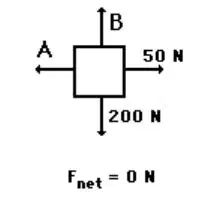
A free-body diagram is shown below. The net force is known. However, the magnitudes of a few of the individual forces are not known. Analyze the diagram and determine the magnitude of the unknown forces.
A= 50 N, B= 50 N
A= 200 N, B= 200 N
A= 200 N, B= 50 N
A= 50 N, B= 200 N
Two students are sitting 1.50 m apart. One student has a mass of 70.0 kg and the other has a mass of 52.0 kg. What is the gravitational force between them?
1.08x10^-7
2.76x10^-9
1.6x10^-12
10.8 x10^-7
85kg
64kg
38 kg
54 kg
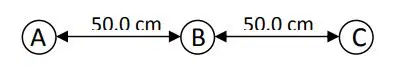
Three objects A, B, C are placed 50.0 cm apart along a straight line. A and B have a mass of 10.0 kg, while C has a mass of 15.0 kg. What is the net force on B due to A and C?
2.33 x10^‐8 N
1.33x10^‐8 N
4.71x10^‐12 N
5.42X10^-9 N

