wayground logo

Free Printable Worksheets

Font size

S
M
L
XL
Worksheets

Chemistry 1 | Final Exam 22/23

Total questions: 50

Worksheet time: 2hrs 28mins

Name
Class
Date
1.
Who is required to wear eye protection (goggles) in the laboratory?
a)

All visitors, unless they are present for less than one minute

b)

Students, but not teachers

c)

Everyone, but only when the chemical look dangerous

d)

Everyone, no exceptions

e)

No one, ever. Goggles are tacky

2.
You have been injured in the laboratory (cut, burn, etc.). First you should...
a)

apply first aid yourself

b)

see a doctor after school

c)

tell the teacher immediately

d)

visit the school nurse after class

e)

cry until the pain goes away

3.
Matter is defined by anything that...
a)
has mass and volume.
b)
has mass only.
c)
takes up space.
d)
neither has mass nor takes up space
4.
Junior Chemist is mad that they failed their test and burned it to ash using a Bunsen burner. Is this an example of a physical or chemical change? Why?
a)
Physical Change - it’s the same substance, only the phase changed
b)
Chemical Change - a new substance has formed
c)
Chemical Change - it’s the same substance, only the phase changed
d)
Physical Change - a new substance has formed
5.
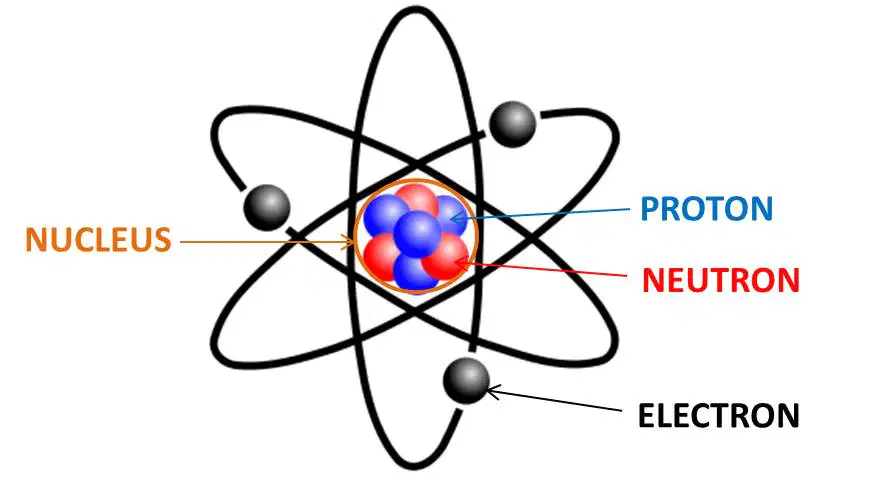
Which of the following statements best describes an atom?
a)
Protons and electrons grouped together in a random pattern
b)
Protons and electrons grouped together in an alternating pattern
c)
A core of electrons and neutrons surrounded by protons
d)
A core of protons and neutrons surrounded by electrons
6.

Table salt (chemical formula NaCl) & water (chemical formula H2O) are examples of…

a)

compounds

b)

elements

c)

mixtures

d)

atoms

7.
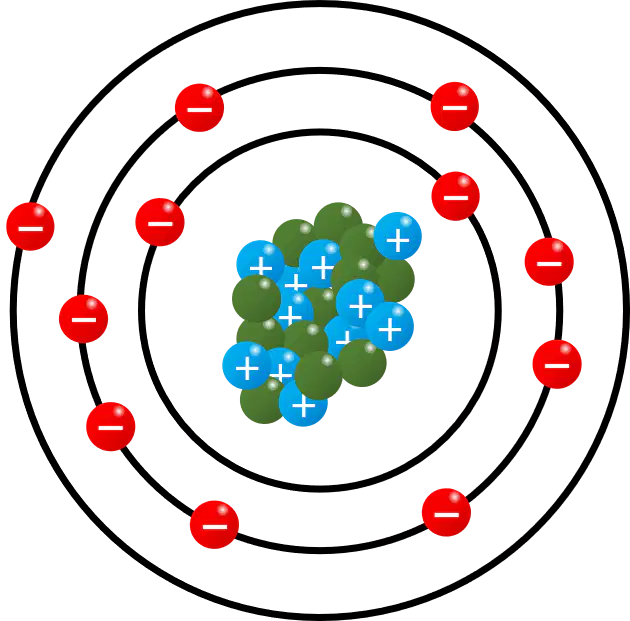
What is the atomic number and mass number of this atom?
a)

The atomic number is 3; the mass number is 7.

b)

The atomic number is 4; the mass number is 7.

c)

The atomic number is 4; the mass number is 6.

d)

The atomic number is 3; the mass number is 6.

e)

The atomic number is 7; the mass number is 10.

8.
An atom of Nitrogen has 7 protons, 7 neutrons, and 8 electrons. What is the overall charge for this atom?
a)

-1 charge

b)

neutral

c)

+1 charge

d)

+2 charge

e)

0 charge

9.
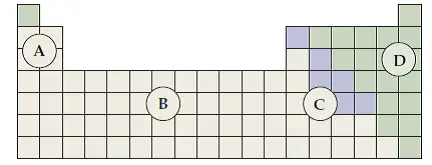
What two sections hold the majority of metals on the Periodic Table?
a)

Sections B & C

b)

Sections B & D

c)

Sections A & B

d)

Sections A & C

e)

None of these

10.

An atom of Oxygen has a -2 overall charge. This O-2 atom is a(n)...

a)

Ration

b)

Anion

c)

Cation

d)

‘Ion-even-kno

11.
An ionic bond will form between...
a)
two ions that have opposite charges
b)
two ions that have similar charges
c)
two nonmetals
d)
two metals
12.

What is the correct chemical formula for a compound formed between a magnesium ion (Mg+2) and a nitrogen ion (N-3)?

a)

MgN

b)

Mg2N3

c)

Mg3N2

d)

MG5N2

13.

Which element in the formula BeBr2 is the anion and what is its charge?

a)

Be +2

b)

Be -1

c)

Br +2

d)

Br -1

14.

Which element in the formula Na2O is the cation and what is its charge?

a)

Na +1

b)

Na -2

c)

O +1

d)

O -1

15.
What is the name for this ionic compound? Ba(OH)2
a)
Barium oxygen hydrogen two
b)
Barium hydroxide
c)
Barium dihydroxide
d)
Barium dihydrogen monoxide
16.
The modern periodic table is arranged (Left-->Right) in order of increasing atomic ____.
a)
mass
b)
charge
c)
number
d)
radius
17.

In the balanced reaction 2CO + O₂ → 2CO₂, what is the ratio of moles of oxygen reacted to moles of CO₂ produced?

a)

1:1

b)

1:2

c)

2:2

d)

2:1

18.
Epsom salt Mg(SO4) is a chemical that can be absorbed through the skin for health-related benefits. What is the chemical name for Mg(SO4)?
a)
Magnesium sulfur oxygen-ide
b)
Magnesium sulfide
c)
Manganese (II) sulfate
d)
Magnesium sulfate
19.

What is the correct name for the chemical formula N4O8?

a)

Teranickel

ochoxide

b)

Tetranitrogen octoxide

c)

Tetranitrogen octaoxygen

d)

Nitrogen oxide

e)

quadranitrogen octaoxygenide

20.
What is the formula for the name pentasulfur hexafluoride?
a)

Na5F6

b)

Na5Fl6

c)

S5Fl6

d)

S5F6

21.
What is the correct formula unit of sodium nitride?
a)
NaN
b)
Na₂N
c)
Na₃N
d)
NaNO₂
22.

"A new movement sweeping the nation is to ban the chemical dihydrogen monoxide." What is the chemical formula for dihydrogen monoxide?

a)

H2O

b)

OHOH

c)

(OH)2

d)

Ho2O

e)

2H + 1O

23.
The process by which one or more substances are rearranged to form different substances is called a...
a)
chemical reaction
b)
classified reaction
c)
mathematical equation
d)
qualitative equation
24.

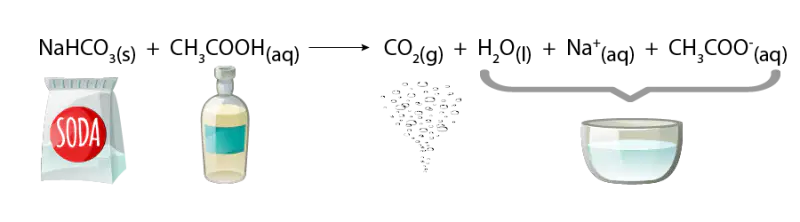
Which of the following are the reactants in the BakingSoda:Vinegar Volcano reaction?

a)

CO2 +

H2O +

NaC2H3O2

b)

CO2 +

H2O

c)

NaHCO3 +

HC2H3O2

d)

nacho3 +

ch3choo

25.
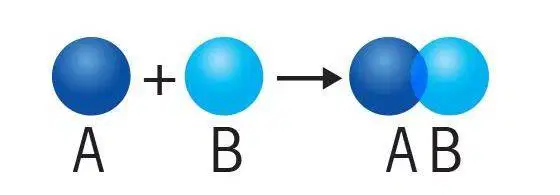
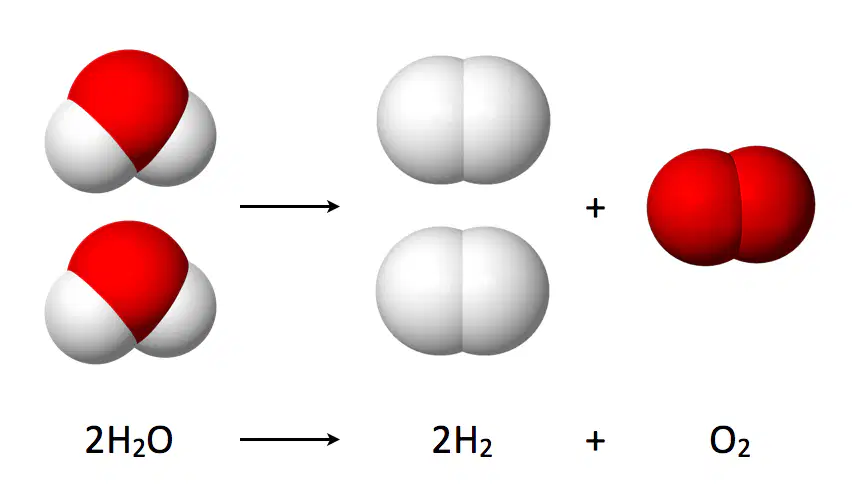
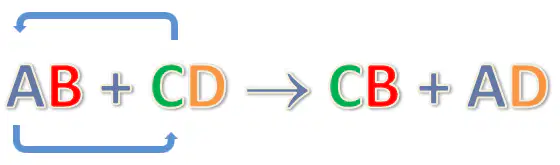
What type of reaction is pictured below?
a)
Combustion
b)
Single Replacment
c)
Synthesis
d)
Decomposition
e)
Double Replacement
26.
What type of reaction involves the breaking down of a substance into simpler substances?
a)
Combustion
b)
Single Replacment
c)
Synthesis
d)
Decomposition
e)
Double Replacement
27.
What type of reaction involves ions from 2 compounds exchanging places to form 2 completely new compounds?
a)
Combustion
b)
Single Replacment
c)
Synthesis
d)
Decomposition
e)
Double Replacement
28.
What is the little number after an element in a chemical equation called. Example: H₂
a)
subscript
b)
coefficient
c)
superscript
d)
equation
29.
How many total oxygens are present?: 3 Mg(OH)2
a)
1
b)
2
c)
5
d)
6
30.

How many total carbons are present?: CaCO3

a)

1

b)

2

c)

3

d)

6

31.
What is the molar mass NaCl?
a)
58 grams
b)
162 grams
c)
22.95 grams
d)
6.02 x 10^23 grams
32.
What is the molar mass H₂O?
a)
18 grams
b)
16 grams
c)
15.99999 grams
d)
6.02 x 10^23 grams
33.
How many moles are in 6.02 x 10^23 molecules of H2O?
a)
6.02 x 10^23 moles
b)
18 moles
c)
6.02 mole
d)
1 mole
34.
What coefficient should be used for oxygen gas (O₂) to correctly balance this equation?
a)
3
b)
4
c)
14
d)
7
35.

Which of the following are the products in the BakingSoda:Vinegar Volcano reaction?

a)

CO2 +

H2O +

NaC2H3O2

b)

CO2 +

H2O

c)

NaHCO3 +

HC2H3O2

d)

nacho3 +

ch3choo

36.

How many total oxygens are present?: CaCO3

a)

1

b)

2

c)

3

d)

6

37.

What atom matches this electron configuration?

1s22s22p63s2

a)

Neon

b)

Magnesium

c)

Aluminum

d)

Potassium

38.

What electron configuration matches an oxygen atom?

a)

1s22s22p63s2, 3p64s23d104p5

b)

1s22s22p4

c)

1s22s22p6

d)

1s22s22p63s23p64s23d1

39.
Which element is pictured?
a)
neon
b)
fluorine
c)
magnesium
d)
argon
40.

Using noble gas notation, calcium is represented by [Ar] 4s2. How many electrons does calcium have?

a)

18

b)

20

c)

22

d)

24

41.
What electron configuration matches an oxygen atom?
a)
1s22s22p63s2, 3p64s23d104p5
b)
1s22s22p4
c)
1s22s22p6
d)
1s22s22p63s23p64s23d1
42.
How many Hydrogen are in 4H2O?
a)

6

b)

8

c)

2

d)

4

e)

1

43.
Which of the following combinations would need roman numerals in the name?
a)
potassium + fluorine
b)
beryllium + oxygen
c)
boron + iodine
d)
silver + oxygen
44.

Group 18 Elements are known as _________ because they have full valence electron shells and are unreactive.

a)

Alkali Metals

b)

Halogen

c)

Noble Gases

d)

Transition Elements

45.

Which one is a transition metal?

a)

Hydrogen (H)

b)

Oxygen (O)

c)

Nickel (Ni)

d)

Phosphorus (P)

46.

What is the formula for potassium carbonate?

a)

K(CO3)2

b)

P3(CO3)2

c)

K2(CO3)

d)

P2(CO3)3

e)

K4C

47.

What is the correct formula for Zinc (II) Bromide?

a)

ZnBr2

b)

Zn2Br2

c)

ZnBr

d)

Zn2Br

e)

Zn3B2

48.

Name the following ionic compound: Cu(NO3)3

a)

cobalt nitrite

b)

copper nitrate

c)

cobalt (III) nitrate

d)

copper (III) nitrate

e)

copper nitrite

49.

What is the mass of one mole of silver?

a)

32.06 g

b)

107.87 g

c)

14.01 g

d)

22.99 g

50.

How many moles are in 6.02 x 10²³ molecules of H2O?

a)

1 mole

b)

17 moles

c)

18 moles

d)

0 moles

e)

6.02 x 10²³ moles