
 Worksheets
Ch. 9 : Muscle Microanatomy Practice Quiz
Total questions: 49
Worksheet time: 25mins
Name
Class
Date
1.
Which muscle tissue(s) are considered to be under INVOLUNTARY control?
a)
Cardiac Muscle
b)
Smooth Muscle
c)
Skeletal Muscle
2.
Which muscle tissue(s) have a banded, or striated, appearance?
a)
Cardiac Muscle
b)
Smooth Muscle
c)
Skeletal Muscle
3.
Which muscle tissue has longitudinally and circularly arranged layers that contract to move materials through tubes?
a)
Cardiac Muscle
b)
Smooth Muscle
c)
Skeletal Muscle
4.
Which muscle is surrounded by dense, connective tissue packaging around LONG muscle fibers?
a)
Cardiac Muscle
b)
Smooth Muscle
c)
Skeletal Muscle
5.
Which muscle's coordinated stimulus activity allows it to act as a pump?
a)
Cardiac Muscle
b)
Smooth Muscle
c)
Skeletal Muscle
6.
Which muscle moves bones and the facial skin?
a)
Cardiac Muscle
b)
Smooth Muscle
c)
Skeletal Muscle
7.
Which muscle tissue is considered to be under VOLUNTARY control?
a)
Cardiac Muscle
b)
Smooth Muscle
c)
Skeletal Muscle
8.
Which muscle contains INTERCALATED discs?
a)
Cardiac Muscle
b)
Smooth Muscle
c)
Skeletal Muscle
9.
Which muscle moves blood through blood vessels and food through the digestive tract?
a)
Cardiac Muscle
b)
Smooth Muscle
c)
Skeletal Muscle
10.
Which muscle's contraction resembles a snake consuming its prey?
a)
Cardiac Muscle
b)
Smooth Muscle
c)
Skeletal Muscle
11.
Which muscle is damaged by a cardiac infarction (heart attack)?
a)
Cardiac Muscle
b)
Smooth Muscle
c)
Skeletal Muscle
12.
Which muscle works with the skeletal system to move the body?
a)
Cardiac Muscle
b)
Smooth Muscle
c)
Skeletal Muscle
13.
Choose the word in the grouping that DOES NOT BELONG with the others.
a)
bones
b)
small intestine
c)
blood vessels
d)
smooth muscle
14.
Choose the word in the grouping that DOES NOT BELONG with the others.
a)
heart
b)
cardiac muscle
c)
blood pump
d)
movement of the eye
15.
Choose the word in the grouping that DOES NOT BELONG with the others.
a)
shortens
b)
contractility
c)
pull on bones
d)
peristalsis (swallowing action)
16.
Choose the word in the grouping that DOES NOT BELONG with the others.
a)
maintains posture
b)
locomotion of the body
c)
intercalated discs
d)
generates heat
17.
Choose the word in the grouping that DOES NOT BELONG with the others.
a)
striated
b)
multi-nucleated
c)
skeletal muscle
d)
stomach
18.
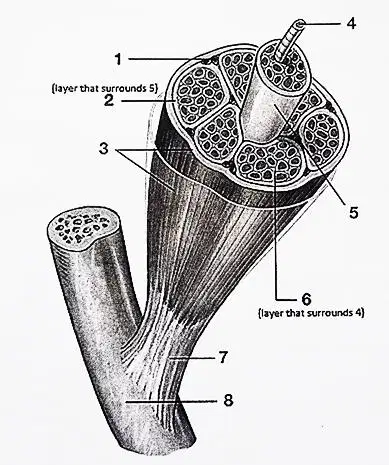
Identify # 1 in the picture. (hint: they are normally blood and red)
a)
blood vessels
b)
endomysium
c)
fascicle
d)
bone
e)
perimysium
19.
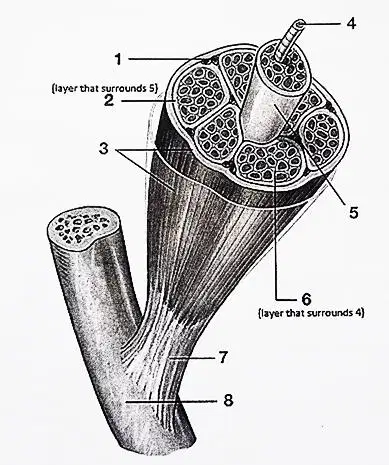
Identify # 2 in the picture.
a)
perimysium
b)
endomysium
c)
fascicle
d)
bone
e)
tendon
20.
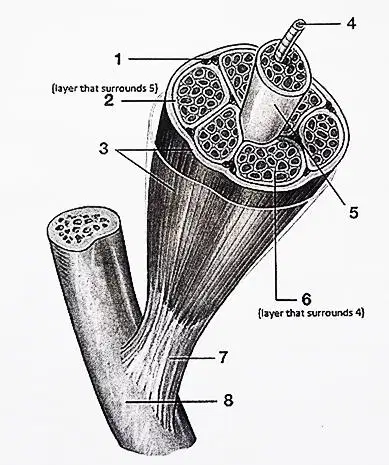
Identify # 3 in the picture.
a)
epimysium
b)
endomysium
c)
fascicle
d)
bone
e)
perimysium
21.
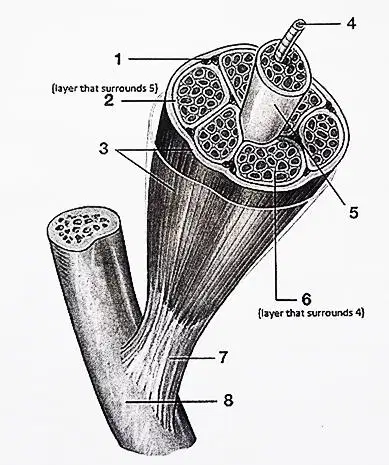
Identify # 4 in the picture.
a)
muscle fiber (cell)
b)
endomysium
c)
fascicle
d)
bone
e)
perimysium
22.
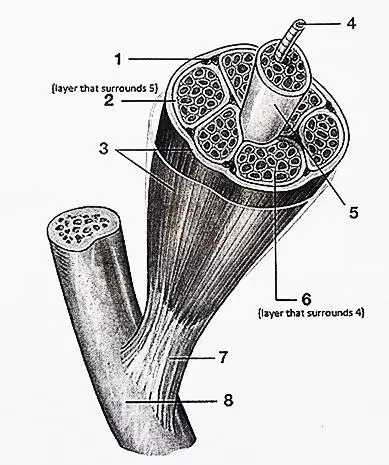
Identify # 5 in the picture.
a)
fascicle
b)
endomysium
c)
bone
d)
perimysium
e)
tendon
23.
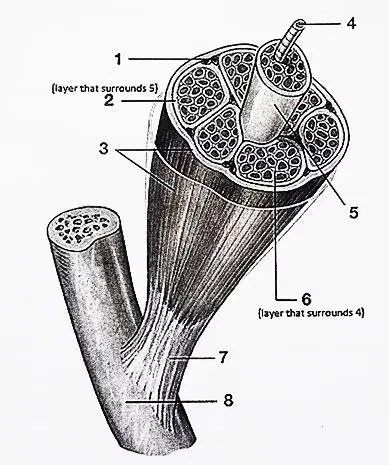
Identify # 6 in the picture.
a)
endomysium
b)
fascicle
c)
bone
d)
perimysium
e)
tendon
24.
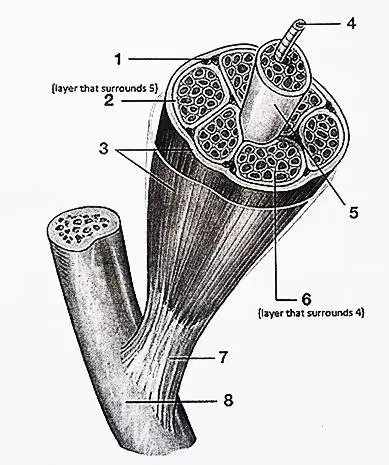
Identify # 7 in the picture.
a)
tendon
b)
endomysium
c)
fascicle
d)
bone
e)
perimysium
25.
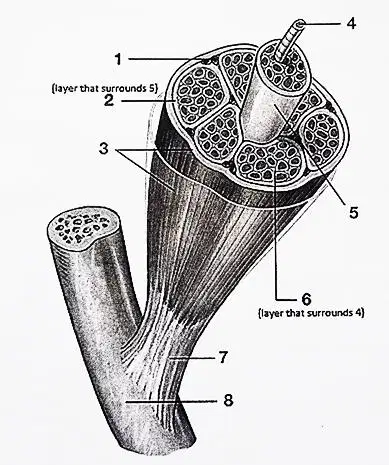
Identify # 8 in the picture.
a)
bone
b)
endomysium
c)
fascicle
d)
perimysium
e)
tendon
26.
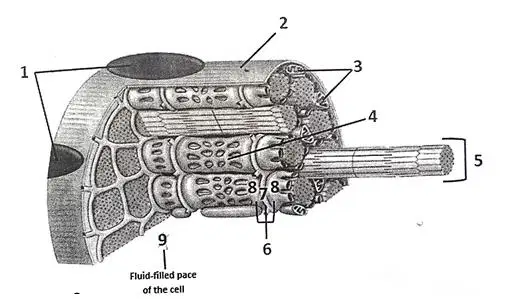
Identify #1 in the picture.
a)
nucleus
b)
sarcoplasm
c)
sarcoplasmic reticulum
d)
T-tubule
e)
myofibril
27.
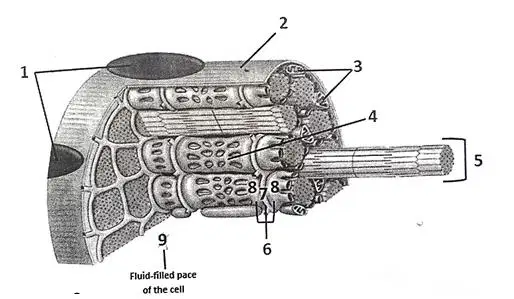
Identify #2 in the picture.
a)
sarcolemma
b)
sarcoplasm
c)
sarcoplasmic reticulum
d)
T-tubule
e)
myofibril
28.
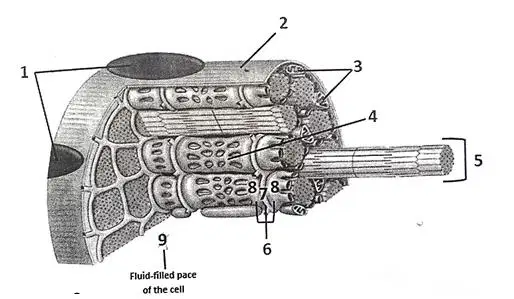
Identify #3 in the picture.
a)
mitochondria
b)
sarcoplasm
c)
sarcoplasmic reticulum
d)
T-tubule
e)
myofibril
29.
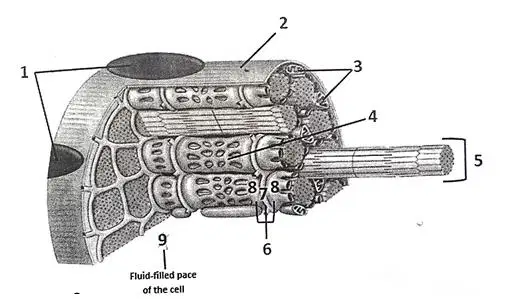
Identify #4 in the picture.
a)
sarcoplasmic reticulum
b)
sarcoplasm
c)
T-tubule
d)
myofibril
e)
mitochondria
30.
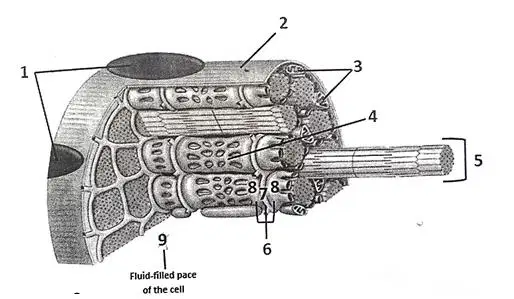
Identify #5 in the picture.
a)
myofibril
b)
sarcoplasm
c)
sarcoplasmic reticulum
d)
T-tubule
e)
mitochondria
31.
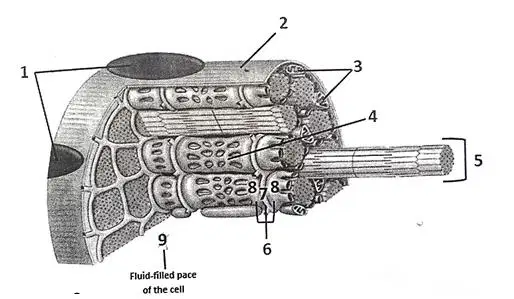
Identify #6 in the picture.
a)
triad
b)
sarcoplasm
c)
sarcoplasmic reticulum
d)
T-tubule
e)
myofibril
32.
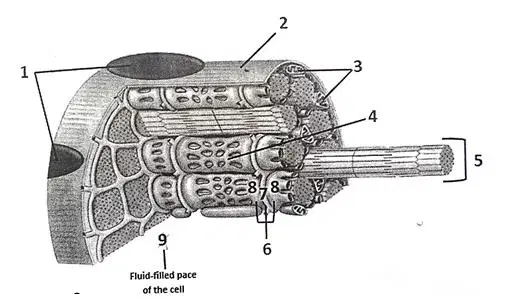
Identify #7 in the picture.
a)
T-tubule
b)
sarcoplasm
c)
sarcoplasmic reticulum
d)
myofibril
e)
mitochondria
33.
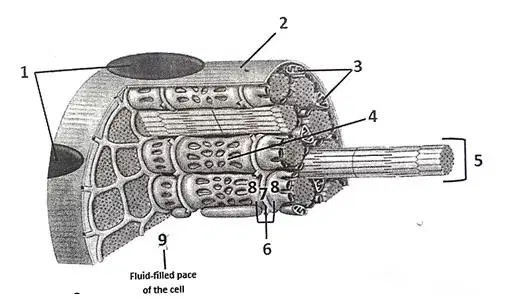
Identify #8 in the picture.
a)
terminal cisternae
b)
sarcoplasm
c)
sarcoplasmic reticulum
d)
T-tubule
e)
myofibril
34.
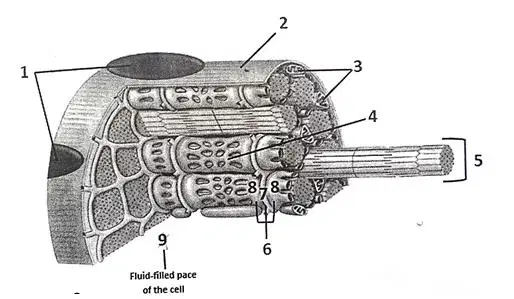
Identify #9 in the picture.
a)
sarcoplasm
b)
sarcoplasmic reticulum
c)
T-tubule
d)
myofibril
e)
mitochondria
35.
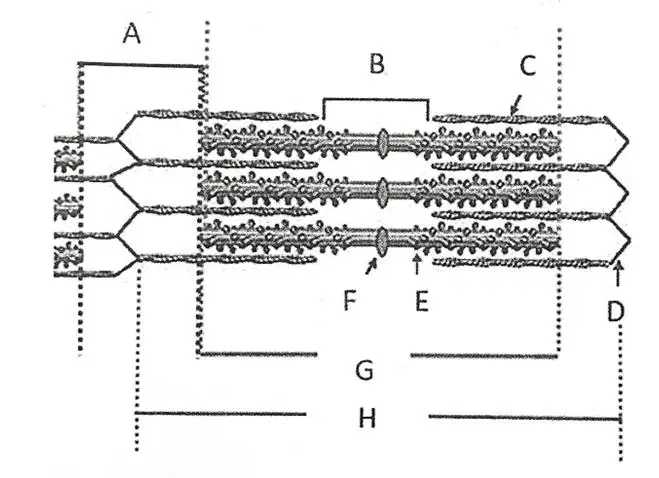
Identify letter A in the sarcomere.
a)
I-Band, or light band
b)
A-Band, or dark band
c)
Z-Line
d)
M-Line
e)
H-Zone, which decreases in length when a muscle contracts
36.
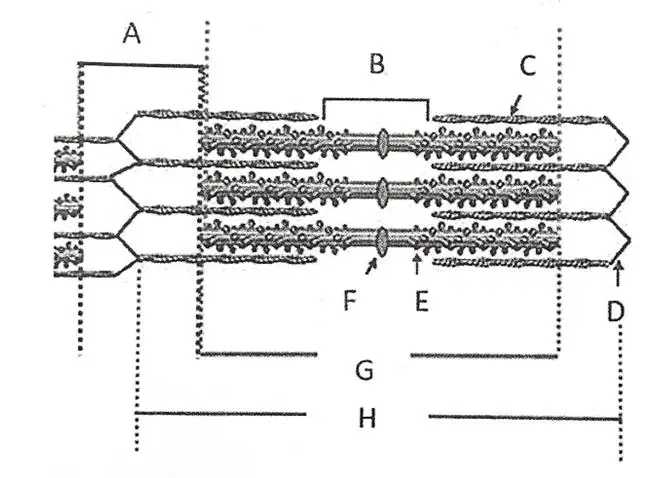
Identify letter B in the sarcomere.
a)
H-Zone, which decreases in length when a muscle contracts
b)
I-Band, or light band
c)
A-Band, or dark band
d)
Z-Line
e)
M-Line
37.
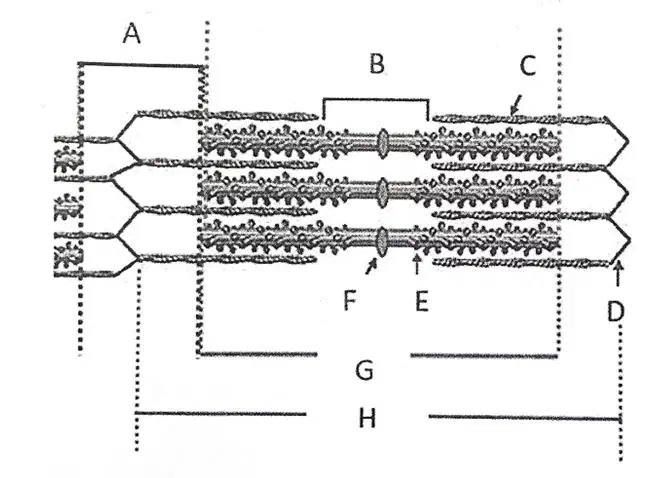
Identify letter C in the sarcomere.
a)
Actin, or thin filament
b)
I-Band, or light band
c)
A-Band, or dark band
d)
Z-Line
e)
M-Line
38.
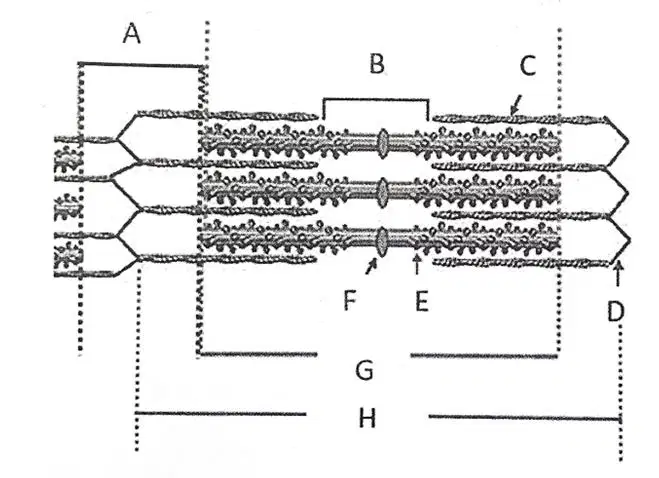
Identify letter D in the sarcomere.
a)
Z-Line
b)
I-Band, or light band
c)
A-Band, or dark band
d)
M-Line
e)
H-Zone, which decreases in length when a muscle contracts
39.
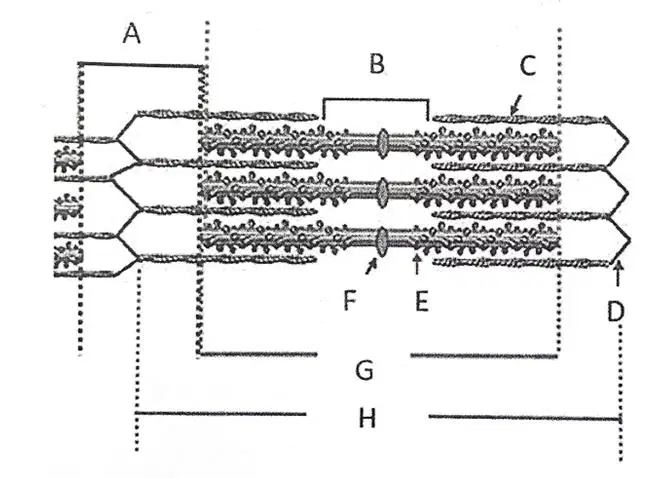
Identify letter E in the sarcomere.
a)
Myosin, or thick filament
b)
I-Band, or light band
c)
A-Band, or dark band
d)
Z-Line
e)
M-Line
40.
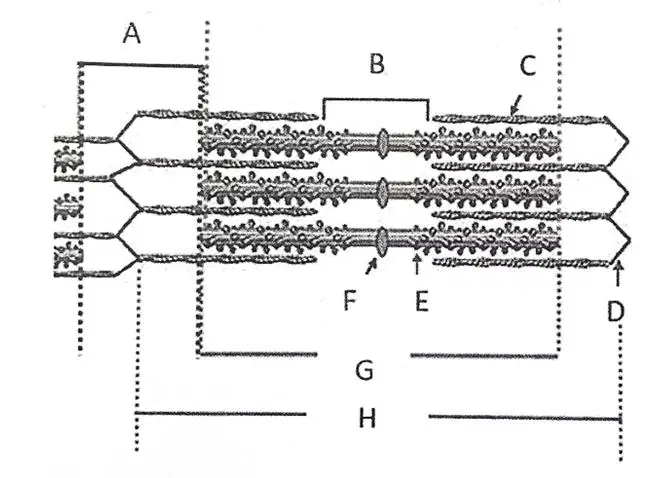
Identify letter F in the sarcomere.
a)
M-Line
b)
I-Band, or light band
c)
A-Band, or dark band
d)
Z-Line
e)
H-Zone, which decreases in length when a muscle contracts
41.
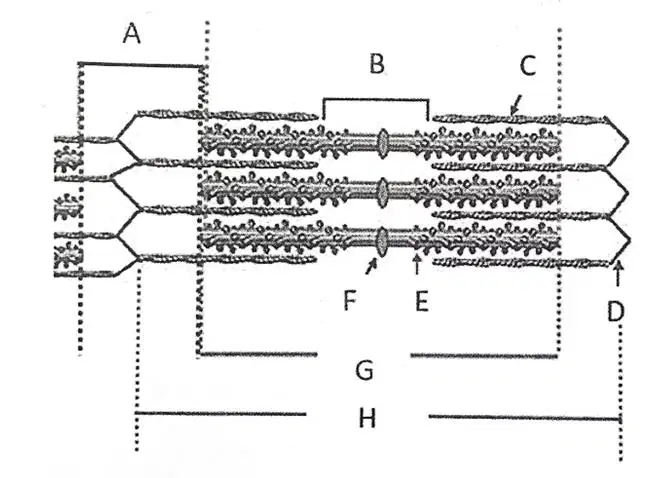
Identify letter G in the sarcomere.
a)
A-Band, or dark band
b)
I-Band, or light band
c)
Z-Line
d)
M-Line
e)
H-Zone, which decreases in length when a muscle contracts
42.
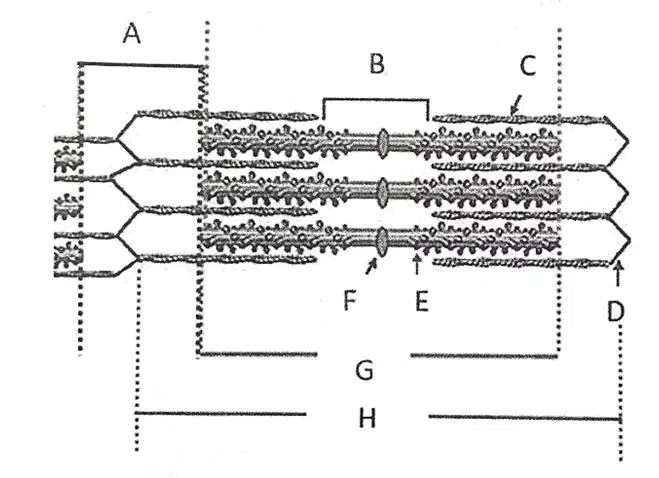
Identify letter H in the sarcomere.
a)
Sarcomere, or primary contractile unit of a muscle fiber
b)
I-Band, or light band
c)
A-Band, or dark band
d)
Z-Line
e)
M-Line
43.
According to the sliding filament theory of muscle contraction:
a)
muscle fibers contain thin myofilaments made up of a protein called myosin.
b)
muscle fibers contain thick myofilaments made up of a protein called actin.
c)
Thin and thick myofilaments bind to cause muscle contraction.
d)
All of the above.
44.
When an organism dies, its muscles may remain in a contracted state called RIGOR for a period of time. Which of the following is most directly responsible for this phenomenon?
a)
no energy for the synthesis of actin and myosin
b)
no ATP to detach the cross-bridges between the thin and thick myofilaments
c)
no calcium to bind to the myofilaments
d)
no lactic acid present in the muscle
45.
TURN ON CAPS LOCK! _______________________attach muscles to bone, ______________________attach bones to bones
(a)
46.
TURN ON CAPS LOCK! During muscle contraction (a) ions must be present to start the binding of the actin and myosin
47.
TURN ON CAPS LOCK! (a) is one type of protein that prevents the attachment of actin and myosin
48.
TURN ON CAPS LOCK! Thin myofilaments are called ________________and thick myofilaments are called _______________.
(a)
49.
TRUE or FALSE: This is the correct order of events for muscle contraction: Thin and thick myofilaments attach by means of a cross-bridge and ATP “readies” myosin for the power stroke movement. A nerve impulse reaches the muscle, triggering the release of calcium ions into the cytoplasm of the muscle cell. ATP “breaks” the myofilament bridge, relaxation occurs, and Ions are pumped back into the sarcoplasmic reticulum. Released ions cause the troponin-tropomyosin complex to roll away and prepares actin to bind to myosin
a)
True
b)
False
100 %

