wayground logo

Free Printable Worksheets

Font size

S
M
L
XL
Worksheets

Ecology Test Review

Total questions: 49

Worksheet time: 33mins
Name
Class
Date
1.
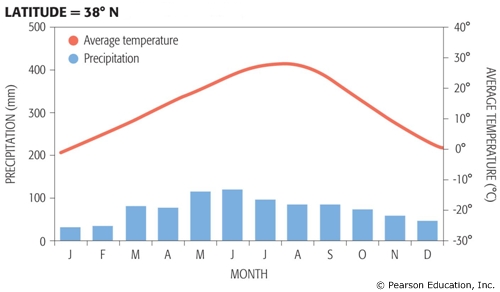
The biome that is best described by this climate graph is...
a)
Tundra
b)
Rain Forest
c)
Desert
d)
Grasslands
2.
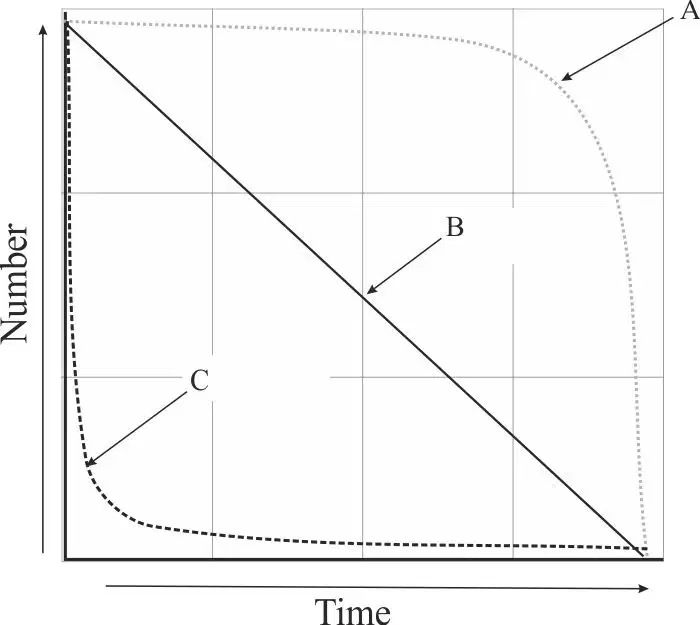
Which survivorship curve best describes insects (ex- mosquitoes)?
a)
A
b)
B
c)
C
3.
Which factor is a density-dependent limiting factor on the population of a species?
a)
Predation
b)
Temperature
c)
Natural disasters
d)
Seasonal Variation
4.
All of the organisms of the same species living in the same geographic area?
a)
population
b)
community
c)
ecology
d)
species
5.
During photosynthesis, producers convert carbon dioxide and other materials to:
a)
Lipids
b)
Amino Acids
c)
Nucleic Acids
d)
Sugars
6.
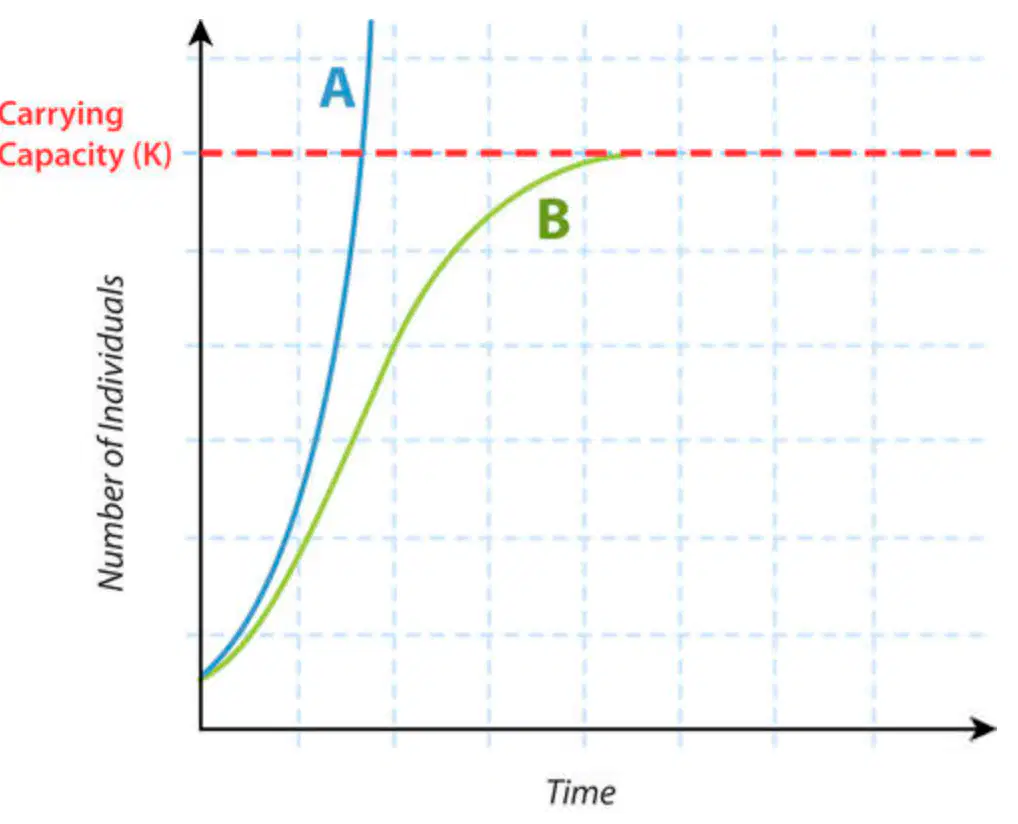
In the image shown below, which graph shows EXPONENTIAL growth?
a)
A
b)
B
c)
Neither of the above
7.
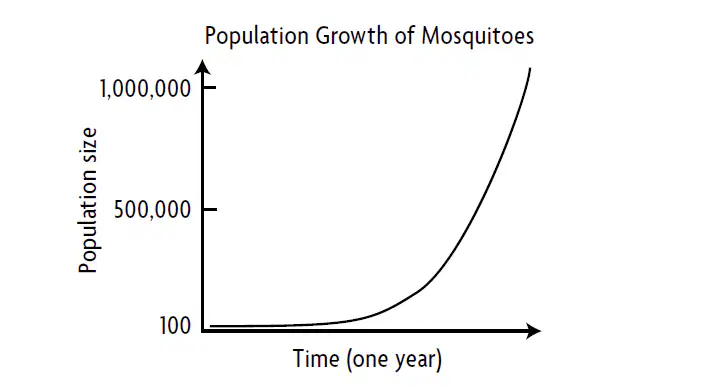
The graph describes the population of mosquitoes in a pond over the course over the course of one summer Which statement best describes the growth of the mosquitoes?
a)
Linear growth occurs becuase the pond provides abundant but not limited resources over the course of the year
b)
Exponential growth occurs because the lake provides unlimited resources over the course of the year
c)
Logistic growth occurs because the lake provides unlimited resources over the course of the year
d)
Fluctuating growth patterns are observed because the mosquitoes reached their carrying capacity early in the year
8.
An ecologist studying a in forest gathers the following data. Birthrate~ 50 deer/year Death rate~ 70 deer/year The ecologist observes that over time the population change is not changing- what must be occurring?
a)
About 20 deer per year immigrate to the forest
b)
About 20 deer per year emigrate from the forest
c)
The average life span of deer in the forest is 20 years
d)
The deer population has reached it's carrying capacity
9.
Of the following lists of factors relating to an ecosystem, which list contains only abiotic factors?
a)
Sunlight, green plants, rainfall, consumers, oxygen
b)
Sunlight, climate, rainfall, minerals, gases
c)
Sunlight, green plants, rainfall, producers, carbon dioxide
d)
Sunlight, rainfall, consumers, producers, water
10.
Which is a description of climate, not weather?
a)
Summer is wetter and warmer than winter
b)
A hurricane is likely to reach Southern California this afternoon
c)
The air today is more humid than it was yesterday
d)
No rain is likely for the next week
11.
An increase in the concentration of greenhouse gasses in Earth's atmosphere would have which of the these effects on temperature?
a)
a decrease in average temperatures on Earth's surface
b)
an increase in average temperatures on Earth's surface
c)
an increase in average temperatures in the upper atmosphere
d)
a decrease in average temperature within all Earth's systems
12.
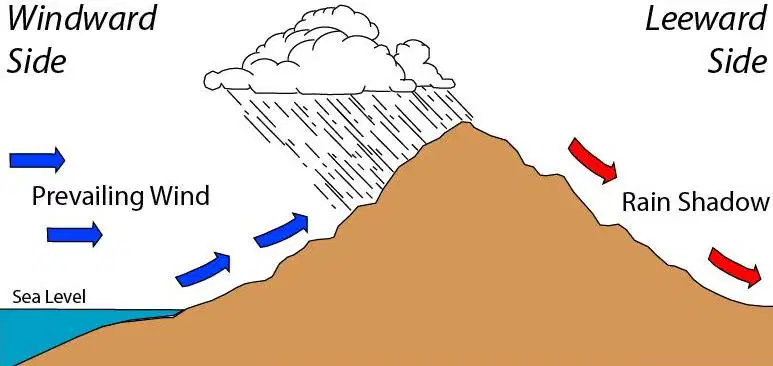
The diagram shows that one side of the mountain range tends to receive more precipitation than the other side Which statement is most useful for explaining this observation
a)
Winds always move from West to East
b)
Water vapor condenses to form liquid water
c)
Evaporation allows water vapor to rise through the air
d)
Cold air holds less moisture than warm air
13.
The biological process that removes Carbon Dioxide from the air is...
a)
Photosynthesis
b)
Cellular Respiration
c)
lactic acid fermentation
d)
burning fossil fuels
14.
A carbon molecule stored on the deep ocean floor is consumed by a deep ocean organism- What best describes this process?
a)
Atmosphere-> Biosphere
b)
Biosphere-> Lithosphere
c)
Lithosphere-> Biosphere
d)
Lithosphere-> Atmosphere
15.
Which of the following best describes the hydrosphere
a)
Water that is only found on the surface of the earth- not underground or in the atmosphere
b)
Water that is found underground
c)
Salt water that is found in the oceans, but not fresh water
d)
Water that is found in any location on Earth, above ground, below ground, or in the atmosphere
16.
Ecology includes studying ecosystems at different levels. Which is the largest or broadest level?
a)
Biosphere
b)
Biome
c)
Species
d)
Community
e)
Population
17.
The area directly around Lincoln High School can best be described as ....
a)
an ecosystem
b)
an anthrome
c)
a biome
d)
an ecological network
18.

Which of the following is an example of an abiotic factor affecting a population?

a)

Spread of disease

b)

A prolonged drought

c)

Competition for mates

d)

Predation by wolves

19.

If a population exceeds its carrying capacity, what is the most likely outcome?

a)

The population will continue to grow exponentially

b)

Resources will become more abundant

c)

The population size will decrease due to limited resources

d)

The carrying capacity will increase automatically

20.

Which line represents the carrying capacity of this population?

21.

This is a(n) ​ (a)   growth curve. This applies when resources are ​ (b)   for a population.

Choose from the below words
exponential
unlimited
logistic
limited
22.

Identify this populations carrying capacity

23.

Match the following

a)

movement of individuals out of an area

1.

emigration

b)

movement of individuals into an area

2.

immigration

c)

largest number of individuals in a population that the environment can support

3.

carrying capacity

24.

Match the following

a)

density independent

1.

weather

b)

density dependent

2.

disease

c)

natural disaster

3.

density independent

d)

biotic

4.

living

e)

abiotic

5.

non-living

25.

Bacteria exhibit ​ (a)   growth due to rapid reproduction. Animals have ​ (b)   due to slower reproduction. In an ecosystem the ​ (c)   is the maximum number of organisms an ecosystem can support. ​ (d)   determine the carrying capacity.

Choose from the below words
exponential
logistical growth
carrying capacity
limiting factors
biotic
density dependent
abiotic
26.

Which of the following is an example of a biotic factor interacting with an abiotic factor in an ecosystem?

a)

A fish swimming in pond water

b)

Wind blowing through a forest canopy

c)

Sunlight warming the surface of a rock

d)

Rainwater evaporating from the soil

27.

What is the main reason why populations cannot grow exponentially forever in a natural ecosystem?

a)

All individuals live to old age

b)

Resources become limited over time

c)

Climate remains constant

d)

Predators always increase in number

28.

Which of the following best describes a community in an ecosystem?

a)

All the plants in a forest

b)

All the individuals of one species in an area

c)

All the abiotic factors in an area

d)

All the populations of different species living together in an area

29.

Which process adds carbon dioxide to the atmosphere?

a)

Absorption by plants

b)

Formation of fossil fuels

c)

Cellular respiration

d)

Photosynthesis

30.

Which of the following is an abiotic factor that can influence the distribution of organisms in an ecosystem?

a)

Temperature

b)

Predation

c)

Parasitism

d)

Competition

31.

Which process in the carbon cycle removes carbon dioxide from the atmosphere?

a)

Photosynthesis

b)

Respiration

c)

Combustion

d)

Decomposition

32.

The most important abiotic factors when studying biomes are...

a)

Soil and Freshwater

b)

Producers and Consumers

c)

Native Plants and Animals

d)

Precipitation and Temperature

33.

A large ecosystem is called a/an ---

a)

Ecosystem.

b)

Habitat.

c)

Biome.

d)

Niche.

34.

The biome shown in the climatogram above would best be described as a:

a)

temperate deciduous forest

b)

desert

c)

tundra

d)

tropical rain forest

35.

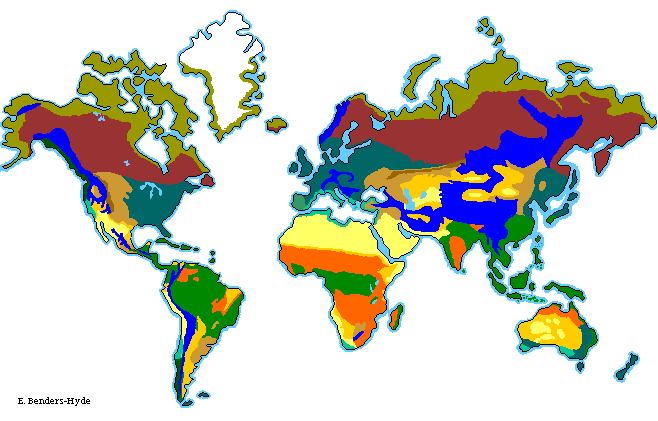
According to the diagram, which of the following both have large amounts of precipitation?

a)

desert & tropical rain forest

b)

seasonal forest & tundra

c)

tundra & desert

d)

tropical rain forest & temperate rain forest

36.

What factors influence the type of plants grow in a biome?

a)

temperature & precipitation

b)

temperature only

c)

precipitation only

d)

none of these

37.
Look at the following graph to determine biome
a)
Savanna Grassland
b)
Chapparal
c)
Desert
d)
Tundra
38.

environmental factors that cause a population to stop growing or decrease in size

a)

carrying capacity

b)

limiting factor

c)

ecosystem

d)

community

39.

If a disease that destroyed oak trees came through an ecosystem, what would happen to the acorn eating squirrel population?

a)

nothing - it would stay the same

b)

the squirrel population would increase

c)

the squirrel population would decrease

d)

none of the above

40.

What is the carrying capacity of the graph?

a)

around 500

b)

800

c)

300

41.
What is the carrying capacity of the following graph?
a)
1000
b)
8000
c)
800
d)
600
42.
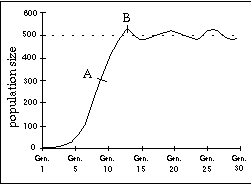
What point on the graph represents the carrying capacity?
a)
A
b)
B
c)
C
d)
D
43.

The term greenhouse effect

a)

describes efforts by the White House to support environmental legislation.

b)

describes the trapping of heat energy in the troposphere by certain gaseous molecules.

c)

describes the trapping of heat energy in the stratosphere by nitrogen

d)

describes the trapping of heat energy in the troposphere by nitrogen.

44.
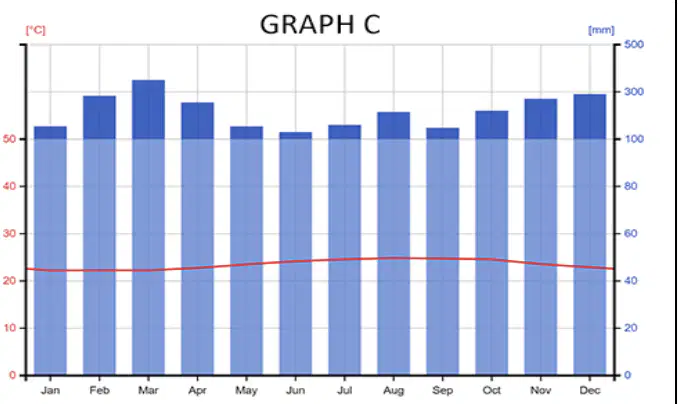
Look at the following graph and determine the biome
a)
Tropical Rain forest
b)
Temperate Grassland
c)
Taiga (Boreal Forest)
d)
Tundra
45.

Which of the following biomes is characterized by low precipitation and extreme temperature variations?

a)

Taiga

b)

Desert

c)

Temperate Deciduous Forest

d)

Tropical Rain Forest

46.

Which of the following is an example of a biotic factor in an ecosystem?

a)

Temperature

b)

Sunlight

c)

Rainfall

d)

Predation

47.

What is the primary abiotic factor that distinguishes a desert from a grassland?

a)

Presence of trees

b)

Average temperature

c)

Precipitation levels

d)

Soil type

48.

Which of the following is an abiotic factor that can limit the growth of a population?

a)

Predation

b)

Competition

c)

Parasitism

d)

Temperature

49.

What is the main source of energy for producers in most ecosystems?

a)

Sunlight

b)

Soil nutrients

c)

Oxygen

d)

Carbon dioxide