
 Worksheets
Earth's Past: Fossils, Relative-Dating, Absolute-Dating
Total questions: 51
Worksheet time: 26mins
Name
Class
Date
1.
After one half life, the percent of parent atoms to daughter atoms in a sample is 25% parent and 75% daughter.
a)
True
b)
False
2.
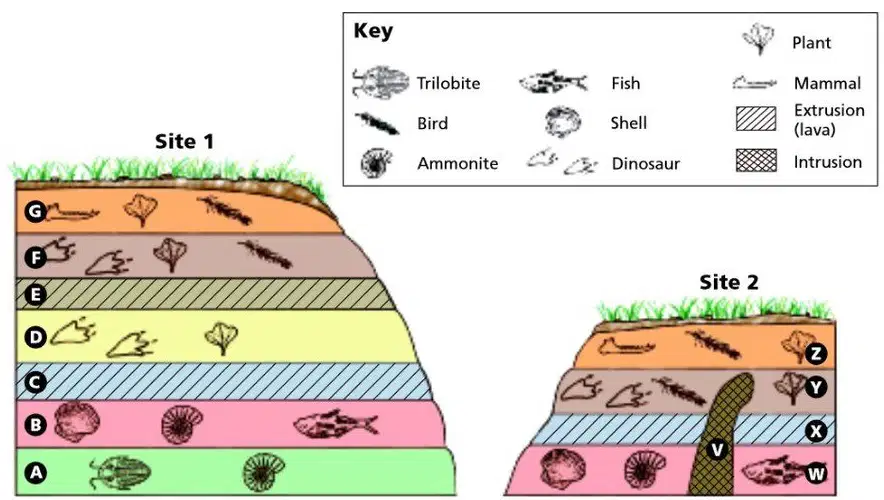
What type of fossil is found in the most different layers in both sites together?
a)
dinosaur
b)
plant
c)
ammonite
d)
bird
3.
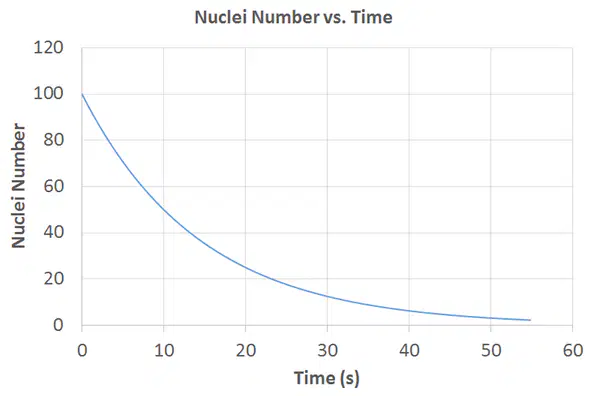
Observe the graph below to determine the half-life of this element.
a)
15 seconds
b)
5 seconds
c)
10 seconds
d)
20 seconds
4.
Radiocarbon dating is a useful tool in dating the age of the Earth.
a)
True
b)
False
5.
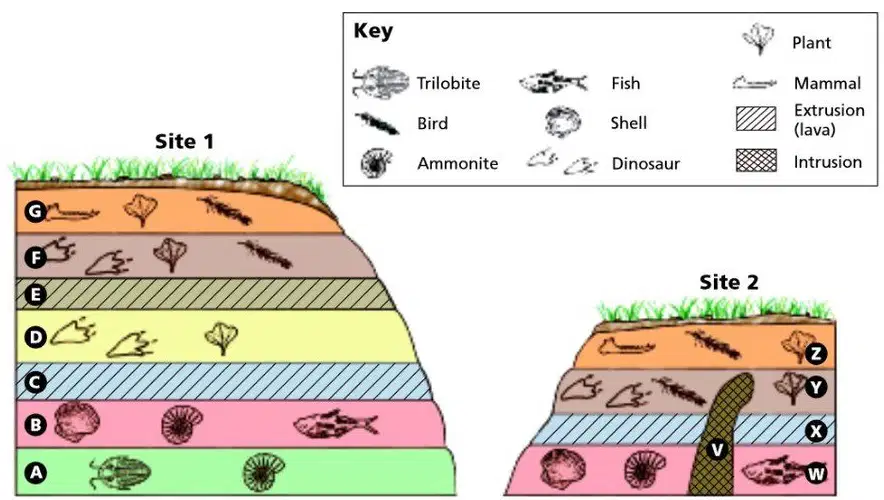
Compare the ages of intrusion v and layer w.
Intrusion V is ________________ than layer W?
a)
older
b)
younger
6.
Geologists can match exposed rock layers to correlate the two rock formations in different areas.
a)
True
b)
False
7.
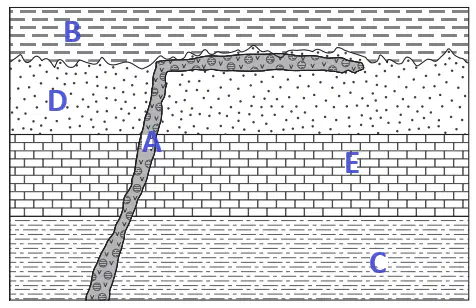
Compare the ages of the rock layers below by putting the rock layers below in order from oldest to youngest.
a)
B, D, A, E, C
b)
B, D, E, C, A
c)
C, E, A, D, B
d)
C, E, D, A, B
8.
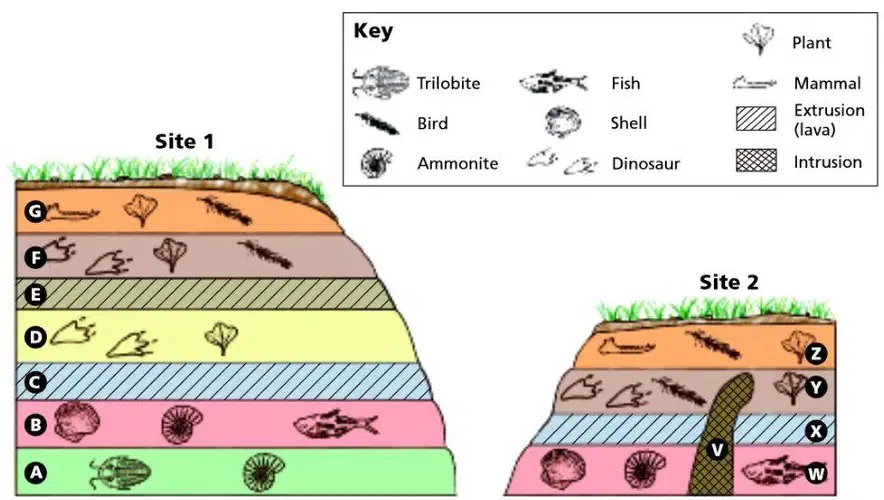
Observe the layers of Earth below to determine if the Trilobite should be considered an index fossil in this diagram?
a)
yes, the trilobite is an index fossil
b)
no, the trilobite is not an index fossil
9.
Dinosaur footprints are an example of original remains.
a)
True
b)
False
10.
Nonconformities occur when sedimentary rocks are deposited on top of uplifted and eroded metamorphic or igneous rocks.
a)
True
b)
False
11.
Carbon films are formed when a thin film of carbon is left, forming a outline of the original organism.
a)
True
b)
False
12.
The principle of uniformitarianism states that sedimentary rocks are deposited in horizontal layers.
a)
True
b)
False
13.
According to the principle of superposition, the youngest rock layers are closest to the surface.
a)
True
b)
False
14.
Index fossils are the remains of species that existed on Earth for relatively short periods of time.
a)
True
b)
False
15.
Index fossils are useful to geologists if the fossils ____.
a)
have lived over a short period of time
b)
are not easily recognized
c)
are not widely distributed geographically
d)
are scarce
16.
Determining the order of events and the relative age of rocks by examining the position of rocks in a sequence is called ____.
a)
absolute dating
b)
radiometric dating
c)
relative dating
d)
radiocarbon dating
17.
Rock layers are correlated if they both contain the same ____.
a)
elements
b)
shapes
c)
fossils
d)
type of rock
18.
An example of a fossil with original preservation includes a(n) ____.
a)
insect imbedded in amber
b)
coprolite
c)
dinosaur footprint
d)
mold of a fish skeleton
19.
An example of a trace fossil includes a ____.
a)
cast of a clam
b)
nests
c)
mud crack
d)
raindrop impression
20.
When part of the rock record is destroyed, the erosional gap that forms is a(n) ____.
a)
inclusion
b)
key bed
c)
unconformity
d)
superposition
21.
Which statement is NOT true regarding Earth’s past climate?
a)
Earth was very warm 100 million years ago.
b)
A shallow ocean covered much of North America 450 million years ago.
c)
Tropical forests and swamps covered much of Earth’s surface many years ago.
d)
Earth’s climate has stayed the same throughout the past.
22.
What characteristic of radioactive decay makes it useful for determining the absolute age of samples?
a)
occurs at a constant rate
b)
changes based on temperature
c)
speeds up under high pressure
d)
slows down in very dense samples
23.
What is the hardened tree sap that fossil insects are preserved in?
a)
trace fossils
b)
gastroliths
c)
coprolites
d)
amber
24.
The amount of time it takes for one-half of the original amount of an isotope to decay is known as its ____.
a)
correlation
b)
half-life
c)
period
d)
radioactivity
25.
The principle of superposition can be used to determine.
a)
the actual age of these rock layers
b)
the relative densities of these rock layers
c)
the actual temperatures of these rock layers
d)
the relative age of these rock layers
26.
Which statement goes in the middle?
Fish -> ________________________ -> Carbon Film
a)
preserved in amber
b)
pressure that removes all gases and liquids from organism’s tissues
c)
replacing organism with minerals
d)
tracks left behind in soft sediment
27.
Which of the following is used to determine the absolute age of a rock?
a)
relative-age dating
b)
correlation
c)
permineralization
d)
radiometric dating
28.
Using carbon-14 (with a half-life of 5,730) is one way to measure the age of the remains of organisms. Which correctly describes the one limitation in using this particular type of dating?
a)
An organism continues to take in carbon-14 long after it has died. First scientists must determine the life-span of the organism before making an accurate prediction.
b)
The half-life of carbon-14 is only 5,730 years making it difficult to measure very old organisms.
c)
The ratio of carbon-14 and carbon-12 is not equal in the atmosphere. In order to find an accurate measurement, carbon-12 must also be measured.
d)
Organisms use nitrogen to build and repair tissues. Measuring the amount of nitrogen combined with carbon is the only way to get an accurate time frame.
29.
The oldest rock layer in an undisturbed rock sequence occurs ____.
a)
at the bottom of the sequence
b)
below the sedimentary rock layer
c)
below the unconformity
d)
at the top of the sequence
30.
With ____ dating, a rock's exact age can be determined, whereas with ____ dating, a rock's age is compared to the ages of other rocks.
a)
absolute, relative
b)
relative, absolute
c)
true, absolute
d)
relative, approximate
31.
Molds, casts, trace, and petrified wood are all example of ____.
a)
fossils
b)
radioactive isotopes
c)
unconformities
d)
disconformities
32.
What would change in the following picture to represent an isotope of the element chlorine?
Element = Chlorine
Atomic Number = 17
Atomic Mass Number = 35.453
State of Matter = Gas
Symbol = Cl
a)
Element - chlorine becomes argon after turning into an isotope
b)
Atomic Number - the number of protons increases which makes 17 become 18
c)
State of Matter - chlorine would become a liquid after turning into an isotope
d)
Atomic Mass - adding neutrons to protons increases the atomic mass
33.
A ______ may tell a paleontologist when, where, and how an organism lived.
a)
fossil
b)
remains
c)
mold
d)
hard
e)
missing layer
34.
A ______ is the cavity left behind in the rock after an organism's hard part has decayed.
a)
mold
b)
remains
c)
fossil
d)
hard
e)
missing layer
35.
Fossils up to 50,000 years old can be dated with ______.
a)
carbon-14
b)
remains
c)
fossil
d)
mold
e)
hard
36.
The ______ parts of organisms are most likely to become fossils.
a)
hard
b)
remains
c)
fossil
d)
mold
e)
missing layer
37.
Fossils are the ______, imprints, or traces of once-living organisms preserved in rock.
a)
remains
b)
fossil
c)
mold
d)
hard
e)
missing layer
38.
An unconformity is a ______ of rock.
a)
missing layer
b)
remains
c)
fossil
d)
mold
e)
hard
39.
Preserved animal tracks are called ______ fossils.
a)
trace
b)
remains
c)
fossil
d)
mold
e)
hard
40.
is measured in half-lives
a)
radioactive decay
b)
remains
c)
fossil
d)
mold
e)
hard
41.
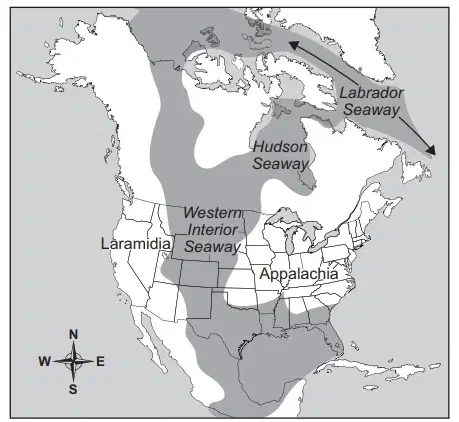
The map shows how North America looked approximately 100 million years ago. There are five main areas labeled on the map. The shaded area represents where water had flooded over North America. Identify the main areas of North America on the map where people would expect to find 100-million-year-old sedimentary rocks that contain fossils of microscopic ocean organisms.
a)
Hudson Seaway
b)
Appalachia
c)
Western Interior Seaway
d)
Labrador Seaway
e)
Laramidia
42.
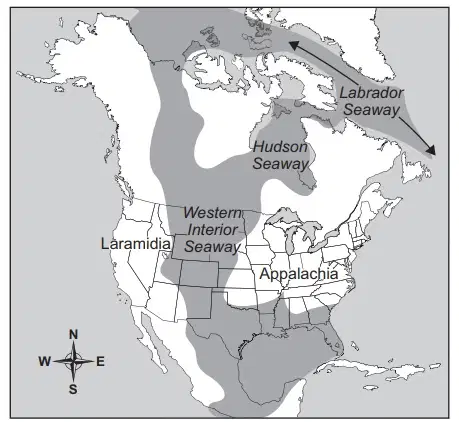
The map shows how North America looked approximately 100 million years ago. There are five main areas labeled on the map. The shaded area represents where water had flooded over North America.
Oil and gas are formed from the remains of microscopic ocean organisms. A student claims that the oil and gas deposits in California are about 100 million years old. Based on the map, decide whether you agree or disagree with the student's claim.
a)
Agree
b)
Disagree
43.
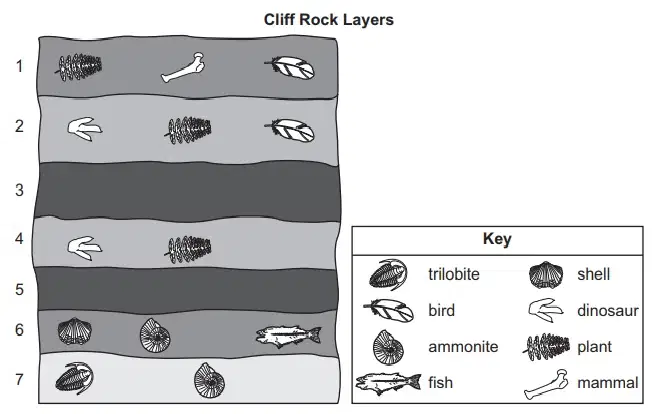
A scientist hiking in a desert observes a cliff. The scientist makes a drawing of the layers of rock in the cliff and the types of fossils observed in the layers. Based on observations, the scientist determines layers 3 and 5 were formed from cooled lava. The scientist's drawing is shown.
Identify the oldest layer in the rock cliff and explain your reasoning for the layer chosen.
a)
1. because it is on top
b)
7 because it is on the bottom
c)
6. because ammonite is the oldest fossil
d)
2. because it still has a dinosaur fossil
44.
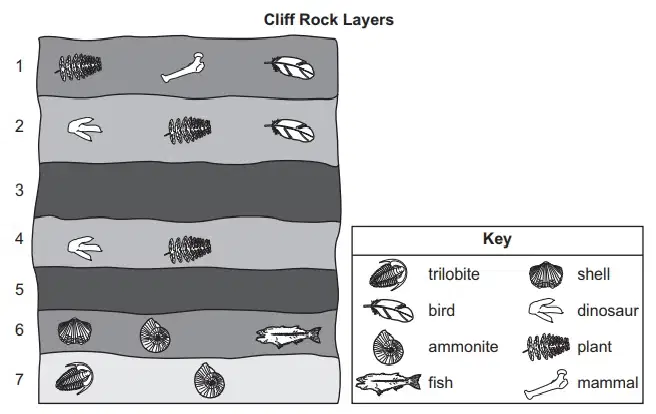
A scientist hiking in a desert observes a cliff. The scientist makes a drawing of the layers of rock in the cliff and the types of fossils observed in the layers. Based on observations, the scientist determines layers 3 and 5 were formed from cooled lava. The scientist's drawing is shown.
Explain how the environment has changed over time at this location. Include evidence in your explanation.
a)
The environment has not changed much over time. Each layer has similar organisms in it.
b)
The top layers show similar shades of colors which means the layers are made of the same types of rock which show there has not been much change.
c)
The bottom layers show fish fossils while the top layers show mammal fossils, this supports the theory that the area used be covered by water and now is a land biome.
d)
The environment has not changed but the animals that live there have changed.
45.
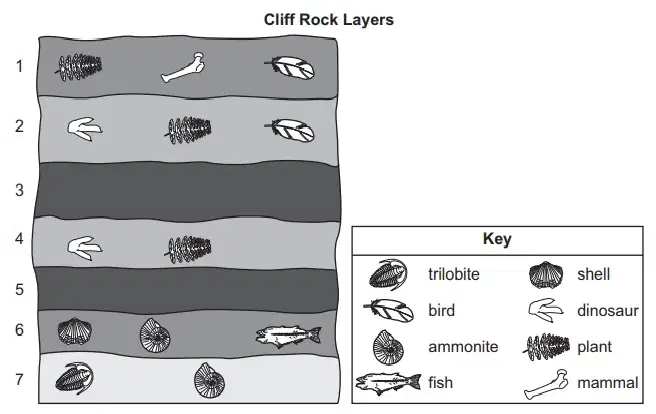
A scientist hiking in a desert observes a cliff. The scientist makes a drawing of the layers of rock in the cliff and the types of fossils observed in the layers. Based on observations, the scientist determines layers 3 and 5 were formed from cooled lava. The scientist's drawing is shown.
A scientist claims that volcanic eruptions caused dinosaurs to become extinct at this location. Decide whether you agree or disagree with the scientists claim and then explain your decision based on the evidence provided.
a)
I disagree with the scientists claim. Dinosaurs became extinct because of a meteor crashed on Earth, not because of a volcanic eruption.
b)
I agree with the scientists claim. This location did have two volcanic eruptions that would likely lead to the extinction of dinosaurs in this location.
c)
I agree with the scientists claim. Layer three show no dinosaur fossils so they must have become extinct due to the volcanic eruption.
d)
I disagree with the scientists claim. The dinosaurs are still alive after the last volcanic eruption because layer two still has dinosaur fossils.
46.
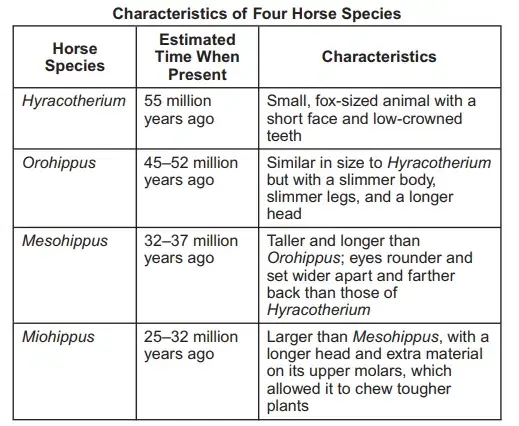
Using fossil evidence, scientists can learn how organisms have changed over long periods of time. The chart show information about how traits of ancestors of the modern horse have changed.
People such as farmers and scientists can affect the traits of organisms, including horses, cattle, and corn. A scientist finds a site that contain fossils of Orohippus, Mesohippus, and Miohippus. Identify the species of horse fossils that would be found in the uppermost layer of rock and explain your answer.
a)
Hyracotherium, because it is the oldest horse species.
b)
Miohippus, because it is the youngest horse species.
c)
Orohippus, because it is the oldest horse species found at this site.
d)
Mesohippus, because it is the oldest horse species found at this site.
47.
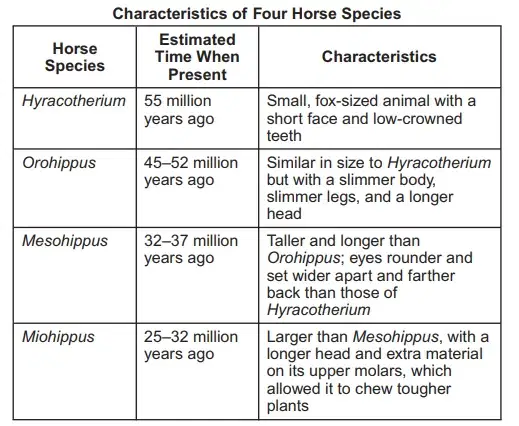
Using fossil evidence, scientists can learn how organisms have changed over long periods of time. The chart show information about how traits of ancestors of the modern horse have changed.
People such as farmers and scientists can affect the traits of organisms, including horses, cattle, and corn. A scientist finds a site that contain fossils of Orohippus, Mesohippus, and Miohippus. Identify the species of horse fossils that would be found in the bottommost layer of rock and explain your answer.
a)
Hyracotherium, because it is the oldest horse species.
b)
Miohippus, because it is the youngest horse species.
c)
Orohippus, because it is the oldest horse species found at this site.
d)
Mesohippus, because it is the oldest horse species found at this site.
48.
What is the name for the belief that a sudden and quick violent event can change Earth and organisms.
a)
uniformitarianism
b)
catastrophism
c)
preservationism
d)
conservationism
49.
This is the theory that geological processes are similar in the past and today.
a)
uniformitarianism
b)
catastrophism
c)
preservationism
d)
conservationism
50.
This type of fossil requires a microscope to view it.
a)
soft animal fossils
b)
hard animal fossils
c)
microfossils
d)
macrofossils
51.
This type of fossil is used to compare the ages of fossils.
a)
common fossils
b)
plant fossils
c)
animal fossils
d)
index fossils
100 %

