
 Worksheets
Digital Citizenship and Cyber Hygiene Quiz
Total questions: 161
Worksheet time: 2hrs 55mins
True or False: As long as you cite your source, you are free to use or share any kind of media you find on the Internet.
True
False
Your uncle is complaining that his computer has gotten slower since he downloaded this new game onto his computer. What type of attack could this be?
Adware
Shareware
Trojan
Virus
You read a recent news article about a cybercriminal who stole a computer and was able to access the computer’s files without ever gaining access to the system’s operating system. The attacker also did not use the computer’s login or password information to gain access. What security technique could have possibly prevented this attack?
Installing antivirus software
Encrypting the Wi-Fi connection
Setting a BIOS/UEFI password
Blocking Internet traffic with a firewall
Your school’s IT Specialist has called you into work on a special task. You are asked to watch your school’s flow of data to see and record what time certain actions take place and where Internet traffic is going. What are you working on?
Identifying suspicious activity
Intrusive testing
Sniffing the network
Social engineering
This term is used when a penetration tester has as much knowledge as possible about the network and computing resources that are being evaluated.
Blue Box
Black Box
Grey Box
White Box
Your computer crashed! Your data was not corrupted due to which feature of your NTFS system drive?
compression
encryption
journaling
permissions
A locally installed application is an example of which application architecture?
N-tier
One tier
Two tier
Three tier
Which of the following are saved even when in private browsing?
Cookies
Bookmarks
Temporary Files
Search Records
You’d like to add features to a calendar app with the permission of the vendor without paying any licensing fees. What type of license is required to be able to do this?
Free
Open source
Site license
Subscription
Roland knew that the code to his sister’s toy safe was only two digits long. He was able to crack the safe open by attempting every two-digit code until he found the correct one. What method of code-breaking did Roland use?
Frequency analysis
Brute force
Frequency distribution
Using a dictionary


What is your Digital Footprint?
Textual content, images, and multimedia that the creator must have the right to use
All of the information online about a person posted either by that person or other, intentionally or unintentionally
A program that detects, prevents, and takes action to disarm or remove malicious software
Software that has malicious intent.


What should you do if someone you don't know asks for your password online?
Tell them your password because they asked nicely.
Keep your password a secret and tell a trusted adult.
Write your password in an email and send it to them.
Share your password only if they promise to be your friend.

Imagine Aria and David have set up a small office network. What is the primary function of a firewall they installed to protect their network?
To increase internet speed.
To serve as a physical barrier against network intrusion.
To monitor and control incoming and outgoing network traffic based on predetermined security rules.
To detect and remove viruses and other malware.

The act of securing and protecting individuals, businesses, organizations, and governments that are connected to the Internet and the Web.
cybersecurity
cybercriminals
privacy policies
Social engineering

What is Phishing?
Web pages you have visited that are stored on your hard drive
Text files some websites use to identify users
A scam to get confidential information
A form where you type confidential information

T/F: Students should share their passwords with their friends.
True
False

If a student forgets to log out of their computer you should ______________
tell a teacher
log them off the computer
show everyone at your table
make fun of the student next time you see them

Which of these is an example of social engineering?
A Trojan Horse
Ransomware
A Phishing Email
A Virus

How many elements of digital citizenship are there that students need to know
4
9
7
3

What is cybersecurity?
the state of being protected against the criminal or unauthorized use of electronic data,
Security against breaking into your house
Top secret Government security

T/F: You should always accept friend requests from people you do not know.
True
False
Imagine Aria and David have set up a small office network. What is the primary function of a firewall they installed to protect their network?
To monitor and control incoming and outgoing network traffic based on predetermined security rules.
To enhance the speed of the network by increasing bandwidth.
To provide a physical barrier against unauthorized access to the office.
To store and manage all the data within the network.

Digital Citizenship consists of how many elements?
All podcast material is typically copyrighted by its creator. What is a copyright?
Asking someone if you can use their work.
A form of protection for your own creative work.
Taking something off of the internet and using it in your presentation.
A form saying you're the author of a specific piece of work.
Luke plans on using several images that he found on the Internet for his school report on a famous sports figure. How can he be sure he is following copyright law when he is downloading and using these images?
Cite the source, giving credit to the owner.
E-mail the owner of each Web site to request permission to use the photos.
Place the copyright symbol on each image.
Inform his professor that the images were downloaded from the Internet.
True or False: As long as you cite your sources, you can put any image you find online on your website.
True
False
Shania's best friend shows her a Web site where she has been downloading hundreds of songs by popular artists that they both enjoy. Everything is "free". She knows that this is probably not legal. What is the crime that both the Web site and Shania's friend are most likely guilty of?
Copyright infringement
Plagiarism
Fair Use Act
Improper citation
Isla is working on a school project and she found some copyrighted material that she thinks would be perfect for her presentation. Grace and Henry told her to be careful about using such materials. When is it acceptable for Isla to use this copyrighted material without permission?
Never
Only on weekends
When the material is really popular
Fair use
Stealing copyrighted work by downloading or copying it in order to keep, sell, or give it away without permission and without paying is a form of _______.
License
Piracy
Plagiarize
Public Domain
Rose is gathering images of New York City for a group project at school. She wants to make sure that she follows copyright law because it is the right thing to do. Under the Fair Use Act, she can use some images for educational purposes. What else should Rose do?
E-mail the project to her family members
Cite the source of the images, giving credit to the owner
Print copies of the images for everyone in her class
Post the project on her social networking site
In order to use copyrighted things, you have to...
Ask the owner for permission
Ask your parents/guardians
Ask your teacher
Download it
Emma is creating a presentation for her class. Which of the following is NOT a condition of Fair Use?
The purpose and character of the use
The nature of the copyrighted work
The amount and substantiality of the portion used
The popularity of the work
Aiden is working on a school project and wants to use some online images. What is the main difference between Fair Use and Creative Commons?
Fair Use is a legal doctrine, while Creative Commons is a licensing system
Fair Use applies only to music, while Creative Commons applies to all media
Fair Use requires payment, while Creative Commons is free
Fair Use is international, while Creative Commons is only in the U.S.
Rohan is creating a documentary and wants to use clips from a popular movie. How does the "Transformative Use" aspect of Fair Use benefit him?
It allows him to use copyrighted material without any changes
It permits the use of copyrighted material in a new and original way
It lets him sell the original work as his own
It requires him to pay royalties to the original creator
Hannah is writing a research paper. Which of the following is an example of Fair Use?
Using a song in a commercial without permission
Quoting a paragraph from a book in a research paper
Copying an entire book and distributing it
Downloading a movie from an unauthorized website
Olivia is working on a school project and she found some copyrighted material that would be perfect for her presentation. Can she use it without permission? (a) Yes (b) No
Only on weekends
a
b
Maybe
What is a collection of public copyright licenses that enable the free distribution?
Creative Commons
copyright
music
movie
What is copyright infringement?
anyone who uses someone's work without permission
a copy of someone's work
a picture of someone's work
anyone who uses someone's work, but with permission
You join a file-sharing network and download unauthorized copies of copyrighted music...
Copyright
Plagiarism
Both
Neither
What is copyright?
a legal term that gives the creator of an orugial work exclusive rights to it.
Exclusive right to design and deliver a presentation
A legal copy of a document
A copy of an image that includes the name of the author or artist
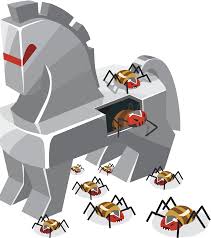
What is a Trojan virus?
A story from Greek mythology
Something that can break your computer
When you download an app and it's actually a virus
A virus only made by hackers

I lock all your files until you pay for them to be unlocked – if you don’t pay in 24 hours, I will delete them all – What am i?
Spyware
Ransomware
Malware
Virus

I look like a normal piece of software but secretly I will infect your system – What am i?
Trojan Horse
Virus
Phishing Email
Ransomware

I attach myself to documents and files, I disrupt the system. I need a host program to work from the inside - What am i?
A Virus
Trojan Horse
Ransomware
Spyware

I replicate and spread across through devices connected on the network.
A Virus
A worm
A Firewall
Ransomeware

This type of software is designed to gain access to your computer with malicious intent.
Some examples are: viruses, worms, Remote Access Trojans (RATs).
malware
ransomware
adware
spyware
What is Malware?
Software that protects your computer from viruses
Software that protects your computer from spyware and adware infections
Software that updates your computers operating system
Software that may harm your computer
Standalone malware computer program that replicates itself in order to spread to other computers. Often, it uses a computer network to spread itself, relying on security failures on the target computer to access it.
Malicious Code
Computer Worm
Anti Virus Software
Computer Virus
type of malicious software program (malware) that, when executed, replicates by reproducing itself (copying its own source code) or infecting other computer programs by modifying them.
Computer Virus
Computer Worm
MyDoom
Malicious Code
Which general term refers to all kinds of harmful software, including viruses, worms, trojan horses, and spyware?
Source code
Malware
Bug
Spam
Select ALL the malware
Worm
Trojan Horse
WAN
Virus
Malware.....
Are different types of threats to computer systems.
Is a manufacturer of computer parts
Hard to find on the internet
Distribution is completely legal.
The _____ type of malware collects personal information and sends it to a third party.
Worm
Toolbar
Homepage hijacker
Spyware
What is the term for computer programs that attack your computer?
Malware
DangerDroids
RudeBots
Dangerware
Trojan Horses
Does not need to attach to a program
Can only occur when a computer is not connected to a network
A type of social engineering
Designed to access a computer by misleading users of its’ intent by prompting to download a program
What should you do if someone you don't know asks for your password online?
Tell them your password because they asked nicely.
Keep your password a secret and tell a trusted adult.
Write your password in an email and send it to them.
Share your password only if they promise to be your friend.
The act of securing and protecting individuals, businesses, organizations, and governments that are connected to the Internet and the Web.
cybersecurity
cybercriminals
privacy policies
Social engineering
What is your digital footprint?
A record of everywhere you have been online
A record of all the different devices you have
A new world order
When on social media, we should all be cautious of...
How our outfit looks
Oversharing
If we have a charger
What does digital citizenship mean?
Any information about you on the Internet
An online membership
Using digital media safely, responsibly, and ethically.
Not giving credit to someone else's work.
Your best friend takes a picture of you and post it online. Should she have asked your permission first?
YES
NO
What is your digital footprint?
A record of everywhere you have been online
A record of all the devices you have
Government tracking your online data
Which is not private information?
address
phone number
name
favorite color
You heard a rumor at school that a classmate stole money from the locker room. You should...
post online the student you think did it.
chat with friends online about who you each think did it.
tell a trusted adult about the situation.
make a post with the students picture in it.
If someone you don't know asks where you go to school, what should you do?
See if they're a friend of a friend
Don't respond
Lie to them
Ask why they want to know
Which of the following situations is an example of oversharing?
Abby submits her poem to an online poetry contest.
John streams live video of his piano recital.
Denise posts a photo of herself making a rude gesture.
Carla uploads a slide show of her paintings.
Which are the disadvantages of the internet?
(Check all that apply.)
Receiving unwanted emails which is called Spam.
Being able to communicate with friends and relatives.
Someone sending a virus to your computer.
Being able to use the internet for research
Your private information has a risk of being stolen.
You should share your passwords?
False
True
T/F: Once something is posted on the internet, it could be there forever.
False
True
If a friend posts something online that hurts your feelings, what should you do?
Ask to talk to them in person
Text them and say they hurt your feelings
Post something hurtful about them
Ask why they're mad at you in the comments
When do you need to use anti-virus software.
When you are sick.
When you are a doctor and give appointments
When you buy your first computer
All the time, in all devices and wireless connections to protect your devices.
One of your classmates has shared a photo of you that you really don’t like. What do you do?
Share an embarrassing photo of them in return!
Tell an adult and explain why you’re unhappy.
Nothing; it’s up to them what they post online.
What are "clean numbers"?
Numbers that are refined and filtered
They tell where you are, physically
Numbers that have not been used for accounts or loans
How long do pictures that you post stay online?
One day
One week
Forever
Until you delete them
What is netiquette?
rules of how to behave online.
a net on the internet.
rules to buy items.
rules to live by.
information about you that can be used to identify you because it is unique to you (e.g. your full name or your address)
risky
red flad feeling
digital media
private information
Seventeen-year-old Scott posts online, that his math teacher is a racist. Can his teacher successfully sue him for his post?
Yes, but only if someone forwards it to the teacher and he/she is materially offended
No, as long as it was a private post to his friends and not the general public
No, because of Scott's protected rights under the First Amendment
Yes, if his teachers discovers the statement, can show that it's false and it damages his/her reputation
What kind of personal information is OK to post online?
Your full name, date of birth, and the town where you live.
Your first name, your age, and the country where you live.
Your full name, telephone number, and the street where you live,
information that comes to us through the internet, often through a tablet, smartphone, or laptop
media balance
internet scam
digital media
phishing
To help friends find you online, your user name or screen name should contain a limited amount of personal information like your name, gender, age or indications where you live or go to school.
True
False
What should you do if you receive an email from an unknown sender asking for personal information?
Reply with the information requested
Delete the email
Forward the email to your friends
Open any attachments to see what they want
Shaquan just created a password. Who should know what Shaquan’s password is?
his best friend
his teammates
anyone who asks him
none of the answers
Someone onine keeps entering your favorite chat rooms, calling people names and making rude comments. THis person fits the definition of being a :
Troll
citizen
stalker
victim
Practicing appropriate online behavior means you are a good:
student
friend
digital citizen
employee
It is fine to watch tv and listen to music during class.
True
False
Why is it important to log out of your accounts when using shared or public computers?
To make the computer run faster for the next person.
To prevent others from accessing your accounts and personal information.
Because it saves electricity.
To clear the browser history.
What does digital citizenship mean?
Any information about you on the Internet
An online membership
Using digital media safely, responsibly, and ethically.
Not giving credit to someone else's work.
If a friend posts something online that hurts your feelings, what should you do?
Ask to talk to them in person
Text them and say they hurt your feelings
Post something hurtful about them
Ask why they're mad at you in the comments
You heard a rumor at school that a classmate stole money from the locker room. You should...
post online the student you think did it.
chat with friends online about who you each think did it.
tell a trusted adult about the situation.
make a post with the students picture in it.
What is netiquette?
rules of how to behave online.
a net on the internet.
rules to buy items.
rules to live by.
Who can suggest a new emoji?
anyone
people from tech companies
consortium members
adults only
Seventeen-year-old Scott posts online, that his math teacher is a racist. Can his teacher successfully sue him for his post?
Yes, but only if someone forwards it to the teacher and he/she is materially offended
No, as long as it was a private post to his friends and not the general public
No, because of Scott's protected rights under the First Amendment
Yes, if his teachers discovers the statement, can show that it's false and it damages his/her reputation
One of your classmates has shared a photo of you that you really don’t like. What do you do?
Share an embarrassing photo of them in return!
Tell an adult and explain why you’re unhappy.
Nothing; it’s up to them what they post online.
If you met someone online, which of the following questions should you NOT answer.
What is your favorite type of video game? Do you like xbox?
Do you have any pets? Did you see Secret Life of Pets?
What type of music do you like? Do you like the piano?
What school do you go to? What's your phone number?
not acceptable in the situation; not okay
inappropriate
unplug
internet scam
shortened URL
Why is it important to use privacy settings on social media?
To make your profile look colorful
To control who can see your information and posts
To make your account more popular
To get more likes and comments
Why is it not safe to share your password with friends?
They might forget it
They might use it to access your accounts
They might think it's a funny joke
They will remember it forever
What is a strategic way to manage your digital footprint?
Regularly review and adjust your privacy settings on social media
Share all your activities online
Never use the internet
Use the same password for all accounts
If you see something online that makes you feel uncomfortable, what should you do?
Ignore it.
Try to fix it yourself.
Keep it a secret.
Tell a trusted adult.
Answering questionnaires on social media and sharing them to your page is not always safe because ______
They are fun to do.
You may be revealing personally identifying information about yourself.
You don't know who else is reading your page.
It could cause you to be hacked.
What should you consider before sharing a photo online?
Whether it will get a lot of likes
If it reveals personal information or could be embarrassing
If it matches your favorite color
If it is a picture of your pet
___________ describes good internet behavior or how you should behave online.
ethics
netiquette
etiquette
morals
What is the best action to take if someone sends you a mean message online?
Send a mean message back
Ignore the message and tell an adult
Share the message with everyone
Laugh about it
Should you share your username and password with other people?
Yes
No
Michael, Priya, and Ethan are using their school's computer network. What could happen if they violate the network's acceptable use policy?
They could face disciplinary action, including termination of access to the network or legal consequences
There would be no consequences at all
They would receive a verbal warning only
They would receive a monetary reward for violating the policy
Who's a superstar in the digital world?
Someone who uses technology safely and responsibly
A secret handshake only cool kids know
Put these in the right spots. If you're talking to a stranger online:
Favorite song
Username
Dog's Name
A funny animal picture
Your password
Your address
Your last name
Selfie pictures
What does it mean to be respectful online?
Share personal information with strangers
Use mean language
Treat others how you want to be treated
Ignore others' feelings
It is ok to play with my toys during class.
True
False
True or False? You should never take pictures or videos of other students unless it is part of a school project where you have permission.
True
False
Chloe is posting to her social media account some pictures from the school’s dance last night. In one of the photos her friend Jordan is acting pretty silly. What is her responsibility to Jordan?
Post the photos and add Jordan’s name.
Ask Jordan for permission before posting the photo.
Text the photo to all of her friends, but don’t post it online.
Rules that state how a computer should be used.
Computer ABC's
Computer Ethics
Technology Values
The Internet Guide
What should you do before downloading an app or game on your device?
Download it immediately because it looks fun.
Check reviews and ratings to ensure it is safe and appropriate.
Share it with your friends to see if they like it.
Give it access to all your personal information.
Why is it important to be kind and respectful online?
It's not important.
To make the internet a better place for everyone.
So you can win more games.
To get more followers.
What should you do if you see something upsetting or inappropriate online?
Keep it to yourself
Share it with your friends
Tell a trusted adult
Laugh it off
Which action is correct?
Pay attention to class at all times.
Chat with your friends during the class.
Mute over people when they are talking.
What should you do if you receive a message from a stranger asking for personal information online?
Reply with the information they asked for.
Ignore the message and tell a trusted adult.
Ask them why they need your information.
Send them a message back asking for their personal information instead.
A student can check their school email when they are NOT at school.
True
False
If a friend posts something online that hurts your feelings, what should you do?
Post something hurtful about them
Ask why they're mad at you in the comments.
Text them and say they hurt your feelings
Ask to talk to them in person.
Why do they tell you to put your phone up in school during a test?

