
 Worksheets
Chemistry Quiz 1 Review
Total questions: 45
Worksheet time: 23mins
Which type of pure substance is made of more than one type of atom?
Which of the following IS NOT a compound?
HCl
Na
NaCl
CO2
Carbon (C) is considered an element while carbon dioxide (CO2) is considered a compound.
This is because carbon dioxide is –
a gas at room temperature.
made of two different elements.
made of one type of atom

This is an example of a(n) ______
Element
Compound
Mixture

This is an example of a(n) ____
Element
Compound
Mixture

This is an example of a(n) ____
Compound
Atom
Mixture

This is a(n) ______
Element
Compound
Mixture of elements and compounds
Mixture of elements

This is a(n) ____
Element
Compound
Mixture of compounds
Mixture of elements

This is a(n) ____
Element
Compound
Mixture of elements
Mixture of compounds

What is Silver (Ag)?
homogeneous mixture
heterogeneous mixture


Hot cocoa is a ________
Homogeneous Mixture
Heterogeneous Mixture

The legos in the picture are a _____
Homogeneous Mixture
Heterogeneous Mixture

Food dye and water is a ____
Homogeneous mixture
Heterogeneous mixture

Chicken noodle soup is an example of
Heterogeneous mixture
Homogeneous mixture

All substances are soluble in water. This statement is ___
True
False

The ___ is the thing being dissolved.
solute
solvent
mixture
solution
What is a solvent?
A liquid that dissolves a solute
Another word for solution
A type of homogeneous mixture
The solid that gets dissolved
If salt is dissolved in water, what is the solvent?
the salt
the water
salt water mixture
Sugar is dissolved in water, what is the solution?
the water
the sugar
sugar water
Salt is dissolved in water, what is the solute?
the water
salt water
the salt
Which is the best description of the word soluble?
a substance that can dissolve in water
a substance that cannot dissolve in water
a substance that floats on top of water
Which best describes the term insoluble?
a substance that can dissolve in water
A substance that cannot dissolve in water.
A substance that sinks in water

Is vegetable oil soluble or insoluble when added to water?
soluble
insoluble

Sugar is ____ in water.
soluble
insoluble
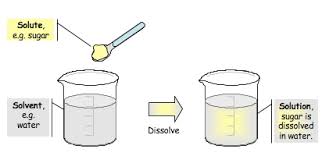
The ability of sugar to dissolve in water is called ____
Malleability
Density
State
Solubility

Based on the solubility curve, how many grams of sugar will dissolve in a 100 mL of water at 20°C?
100 g
150 g
200 g
250 g
The substance that does the dissolving is the _____.
Solute
Solvent
Solution
Miscibility

When no more sugar will dissolve in a glass of water, the solution is ___.
A solute is the
substance that gets dissolved
substance that does the dissolving
process of surrounding and breaking apart a substance
solute + solvent = ______
solution
solubility

Is this soluble?
Yes
No
12 g/cm3
If an object has a density of 0.6 g/mL and you put it into water, will it sink or float?
(REMEMBER: water has a density of 1.0 g/mL)
What two types of measurements do you need to calculate DENSITY?
Length and Volume
If an object has a density of 3.6 g/mL and you put it into water, will it sink or float?
(REMEMBER: water has a density of 1.0 g/mL)
0.5 g/cm3
What is the formula for density?
Density = mass × volume
Density = massvolume
Density = volumemass
Density = mass − volume

What is this tool that is used to measure volume?
graduated cylinder

What is the volume of Object X?
starting fluid level= 65
final fluid level = 90
90 mL
65 mL
20 mL
25 mL

What is the volume of the fish?
Starting volume = 32 ml
Final volume = 38 ml
38 ml
6 ml
32 ml

Which object has the highest density in this picture?
object A
object B
object C

Which object has the lowest density in this picture?
object A
object B
object C

Phil has a 20 g cube of nickel and a 3 gram piece of nickel.
Which statement is correct about the density of both pieces of nickel?
The 20 g cube is more dense
The 3 g piece is more dense
Both pieces have the same density.

Why does the line representing the solute stop going up?
The person stopped mixing the solution
The timer stopped
The solution is saturated
The solution froze because it got cold

