
 Worksheets
Chemistry Midterm Review 1
Total questions: 17
Worksheet time: 9mins
Name
Class
Date
1.
Where do you find the transition metals on the periodic table?
a)
The central block
b)
Left and right hand side blocks
c)
At the top
d)
Near the bottom
2.
Where do you find the metals and non-metals in the periodic table?
a)
Metals on the right, non-metals on the left
b)
Non-metals in the middle surrounded by the metals
c)
Metals in the middle surrounded by the non-metals
d)
Metals on the left, non-metals on the right
3.
What are the elements of this Group 18 called and why are they unreactive?
a)
Noble solids and they have 8 electrons in their outer energy level (shell)
b)
Noble liquids and they have 8 electrons in their outer energy level (shell) except helium which has 2)h has 2
c)
Noble gasses and they have a complete (full) outer energy level (shell)
d)
Noble elements and they have an empty outer energy level (shell)
4.
The elements are arranged in groups and periods. What is a period on the table?
a)
A vertical column
b)
A horizontal row
c)
A diagonal row
d)
A block of columns
5.
The atomic number of an element is 11 and its mass number is 23. Pick the correct combination of protons, neutrons and electrons.
a)
p=12, n=12, e=11
b)
p=11, n=11, e=12
c)
p=12, n=11, e=11
d)
p=11, n=12, e=11
6.
The mass number of an element tells us...
a)
the number of protons in the nucleus
b)
the number of protons plus electrons
c)
the number of neutrons plus electrons
d)
the number of neutrons plus protons
7.
Which of the following is a formula for a compound formed from sodium (Na) and oxygen (O)?
a)
A. NaO
b)
B. NaO₂
c)
C. Na₂O
d)
D. Na₂O₃
8.
When do you use Roman numerals if you are naming compounds?
a)
when naming polar covalent molecules
b)
when naming ionic compounds with a transition metal
c)
when using polyatomic ions
d)
when naming binary compounds
9.
How is a cation formed from a neutral atom?
a)
cations form by sharing electrons
b)
cations form by donating electrons
c)
cations form by taking electrons
d)
cations form by donating protons
10.
How is an anion formed from a neutral atom?
a)
anions form by sharing electrons
b)
anions form by donating electrons
c)
anions form by taking electrons
d)
anions form by taking protons
11.
Neutral atoms have the same number of protons and electrons. Isotopes of an atom differ in
a)
the number of electrons
b)
the number of protons
c)
the number of neutrons
d)
both protons and neutrons
12.
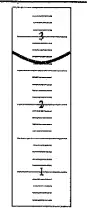
What is the volume shown in the graduated cylinder below?
a)
3.4 ml
b)
3.4 g
c)
2.6 ml
d)
2.6 g
13.
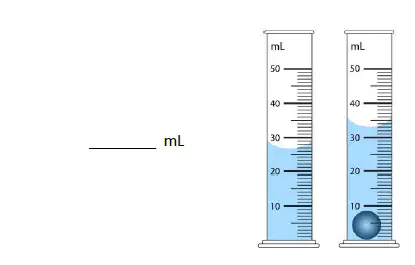
What is the volume of the object in the graduated cylinder?
a)
27 ml
b)
29 ml
c)
7 cm³
d)
33 cm³
14.
What is the formula for the Chlorate ion?
a)
ClO₄ ⁻¹
b)
ClO₃⁻¹
c)
ClO₂⁻¹
d)
ClO⁻¹
15.
What is the proper formula for the Acetate ion?
a)
C₂H₄O₂
b)
CH₄CO₂
c)
CH₃COOH
d)
CH₃CO₂H
16.
Which of the following ions has a positive charge associated with it?
a)
ClO₂
b)
NH₄
c)
CrO₄
d)
NO₂
17.
Which is the correct formula for a compound of iron and oxygen, when iron has an oxidation state of +3 ?
a)
Fe₂O₃
b)
FeO
c)
Fe₃O₂
100 %

