
NEW
Font size
 Worksheets
Infection Control Principles for Health Care Workers
Total questions: 60
Worksheet time: 30mins
Emma is starting her first day as a nurse at a hospital. Why is it essential for her to understand the principles of infection control?
It helps her diagnose diseases
It is required for legal reasons
It is essential to all health care workers
It allows her to prescribe medication
Kai is responsible for maintaining hygiene standards in a hospital. What should be the main emphasis of infection control principles in Kai's work?
Treatment of disease
Prevention of disease
Diagnosis of disease
Research on disease
Emma is attending a training session at the hospital where she works. The session is focused on infection control for health care workers. What is a basic goal of this infection control education?
To provide advanced surgical skills
To provide a basic knowledge of how disease is transmitted
To teach financial management
To improve communication skills
A hospital administrator wants to reduce the spread of infections among staff and patients. Based on the principles of infection control, what should be the primary focus of their training program?
Emphasizing disease prevention strategies
Increasing the number of staff
Reducing working hours
Improving hospital food quality
William is looking at a drop of pond water under a microscope and notices tiny living things moving around that he can't see with his naked eye. Which of the following statements best describes what William is observing?
Large living organisms visible to the naked eye
Small living organisms not visible to the naked eye
Non-living particles only found in water
Organisms that can only survive in extreme heat
During a biology class, Avery wonders about the role of microorganisms in the human body. Which of the following is true about the relationship between microorganisms and the human body?
Microorganisms are never found in the human body
Microorganisms are only harmful to humans
Many microorganisms are part of the normal flora of the body
Microorganisms can only survive outside the human body
Mia is learning about microorganisms in her science class. Her teacher asks her to explain why microorganisms are considered beneficial, providing at least one example of their positive role in the environment or human body. What should Mia say?
They are always harmful and cause diseases
They help in digestion and protect against harmful microbes
They only exist to decompose dead matter
They are used only in scientific experiments
Emma is learning about how infections spread in her biology class. She wants to understand the correct sequence of events in the chain of infection. What is the correct order?
Infectious Agent → Reservoir → Portal of Exit → Mode of Transmission → Portal of Entry → Susceptible Host
Reservoir → Infectious Agent → Portal of Exit → Mode of Transmission → Portal of Entry → Susceptible Host
Susceptible Host → Portal of Entry → Mode of Transmission → Portal of Exit → Reservoir → Infectious Agent
Infectious Agent → Portal of Entry → Reservoir → Portal of Exit → Mode of Transmission → Susceptible Host

Olivia is learning about how diseases spread in her health class. She wants to know which part of the chain of infection refers to the place where the infectious agent lives and multiplies. What is the correct answer?
Portal of Entry
Reservoir
Susceptible Host
Mode of Transmission

Kai works in a hospital and wants to prevent the spread of infection among patients. If Kai decides to use hand hygiene, which link in the chain of infection is he targeting?
Infectious Agent
Mode of Transmission
Susceptible Host
Reservoir
Arjun is learning about health and diseases in his science class. His teacher asks him which of the following statements is true about pathogens. Which should he choose?
Pathogens are microorganisms that can harm the body
Pathogens are always beneficial to humans
Pathogens cannot cause infections
Pathogens are only found in water
Sophia is studying different types of microorganisms in her biology class. She discovers one that does not harm the body. Which category should she place it in?
Nonpathogen
Pathogen
Virus
Bacteria
Samuel is setting up an experiment to grow microorganisms in his lab. He wants to create the best environment for their growth. Which of the following environments should Samuel choose?
Cold and dry
Warm and dark
Bright and cold
Dry and hot
Priya wants to grow some microorganisms in a science experiment. What does she need to provide as a source for their growth?
Only sunlight
Only air
Food and moisture
Only minerals
Hannah is learning about why people can sometimes get sick from germs. Her teacher explains that the human body is an ideal supplier for the growth requirements of microorganisms. Why is this the case?
It is always cold
It provides food, moisture, and warmth
It is exposed to sunlight
It lacks nutrients
Daniel is conducting an experiment to grow different types of microorganisms in the lab. He notices that one type only grows when oxygen is present. Which type of microorganism is Daniel observing?
Anaerobic
Aerobic
Fungal
Viral
Olivia is conducting an experiment to grow two types of microorganisms in her lab. She notices that one type grows only when there is no oxygen present, while the other type needs oxygen to grow. How do these two types of microorganisms differ in terms of their growth requirements?
Anaerobic microorganisms need sunlight, while aerobic do not
Anaerobic microorganisms grow in the absence of oxygen, while aerobic need oxygen to grow
Anaerobic microorganisms need more food, while aerobic need less
Anaerobic microorganisms grow only in cold environments, while aerobic grow in warm environments
Emma is studying different types of living things in her science class. Her teacher asks her, "Which of the following is a classification of microbes?"
Plants
Rickettsiae
Animals
Minerals
Jackson is working in a laboratory and discovers a new microorganism under his microscope. Based on the classifications provided, which of the following categories could it potentially belong to?
Fungi
Mammals
Insects
Fish
Zoe is looking at different types of living things under a microscope in her science class. She observes some that are very simple and have only one cell. Which of the following best describes what Zoe is observing?
Complex, multi-celled organisms
Simple, one-celled organisms
Organisms that do not multiply
Organisms classified only by color
Benjamin is working on a science project about bacteria. He wants to know the best way to classify different types of bacteria he observes under the microscope. How should Benjamin classify the bacteria?
By their color and size
By their shape and arrangement
By their ability to photosynthesize
By their habitat
Mia is working in a hospital laboratory and needs to identify a bacterial infection in a patient. Why is the classification of bacteria by shape and arrangement important for her work?
It helps in identifying bacteria and understanding their behavior.
It determines their color.
It shows how fast they multiply.
It tells if they are multi-celled.
During a biology lab, Olivia observes some bacteria under a microscope. She notes that the bacteria are round or spherical in shape. Based on their appearance, what is the typical shape of cocci bacteria?
Rod-shaped
Spiral-shaped
Round or spherical in shape
Comma-shaped
During a biology lab, Priya is asked to identify which of the following is NOT a type of cocci bacteria. Which should she choose?
Diplococci
Streptococci
Bacilli
Staphylococci
Grace is working in a microbiology lab and is examining a bacterial sample under a microscope. She needs to determine whether the bacteria are diplococci or streptococci. How should she distinguish between them?
By their color
By their arrangement: diplococci appear in pairs, while streptococci appear in chains
By their size
By their ability to move

Priya is studying microbiology and needs to identify a Gram-positive bacterium for her lab report. Which of the following bacteria should she choose?
Escherichia coli
Neisseria meningitidis
Staphylococcus aureus
Haemophilus influenzae

Aria is studying for her microbiology exam and needs to identify which of the following bacteria is Gram-negative. Which one should she choose?
Streptococcus pneumoniae
Listeria monocytogenes
Klebsiella pneumoniae
Streptococcus agalactiae
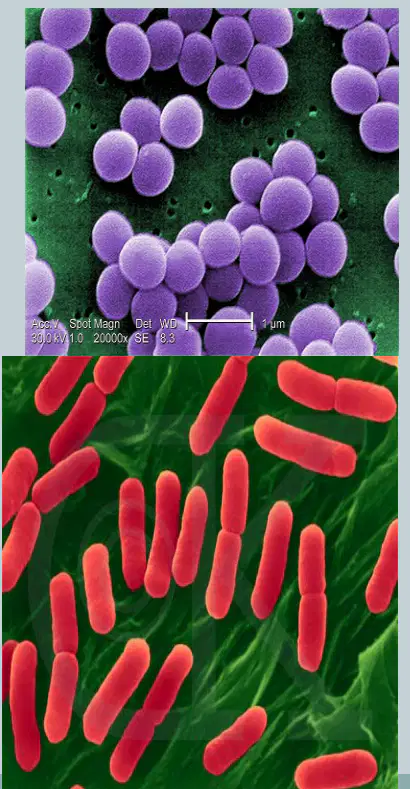
Rohan is examining bacterial samples under a microscope in his laboratory. He notices that one type of bacterium tends to form clusters, as shown in the images. Based on the images, which bacterium is most likely to be found in clusters?
Staphylococcus aureus
Haemophilus influenzae
Klebsiella pneumoniae
Listeria monocytogenes
While looking at bacteria samples under a microscope in her biology class, Evelyn notices some bacteria that are rod-shaped. Which of the following best describes the shape of these bacilli bacteria?
Spherical
Spiral
Rod-shaped
Cuboidal
Jackson is observing bacilli bacteria under a microscope for his biology project. He notices that these bacteria can be found in different arrangements. In which of the following ways can bacilli bacteria occur?
Only in chains
Only singly
Singly, in pairs, or in chains
Only in clusters
Emma is studying bacteria under a microscope and notices that some bacilli are able to move. Which feature may be present in these bacilli that aids in movement?
Cilia
Flagella
Pseudopodia
Pili
During a science experiment, Mia observes that some bacilli bacteria can survive extreme heat and dryness in the lab. What unique ability helps these bacteria endure such harsh conditions?
Photosynthesis
Forming spores
Producing toxins
Releasing enzymes
While working in a laboratory, Sophia discovers a rod-shaped bacterium under the microscope. She notes that it can form spores and sometimes has flagella. Based on these characteristics, which group does this bacterium most likely belong to?
Cocci
Spirilla
Bacilli
Vibrios
During a laboratory investigation, Abigail is examining a sample suspected to contain Bacillus anthracis. She observes a particular structure under the microscope that is commonly associated with this bacterium. Which structure is Abigail most likely observing?
Spores
Capsules
Flagella
Pili
Lily is studying Bacillus anthracis in her microbiology class. She learns that this bacterium can survive in the soil for many years. Why are spores important in the context of Bacillus anthracis?
They allow the bacterium to survive harsh conditions.
They help the bacterium move.
They are responsible for nutrient absorption.
They produce toxins directly.

Emma is studying bacteria that can survive in harsh environmental conditions for long periods. She observes Bacillus anthracis under the microscope, as shown in the image. Which feature is most likely to help Bacillus anthracis persist in the environment?
Formation of spores
Production of antibiotics
Rapid cell division
Photosynthesis
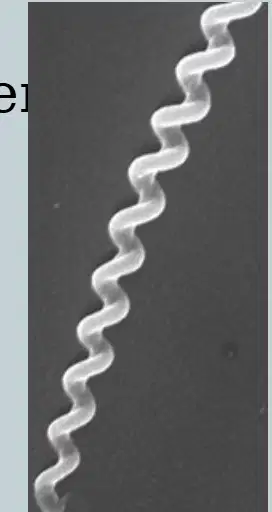
Hannah is looking at different types of bacteria under a microscope for her biology project. She observes one type that has a distinct spiral or corkscrew shape. What is the characteristic shape of spirilla bacteria that Hannah is most likely observing?
Spiral or corkscrew shape
Rod shape
Spherical shape
Cuboidal shape
Emma is studying about different types of bacteria in her biology class. She learns that spirilla bacteria can cause certain diseases. Which of the following diseases can be caused by spirilla bacteria?
Syphilis and cholera
Tuberculosis and pneumonia
Influenza and measles
Malaria and dengue
While working in a microbiology lab, Benjamin observes different bacterial shapes under the microscope. He needs to identify which forms are classified as spirilla bacteria. Which of the following forms should Benjamin select?
Comma-shaped vibrio and corkscrew spirochete
Spherical cocci and rod-shaped bacilli
Filamentous actinomycetes and branching mycobacteria
Club-shaped corynebacteria and square-shaped archaea
Which of the following bacteria is associated with the disease cholera?
Vibrio cholera
Escherichia coli
Staphylococcus aureus
Bacillus anthracis
What is the primary purpose of antibiotics?
To kill viruses
To kill bacteria
To strengthen the immune system
To relieve pain
Why is antibiotic resistance a concern in the treatment of bacterial infections?
It makes antibiotics more effective
It causes bacteria to multiply faster
It means antibiotics are no longer effective against certain bacteria
It prevents bacteria from spreading
Which of the following best describes protozoa?
One-celled, animal-like organism
Multi-celled, plant-like organism
One-celled, plant-like organism
Multi-celled, animal-like organism
Where are protozoa commonly found?
In dry soil
In decayed materials and contaminated water
In the air
On tree bark
Which structure may protozoa use for movement?
Cilia
Flagella
Pseudopodia
Fins
Which of the following best describes fungi?
Simple, plant-like organisms
Complex, animal-like organisms
Single-celled bacteria
Viruses
Which of the following are examples of fungi?
Bacteria and viruses
Yeast and molds
Algae and protozoa
Worms and insects
Why are antibiotics ineffective against fungi?
Fungi are resistant to all medications
Antibiotics only kill bacteria, not fungi
Fungi are viruses
Antibiotics enhance fungal growth
Which type of medication is used to treat fungal infections?
Antiviral medications
Antifungal medications
Antibiotics
Antiparasitic medications
Which of the following best describes Rickettsiae?
Parasitic microorganisms
Free-living bacteria
Fungi
Viruses
How are Rickettsiae typically transmitted to humans?
Through contaminated water
By the bites of insects such as fleas, lice, ticks, and mites
By direct contact with infected animals
Through airborne droplets
Why can't Rickettsiae live outside the cells of another living organism?
They require host cells for survival and reproduction
They are too large to survive independently
They need sunlight to grow
They are resistant to antibiotics
Which of the following statements is true regarding the treatment of diseases caused by Rickettsiae?
Antibiotics are not effective against them
Vaccines are the only treatment
Antibiotics are effective against many of them
Only antiviral drugs work
Which of the following statements is true about viruses?
They can reproduce on their own outside a living cell.
They are the largest microorganisms.
They must be inside another living cell to reproduce.
They are easy to kill.
Which method is a common way for viruses to spread?
Through soil only
By blood and body secretions
By sunlight exposure
Through sound waves
Which organ is primarily affected by Hepatitis B?
Heart
Liver
Lungs
Kidneys
How is Hepatitis B most commonly transmitted?
Through the air
By contaminated water
By blood serum and body secretions
By insect bites
Which type of pathogen is responsible for causing the flu, chicken pox, and yellow fever?
viruses
parasites
fungi
bacteria

