
 Worksheets
Sociolinguistics Quiz: Language Change
Total questions: 50
Worksheet time: 50mins
What is meant by "language change"?
The process by which a new language is created from scratch.
The process of permanent change in the features and usage of a language over time.
The process of eliminating an old language from society.
The process of translating a language from one form to another.
What is analyzed in "diachronic variation"?
How language is used in current social contexts.
How language changes historically.
How language is learned by children.
How language influences culture.
What is an example of "diachronic variation" mentioned in the text?
The changes in the Lord's Prayer from Old English to Middle English and Early Modern English.
The changes in grammar in the Latin language.
The changes in accent in modern English.
The changes in vocabulary in French.
What is the focus of "synchronic variation"?
Looking at language variation as it exists currently.
Looking at language change from the past to the present.
Looking at the relationship between language and culture.
Looking at how children learn language.
How does sociolinguistics connect "diachronic variation" and "synchronic variation"?
By studying current language variation to understand future changes.
By comparing different languages around the world.
By analyzing the relationship between language and religion.
By creating new languages based on existing variations.
What languages are recognized to have similarities by Sir William Jones?
Latin, Greek, and Sanskrit
Latin, French, and English
Greek, German, and Sanskrit
English, Latin, and French
What is the main contribution of Sir William Jones in the field of linguistics?
Initiating synchronic linguistics
Initiating diachronic linguistics
Discovering a new alphabet
Creating an artificial language
What is meant by "Phonological Change" in the context of linguistic change?
Change in the meaning of words
Change in grammatical structure
Change in the sounds or phonetics of a language
Change in word usage
What type of linguistic change related to grammar or structure is called?
Semantic Change
Phonological Change
Morphosyntactic Change
Phonetic Change
Changes that involve the meaning of words in a language are called?
Semantic Change
Phonological Change
Morphosyntactic Change
Structural Change
What happens in the process of "Metathesis"?
Two sounds switch positions within a word.
Vowel sounds are removed from a word.
Consonant sounds are added to the end of a word.
The word is changed to its plural form.
Which of the following is an example of "Metathesis"?
"acsi" becomes "ask".
"frist" becomes "first".
"bridd" becomes "bird".
All answers are correct.
In the example of "Metathesis", what does the word "wæps" change into?
Wasp.
Horse.
Bird.
First.
Why is "Metathesis" considered a part of phonological change?
Because it involves changes in grammar.
Because it involves changes in the position of sounds within a word.
Because it involves the addition of new sounds.
Because it involves the deletion of sounds.
What is meant by "Epenthesis" in sound change?
Omission of sound at the beginning of a word
Addition of sound in the middle of a word
Change of sound at the end of a word
Replacement of sound throughout the word
Which of the following is an example of "Epenthesis"?
æmtig → empty
cat → cats
run → running
fast → faster
What is the main purpose of the process of "Epenthesis" in linguistics?
To eliminate unnecessary sounds
To add sounds to make words easier to pronounce
To replace sounds with more modern ones
To remove irrelevant words
What is meant by "Prothesis" in sound change?
Addition of sound at the end of the word
Addition of sound at the beginning of the word
Omission of sound in the middle of the word
Replacement of sound at the end of the word

What is meant by "Semantic Change"?
Changes in the grammatical structure of a language
Changes in the meaning of a word or phrase over time
Addition of new words to the vocabulary of a language
Removal of words that are no longer used
What does the term "Broadening" mean in the context of semantic change?
A word or phrase takes on a broader and more general meaning over time
A word or phrase loses some of its meaning
A word or phrase changes to a completely new meaning
A word or phrase is no longer used in the language
Which of the following is an example of "Broadening" in semantic change?
The word "Holiday" which originally meant "holy day" but now means any vacation
The word "Nice" which originally meant "foolish" but now means "good"
The word "Awful" which originally meant "full of awe" but now means "bad"
The word "Mouse" which originally meant an animal but now also means a computer device
What is meant by the word "Holiday" in the context of the semantic change "Broadening"?
A day specifically designated for religious activities
A holiday that encompasses all types of breaks from work
A day designated for national celebrations
A day specifically designated for family activities

What is meant by "Narrowing" in linguistics?
A word/phrase takes on a broader meaning over time.
A word/phrase takes on a more specific meaning over time.
A word/phrase loses its meaning over time.
A word/phrase retains its original meaning without change.
What is the original meaning of the word "Meat" before it underwent Narrowing?
Animal flesh as food.
Food in general.
Beverage.
Livestock.
How does the process of Narrowing affect the meaning of words in a language?
Makes the meaning of a word more specific.
Makes the meaning of a word broader.
Completely removes the meaning of a word.
Changes the word to become meaningless.
What is meant by "amelioration" in linguistics?
The process by which a word/phrase takes on a more negative meaning over time
The process by which a word/phrase takes on a more positive meaning over time
The process by which a word/phrase completely loses its meaning
The process by which a word/phrase retains the same meaning over time
Which of the following is an example of a word that has undergone "amelioration"?
Sick which now means 'awesome' in slang
Ugly which still means 'ugly'
Bad which still means 'bad'
Disgusting which still means 'disgusting'
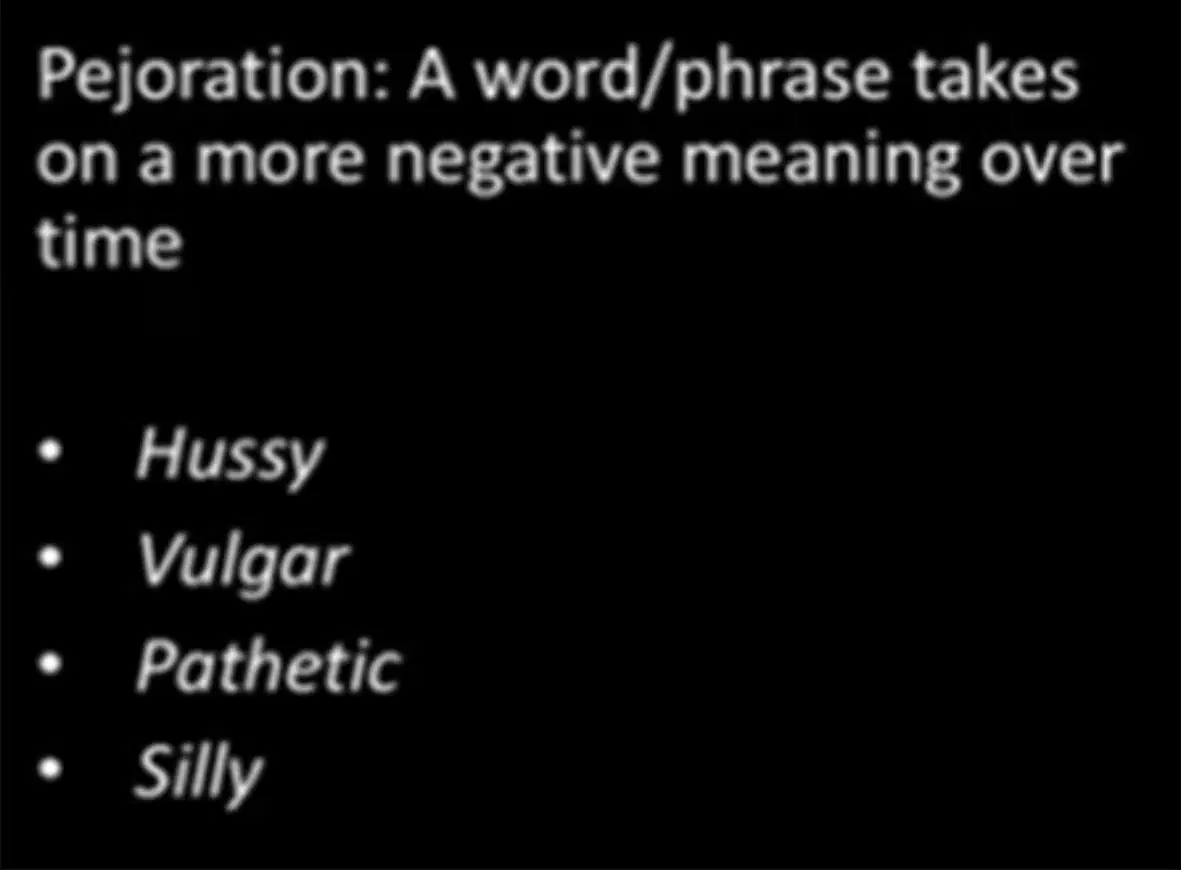
What is meant by "pejoration"?
A word/phrase takes on a more positive meaning over time.
A word/phrase takes on a more negative meaning over time.
A word/phrase loses its meaning over time.
A word/phrase retains its original meaning over time.

Which of the following words is an example of "pejoration" as described in the diagram?
Hussy
Hero
Kind
Generous
What is meant by "Grammaticalization" in morphosyntactic change?
Change in the structure of words or sentences to become simpler.
A process in which the form of a word takes on a greater grammatical function over time.
The use of verbs to indicate physical actions.
Change in the meaning of a word to become more specific.
In the example "I'm going to write a letter", the word "going" has undergone grammaticalization to indicate what?
Past.
Present.
Future.
Hypothetical condition.
Which of the following is an example of grammaticalization?
The verb "run" is used to indicate physical movement.
The verb "go" is used to indicate future time.
The noun "book" is used to indicate a physical object.
The adjective "happy" is used to describe feelings.
What triggers changes and variations in sociolinguistics?
Social contact
Climate change
Modern technology
Formal education
What phenomenon is produced from social contact in sociolinguistics?
Code-switching, pidgin, and diglossia
Industrial revolution and urbanization
Genetic changes and evolution
New technology discoveries
What is meant by "Code Switching" or "Code Mixing"?
Transition from one language or dialect to another by a speaker or writer.
Use of one language exclusively in communication.
Change of grammar within one language without involving another language.
Elimination of grammatical rules in communication.
What is required by a speaker to perform "Code Switching"?
The ability to speak in only one language.
The ability to be multilingual or bilingual.
The ability to ignore grammatical rules.
The ability to speak without considering social context.
"Code Switching" reflects what in communication?
Inability to understand grammar.
Linguistic variation that reflects social context or identity.
Inconsistency in language use.
Use of language that does not follow rules.
What should speakers respect when doing "Code Switching"?
The grammatical rules of both languages.
Only the grammatical rules of the first language.
Only the grammatical rules of the second language.
No grammatical rules need to be respected.
What is meant by "Pidgin"?
A language that has native speakers.
A language that has a limited vocabulary and simple structure.
A language that develops from only one group of people.
A language used by speakers with the same language.
What is the main characteristic of "Pidgin"?
Has native speakers.
Has a complex vocabulary.
Does not have native speakers.
Developed by one community.
Why was "Pidgin" created?
To replace the native language of a group.
Because of contact between two groups speaking different languages.
To expand the vocabulary of a certain language.
Because of the need to create a new language with native speakers.
What is meant by Creole?
A language used by a small group without grammatical rules.
A language that develops from Pidgin into the native language of a group of speakers.
A language that is only used for temporary communication.
A language that lacks complex structure or vocabulary.
What distinguishes Creole from Pidgin?
Creole is simpler than Pidgin.
Creole has a more complex structure and vocabulary than Pidgin.
Creole is only used for temporary communication.
Creole has no native speakers.
What is an example of a Creole language mentioned in the text?
English
Tok Pisin
Spanish
French
Why is Tok Pisin considered a Creole?
Because Tok Pisin has no native speakers.
Because Tok Pisin is the official language in Papua New Guinea that developed from Pidgin.
Because Tok Pisin is only used for trade.
Because Tok Pisin does not have a complex language structure.
What is meant by diglossia?
A situation where only one language is used in society.
A situation where two languages or dialects are used side by side with different social roles.
A situation where language is only used in informal contexts.
A situation where language has no specific social role.
What is meant by H-variety (High) in the context of diglossia?
Language or dialect used in everyday communication.
Language or dialect that has no prestige.
Language or dialect used in formal settings such as government, education, and media.
Language or dialect used only by a small group of people.
What is meant by L-variety (Low) in the context of diglossia?
Language or dialect used in formal settings.
Language or dialect used for everyday and informal communication.
Language or dialect that has high prestige.
Language or dialect that is only used in media.
What social factor is explained by the concept of diglossia?
How language influences the structure of government.
How factors like prestige determine the use of language variations in certain domains.
How language develops into a single form.
How language is used only in educational contexts.
In the context of diglossia, what influences the direction of linguistic maintenance or change?
Economic factors.
Social factors such as prestige.
Geographical factors.
Technological factors.

