
 Worksheets
heat pump 2
Total questions: 20
Worksheet time: 10mins
According to the table, what is the recommended cylinder size for a one bed one bathroom house connected to a 3kW HP?
88L
122L
70L
260L
What is the main function of buffer tanks and volumisers in heat pump systems?
To increase system volume
To decrease system volume
To cool the system
To heat the system
Buffer tanks will usually have a flow and return from the heat pump and flow and return to the heating system, often referred to as a "4 pipe buffer".
True
False
To achieve minimum flow rates, the installation of a volumiser tank may require a ________ valve to be fitted.
bypass
check
relief
isolation
What is the bivalent point in the context of heat pump systems?
The bivalent point is the temperature at which the entire heat load can be met by the heat pump, i.e., where the diagonal line crosses the output curve.
The bivalent point is the maximum efficiency point of the heat pump during summer operation.
The bivalent point is the temperature at which the heat pump switches to cooling mode.
The bivalent point is the lowest temperature at which the heat pump can operate without any auxiliary heating.
What is the hourly dry-bulb temperature (°C) equal to or exceeded for 99% of the hours in a year in London?
-1.7
2.5
0.0
4.3
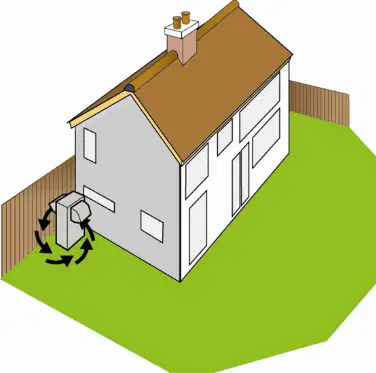
The positioning of the heat pump in relation to other structures is important because:
it affects the efficiency and performance of the heat pump.
it determines the color of the heat pump.
it changes the type of refrigerant used.
it increases the noise level in the house.
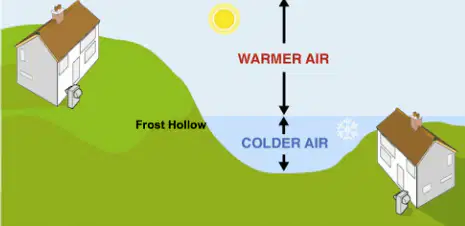
A 'frost hollow' is an area where cold air settles and can affect the operation of a heat pump by:
Causing the heat pump to work less efficiently due to lower temperatures.
Increasing the efficiency of the heat pump by providing more heat.
Having no effect on the heat pump's operation.
Making the heat pump overheat due to trapped warm air.
What can happen if the ambient air temperature falls below 10°C and the cool evaporator causes condensation to freeze?
The heat pump may trip out on a low pressure fault if there is no defrost cycle available or the system has been incorrectly specified.
The heat pump will automatically increase its efficiency.
The system will start heating the air more rapidly.
No effect will be observed on the heat pump operation.
Why is it important to ensure that there is a buffer or volumiser tank installed in most emitter circuits for the defrost cycle to be successful?
Because most emitter circuits, unless completely open zone, won’t provide enough energy in their water content to allow the defrost cycle to complete, unlike the buffer tank which has a large volume of water that can be readily used to defrost the evaporator.
Because buffer tanks help to reduce the noise produced during the defrost cycle.
Because buffer tanks are required to maintain the correct pressure in the emitter circuits.
Because buffer tanks prevent the formation of ice in the water pipes during the defrost cycle.
Fill in the blank: Traditional heat pumps typically use modern _______ refrigerants, while gas-absorption heat pumps use ammonia as the refrigerant.
fluorinated
hydrogenated
chlorinated
carbonated
The lower the flow temperature of the heating system, the better the SCOP (Seasonal Coefficient of Performance).
True
False

What is the specific heat extraction capacity for dry non-cohesive soils at 1800 hours per year?
5 W/m
2 W/m
10 W/m
7 W/m
What is the recommended depth range for pipes according to MGD 007?
Between 0.8m and 1.2m
Between 0.2m and 0.5m
Between 1.5m and 2.0m
Between 2.0m and 2.5m
Which of the following is a recommended request to make to a sub-contractor when subcontracting borehole work?
Install the collector tube
Paint the borehole
Remove the collector tube
Plant trees near the borehole
Collectors for boreholes are generally made from a single or double U tube section with electro fusion welded U section at the bottom.
True
False
Which of the following is a condition for use for the slinky ground heat exchanger trench table?
0.75m minimum pipe spacing
Table created assuming 25mm OD SDR 11 pipe
3m minimum trench spacing
Pipe depth between 0.8m and 1.2m
According to the formula provided, how are FLEQ Run Hours calculated?
FLEQ Run Hours = Total heating energy demand / Heat pump heating capacity
FLEQ Run Hours = Heat pump heating capacity / Total heating energy demand
FLEQ Run Hours = Total heating energy demand × Heat pump heating capacity
FLEQ Run Hours = (Total heating energy demand + Heat pump heating capacity) / 2
The more time a heat pump is in operation (higher FLEQ hours), the less heat can be extracted from the ground.
True
False
Which of the following is NOT an advantage of ground source heat pumps over air source equivalents?
More stable collection temperatures
Generally better coefficient of performance than air source
No defrost cycle required
Requires frequent defrost cycles

