
 Worksheets
Module 2 Test Practice Questions
Total questions: 49
Worksheet time: 25mins
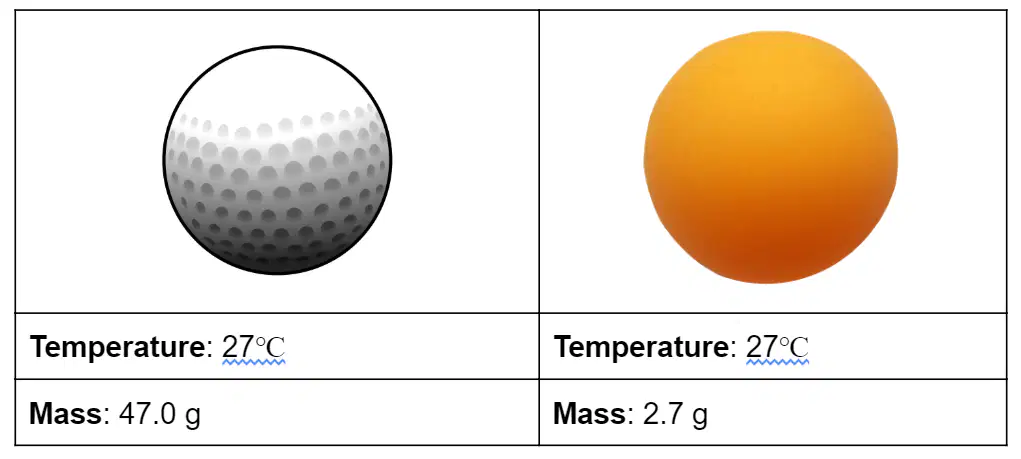
The ping pong ball has the most thermal energy.
Both spheres have the same thermal energy.
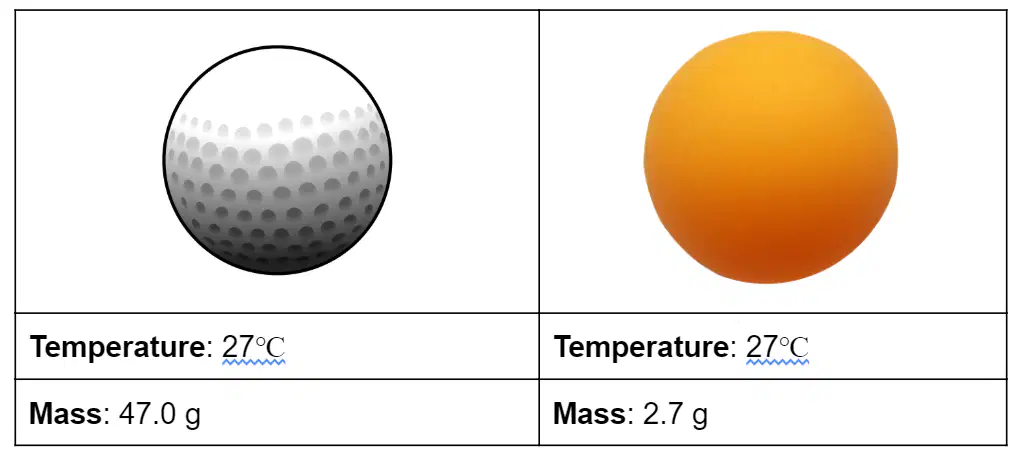
4b. What is 1 piece of evidence to support the claim that the golf ball has more thermal energy?
The ping pong ball has the most mass.
Both spheres have the same temperature.
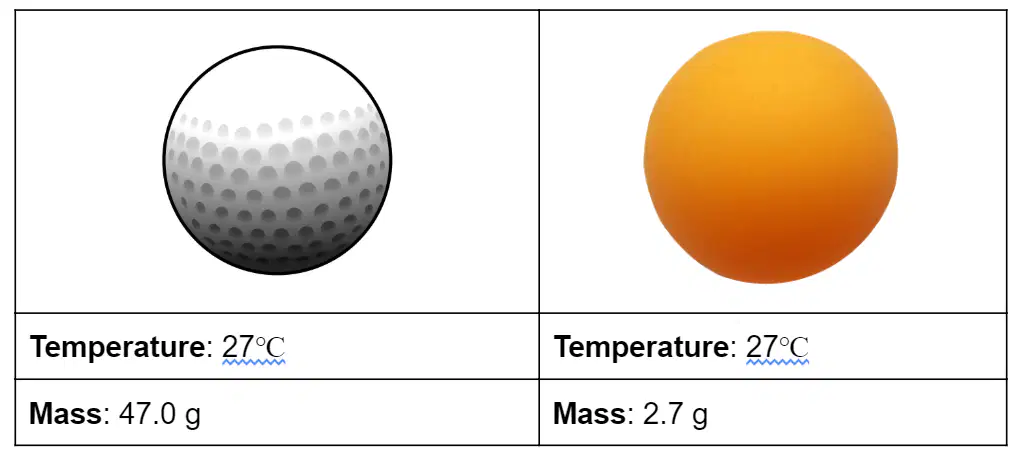
4c. Which sentence supports your claim that the golf ball has more thermal energy?
Potential energy is the sum of the kinetic energy in an object. Kinetic energy is measured by each molecule. The golf ball has more molecules so it has more kinetic energy.
Chemical energy is the sum of the kinetic energy in an object. Kinetic energy is measured by each molecule. The golf ball has more molecules so it has more kinetic energy.
Kinetic energy is the sum of the kinetic energy in an object. Kinetic energy is measured by each molecule. The golf ball has more molecules so it has more kinetic energy.
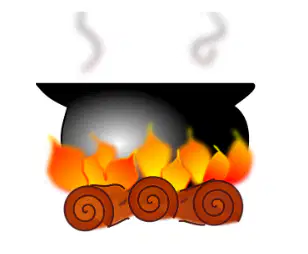
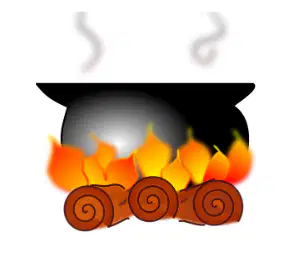
The wood is the source of the thermal energy that is transferring to the water.
The pot is the source of the thermal energy that is transferring to the water.
The air is the source of the thermal energy that is transferring to the water.
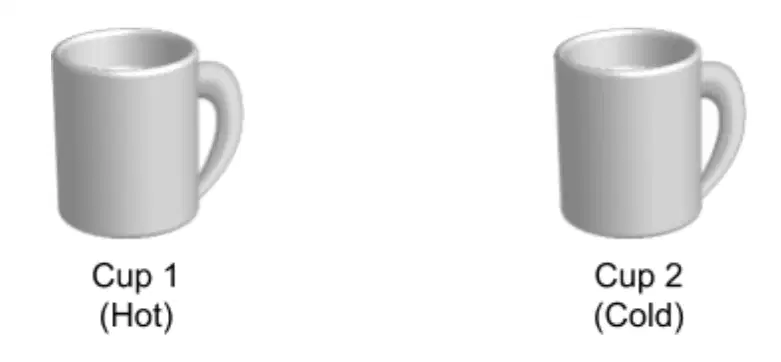
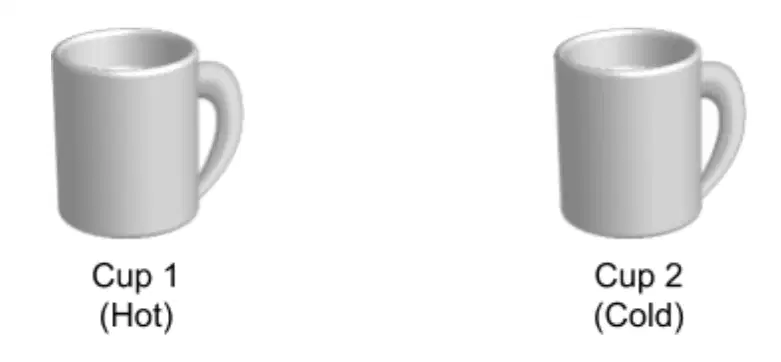
8b. You place one cup of near-freezing cold water and one cup of hot water in a room temperature room. What will happen to the thermal energy in Cup 2?
The thermal energy in cup 2 to will increase.
Thermal energy in cup 1 will increase.
Thermal energy will stay the same in cup 2.
Thermal energy doesn't change for either cup.
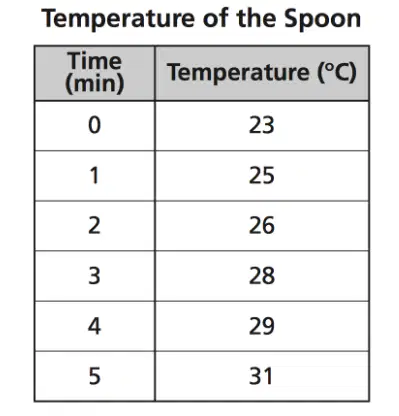
9a. A teacher placed a metal spoon in a container of water with a temperature of 37°C (100°F). Then the teacher measured the temperature of the spoon in the water for 5 minutes. Which statement best describes the flow of energy in this system?
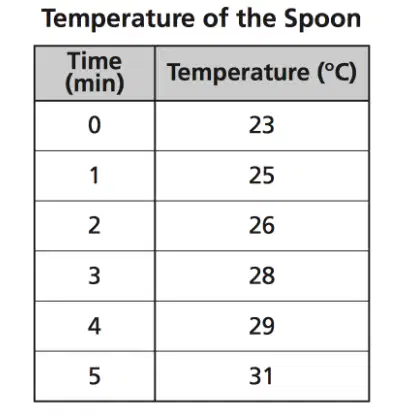
9b. A teacher placed a metal spoon in a container of water with a temperature of 37°C (100°F). Then the teacher measured the temperature of the spoon in the water for 5 minutes. What was the method of energy transfer?
11a. Jessica wants to fill a bag with a hot substance and use it to heat her sore back. She is trying to decide whether to fill the hot pack with sand or salt, and wants to select the one that transfers the most thermal energy to her back. She knows that they will cool to room temperature, but she wants to know whether they will have transferred the same amount of thermal energy. Help Jessica plan an investigation to by answering the following questions.
Jessica filled one hot pack with 2000 g of salt. How much sand would you suggest she put into another hot pack?
11d. Jessica wants to fill a bag with a hot substance and use it to heat her sore back. She is trying to decide whether to fill the hot pack with sand or salt, and wants to select the one that transfers the most thermal energy to her back. She knows that they will cool to room temperature, but she wants to know whether they will have transferred the same amount of thermal energy. Help Jessica plan an investigation to by answering the following questions. Jessica decides sand transfers more thermal energy, heating her back up the longest. Jessica has the option of using 2000 g of sand or 3000 g of sand. What quantity of sand would you suggest Jessica uses.

12a. Here is a data table of temperature differences inside and outside of a greenhouse. Which of the following statements is an accurate conclusion about the data?
The energy released when a chemical compound reacts to produce new compounds.
Chemical energy
Chemical Reaction
Energy Transfer
Thermal Energy
The process by which one or more substances change to produce one or more different substances
Thermal Energy
Chemical Energy
Physical Reaction
Chemical Reaction
Limitations on an engineering design.
Criteria
Constraints
System
Design Cycle
The requirements a design needs to do in order to be successful.
Constraints
System
Criteria
Design cycle
A series of steps that engineers use to come up with a solution to a problem.
Engineering Criteria
Engineering Constriants
Engineering Reaction
Engineering Design Cycle
The capacity to do work. It exists in a variety of forms and can be converted from one form to another.
Energy
Engineering
Temperature
System
The movement of energy within a system or between a system.
Thermal Energy
Energy Transfer
Kinetic Energy
Potential Energy
Energy that is transferred from one system or body to another as a result of a difference in temperature between the two.
Energy
Thermal Energy
Heat
Kinetic Energy
The energy that an object possesses as a result of being in motion.
Kinetic energy
Thermal energy
Temperature
Chemical energy
A collection of objects organized into a whole.
Thermal
System
Criteria
Constraints
The measure of the average kinetic energy of all the molecules in an object.
Thermal Energy
Chemical Energy
Kinetic Energy
Temperature
The kinetic energy of a substance's atoms.
Potential Energy
Chemical energy
Thermal energy
Chemical Reaction
The transfer of energy, such as heat, through a substance. Energy flows by direct contact of the substance's molecules with each other.
Convection
Radiation
Conduction
Heat
The transfer of heat energy in a liquid or gas by movement of the substance's molecules.
Conduction
Convection
Radiation
Heat
Energy in the form of electromagnetic waves or streams of particles.
Conduction
Convection
Radiation
Heat
The quantity of matter in a physical body.
Matter
Mass
Volume
Criteria
A material that allows energy in the form of heat, to be transferred within the material, without any movement of the material itself.
Thermal Conductor
Thermal Energy
Thermal Insulator
Thermometer
A material that prevents heat from moving from one place to another.
Thermal Conductor
Thermal Energy
Thermal Insulator
Thermal Coupler
Which of the following is not a source of thermal energy?
Friction
Heat source
Mitten
Chemical reaction
A student places two identical toy bears on a shelf near a window. The bears are at the same temperature. Then the student opens the shutters on the window so that the sun shines on one of the bears but not on the other. Which of the following describes the thermal energy of the bears?
The thermal energy of both bears will be the same because they are both in the same room.
The thermal energy of both bears will be the same because they are identical bears and started out at the same temperature.
The thermal energy of the bear in the sunlight will be greater than the thermal energy of the bear in the shade because more energy was transferred directly from the sun to the bear in the sunlight.
The thermal energy of the bear in the shade will be greater than the thermal energy of the bear in the sunlight because the bear in the shade changed to a darker color, absorbing more thermal energy.
Which of the following is true about chemical reactions?
Chemical reactions do not release or absorb energy.
Some chemical reactions release energy and others absorb energy.
All chemical reactions release energy.
All chemical reactions absorb energy.
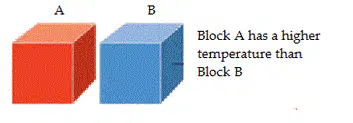
Look at the diagram below. In what direction will thermal energy move?
From block A to block B until both blocks become the same temperature.
From block B to block A both blocks become the same temperature.
Thermal energy will not flow because the blocks do not touch.
Back and forth (between both blocks) until they are both the same temperature.
A student is holding a cold piece of metal in her hand. While she is holding the piece of metal, her hand gets colder. Does the piece of metal get warmer? Why or why not?
Yes, the piece of metal will get warmer because some thermal energy is transferred from the metal to the student’s hand.
Yes, the piece of metal will get warmer because some thermal energy is transferred from the student’s hand to the metal.
No, the piece of metal will stay at the same temperature because an equal amount of thermal energy is exchanged between the student’s hand and the metal.
No, the piece of metal will stay at the same temperature because thermal energy is not transferred between the student’s hand and the metal.
If you place three ice cubes in a glass of water at room temperature, which of the following will occur?
Energy from the water will transfer to the ice cubes, causing the ice to melt.
Cold from the ice cubes will transfer to the water, causing the water to freeze.
Energy will transfer equally between the ice cubes and the water, causing no change.
Cold is transferred from the ice/water mixture to the air, causing the air to cool.
You are observing heat transfer in lab. You pour 50mL of water in a styrofoam cup (the mass of water is 50g). Then you put a 50 gram block of metal in the cup with the water. You measured the temperature immediately but noticed no temperature change.
Heat can not transfer from a metal to water.
The metal must have been colder than the water.
The metal and water must have been the same temperature.
The room temperature must have been too hot to notice a difference.
Which of the following statements best explains why there is no change in temperature once thermal equilibrium between two objects in contact is reached?
Heat can flow between two objects in contact.
Heat does not flow between two objects at the same temperature.
Heat does not flow from cooler object to warmer object.
Heat flows by conduction, convection and radiation when the temperatures are the same.
The thermal energy of an object depends on which of the following?
Both the mass of the object and the material it is made of
The mass of the object but not the material it is made of
The material the object is made of but not the mass of the object
Neither the mass of the object nor the material it is made of
A student has two blocks made of the same type of wood. The wooden blocks are both at the same temperature, but Block 1 weighs more than the Block 2.
Which block has more thermal energy?
Block 1 has more thermal energy.
Block 2 has more thermal energy.
Both blocks have the same amount of thermal energy.
Neither block has any thermal energy.

