
 Worksheets
7th Grade Final Review
Total questions: 51
Worksheet time: 26mins
Name
Class
Date
1.
Which is the correct order of the scientific method?
a)
ask questions, test hypothesis, analyze results, carry out farther inquiry, draw conclusion, hypothesis, communicate
b)
communicate, carry out inquiry, draw conclusion, analyze results, hypothesis, test hypothesis, ask questions
c)
carry out inquiry, communicate, draw conclusions, analyze, test hypothesis, hypothesis, ask questions
d)
ask questions, hypothesis, test hypothesis, analyze results, draw conclusions, communicate, carry out inquiry
2.
Safety glasses must be worn when using:
a)
heat
b)
glassware
c)
chemicals
d)
all of the above
3.
Never taste chemicals and never touch chemicals with your hands.
a)
True
b)
False
4.
An accident has occurred in the lab. The first thing you should do is clean up the mess.
a)
True
b)
False
5.
It is important to follow all safety procedures in the lab in order to:
a)
prevent accidents
b)
prevent damage to the lab equipment
c)
avoid injury to others
d)
all of the above
6.
You find a bottle of liquid on the lab shelf that is missing a label. You should:
a)
give the bottle to your teacher
b)
pour contents down the drain
c)
try to find another bottle like it and assume contents are the same
d)
try to identify the liquid by tasting a drop of smelling it
7.
What is an dependent variable?
a)
what you observe
b)
what you change
c)
what stays the same
8.
Food may be brought into the lab if:
a)
if it is kept in your bag
b)
you do not eat it until your lab is finished
c)
it does not produce crumbs or waste
d)
none of the above
9.
Tongs should be used to safely pick up hot glassware.
a)
True
b)
False
10.
How do you find the average (mean) of multiple trials?
a)
add them together and divide by # of trials
b)
find the most common number
c)
subtract the least from the greatest number
d)
add them together
11.
What is an independent variable?
a)
what you observe
b)
what you change
c)
what stays the same
12.
When working in the science lab:
a)
materials can be assumed to be harmless
b)
washing your hands with soap and water
c)
unsupervised experiments are allowed
d)
all of the above
13.
It is okay to pick up broken glass.
a)
True
b)
False
14.
How can you test the hardness of a rock?
a)
scratching on a streak plate
b)
shining a light on the rock
c)
scratching it with a penny or nail
d)
observing it through a magnifying lens
15.
How do you test the color of the rock?
a)
scratching on a streak plate
b)
shining a light on the rock
c)
scratching it with a penny or nail
d)
observing it through a magnifying lens
16.
How do you determine the color of the color of the rock in powder form? (what is left behind when scratched)
a)
scratching on a streak plate
b)
shining a light on the rock
c)
scratching it with a penny or nail
d)
observing it through a magnifying lens
17.
How do you identify an igneous rock?
a)
interlocking crystals with no layering or color banding, may contain small holes
b)
formed of particles like sand, pebbles, or clay; may form layers
c)
formed by heat/pressure, interlocking crystals texture showing layers of alternating dark and light bands
18.
How do you identify metamorphic rock?
a)
interlocking crystals with no layering or color banding, may contain small holes
b)
formed of particles like sand, pebbles, or clay; may form layers
c)
formed by heat/pressure, interlocking crystals texture showing layers of alternating dark and light bands
19.
How do you identify sedimentary rock?
a)
interlocking crystals with no layering or color banding, may contain small holes
b)
formed of particles like sand, pebbles, or clay; may form layers
c)
formed by heat/pressure, interlocking crystals texture showing layers of alternating dark and light bands
20.
What has to happen to form sediments?
a)
weather and erosion
b)
heat and pressure
c)
compaction and cementation
d)
cooling of the rock
21.
What has to happen to form sedimentary rock?
a)
weather and erosion
b)
heat and pressure
c)
compaction and cementation
d)
cooling of the rock
22.
What has to happen to form metamorphic rock?
a)
weathering and erosion
b)
heat and pressure
c)
compaction and cementation
d)
cooling of the rock
23.
What has to happen to form igneous rock?
a)
weathering and erosion
b)
heat and pressure
c)
compaction and cementation
d)
cooling of the rock
24.
What is the biosphere?
a)
all living things
b)
all water on earth
c)
all solid rock and minerals on earth
d)
mixture of gases forming a layer around earth
25.
What is the atmosphere?
a)
all living things on earth
b)
all water on earth
c)
all solid rock and minerals on earth
d)
mixture of gases forming a layer around earth
26.
What is the geosphere?
a)
all living things
b)
all water on earth
c)
all solid rock and minerals on earth
d)
mixture of gases forming a layer around earth
27.
What is the hydrosphere?
a)
all living things
b)
all water on earth
c)
all solid rock and minerals on earth
d)
mixture of gases forming a layer around earth
28.
What is precipitation?
a)
moisture that falls from the clouds to earth’s surface
b)
plants releasing water vapor through the leaves
c)
liquid rising to clouds and changing into a gas
d)
gas changing to a liquid by water drops forming a cloud
29.
What is condensation?
a)
moisture that falls from the clouds to earth’s surface
b)
plants releasing water vapor through the leaves
c)
liquid rising to clouds and changing into a gas
d)
gas changing to a liquid by water drops forming a cloud
30.
What is transpiration?
a)
moisture that falls from the clouds to earth’s surface
b)
plants releasing water vapor through the leaves
c)
liquid rising to clouds and changing into a gas
d)
gas changing to a liquid by water drops forming a cloud
31.
What is evaporation?
a)
moisture that falls from the clouds to earth’s surface
b)
plants releasing water vapor through the leaves
c)
liquid rising to clouds and changing into a gas
d)
gas changing to a liquid by water drops forming a cloud
32.
All of the earth’s systems can work together in every cycle.
a)
True
b)
False
33.
What is a light-year?
a)
distance of the moon from earth
b)
distance light travels from the sun to neptune
c)
distance light travels in a year
d)
distance light travels from the sun to earth
34.
Why is the same side of the Moon always visible from earth?
a)
moon does not rotate
b)
moon does not revolve around earth
c)
moon makes exactly one rotation for each revolution around earth
d)
moons rotation axis is not tilted
35.
What determines whether a lunar eclipse will be a partial or full eclipse?
a)
only the portion of the moon that passes through the penumbra is the full eclipse
b)
tilt of the earth on its axis determines the extend of the eclipse
c)
portion of the moon that passes through the earth's umbra determines whether an eclipse will be partial
d)
each pass of the moon around earth determines how the next eclipse will be seen
36.
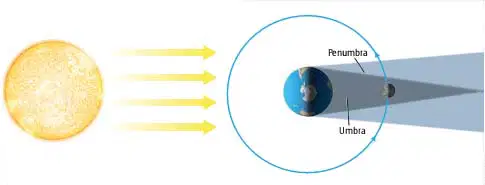
What event is shown in the figure below?
a)
lunar eclipse
b)
solar eclipse
c)
tide formation
d)
sun spots
37.
How many times a day does the water rise and fall to produce tides?
a)
once
b)
twice
c)
three times
d)
four times
38.
Which statement best describes the phases of the moon?
a)
during waxing and waning phase, the amount of light received by the sun changes
b)
during the waxing phase, less of the moon's near side is lit each night
c)
during the waning phase, less of the moon's near side is lit each night
d)
during both waxing and waning, the moon is not visible to people from earth
39.
What are the large dark areas seen on the surface of the moon?
a)
craters
b)
caleras
c)
highlands
d)
maria
40.
What feature of the moon was formed from objects impacting the surface?
a)
maria
b)
rivers
c)
highlands
d)
craters
41.
Which is a layer of the earth?
a)
crust
b)
lithosphere
c)
mantle
d)
all of the above
42.
How many major tectonic plates for the earth have?
a)
5
b)
6
c)
8
d)
10
43.
How do tectonic plates move?
a)
from the wind
b)
they are alive
c)
they are floating
d)
they are heavy
44.
The movement of tectonic plates can cause...
a)
tornadoes
b)
huricanes
c)
blizzards
d)
earthquakes
45.
Which type of boundary causes a lot of earthquakes?
a)
convergent
b)
divergent
c)
transform
46.
Which type of boundary causes mountains/volcanoes?
a)
convergent
b)
divergent
c)
transform
47.
Which type of boundary causes seafloor spreading?
a)
convergent
b)
divergent
c)
transform
48.
Plates move around very quickly.
a)
True
b)
False
49.
What causes the different seasons on Earth?
a)
distance from the sun
b)
earth's tilt on its axis
c)
shape of the earth's orbit
d)
changes in the sun's brightness
50.
What is the main source of energy that drives the water cycle?
a)
wind
b)
ocean tides
c)
the sun
d)
earth's rotation
51.
What is the process of rocks being broken down into smaller pieces?
a)
deposition
b)
erosion
c)
weathering
d)
melting
100 %

