
 Worksheets
CONTENTS
Total questions: 83
Worksheet time: 42mins
What is the full form of RAM?
Random Access Memory
Readily Available Memory
Run Access Module
Random Allocation Method
What is the full form of DRAM?
Dynamic Random Access Memory
Direct Read Access Memory
Digital Random Access Module
Data Read Access Method
What is the full form of SRAM?
Static Random Access Memory
Sequential Read Access Memory
Synchronous Random Access Memory
Serial Read Access Module
What is the full form of SDRAM?
Synchronous Dynamic Random Access Memory
Static Dynamic Random Access Memory
Synchronous Direct Read Access Memory
Serial Dynamic Random Access Memory
What is the full form of DDRAM?
Double Data Rate Random Access Memory
Dynamic Data Random Access Memory
Direct Data Read Access Memory
Dual Device Random Access Memory
What is the full form of ROM?
Read Only Memory
Random Output Memory
Run On Memory
Read Over Module
What is the full form of PROM?
Programmable Read Only Memory
Primary Read Only Memory
Permanent Read Only Memory
Protected Read Only Memory
What is the full form of EPROM?
Erasable Programmable Read Only Memory
Electronic Programmable Read Only Memory
Extended Programmable Read Only Memory
Embedded Programmable Read Only Memory
What is the full form of EEPROM?
Electrically Erasable Programmable Read Only Memory
Electronically Erasable Programmable Output Memory
Enhanced Erasable Programmable Read Only Memory
Electrically Editable Programmable Read Only Memory
What is cache memory used for in a computer system?
Cache memory is used to store frequently accessed data and instructions to speed up processing.
Cache memory is used to permanently store user files and documents.
Cache memory is used to connect the computer to the internet.
Cache memory is used to display graphics on the monitor.
What is a counter in digital electronics?
A combinational circuit
A sequential circuit that goes through a predefined sequence of states upon receiving clock pulses
A type of memory
A logic gate
Name the two types of counters mentioned in the slide.
Synchronous and Asynchronous counters
Up and Down counters
Ring and Johnson counters
Ripple and Decade counters
What does the modulus of a counter represent?
Number of states in a counter
Number of flip-flops used
Frequency of the clock signal
Type of logic family
A Mod 3 counter has how many states and what are they?
3 states: 0, 1, 2
2 states: 0, 1
4 states: 0, 1, 2, 3
5 states: 0, 1, 2, 3, 4
A Mod 8 counter counts from ______ to ______.
0 to 7
1 to 8
0 to 8
1 to 7
Which type of counter has all flip-flops receiving the clock signal simultaneously?
Synchronous Counter
Asynchronous Counter
Which type of counter is faster due to simultaneous switching?
Synchronous Counter
Asynchronous Counter
Fill in the blank: The propagation delay in a synchronous counter is _______.
Minimal
Maximum
Unpredictable
Very High
Which type of counter has a more complex circuit with extra logic gates?
Synchronous Counter
Asynchronous Counter
Which type of counter has higher power consumption due to additional gates?
Synchronous Counter
Asynchronous Counter
Which type of counter is more reliable and stable?
Synchronous Counter
Asynchronous Counter
Fill in the blank: The cost of a synchronous counter is _______ due to extra hardware.
Higher
Lower
Negligible
Unchanged
Can an asynchronous (ripple) counter be designed using JK flip-flops with the toggle property?
Yes
No
In an asynchronous (ripple) counter, the number of flip-flops in the counter is equal to the number of bits.
True
False
How many states does a 3-bit ripple counter have?
4
6
8
16
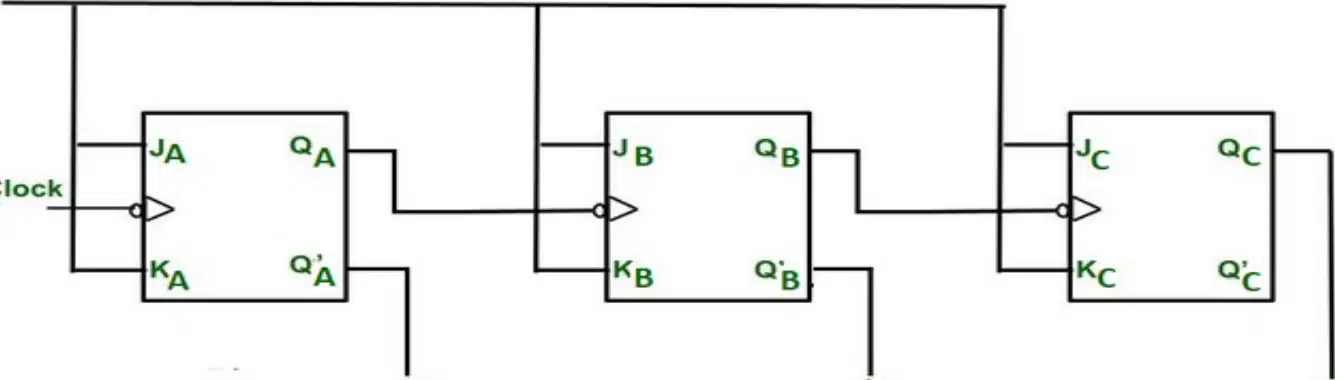
Identify the diagram shown: Is it a 3-bit ripple counter circuit?
True
False
What is the value of QC at the 4th clock cycle?
1
0
2
3
What is the value of Q'A at the 2nd clock cycle?
1
0
2
3
What is the value of QB at the 6th clock cycle?
1
0
2
3
What is the value of Q'C at the 3rd clock cycle?
1
0
2
3
What is the value of QA at the 1st clock cycle?
1
0
2
-1

Step 1: Find the number of flip-flops required to design a Mod-6 counter.
2
3
4
5
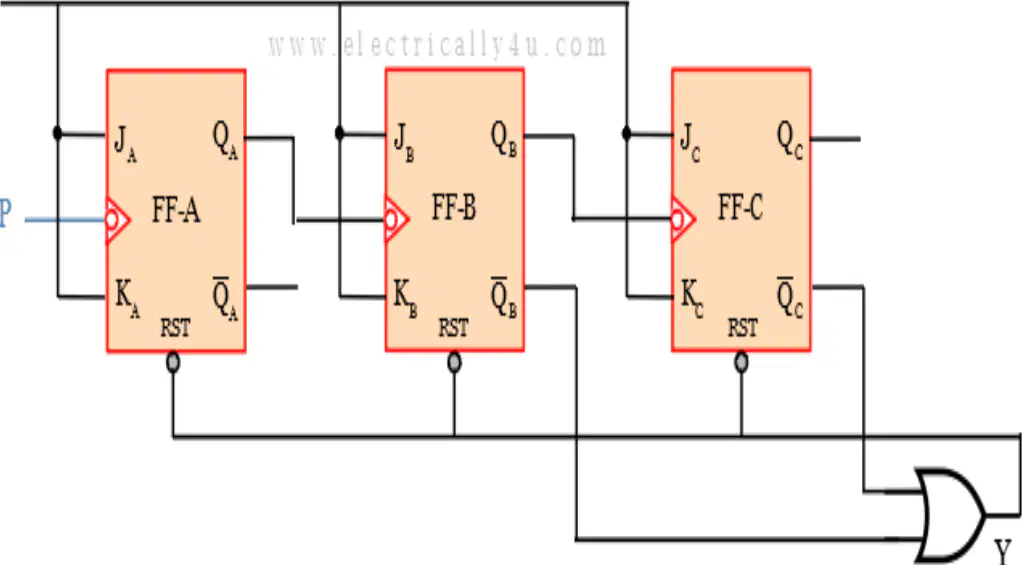
Which of the following is the correct truth table for a mod-6 asynchronous counter?
A table showing states from 000 to 101, then resetting to 000
A table showing states from 000 to 110, then resetting to 000
A table showing states from 000 to 111, then resetting to 000
A table showing states from 000 to 100, then resetting to 000
Step 3: Use Kmap to find the reset logic function for the Mod-6 counter.
The reset logic function for the Mod-6 counter is Q2·Q1.
The reset logic function for the Mod-6 counter is Q0·Q1.
The reset logic function for the Mod-6 counter is Q2 + Q0.
The reset logic function for the Mod-6 counter is Q1 + Q0.
Select the correct logic circuit diagram for the Mod-6 counter.
A diagram showing a 3-bit counter with reset logic to count from 0 to 5.
A diagram showing a 4-bit counter with no reset logic.
A diagram showing a 2-bit counter with feedback loop.
A diagram showing a 3-bit counter with no reset logic.

What type of digital circuit is shown in the diagram?
Mod 8 Synchronous Counter
Mod 10 Asynchronous Counter
Mod 4 Ripple Counter
Mod 16 Synchronous Counter
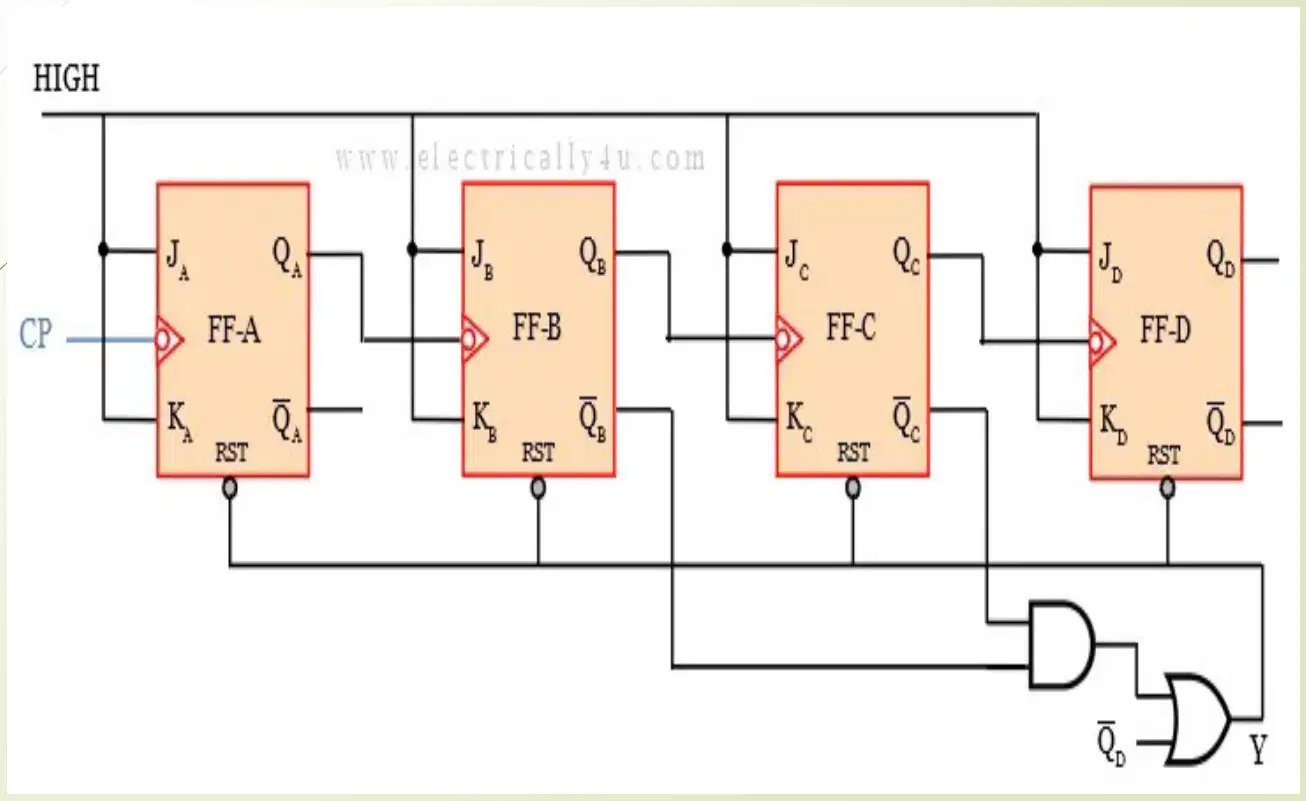
How many flip-flops are used in the Mod 10 Asynchronous Counter circuit?
4
2
5
8

Which logic gates are used in the Mod 10 Asynchronous Counter circuit as shown in the diagram?
A) AND and OR gates
B) NAND and NOR gates
C) XOR and XNOR gates
D) NOT and NOR gates

What is Step 1 in designing a synchronous counter?
Identify number of bits and Flip Flop
Connect the output to the input directly
Choose the clock frequency
Write the truth table

What is Step 2 in designing a synchronous counter?
Write Excitation Table of Flip Flop
Connect the output to the clock input
Determine the number of states required
Select the type of counter

What is Step 3 in designing a synchronous counter?
Make State Diagram and State Table
Choose the type of flip-flop to use
Assign binary values to the states
Draw the excitation table
What is Step 4 in designing a synchronous counter?
Solve Boolean Expression
Draw State Diagram
Assign Flip-Flop Inputs
Determine Number of States
What is Step 5 in designing a synchronous counter?
Make Circuit.
Draw State Diagram.
Assign Flip-Flop Inputs.
Write Excitation Table.
Fill in the value of T when Q_N = 1 and Q_N+1 = 0.
1
0
2
-1
Draw the state table for the synchronous 3 bit up counter. Fill in the value of T_B when Q_C Q_B Q_A = 0 0 1.
1
0
2
3
According to the KMAP equations given, what is the value of T_A?
1
0
A+B
A'B
According to the KMAP equations given, what is the value of T_B?
Q_A
Q_B
Q_C
Q_D
According to the KMAP equations given, what is the value of T_C?
Q_A Q_B
Q_A + Q_B
Q_A Q_B'
Q_A' Q_B

What type of flip-flop is used in the circuit?
T flip-flop
D flip-flop
SR flip-flop
JK flip-flop

How many T flip-flops are present in the circuit?
Three
One
Two
Four
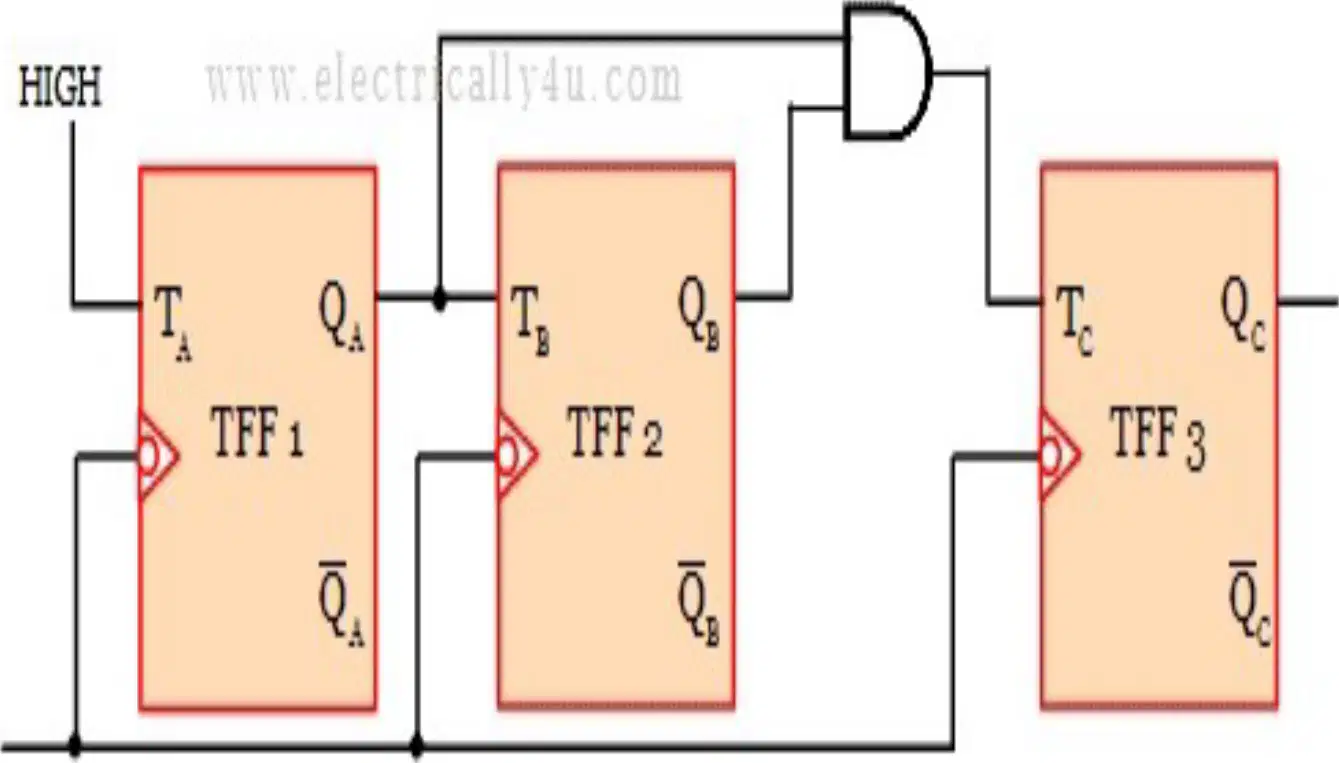
What is the function of the AND gate in the circuit?
The AND gate combines the outputs of the first two flip-flops to control the third flip-flop.
The AND gate resets all flip-flops simultaneously.
The AND gate provides clock pulses to the flip-flops.
The AND gate inverts the output of the last flip-flop.

Refer to the given circuit diagram. What is the label of the clock pulse input in the circuit?
CP
Q
D
CLR
How many flip-flops (FFs) are required for a synchronous 3-bit down counter?
3
2
4
5
What is the value of T when QN = 1 and QN+1 = 0?
1
0
2
-1
In the excitation table of T flip-flop, what is the value of T when QN = 0 and QN+1 = 1?
0
1
QN
QN+1
Which of the following is a type of primary memory?
RAM
ROM
Both A and B
None of the above

Fill in the blank: ________ is a type of memory that is non-volatile and cannot be modified easily.
ROM
RAM
Cache
Register
Which of the following is NOT a type of RAM?
DRAM
SRAM
PROM
DDRAM

Which of the following is a type of ROM?
EPROM
SDRAM
DRAM
DDRAM
Fill in the blank: ________ memory is used to temporarily store data that is being processed by the CPU.
RAM
ROM
Cache
Hard disk

Which of the following is a type of flash memory?
A) EEPROM
B) DRAM
C) SRAM
D) PROM
Which of the following is used as cache memory?
SRAM
DRAM
PROM
EPROM
What does RAM stand for?
Random Access Memory
Read Access Memory
Rapid Access Memory
Run Access Memory
Fill in the blank: RAM is a ______ memory.
volatile
non-volatile
permanent
secondary
Which of the following statements is true about volatile memory?
It retains information even when the power supply is off.
It stores information based on the power supply and loses data if the power fails.
It is slower than non-volatile memory.
It is only used for permanent storage.
Which type of RAM uses transistors and is capable of retaining its state as long as power is applied?
S RAM
D RAM
SDRAM
None of the above
Which type of RAM needs refreshing of charge on the capacitor after a few milliseconds and is slower than S RAM?
S RAM
D RAM
SDRAM
None of the above
SDRAM refers to ________ dynamic random-access memory.
synchronous
static
serial
secure
DDR refers to ________ data rate SDRAM.
Double
Direct
Dynamic
Distributed
Which of the following statements is true about the speed of DDR compared to SDRAM?
DDR is slower than SDRAM
DDR can transfer data at roughly twice the speed of SDRAM
DDR and SDRAM have the same speed
SDRAM is faster than DDR
What is the data rate range of SDRAM?
(0.8-1.3) GB/s
(2.1-3.2) GB/s
(1.5-2.0) GB/s
(3.0-4.0) GB/s
What is the data rate range of DDR?
(0.8-1.3) GB/s
(2.1-3.2) GB/s
(1.5-2.0) GB/s
(3.0-4.0) GB/s
SDRAM speed is considered as ________
66 MHz
100 MHz
133 MHz
200 MHz
DDR works on speed as 200 MHz, 266 MHz, 333 MHz, ________.
400 MHz
500 MHz
350 MHz
250 MHz
SDRAM is waiting for the completion of the previous command to be able to do another read/write operation.
True
False
DDR is not waiting for the completion of the previous command to be able to do another read/write operation.
True
False
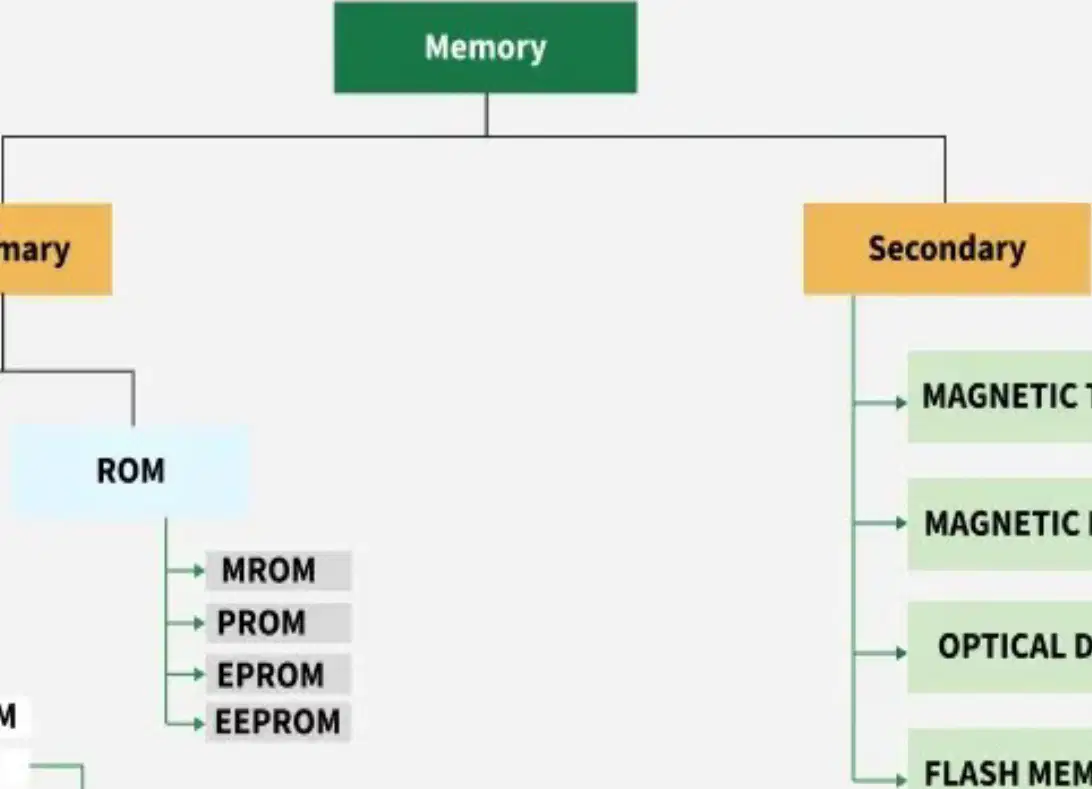
Which of the following is a type of primary memory?
Magnetic Tape
RAM
Optical Disk
Flash Memory
Fill in the blank: ________ is a type of secondary memory used for long-term storage and is not volatile.
Magnetic Disk
RAM
Cache
Register
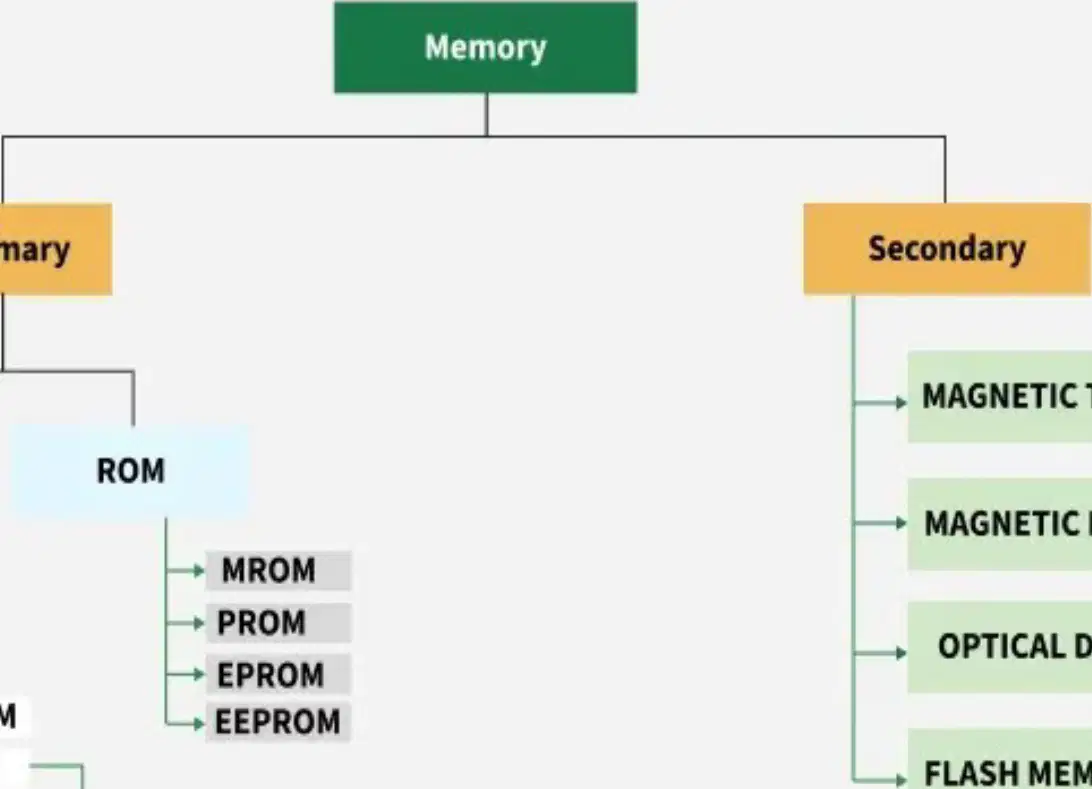
Which of the following is NOT a type of RAM?
SRAM
DRAM
PROM
DDR4

Fill in the blank: DDR1, DDR2, DDR3, DDR4, and DDR5 are types of ________ memory.
DRAM
SRAM
Flash
ROM
Which of the following is a type of secondary memory?
SRAM
EEPROM
Magnetic Tape
DDR3
Flash Memory is classified as secondary memory.
True
False
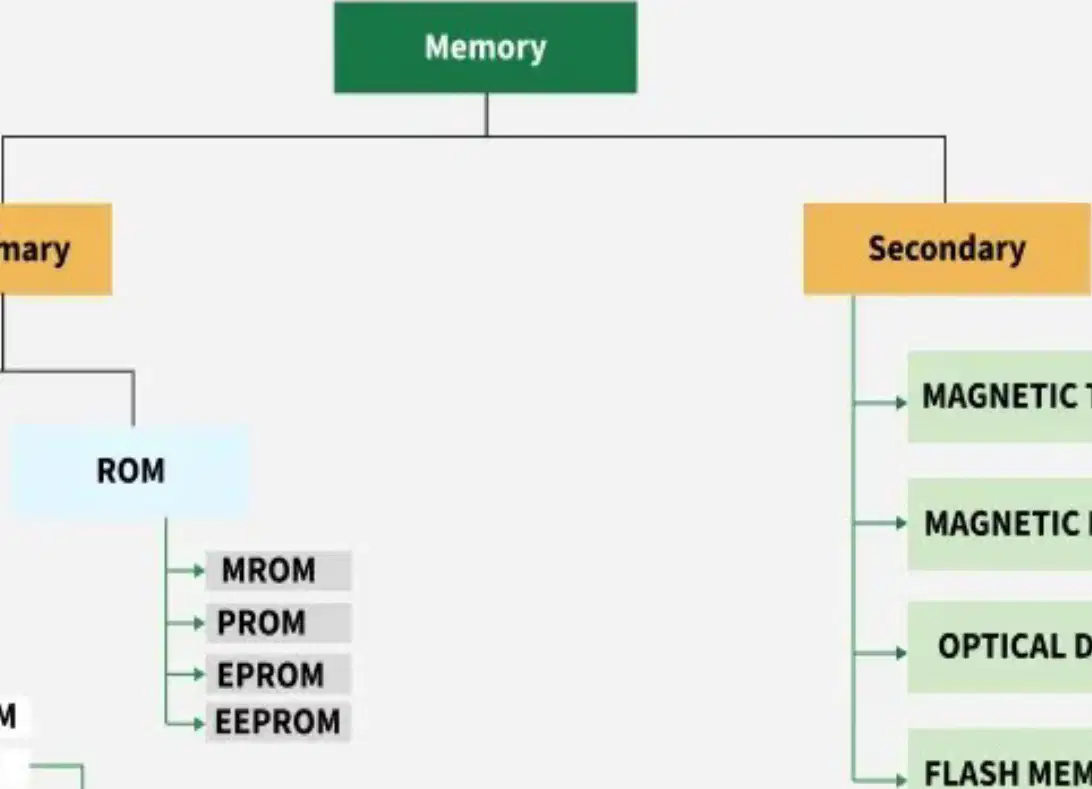
Fill in the blank: ________ and ________ are the two main types of computer memory.
Primary, Secondary
Input, Output
Analog, Digital
Permanent, Temporary

