
 Worksheets
DAY 24 WORKSHEET LSGD (11/11)Concrete
Total questions: 15
Worksheet time: 9mins
The standard cube size for compressive strength test of concrete is ______ cm.
10 × 10 × 10
15 × 15 × 15
20 × 20 × 20
30 × 30 × 30
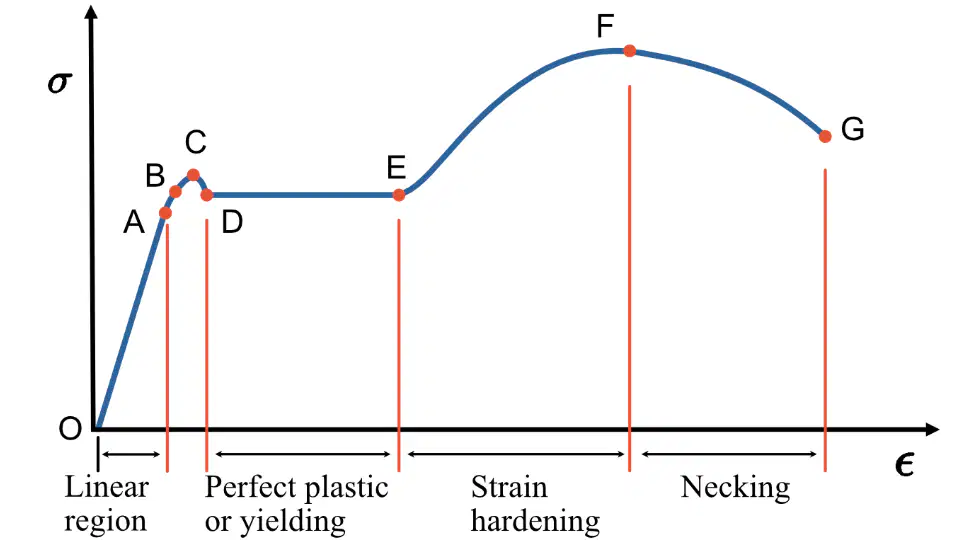
The stress strain curve for mild steel is shown. Identify the critical points (name them) marked on the curve.
(a)
Which test is used to determine the compressive strength of concrete?
Slump test
Cube test
Flow test
Kelly ball test
Write the exposure condition for RCC in the following conditions:
1) surface sheltered from severe rain whilst wet
2)surface exposed to sea water spray
3)surface completely immersed in sea water
4)surface buried under non aggressive soil
(a)
Characteristic strength is defined as the compressive strength of a ____ mm cube at ____ days.
100 mm, 7 days
150 mm, 28 days
200 mm, 14 days
150 mm, 56 days
The relation between target strength and characteristic strength is ____.
f’ck = fck + 1.65 s
f’ck = fck – 1.65 s
f’ck = 1.65 fck
f’ck = fck / 1.65
Shrinkage of concrete occurs due to ____.
Chemical reaction
Loss of moisture
Over vibration
High cement content
Creep in concrete is ____.
Decrease in volume due to loss of moisture
Gradual deformation under sustained load
Sudden failure under impact
Expansion due to temperature
Thermal expansion of hardened concrete should be ____.
Maximum
Minimum
Moderate
Neglected
The stress–strain curve for concrete is ____.
Linear
Bilinear
Non-linear
Elastic
Concrete mix proportion for M15 grade is ____.
1 : 3 : 6
1 : 2 : 4
1 : 1.5 : 3
1 : 4 : 8
For Mild exposure, minimum cement content and maximum water–cement ratio as per IS 456 are ____.
300 kg/m³ & 0.55
320 kg/m³ & 0.45
340 kg/m³ & 0.45
360 kg/m³ & 0.40

MATCH THE FOLLOWING
A–3, B–2, C–1
A–2, B–3, C–1
A–1, B–2, C–3
A–1, B–3, C–2

Match the following
A–1, B–1, C–3
A–2, B–1, C–3
A–1, B–3, C–2
A–1, B–2, C–3
Maximum stress is attained approximately at strain of (a)

