

wayground logo

Free Printable Worksheets

Font size

S
M
L
XL
Worksheets

Peace Resolution World War One

Total questions: 17

Worksheet time: 9mins

Name
Class
Date
1.
Which of the following best explains why the United States refused to ratify the Treaty of Versailles?
a)
President Wilson was voted out before the treaty was written.
b)
The treaty gave away U.S. territories in the Pacific.
c)

Many Americans feared that joining the League of Nations would draw the U.S. into future European wars.

d)

The treaty failed to punish Germany harshly enough.

2.
Which of the following was an issue among the 30 countries at the Paris Peace Conference?
a)
All nations were in agreement on the exact specifications of the future peace agreement
b)
Germany was unwilling to negotiate peace
c)
There was little consensus on how to punish Germany
d)

Difficulty in transportation delayed the conference and peace talks

3.
Which countries were members of the "Big Three?"
a)
America, France, Britain
b)
France, Britain, Italy, USA
c)
USA, France, Britain
d)

USA, France, Germany

4.
Which of the following best describes the goal of French Prime Minister Georges Clemenceau during the Paris Peace Conference?
a)
Germany punished lightly so that the country may regrow in the future
b)
Germany's government to be overtaken by the United States
c)
Usage of German land to hold the French Army
d)
Destruction of the German economy and military to ensure France's future safety
5.
Which of the following countries had overtaken Britain by the end of the war to join the US as one of the world's most powerful countries?
a)
Russia
b)
France
c)
Japan
d)

Britain

6.
Which of the following best defines reparations?
a)
Payment on a loan
b)
Issuing of bonds to cover unfinanced assets
c)
Money owed for damages
d)

An agreement between countries to form an alliance

7.
Which of the following figures led the Russian Revolution?
a)
A.S. Underwood
b)
Joseph Stalin
c)
Vladimir Lenin
d)

Steve Benson

8.
Which of the following is the goal of Communism?
a)
Establish a utopian society in which the King obtains divine right
b)
Establish a society in which anyone can own private property
c)
Establish a classless society in which everyone is equal with no private property
d)

Create a state which cooperatively relies on the support of other states for mutual industrial growth

9.
One major problem with the new successor states created from the Austro-Hungarian and Ottoman Empires was that
a)
they refused to join the League of Nations
b)
they were all governed by monarchies loyal to the Allies
c)
borders often ignored ethnic divisions
d)

each was granted access to warm-water ports

10.
Which response accurately describes President Woodrow Wilson's feelings about German reparations?
a)
He fully supported Germany paying reparations because he believed they should have been punished to the fullest extent possible
b)
He fully supported Germany paying reparations because he wanted to endure
c)
He did not support Germany paying reparations because he feared Germany would become vengeful and lead to another conflict
d)

He believed Germany should pay reparations and be punished, but not to the point of destroying the country's future viability

11.
How would Georges Clemenceau have responded if asked about German Reparations?
a)
He fully supported Germany paying reparations because he wanted to endure
b)
He believed Germany should pay reparations and be punished, but not to the point of destroying the country's future viability
c)
He fully supported Germany paying reparations because he believed they should have been punished to the fullest extent possible
d)

He did not support Germany paying reparations because he feared Germany would become vengeful and lead to another conflict

12.
How would David Lloyd George have responded if asked about German Reparations?
a)
He fully supported Germany paying reparations because he believed they should have been punished to the fullest extent possible
b)
He fully supported Germany paying reparations because he wanted to endure
c)
He believed Germany should pay reparations and be punished to some extent, but not to the point of destroying the country's future viability
d)

He did not support Germany paying reparations because he feared Germany would become vengeful and lead to another conflict vengeful

13.
Inflation is an economic term which refers to a situation where you would likely find
a)
Lower prices of goods and higher unemployment
b)
Rising prices of goods and lower unemployment
c)
Rising prices of goods and higher unemployment
d)

Lower prices of goods and lower unemployment

14.
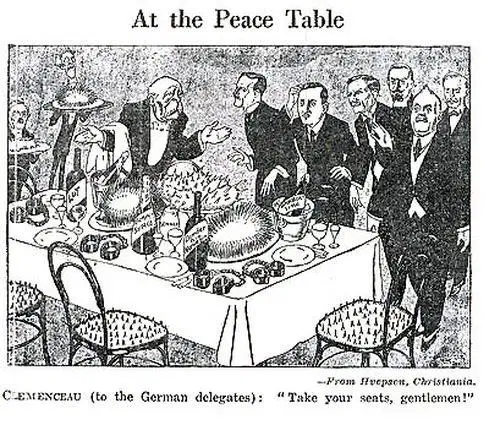
Examine the political cartoon below. Which choice best describes the depiction of this political cartoon?
a)
The United States attempting to broker a peace deal
b)
Germany negotiating the Treaty of Triannon
c)
An unwillingness of allowing Germany to participate in peace negotiations
d)

The dissolution of the Ottoman Empire

15.
Which of the following best describes Germany's acceptance of the Treaty of Versailles?
a)
President Woodrow Wilson's 14 points of peace were fully accounted for and present in the treaty
b)
Germany believed the conditions of the treaty were fair and reasonable
c)
Germany's diplomats were not allowed to negotiate peace, and were forced to accept the treaty
d)

The United States fully supported the Treaty of Versailles

16.
Excerpt from the Treaty of Versailles (1919): “Germany accepts the responsibility of Germany and her allies for causing all the loss and damage to which the Allied and Associated Governments have been subjected.” What was the intended purpose of this clause?
a)
To justify the League of Nations’ formation
b)
To recognize Germany’s contribution to ending the war
c)
To provide legal grounds for demanding reparations from Germany
d)

To encourage reconciliation among former enemies

17.
Which of the following was a common punishment under the Treaty of Sevres, Treaty of Neuilly, Treaty of Trianon and The Treaty of Saint-Germain?
a)
German Reparations
b)
Total elimination of militaries
c)
Redistribution of land held by aggressor nations
d)

An alliance between all nations against Germany
