
 Worksheets
Introduction to Solid Mensuration
Total questions: 57
Worksheet time: 29mins

Geometry is defined as the branch of mathematics that deals with the study of shapes, sizes, and properties of space. Its branches include Euclidean geometry, non-Euclidean geometry, analytic geometry, and differential geometry.
Geometry is the study of numbers and their operations, with branches like algebra and calculus.
Geometry is the study of shapes, sizes, and properties of space, with branches such as Euclidean, non-Euclidean, analytic, and differential geometry.
Geometry is the study of chemical reactions and their properties, with branches like organic and inorganic chemistry.
Geometry is the study of living organisms, with branches such as botany and zoology.
Know the History of Geometry and how it expanded.
Geometry originated in ancient civilizations and expanded through contributions from Greek, Islamic, and European mathematicians.
Geometry was invented in the 20th century and expanded only in Europe.
Geometry started with algebra and expanded through calculus.
Geometry originated in modern times and expanded through computer science.
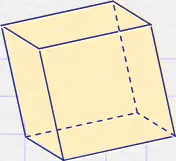
Solid mensuration is defined as:
The study of the measurement of volumes and surface areas of solid figures and its various applications in engineering, architecture, and design.
The study of the measurement of angles in triangles.
The study of the measurement of time intervals.
The study of the measurement of liquid quantities.
What is mensuration?
The process of measuring the lengths, areas, and volumes of solids using algebraic equations and geometric calculations
The process of measuring only the lengths of lines
The process of measuring only the areas of surfaces
The process of measuring only the volumes of solids
Fill in the blank: Plane mensuration deals with perimeter, lengths of sides and areas of (a) figures of shapes.
Which of the following is true about solid mensuration?
Deals with perimeter and area of 2D shapes
Deals with surface areas and volumes of 3-dimensional figures or solids
Deals only with lengths of lines
Deals only with areas of surfaces
Who is known as the 'Father of Geometry'?
Pythagoras
Euclid
Archimedes
Aristotle
Euclid was a Greek mathematician from the city of (a) around 300 BC.
Which form of mathematical proof did Euclid invent that is still used today?
Inductive proof
Deductive proof
Mathematical proof
Experimental proof
Euclid proved that there are infinite primes and showed that all geometry can be done with a ruler and compass.
True
False
Fill in the blank: According to Euclid, things which are equal to the same thing are (a) to each other.
Fill in the blank: According to Euclid, if equals are added to equals, the wholes (sums) are (a) .
Fill in the blank: According to Euclid, if equals are subtracted from equals, the remainders (differences) are (a) .
Fill in the blank: According to Euclid, things that coincide with one another are (a) to one another.
Fill in the blank: According to Euclid, the whole is (a) than the part.

Which Euclid's postulate does this diagram represent?
A straight line segment can be drawn joining any two points.
Any straight line segment can be extended indefinitely in a straight line.
A circle can be drawn with any center and any radius.
All right angles are equal to one another.
Which Euclid's postulate does this diagram represent?
A straight line segment can be drawn joining any two points.
Any straight line segment can be extended indefinitely in a straight line.
A circle can be drawn with any center and any radius.
All right angles are equal to one another.
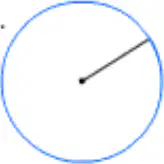
Which Euclid's postulate does this diagram represent?
A straight line segment can be drawn joining any two points.
Any straight line segment can be extended indefinitely in a straight line.
A circle can be drawn with any center and any radius.
All right angles are equal to one another.
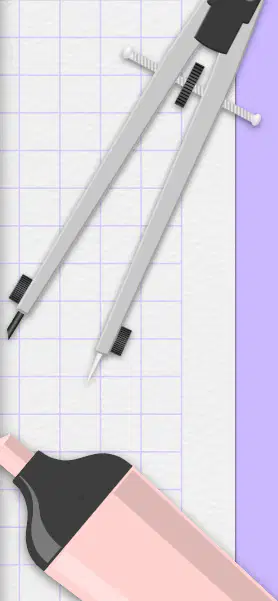
Which Euclid's postulate does this diagram represent?
All right angles are equal to one another.
A straight line segment can be drawn joining any two points.
Any straight line segment can be extended indefinitely in a straight line.
A circle can be drawn with any center and any radius.
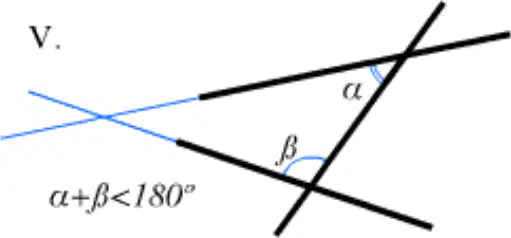
What does the inequality α + β < 180° represent in terms of Euclid's postulates?
If a straight line falling on two straight lines makes the interior angles on the same side less than two right angles, the two straight lines, if produced indefinitely, meet on that side.
All right angles are equal to one another.
A circle can be drawn with any center and any radius.
Any straight line segment can be extended indefinitely in a straight line.
Who said the following quote? 'The laws of nature are but the mathematical thoughts of God.'
Isaac Newton
Albert Einstein
Euclid
Galileo Galilei
What is the origin of the word 'Geometry'?
Latin words geo and metron
Greek words geo ('Earth') and metron ('measure')
French words geo and metron
Roman words geo and metron
Geometry is the branch of (a) concerned with the shape of individual objects, spatial relationships among various objects, and the properties of surrounding space.
Geometry is one of the oldest branches of mathematics, having arisen in response to practical problems such as those found in surveying.
True
False
The name 'Geometry' is derived from Greek words meaning (a) .
Which of the following is a branch of geometry?
Algebraic Geometry
Euclidean Geometry
Number Theory
Calculus
Which of the following is a branch of geometry?
Non-Euclidean Geometry
Arithmetic
Statistics
Topology
Which of the following is a branch of geometry?
A) Analytic Geometry
B) Probability
C) Linear Algebra
D) Set Theory
Which of the following is a branch of geometry?
Differential Geometry
Trigonometry
Algebra
Geometry of Numbers
Which of the following is a branch of geometry?
Projective Geometry
Calculus
Number Theory
Statistics
Which of the following is a branch of geometry?
Solid Geometry
Arithmetic
Algebraic Geometry
Probability
Which of the following is a branch of geometry?
Trigonometry
Set Theory
Calculus
Number Theory
Which of the following is a branch of geometry?
Plane Geometry
Algebra
Statistics
Topology
When did geometry have its beginning according to the passage?
1200 BC
1400 BC
1600 BC
1000 BC
History of Geometry: Egyptians were one of the first known people to use some form of chaining in both land surveying and construction surveying. What method did Egyptians use for land surveying?
Measuring tapes
Laser devices
Chaining with ropes
GPS
History of Geometry: Egyptian surveyors were created to relocate the land divisions. What tool did they use to measure unit distances?
Sticks
Ropes with knots
Stones
Wheels
The term used for Egyptian surveyors who measured land using ropes was (a) .
According to the passage, where and when did the history of geometry begin?
Greece, 6th century BCE
Egypt and Mesopotamia, about 3100 BCE
Renaissance Europe, 15th century
Medieval Islam, 8th century
Fill in the blank: Ancient peoples began to devise mathematical rules and techniques useful for (a) , constructing buildings, and measuring storage containers.
The Greeks began to extend practical knowledge of geometry during which period?
Classical period
Renaissance period
Medieval period
Modern period
The Greeks generalized the abstract subject now known as geometry from practical knowledge.
True
False
Which of the following is NOT mentioned as an application of geometry in the passage?
A) Astronomy
B) Cartography
C) Painting
D) Medicine
Fill in the blank: The article examines the development of geometry through (a) Islam and Renaissance Europe.
The article concludes with a brief discussion of:
the implications of the findings
the methodology used in the study
the historical background of the topic
the author's personal experiences
What is the traditional name for the geometry of three-dimensional space?
Solid Mensuration
Plane Geometry
Trigonometry
Algebra
Solid mensuration is another name for which field in mathematics where measurements of 3-dimensional shapes are studied?
Solid Geometry
Calculus
Statistics
Number Theory
Fill in the blank: Length, width and (a) are the three most important measurements in solid mensuration.
Which three measurements are most important in solid mensuration?
Length, width, height
Area, perimeter, volume
Radius, diameter, circumference
Mass, density, weight
Identify the axes shown in the diagram for three-dimensional space.
A) X, Y, Z
B) A, B, C
C) P, Q, R
D) L, M, N
What is one application of solid mensuration in construction?
It helps engineers/architects develop models and scenarios mathematically before building any resources.
It is used only for decoration purposes.
It is not useful in construction.
It is used to paint buildings.
Refer to the diagram showing a cross-section of a structure. What is the purpose of reinforcement in the structure?
To strengthen the upstream side
To decorate the crest
To increase the height
To reduce thickness
Fill in the blank: The formula for the volume of a cylinder is V = (a) , where B is the area of the base and h is the height.

Which of the following is an application of solid mensuration in interior design?
Used by architects to examine and divide space, as well as to design precise architectural plans.
Used to calculate the speed of vehicles.
Used to analyze chemical reactions.
Used to study animal behavior.
Which of the following devices is NOT mentioned as being designed using geometrical concepts?
Smartphones
Laptops
Tablets
Computers
Fill in the blank: (a) is a prime application of geometry in day-to-day life we can consider here.
Geometry is used in the design of smartphones, laptops, and computers.
True
False
How do artists use geometry in their work according to the passage?
(a)

