
 Worksheets
Prototyping Solutions Quiz
Total questions: 56
Worksheet time: 28mins
What is the fourth step in the design thinking process?
Testing the final product with users
Putting the solution together and testing key ideas with users
Brainstorming various ideas to solve the problem
Structuring an experiment for user feedback
Why is it important to visualize ideas before testing them?
To ensure the ideas are perfect before implementation
To allow users to tangibly interact with the ideas and provide feedback
To finalize the design without user input
To avoid spending time on prototyping
What is one of the key aspects of prototyping as described in the text?
Fully building the final product before testing
Representing an idea without fully building it
Avoiding user feedback during the process
Spending extensive time and energy on the prototype
How does the structure of a prototype influence the testing process?
It determines the final product design
It influences the evidence received during the testing process
It eliminates the need for user feedback
It ensures the prototype is permanent and unchangeable
What is the main goal of the prototype step in the design thinking process according to the Nielsen Norman Group?
To conduct research to develop an understanding of users.
To build a solution that works for users and prepare for feedback.
To combine all research and observe where users' problems exist.
To put the vision into effect.
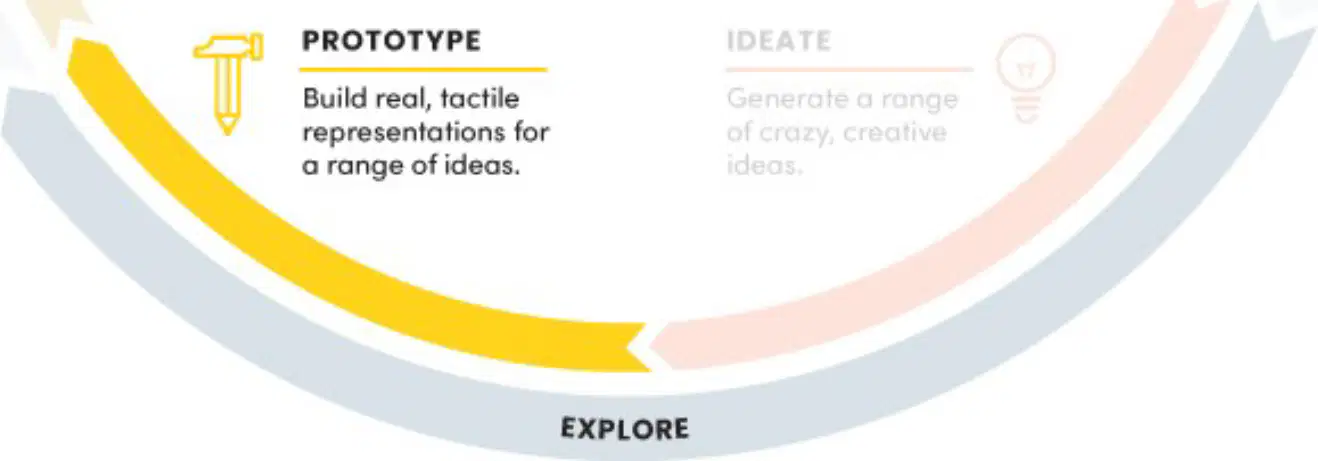
Which step in the design thinking process involves generating a range of creative ideas?
Define
Ideate
Prototype
Test
What is required during the prototype step to create an experience for users to provide feedback?
A detailed report of user problems.
A lean yet tangible representation of the solution.
A finalized product ready for implementation.
A list of creative ideas generated during ideation.
Which step in the design thinking process involves returning to users for feedback?
Test
Prototype
Implement
Empathize
What is the purpose of creating a prototype in the design thinking process?
To finalize the design without testing
To visualize designs in a way that allows interaction
To skip the testing phase
To directly create a high-fidelity product
Which of the following best describes low-fidelity prototypes?
The final visual design of an idea
The initial sketching out of an idea
A fully functional product
A branding-focused design
What is the main characteristic of mid-fidelity prototypes?
They are the initial sketches of an idea
They incorporate branding and final visual design
They are fully functional and ready for production
They skip the feedback phase
How does high-fidelity prototyping differ from low-fidelity prototyping?
High fidelity skips the testing phase
High fidelity feels like a real product
High fidelity is less detailed than low fidelity
High fidelity avoids incorporating branding
Why is it important to show prototypes to others during the design process?
To finalize the design without feedback
To receive different levels of feedback based on fidelity
To avoid testing the design
To directly move to production
What is the purpose of creating a prototype during the design thinking process?
To finalize the design concept.
To test whether ideas are usable, useful, and understood by users.
To replace wireframes in the design process.
To avoid user feedback.
Which of the following best defines a prototype in the design thinking process?
A finalized product ready for launch.
A static representation of a design concept.
An interactive version of a design concept created from wireframes.
A brainstorming tool for generating ideas.
What is the first step in creating a prototype according to the text?
Make wireframes showing the key screens of the task flow.
Start with a task flow to outline how a user goes through the product.
Make the screens interactive using digital tools.
Combine all wireframes into a single design.
What is the purpose of making screens interactive in the prototype creation process?
To finalize the design for production.
To create clickable hotspots or simulate the user interface.
To replace wireframes with a high-fidelity design.
To avoid using digital tools in the design process.
What are wireframes used for in the prototype creation process?
To show the key screens of the task flow.
To replace the need for a prototype.
To act as the final product design.
To avoid creating interactive screens.
What is a prototype?
A final version of a product ready for launch
A preliminary model used to test and validate ideas
A marketing strategy for promoting a product
A finished design for manufacturing
What does Figure 5.2 represent in the context of the learning material?
The final design of a car rental app
The steps in creating a prototype for a car rental app
A marketing plan for a car rental app
A user manual for a car rental app
Which tool is mentioned in the learning material for creating the prototype in Figure 5.2?
Adobe Photoshop
Sketch
Figma
Canva
What do the arrows in Figure 5.2 represent?
The design flow of the app
The navigation path a user will take
The coding structure of the app
The marketing strategy for the app
What is a prototype primarily used for?
To finalize a product design
To test with users, pitch to stakeholders, and check ideas
To manufacture products
To replace the final product
Which of the following is NOT a use of a prototype?
Test with users
Pitch to stakeholders
Check your ideas
Mass production of products
Why might stakeholders be involved in the use of a prototype?
To provide feedback and assess the feasibility of ideas
To manufacture the prototype
To replace the prototype with the final product
To avoid testing with users
Which of the following is NOT one of the four types of fidelity for prototypes mentioned in the learning material?
Low Fidelity
Mid Fidelity
High Fidelity
Physical Fidelity
What factors determine the type of prototype fidelity to use?
The time available, the stage of the design process, and the feedback needed
The cost of materials and the number of team members
The complexity of the final product and the target audience
The software tools available and the project deadline
Which of the following is an example of a prototype fidelity type?
Code
Blueprint
Wireframe
Sketch
What is the primary purpose of low-fidelity prototypes?
To test the specific usability of a product.
To obtain early concept validation and provide a general sense of how an idea can play out.
To finalize the design of a product.
To directly address market fit without showing the vision for the idea.
When are low-fidelity prototypes typically used?
When you need to finalize the usability of a product.
When you need more clarity on whether your approach addresses the problem to solve.
When you are ready to launch the product.
When you need to test the product in the market.
What is the focus of low-fidelity prototypes by nature?
Showing the vision for the idea and getting a sense for its product market fit.
Testing the specific usability of the product.
Providing detailed feedback on the final product design.
Ensuring the product is ready for mass production.
What are mid-fidelity prototypes primarily used for?
Testing the aesthetics of a product
Testing the structure of a solution
Final-stage product validation
Creating high-fidelity designs
At what stage of product development are mid-fidelity prototypes most useful?
Early-stage brainstorming
Mid-stage concept validation
Final-stage product launch
Post-launch feedback collection
What is one of the benefits of using mid-fidelity prototypes?
They provide detailed visual design elements
They help in testing product market fit
They are used for final usability testing
They eliminate the need for high-fidelity prototypes
When should you consider using mid-fidelity prototypes?
When you have no idea about the solution
When you have a decent idea of how a solution could play out
When the product is ready for launch
When you need to finalize the visual design
What are high-fidelity prototypes primarily used for?
Early-stage concept validation
Testing final designs with users or demonstrating final concepts
Brainstorming initial ideas
Creating wireframes for initial designs
At what stage of the design process are high-fidelity prototypes most useful?
Early-stage brainstorming
Mid-stage usability testing
Late-stage validation and alignment
Post-launch feedback gathering
What is the primary focus of high-fidelity prototypes compared to concept validation?
Aesthetic appeal
Usability
Market research
Cost analysis
What additional elements do high-fidelity prototypes often include to enhance realism?
Static images
Transitions and animations
Placeholder text
Basic sketches
What does Figure 5.2 represent in the context of the learning material?
A wireframe for a car rental app
A low-fidelity prototype for a car rental app
The steps in a prototype for a car rental app, made with Figma
A final product design for a car rental app
What is a coded prototype in the context of product development?
A prototype that uses sketches to represent the product.
A prototype that takes in real data during usability tests and simulates the final product.
A prototype that is only used for brainstorming ideas.
A prototype that is created using only physical materials.
Why are coded prototypes considered the highest form of simulation of a product outside of building it?
Because they are created using physical models.
Because they take in real data and remember it during usability tests.
Because they are only used for initial brainstorming.
Because they are the least expensive to create.
What is another term used to describe coded prototypes?
Conceptual prototypes.
Functional prototypes.
Visual prototypes.
Static prototypes.
Which of the following companies is mentioned as an example where designers work with functional prototypes?
Microsoft.
Google.
Apple.
IBM.
What is the purpose of functional prototypes in the development process?
To create a final product for immediate release.
To lay the foundation for the code that will be used in the final product.
To replace the need for usability testing.
To create physical models of the product.
Which of the following tools is commonly used to create wireframes and offers native prototyping solutions?
Webflow
Principle
Figma
Protopie
What is a key feature of tools like Figma, Sketch, and Adobe XD for prototyping?
They require external plugins for prototyping.
They offer native prototyping solutions within the products themselves.
They are only suitable for advanced coding prototypes.
They are primarily used for motion design.
For advanced prototyping needs like microinteractions, which tools are suggested?
Figma and Sketch
Principle and Protopie
Adobe XD and Webflow
Framer and Principle
What does the choice of a prototyping tool depend on?
The budget of the project
The team size
What you want to test
The deadline of the project
Which type of design is recommended early in a project to get a vague sense of whether an idea works?
High-fidelity designs
Mid-fidelity designs
Low-fidelity designs
No design at all
What is the purpose of mid-fidelity designs and tools like Whimsical?
To test the visual design and aesthetics
To comment on the structure and architecture of the product
To finalize the product design
To create a marketing strategy
Which tool is suggested for high-fidelity designs and feedback on visual aesthetics?
Whimsical
Paper sketches
Figma
Adobe Photoshop
What is the purpose of using specific prototyping software like Protopie when creating a product?
To create a basic sketch of the product.
To experience the product with data as if it were a real finished experience.
To avoid the need for coding.
To finalize the product design without testing.
What factors should influence the choice of fidelity level when testing a product?
The color scheme of the product.
The maturity of the product, what you want to learn, and available resources.
The popularity of the prototyping tool.
The number of team members working on the product.
What is the first step before building anything according to the text?
Selecting the prototyping software.
Creating a marketing strategy.
Figuring out the logic of what you want to build.
Testing the product with users.
What is the role of a task flow in the product development process?
To determine the color scheme of the product.
To help figure out the logic of what you want to build.
To finalize the product design.
To avoid the need for prototyping.

