
 Worksheets
2025 6.2 Lessons 1-9
Total questions: 32
Worksheet time: 58mins

How does a hot cup system cool down?
heat energy is transferring out of the cup and into the cool air
cold energy is transferring from the air into the cup
heat is transfering out of the cup AND cold is transferring into the cup
The cup will never cool down.

When a system is warming up, energy is
transferring into it
transferring out of it
Anything that has mass and takes up space
weight
matter
energy
system
We tested two cup systems to determine the effectiveness of having a lid (one cup with a lid and one without). Which system did better at keeping the temperature the same and why?
Both cup systems had the same results. A lid has no effect on maintaining the temperature inside a cup
The open cup system did better at maintaining the temperature because it equalized the air temperature surrounding the cup.
The closed cup system did better at maintaining the temperature because it prevented hot air from escaping.
Sarah was visiting her friend, Regina. They were in Regina’s backyard, enjoying some ice-cold lemonade. They noticed that there were droplets on the outside of the pitcher of lemonade. The 2 friends made the following claims: Sarah said, “Those droplets must be lemonade leaking from inside the pitcher.” Regina said, “The droplets on the outside of the pitcher are water. They came from the air outside the pitcher. Who is correct?
Sarah because lemonade is liquid and air is gas.
Sarah because friends are always right.
Regina because evaporation happens on the outside of the pitcher.
Regina because condensation droplets form from the air around/outside a container.
Which best describes a liquid?
a state of matter that has no definite shape but has a definite volume and moves by sliding past each other
a state of matter that has definite shape and volume and vibrates in place
a state of matter that has no definite shape or volume and moves freely
all of the above
Which best describes a gas?
a state of matter that has no definite shape but has a definite volume and moves by sliding past each other
a state of matter that has definite shape and volume and vibrates in place
a state of matter that has no definite shape or volume and moves freely
all of the above
Recently, we did a cold water test whee we tested the mass initially and then after 10 minutes. What evidence helped proved the water did not come from inside the cup?
The system was a closed system.
The mass of the cup system decreased.
The mass of the cup system increased.
The mass of the cup system kept changing.
Why can't liquids move through solids?
They don't contain enough food coloring.
Solids have densely packed particles that move very little.
They liquids must be hot enough to fit through the spaces between the particles of the solid.
Liquids are not very smart and do not know how to open lids so the system stays a closed system.
Which one of these containers represents an OPEN system (matter can get in and out)?


What does the blue particle that's up high in the circle represent?
The blue circle up high represents a water molecule that has evaporated.
The blue circle up high represents a molecule of air that is not water.
The blue circle up high represents a water molecule that has turned to ice.

When you leave your cold drink outside, the glass may have water drops on it the outside of the glass. This is an example of...
Which model is demonstrating what molecules in a solid look like.


Which model is demonstrating what molecules in a gas look like.

Water at 34º C was placed into containers made of four different materials. An initial temperature was taken, and a final temperature was taken after 10 minutes. Which container allowed the BIGGEST transfer of thermal energy from the water to the environment?
glass
wood
paper
plastic
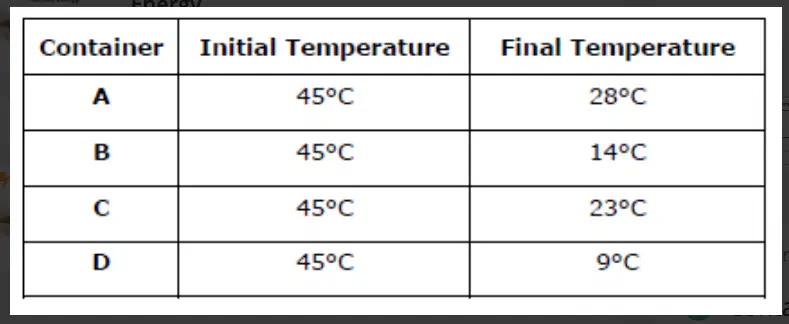
Four containers made of different materials, each containing water at 45º C, were set out on a table. The initial temperature of the water was recorded. The temperature of the water was also recorded 15 minutes later. Which container transferred the LEAST amount of energy?
Container A
Container B
Container C
Container D
Energy is __ when higher-energy particles come into contact with lower-energy particles.
transferred
lost
missing
qualitative

If we are doing an experiment to see how much a warming light shining on a cup will affect how fast the cup warms up what is the INDEPENDENT VARIABLE?
temperature change of the water
amount of light
amount of water in the cup
material of the cup

If we are doing an experiment to see how the amount of light shining on a cup affects how fast the water warms up, what would be the DEPENDENT VARIABLE?
amount of light
amount of water in the cup
temperature change of the water
material of the bottle

If we are trying to see how the amount of light shining a cup will affect how much a cup of water warms up, what is a CONTROLLED VARIABLE? Read carefully.
material of cup
amount of water in cup
number of layers in the cup
All answers are correct.

What is it called when molecules turn from a liquid into a gas?
condensation
evaporation
melting
sublimation

In class, we have drawn models of what is occurring at each of these locations. Select the image below that BEST models what this looks like at location D.


Can temperature CHANGES occur in the water inside a cup even if there is NO light AND/ OR light doesn't transmit through the cup wall?
Yes, temperature changes can happen without light if the room is warmer than the water
No, temperature changes can only occur if there is light shining on the cup
Yes, temperature changes can occur if there is pressure.

TRUE OR FALSE: Energy transfers from hotter objects to colder ones.
True
False
Why do BOTH hot and cold liquids eventually reach ROOM temperature if left in the same environment?
They are both in open systems and loose mass.
The liquids either gain or loose energy until they have the same amount as the particles in the room.
The cold leaves cold liquid and enters the system with hot liquid.
Light enters each system equally causing the temperatures to balance.

when they break in half

when they collide

when they multiply

In class, we drew models to show light shining on various cups. Based on the drawings we made in class, what is occurring in this model?
a clear cup is letting light mostly transmit and some reflect
a clear cup is letting light mostly reflect and some transmit
a black cup is reflecting most light and light can not be transmitted
a white cup is allowing some light to transmit and most light is reflected

In class, we have drawn models of what is occurring at each of these locations. Select the image below that BEST models what this looks like at location A.
In class, we have drawn models of what is occurring at each of these locations. Select the image below that BEST models what this looks like at location B.
In class, we have drawn models of what is occurring at each of these locations. Select the image below that BEST models what this looks like at location C.
In class, we have drawn models of what is occurring at each of these locations. Select the image below that BEST models what this looks like at location D.


