wayground logo

Free Printable Worksheets

Font size

S
M
L
XL
Worksheets

Optional - Cell Membrane, Cell Transport, and Water Potential

Total questions: 25

Worksheet time: 25mins
Name
Class
Date
1.
Two examples of passive transport include
a)
simple diffusion and active transport
b)
simple diffusion and facilitated diffusion
c)
facilitated diffusion and active transport
d)
endocytosis and exocytosis
2.
Which type of membrane proteins penetrate the hydrophobic interior of the lipid bilayer?
a)
Integral proteins
b)
Peripheral proteins
c)
Glycoproteins
d)
All membrane proteins must penetrate the hydrophobic part of the bilayer
3.
Glucose diffuses slowly through artificial phospholipid bilayers. The cells lining the small intestine, however, rapidly move large quantities of glucose from the glucose-rich food into their glucose-poor cytoplasm. Using this information, which transport mechanism is most probably functioning in the intestinal cells?
a)
simple diffusion
b)
facilitated diffusion
c)
active transport
d)
exocytosis
4.
If ATP breakdown (hydrolysis) is inhibited, which of the following types of movement across cell membranes is also inhibited?
a)
Movement of oxygen into a cell
b)
Movement of water through aquaporins
c)
Passage of a solute against its concentration gradient
d)
Facilitated diffusion of a permeable substance
5.
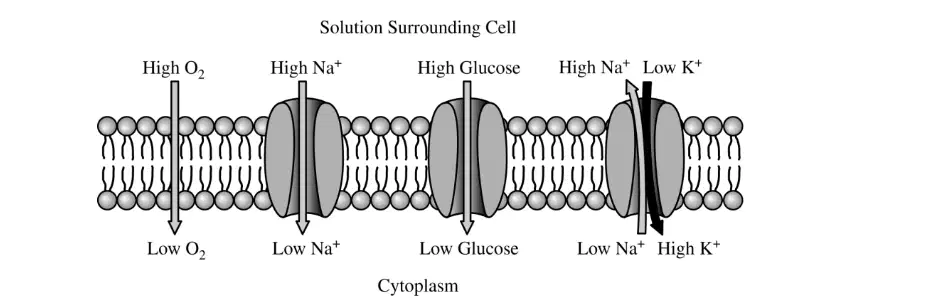
The manner in which several different ions and molecules move through a cell membrane is shown in the diagram below. For each ion or molecule, the relative concentration on each side of the membrane is indicated. Which of the following accurately describes one of the movements taking place?
a)
Glucose is transported into the cell by active transport.
b)
Na+ is transported into the cell by active transport.
c)
Na+ transport out of the cell requires ATP energy..
d)
The movement of glucose through the membrane requires ATP energy.
6.
Intravenous (IV) solutions administered to patients are normally isotonic. Which of the following is most likely if an IV of distilled water is administered to a patient?
a)
The cells that are exposed to hypotonic solutions will shrink as a result of salt moving into the blood.
b)
The liver will secrete additional bile salts into the blood to raise the tonicity of the administered fluid.
c)
The cells that are exposed to hypotonic solutions will expand as water moves osmotically into the cells from the blood.
d)
The patient’s respiration rate will slow to compensate for the higher levels of circulating blood.
7.
Which of the following best explains how molecules such as O2 and CO2 can move across the membrane of a cell?
a)
The majority of the cell membrane contains protein channels that allow this type of molecule into the cell.
b)
The majority of the cell membrane is nonpolar, which allows small, nonpolar molecules to freely cross.
c)
The phospholipids of the membrane are tightly packed, so only small molecules and ions can fit between phospholipids.
d)
ATP is hydrolyzed to provide energy to help O2 and CO2 move against their concentration gradient and across the membrane.
8.
Which of the following accurately describes a model of active transport?
a)
A membrane channel protein facilitates the movement of molecules from an area of high concentration on the outside of the cell to an area of lower concentration on the inside.
b)
A cell in a hypotonic solution swells as water moves into it.
c)
A membrane protein binds a specific molecule outside of the cell and moves the molecule into the cell where there is already a high concentration of the molecule compared with the outside.
d)
A membrane protein binds a specific molecule on the inside of the cell and moves the molecule to an area of lower concentration on the outside of the cell.
9.
Simple diffusion and facilitated diffusion are related in that both
a)
require protein carriers
b)
depend on a concentration gradient
c)
occur via contractions of cytoskeletal elements attached to membrane proteins
d)
occur in eukaryotic cells but not in prokaryotic cells
10.
Cells in the pancreas that make insulin (a large, charged molecule) secrete it into the extracellular fluid by which process?
a)
Exocytosis
b)
Endocytosis
c)
Pinocytosis
d)
Phagocytosis
11.

Which of the following processes includes all others?

a)

osmosis

b)

facilitated diffusion

c)

passive transport

d)

simple diffusion

12.

 Celery stalks that are immersed in fresh water for several hours become stiff and hard. Similar stalks left in a salt solution become limp and soft. From this we can deduce that the cells of the celery stalks are

a)

hypertonic to both fresh water and the salt solution.

b)

hypotonic to both fresh water and the salt solution.

c)

hypertonic to fresh water but hypotonic to the salt solution.

d)

hypotonic to fresh water but hypertonic to the salt solution.

13.

What forms the channels and pumps in the phospholipid bilayer?

a)

carbohydrates

b)

proteins

c)

hydrophilic heads

d)

lipids

14.
Part of the plasma membrane responsible for cell recognition... 
a)
C
b)
E
c)
B
d)
D
15.
Hydrophobic region of the cell membrane?
a)
E
b)
B
c)
C
d)
16.

Phospholipids have a -

a)

nonpolar head and a nonpolar tail.

b)

polar head and a polar tail.

c)

nonpolar head and a polar tail.

d)

polar head and a nonpolar tail.

17.
Even though the concentration of salt is high in some gland cells and low in the blood, these cells can move salt out of blood and into the cells.  This is an example of
a)
passive transport
b)
active transport
c)
diffusion
d)
osmosis
18.

Fewer molecules move from a region of low concentration to high concentration because molecules in the lower concentration area _______________.

a)

have fewer molecular collisions than molecules in the higher concentration area.

b)

vibrate more than molecules in higher concentration areas.

c)

vibrate less than molecules in the higher concentration area.

d)

have more molecular collisions than molecules in the higher concentration area.

19.
Which cell is placed into a hypotonic environment? 
a)
A
b)
B
c)
C
d)
D
20.

Five dialysis bags, constructed from a semi-permeable membrane that is impermeable to sucrose, were filled with various concentrations of sucrose and then placed in separate beakers containing an initial concentration of 0.6 M sucrose solution. At 10-minute intervals, the bags were massed (weighed) and the percent change in mass of each bag was graphed.

Which line represents the bag that contained a solution isotonic to the 0.6 molar solution at the beginning of the experiment?

a)

A

b)

B

c)

C

d)

D

e)

E

21.

A dialysis-tubing bag is filled with a mixture of 3% starch and 3% glucose and placed in a beaker of distilled water, as shown in the image. After 3 hours, glucose can be detected in the water outside the dialysis-tubing bag, but starch cannot.

From the initial conditions and results described which of the following is a logical conclusion?

a)

The initial concentration of glucose in the bag is higher than the initial concentration of starch in the bag.

b)

The pores of the bag are larger than the glucose molecules but smaller than the starch molecules.

c)

The bag is not selectively permeable.

d)

A net movement of water into the beaker has occurred.

e)

The molarity of the solution in the bag and the molarity of the solution in the surrounding beaker are the same.

22.

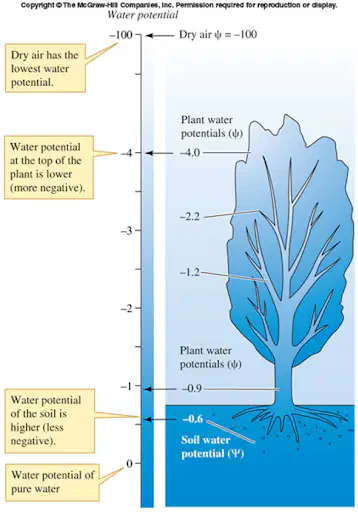
The Ψ of a root cell is -3 bars and the Ψ of the surrounding solution is -2 bars. Which direction will the net flow of water be?

a)

Into the root cell

b)

Into the surrounding solution

c)

There will be no net flow of water in either direction.

d)

There is no way to make this prediction.
23.

What is NOT true about water potential?

a)

Water flows from a more negative Ψ to a less negative Ψ.

b)

Water flows from high water potential to low water potential.

c)

Ψ = Ψs + Ψp

d)

The pressure potential (Ψp) of an open beaker is equal to 0 bars.

24.

If a plant cell has a water potential of -2 bars and a pressure potential of 2 bars, what is the cell's solute potential?

a)

4 bars

b)

0 bars

c)

-4 bars

d)

2 bars

25.

The value for  Ψ\Psi  in root tissue was found to be -3.3 bars.  If you take the root tissue and place it in a 0.1 M solution of sucrose at 20 °\degree C in an open beaker, what is the  Ψ\Psi  of the solution, and in which direction would the net flow of water be?

a)

Ψs\Psi s  = -3.3, net flow into the root

b)

Ψs\Psi s  = 3.3, net flow out of the root (into the solution)

c)

Ψs\Psi s  = -2.43, net flow into the root

d)

Ψs\Psi s  = 2.43, net flow out of the root (into the solution)