
 Worksheets
2025 of Test: Forces and Energy Unit 1 Lessons 1-3 (2025)
Total questions: 43
Worksheet time: 22mins
Name
Class
Date
1.
First Name
4 lines
2.
Last Name
4 lines
3.
Period
a)
1
b)
2
c)
3
d)
4
e)
5
4.
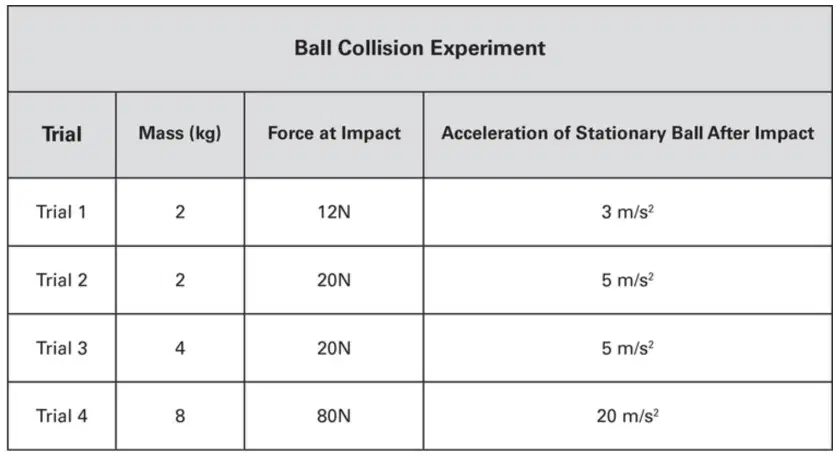
What claim is BEST supported by the evidence gathered during the investigation?
a)
Acceleration of an object increases as its mass increases.
b)
An object’s acceleration is affected by both mass and force.
c)
The rate of acceleration of an object is related only to its mass.
d)
All objects accelerate at the same rate when acted on by equal forces.
5.
Maria drives west during a three-day road trip. On the first day, she travels for 3 hours and stops for the night only 300 km from her starting point. The next day, she continues to drive west for 5 hours and travels another 1100 km. Which correctly states the average velocity of the woman on her two-day trip?
a)
1400 km
b)
175 km/hr
c)
175 km/hr west
d)
1400 km/hr west
6.
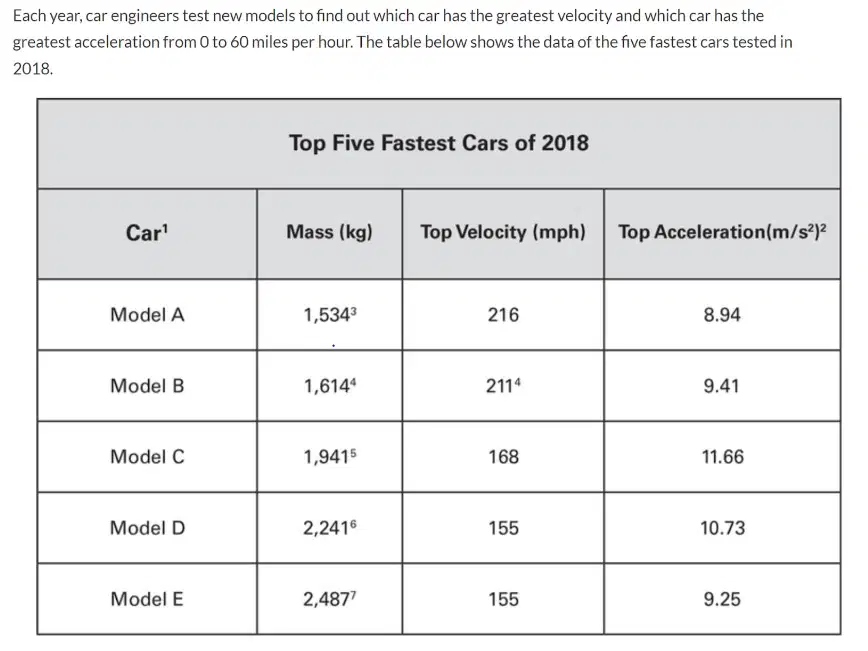
Compare the data for Models D and E. Which of the following claims would be true regarding their top velocity and acceleration?
a)
Based on their acceleration, Model E would reach 155 mph before Model D.
b)
Based on their acceleration, both cars would reach 155 mph at the same time.
c)
Based on their acceleration, Model D would reach 155 mph before Model E.
7.
Both Terrence and Gretchen are confused about what happens to an object when the forces acting on it are balanced, or add up to zero. Terrence thinks, “Only an object that is not moving can have a net force of 0 acting on it.” Gretchen thinks, “Objects that are moving can have a net force of 0 if they are slowing down.” Which of these tests will provide evidence that BOTH Terrence and Gretchen are incorrect?
a)
Measure the force of an object that is not moving.
b)
Measure the force of an object that is moving at a constant speed.
c)
Measure the force of an object that is decelerating (slowing down).
d)
Measure the force of an object that is continually accelerating (speeding up).
8.
You are pushed back into your seat when an airplane takes off follows which law?
a)
Newton's First Law
b)
Newton's Second Law
c)
Newton's Third Law
d)
Does not follow Newton's Law
9.
What is the action force and the reaction force when you sit down on a chair?
a)
When you sit down on a chair the action force is the force your body exerts when sitting down on the chair, and the reaction force will be the force of the chair pushing up against your body.
b)
The action and reaction forces excert themselves on each other
c)
These are forces that act in on you when you are sitting on a chair.
d)
The chair's force upward is the action force and your weight pushing down is the reaction force
10.
During a spacewalk, the astronaut loses connection with the space station he would slowly drift away. Which action might help him get back to the station?
a)
Throwing a heavy tool in the opposite direction
b)
Dropping all his tools to reduce his weight
c)
rolling into a ball to reduce friction and air resistance
d)
acting like a fish and swimming forward
11.
A kid runs 100 yards in 25 seconds. How fast did he go?
a)
4 yards/second
b)
125 yards/ second
c)
75 yards/ second
d)
5 yards/ second
12.
Newtons' three laws describe the _____.
a)
relationship between forces and motion.
b)
relationship between organisms and their environment.
c)
relationship between mass and volume.
d)
relationship elixir to the motion of the planets.
13.
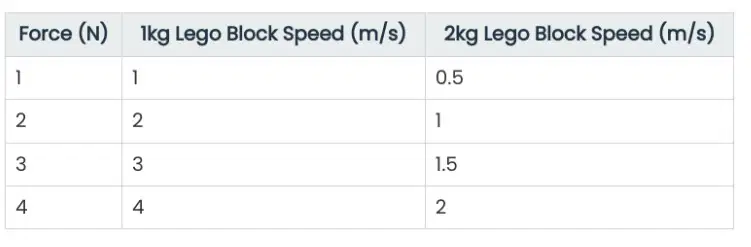
What would happen to the speed of the blocks if the force was increased to 5N?
a)
The blocks would speed up.
b)
The blocks would slow down.
c)
The blocks will remain stationary.
d)
The blocks will maintain a constant speed.
14.
An ant is pulling a leaf at a constant speed when five ants jump on top of the leaf. If the ant does not change the amount of force it is exerting on the leaf, what will happen to the speed of the leaf?
a)
the leaf will speed up
b)
the leaf's speed will stay the same
c)
the leaf will slow down
d)
the leaf's speed will stay the same, but the leaf's direction will change
15.
As the cheetah chased the rabbit, he covered 270 meters in 3 seconds. What was the cheetah's average speed? Formula: v=d/t
a)
810 m/s
b)
810 m
c)
90 m
d)
90 m/s
16.
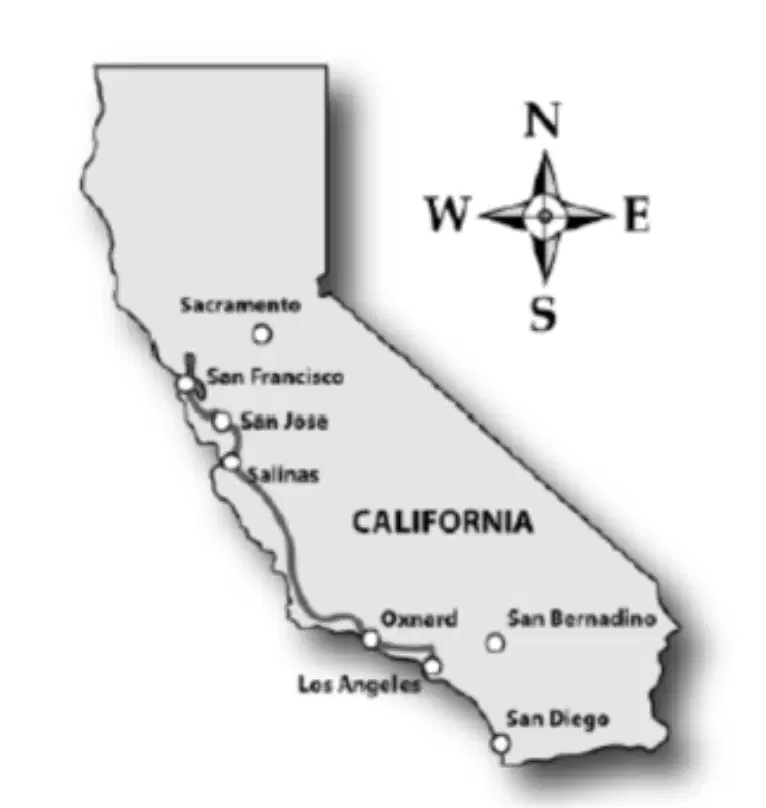
Ms. Smith traveled 400 miles from San Francisco to Los Angeles in 8 hours. What is the BEST way to express her average velocity?
a)
50 mph
b)
20 mph
c)
50 mph southeast
d)
50 mph northwest
17.
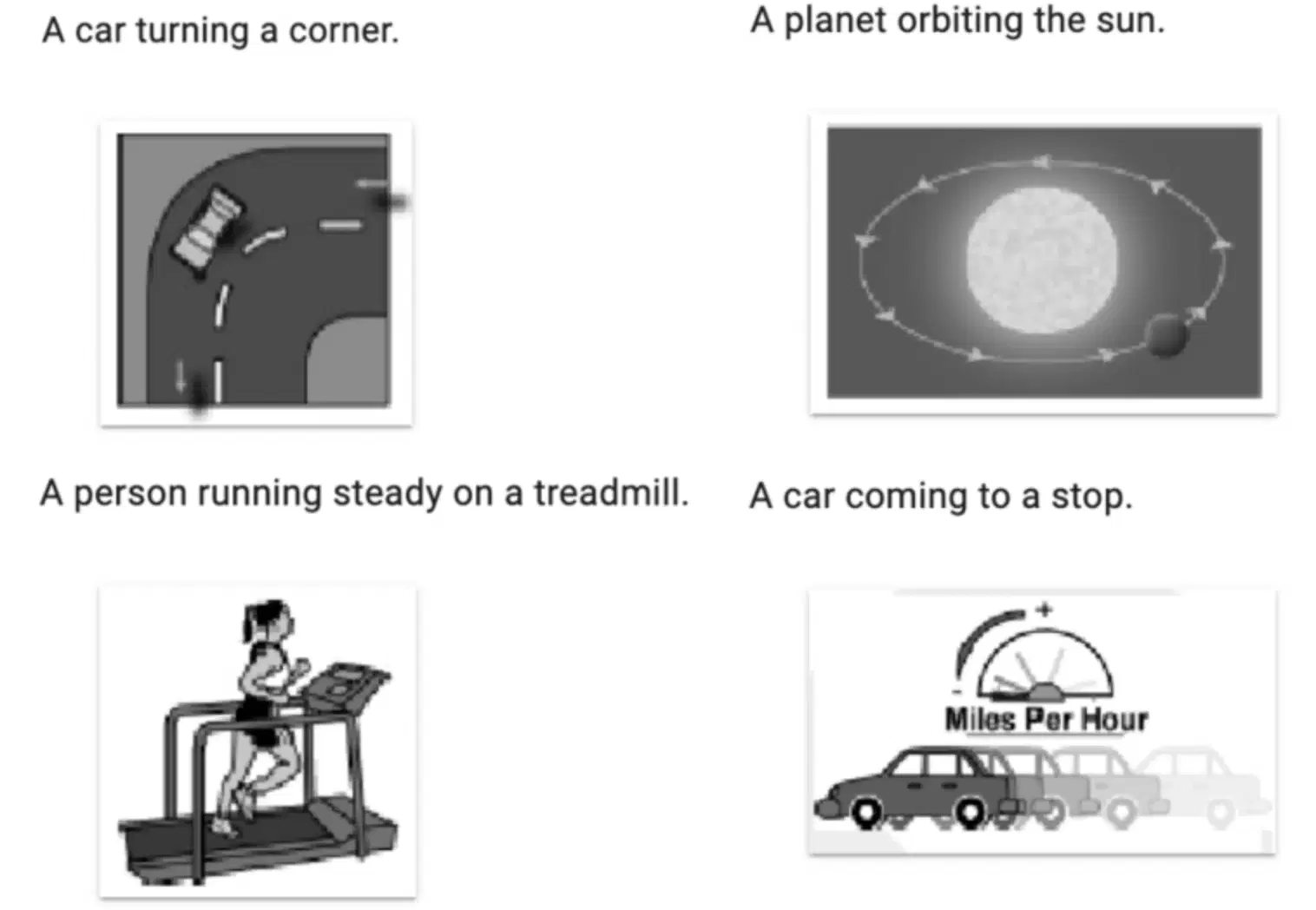
Identify which of the following pictures does NOT show an example of a change in velocity.
a)
A car turning a corner.
b)
A planet orbiting the sun.
c)
A person running steady on a treadmill.
d)
A car coming to a stop.
18.
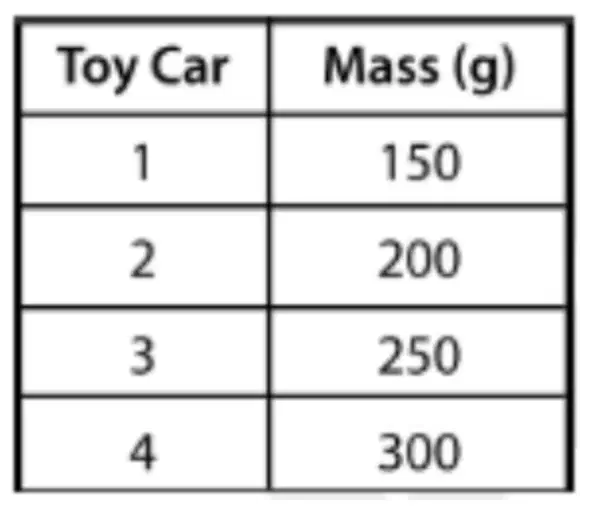
The table below shows the masses of four toy cars. Each car is pushed with a force that causes the same, constant acceleration. Which statement correctly compares the forces needed on the cars to result in the same acceleration?
a)
The force needed on car 2 is equal to the force needed on car 3.
b)
The force needed on car 2 is less than the force needed on car 4.
c)
The force needed on car 1 is greater than the force needed on car 3.
d)
The force needed on car 3 is equal to the force needed on car 4.
19.
A 1,000 kg car and a 2,500 kg truck are driving down a highway at 25 m/s . Which vehicle would require more force to come to a stop?
a)
the car
b)
the truck
c)
both would require the same force
d)
cannot be determined
20.
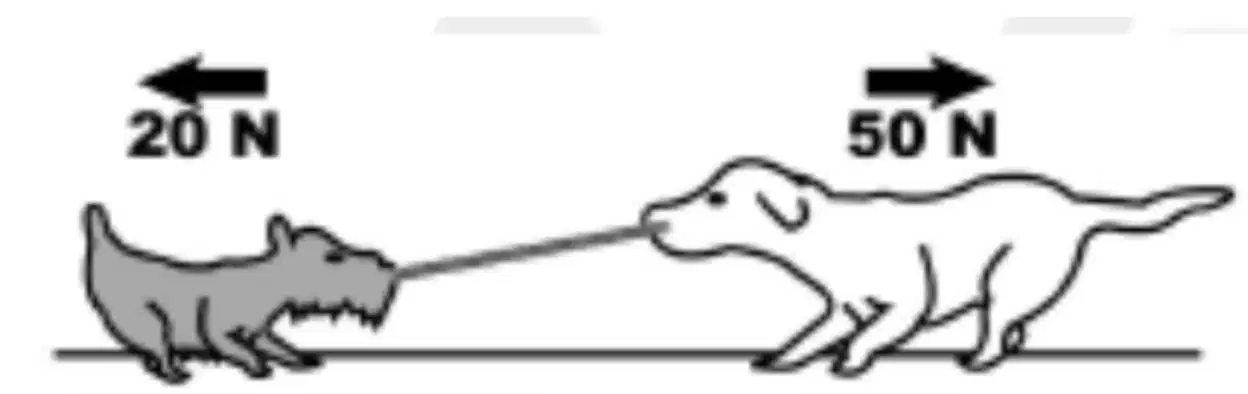
Two dogs are pulling on the same rope. What will be the outcome of the tug-of-war?
a)
The dogs will move in the direction of the stronger force, with a force of 30 N.
b)
The dogs will move in the direction of the stronger force, with a force of 70 N.
c)
The dogs will move in the direction of the stronger force, with a force of 50 N.
d)
The dogs will not move in either direction, and the forces will remain the same.
21.
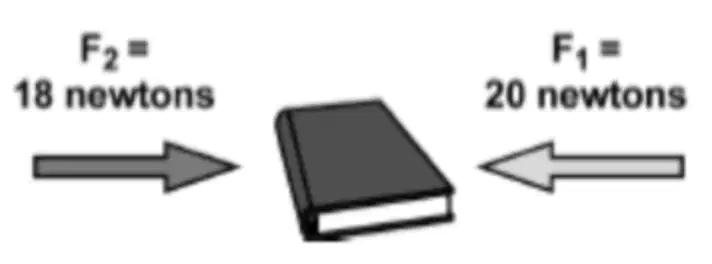
What is the direction and net force on the book indicated in the picture below?
a)
2 newtons to the right
b)
20 newtons to the left
c)
2 newtons to the left
d)
38 newtons to the left
22.
If an object is traveling at constant speed and all of the forces on the object are balanced, what happens to the motion of the object?
a)
The object turns and begins moving in the opposite direction.
b)
The object comes to a sudden and complete stop.
c)
The object slows down and eventually stops.
d)
The object continues at the same speed in the same direction.
23.
Which of the following is NOT a component of Newton’s first law of motion?
a)
An object at rest stays at rest.
b)
An object in motion stays in motion.
c)
An object in motion has a constant velocity unless acted on by a balanced force.
d)
An object in motion has a constant velocity unless acted on by an unbalanced force.
24.
The net force on an object that is at rest
a)
is always 0 N.
b)
changes depending on the location of the object.
c)
is the result of unbalanced forces acting on the object.
d)
depends on the balanced forces acting on the object.
25.
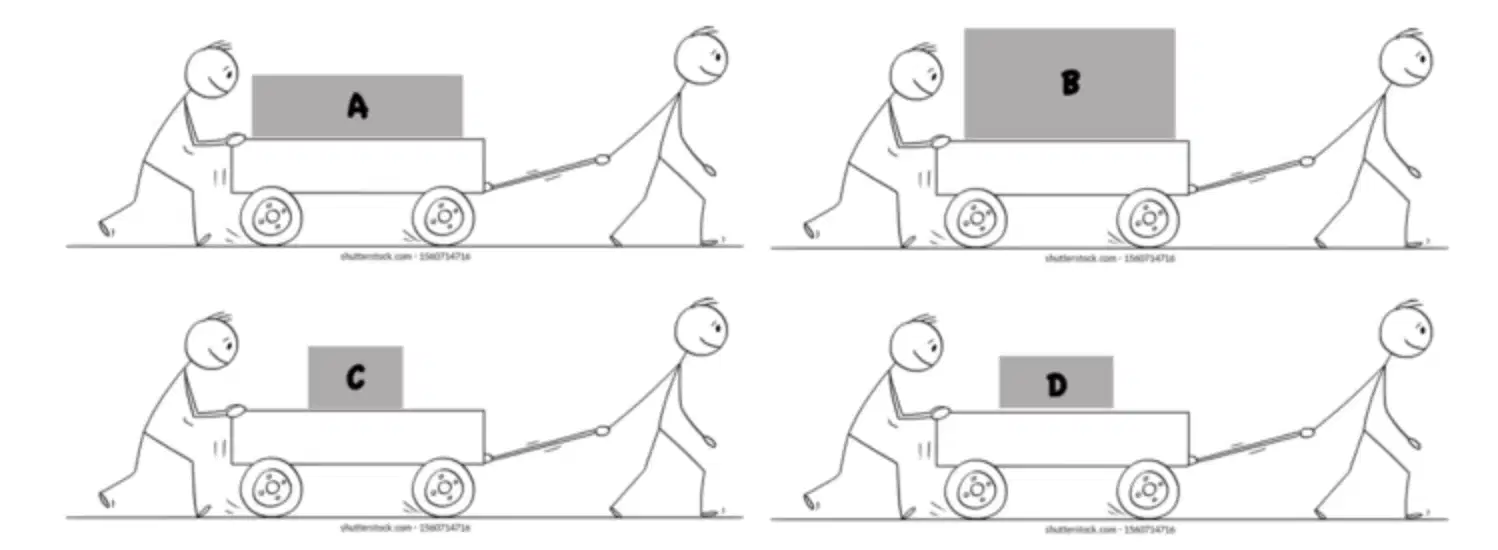
Which of Newton's Laws would best explain what would need to happen in the image below if each wagon needs to go a constant speed of 3m/s?
a)
Newton's First Law
b)
Newton's Second Law
c)
Newton's Third Law
26.
If sleigh dogs pull different masses, which of the following mass will likely have the least acceleration?
a)
50 kg
b)
100 kg
c)
200 kg
d)
400 kg
27.
You are playing catch with a friend when he passes you the ball. If he is the reference point then
a)
you move toward the ball.
b)
your friend moves away from the ball.
c)
the ball moves away from your friend and to you,
d)
your friend moves away from the ball as you move toward it.
28.
A car is moving down the road. Which of the following would be a good reference point to determine if the car is moving?
A. The car's dashboard B. The car's steering wheel C. The road signs D. The car's passengers
a)
The car's dashboard
b)
The car's steering wheel
c)
The road signs
d)
The car's passengers
29.
Speed is a rate that describes
a)
the distance an object moves over time.
b)
an object’s changes in direction over time.
c)
the difference in distance between two objects.
d)
the distance and direction in which an object moves.
30.
Which of the following describes the difference between speed and velocity?
a)
Speed describes an object’s distance and direction while velocity describes an object’s distance.
b)
Speed describes an object’s direction while velocity describes an object’s distance and direction.
c)
Speed describes an object’s distance while velocity describes an objects distance and direction.
d)
Speed describes and object’s distance and direction while velocity describes an objects direction.
31.
Which of the following MOST ACCURATELY describes an object that is accelerating?
a)
speed increasing
b)
speed decreasing
c)
speed increasing; speed decreasing
d)
speed increasing; speed decreasing; changing direction
32.
In science, force refers to
a)
a moving object.
b)
the way objects interact.
c)
a push or pull on an object.
d)
a description of an objects movement.
33.
When do forces always occur?
a)
when two objects interact
b)
when two objects are in motion
c)
when one object is larger than another
d)
when two objects are of the same size
34.
Newton’s third law of motion states that when an object exerts a force on a second object, the second object
a)
exerts a weaker force in the opposite direction.
b)
exerts a stronger force in the opposite direction.
c)
exerts a force with equal strength in the same direction.
d)
exerts a force with equal strength in the opposite direction.
35.

In the example of a swimmer interacting with a wall, the swimmer
a)
exerts no force on any object.
b)
exerts a force on the wall only.
c)
exerts a force on herself only.
d)
exerts a force on both herself and the wall.
36.

To practice their ice-skating routine, a male skater and female skater start by facing each other, as shown below. The first move in the routine requires the male skater to push the female skater backward. Based on Newton’s third law, which sentence BEST explains what will occur?
a)
The skaters will exert an equal force on each other, and neither will move.
b)
When the male skater exerts a force on the female skater, she will skate backward.
c)
When the male skater exerts a force on the female skater, she will exert the same force on him, pushing them both backward.
d)
When the female skater exerts a force back on the male skater, only he will skate backward.
37.
When you dribble a basketball on a court, the basketball returns to your hand even though you have pushed it away from you. Which of the following statements explains why the basketball doesn’t stay on the ground?
a)
Gravity is not strong enough to keep the ball near the ground.
b)
The ground pushes the ball back toward you harder than you pushed it away.
c)
The ground pushes the ball back with the same force that the ball pushes the ground.
d)
The ball has enough recoil in it so that the force used to push the ball down is multiplied.
38.
The greater the net force acting on an object, the greater the __________ of the object is.
a)
speed
b)
given force
c)
acceleration
d)
individual forces
39.
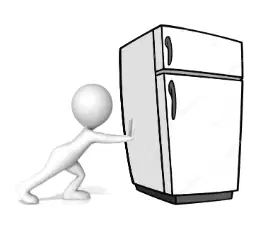
Which of the Newton's Laws would best explain why the refrigerator doesn't move until the person applies a force?
a)
Newton's 1st Law of Motion
b)
Newton's 2nd Law of Motion
c)
Newton's 3rd Law of Motion
40.
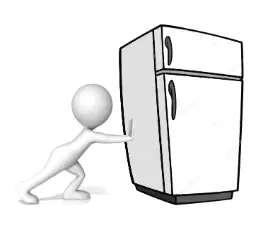
Which of the Newton's Laws would best explain the action and the reaction forces with the refrigerator?
a)
Newton's 1st Law of Motion
b)
Newton's 2nd Law of Motion
c)
Newton's 3rd Law of Motion
41.
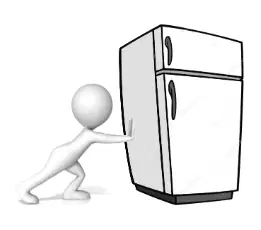
Which of the Newton's Laws would best explain how the mass of the refrigerator affects the acceleration when the person applies a force?
a)
Newton's 1st Law of Motion
b)
Newton's 2nd Law of Motion
c)
Newton's 3rd Law of Motion
42.
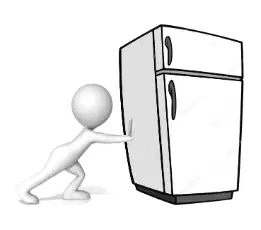
Which of the Newton's Laws would best explain how the refrigerator and the ground interact when the refrigerator is not moving?
a)
Newton's 1st Law of Motion
b)
Newton's 2nd Law of Motion
c)
Newton's 3rd Law of Motion
43.
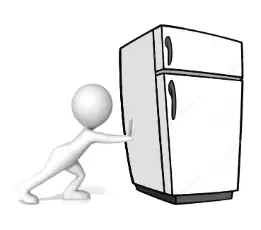
Which of the Newton's Laws would best explain how the refrigerator and the person interact if the person runs at the refrigerator and is thrown back on contact?
a)
Newton's 1st Law of Motion
b)
Newton's 2nd Law of Motion
c)
Newton's 3rd Law of Motion
100 %

