
 Worksheets
ARC4002 - Architectural Office Practice Class Test - AS4
Total questions: 30
Worksheet time: 46mins
Which of the following are competencies of a BA.AS Year 4 graduate?
As built drawings
Contract Administrator
Drawing Surveys
Project Architect
Which of the following are principles of professionalism?
Compassion
Aptitude
Punctuality
Integrity
Principles of professionalism are important for;
To command high fees
Public Health and safety
Public welfare
Maintaining the integrity of the architectural profession
Which of the following would apply to the term “Architect” in Jamaica?
Registered
Someone who has a BA.AS degree
Academically qualified
Someone who has satisfied the requirements of the ARB.
Before moving to the next stage of the architect’s work flow the architect should perform which of the following actions?
Ensure that the building contractor has up to date drawings, schedules and specifications
Obtain written approval from the client to move to the next stage.
Arrange a site meeting with the client.
Check that all the requirements for the stage have been fulfilled in accordance with the Client/Architect agreement.
Give the meaning of the following acronym: JIA
Jamaica Institute of Architects - responsible for enforcing building codes and zoning regulations in Jamaica
Jamaican Institute of Architects - a non-governmental professional organization that promotes and supports the architectural profession in Jamaica
Jamaican Internship of Architects - is the primary institution that regulates the registration of Architects in Jamaica
Jamaican Institute of Architects - a governmental organization promoting the role of Architecture in the built environment of Jamaica.
Give the meaning of the following acronym: ARB
Association of Registered Builders
Agricultural Research Bureau
Association of Road Builders
Architects Registration Board
Give the meaning of the following acronym: UIA
UIA: United International Association
UIA: Union of International Artists
UIA: Universal Institute of Architecture
UIA: International Union of Architects (Union Internationale des Architectes)
According to the module overview, students should be able to describe the roles and responsibilities of which professionals who collaborate during the design and construction process, with specific reference to pre-contract and post-contract services?
Design and construction professionals, including the Design Team and the Building/Construction Team
Contractors only, focusing on site operations
Clients and end users, excluding consultants
Only architects working independently of others
Based on the provided definition, which combination BEST justifies someone using the designation "architect" in a given jurisdiction while fulfilling the profession’s societal responsibilities?
An artist known for innovative spatial installations who rejects regulatory frameworks to maintain creative freedom.
A person with strong design skills who has built several private houses without formal credentials, focusing mainly on aesthetics.
An academically and professionally qualified individual who is registered/licensed/certified to practice in that jurisdiction and who advocates for fair and sustainable development, welfare, and the cultural expression of society’s habitat.
A construction manager with decades of site experience who oversees budgets and schedules across multiple regions without holding an architectural license.
According to the Jamaican Institute of Architects (JIA), which sequence best represents the architect’s pre-contract (pre-design) work stages leading up to tendering for a project? Choose the option that shows a logical progression through the specific stages named in the content.
Design Development Stage → Schematic Design Stage → Tendering Stage → Construction Documents Stage
Construction Documents Stage → Tendering Stage → Schematic Design Stage → Design Development Stage
Tendering Stage → Construction Documents Stage → Design Development Stage → Schematic Design Stage
Schematic Design Stage → Design Development Stage → Construction Documents Stage → Tendering Stage
According to the Jamaican Institute of Architects (JIA) Conditions of Engagement foreword, which combination best captures the Architect’s mandated stance when advising a Client in matters involving a Contractor?
Avoid providing advice to maintain professional distance
Serve primarily as an advocate for the Contractor to ensure project feasibility
Prioritize the Client’s interests over all others, even if it compromises impartiality
Act as a professional adviser to the Client while remaining absolutely disinterested and acting with entire impartiality between the Client and Contractor
You are forming a project team under the JIA General Conditions of Engagement. Plan how consultants should be appointed and paid to align with the stated provisions. Select all statements that must be incorporated into your plan.
Consultants are appointed and paid by the Client (or appointed by the Architect and paid by the Client)
Architect-recommended changes to the Fee Schedule automatically include charges for Quantity Surveyors and Consulting Engineers
Consultants shall be nominated or approved by the Architect in agreement with the Client
Consultants are responsible for integration of services provided by specialist sub-contractors and suppliers
The Architect shall have general supervision of the Consultants’ work and coordinate their efforts
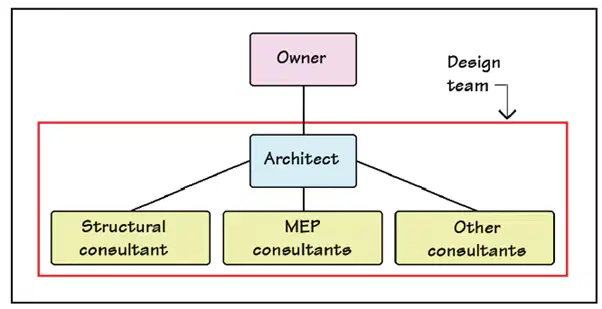
Refer to the diagram showing the Design Team structure in pre-contract services. The diagram presents an Owner at the top, engaging an Architect who coordinates a team of consultants. Consultants explicitly shown include a Structural Consultant and MEP (Mechanical, Electrical, and Plumbing) Consultants. Arrows indicate the Architect as the central coordinator between the Owner and the consultants. Based on this structure, which role acts as the central coordinator linking the Owner with the Structural and MEP consultants during pre-contract services?
Architect
MEP Consultants
Structural Consultant
Owner
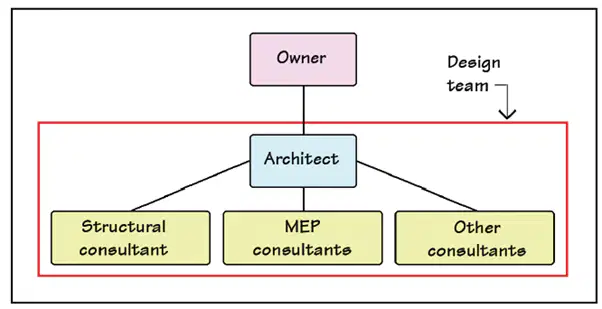
Using the depicted Design Team structure, plan an efficient communication flow for resolving a clash between an electrical conduit route and a structural beam discovered during pre-contract coordination. Which sequence best follows the relationships shown?
MEP Consultants and Structural Consultant resolve the issue privately and submit the final design to the Owner, bypassing the Architect
Owner convenes Structural and MEP consultants without the Architect; Architect is only informed at contract signing
Structural Consultant contacts Architect; Architect coordinates with MEP Consultants; Architect briefs Owner on agreed solution
MEP Consultants inform Owner directly; Owner instructs Structural Consultant; Architect is notified after resolution
Fill in the blank based on the Design Team structure: In pre-contract services, the _______ engages and leads coordination among the Structural Consultant and MEP Consultants while reporting to the Owner.
Architect
Contractor
Quantity Surveyor
Project Manager
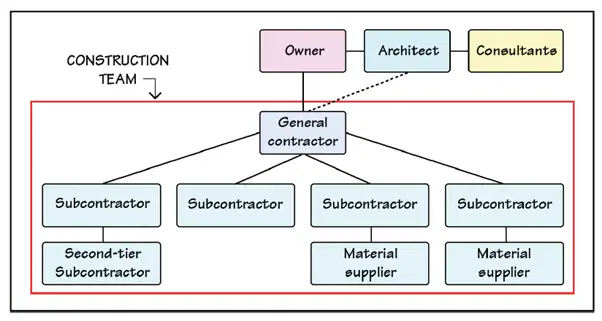
According to the diagram titled "The Construction Team," which entity directly oversees multiple subcontractors within the construction team?
Consultants
Architect
General contractor
Owner
A general contractor would most likely coordinate with which two parties to ensure timely delivery and installation of materials, based on their positions in the construction team hierarchy diagram?
Inspector(s) and engineer(s)
Material supplier(s) and subcontractor(s)
Architect(s) and client(s)
Client(s) and project manager(s)
Based on the Architect’s Services design work flow, why is owner approval a necessary requirement between each stage? Which option best aligns with this purpose?
It ensures the construction team can begin collaboration during the Schematic Design (SD) stage.
It enables quantity surveyors to issue contracts prior to DD work.
It confirms acceptance of SD concepts before DD detailing and confirms DD decisions before CD finalization.
It allows the architect to skip directly from SD to preconstruction if costs rise.
You are advising a client during the Schematic Design Stage (pre-contract). Given the listed tasks, which combination of actions best demonstrates strategic planning to set design parameters before committing to detailed development? Select ALL that apply.
Visit the site, review legislation/codes, and prepare preliminary draft sketches with an implementation cost estimate.
Skip the topographical survey to save time and proceed directly to construction documents.
Guarantee the final project cost while discussing preliminary sketches.
Acquaint the client with Conditions of Engagement and advise on appointing other consultants.
According to the Design Development Stage, which of the following items must be included in a Design Development Report for larger projects? Select ALL that apply.
Tender evaluation report with contractor rankings
Proposed structural system
Design Development Drawings
Proposed environmental control system(s) and applicable standards
Fill in the blank based on the Design Development Stage: Estimates of Probable Construction Cost prepared by the Architect or Quantity Surveyor represent _______ as professionals familiar with the construction industry and are not a guarantee that tenders will not vary from any statement of Probable Construction Cost prepared.
opinions
guarantees
contracts
certainties
A client expects the Architect to guarantee that approvals from Statutory Bodies will be granted during the Construction Documents Stage. What should the Architect communicate to the client and why, citing the relevant stage language?
The Architect should state that they are responsible for obtaining all statutory approvals regardless of circumstances.
The Architect should explain that approvals from Statutory Bodies are beyond their control and cannot be guaranteed, as stated in the agreement.
The Architect should assure the client that all approvals will be granted during the Construction Documents Stage.
The Architect should inform the client that delays in approvals are always the client's responsibility.
According to the Construction Documents Stage, approvals are ______ the Architect’s control, and therefore the Architect cannot guarantee that they will be granted.
outside
within
under
beside
Based on the Pre-Contract Stage: Tendering responsibilities shown, which sequence best outlines the architect’s role leading up to the signing of the Construction Contract?
Conduct approved method of placing the Construction Contract; advise on and obtain Client’s approval to a list of tenderers; arrange for price negotiation or obtain tenders; analyze and report on results with recommendations; obtain Client’s approval to the appointment of the Contractor and arrange necessary Contract Documents; upon signing by Employer and Contractor, tendering services are completed
Arrange price negotiation with building contractor; analyze and report on results; conduct approved method of placing the contract; obtain Client’s approval to appointment; advise on list of tenderers; sign contract on behalf of Employer
Advise on list of tenderers; conduct method of placing contract; obtain Client’s approval to appoint Contractor; analyze tender results; arrange signing of Construction Contract
Analyze and report on construction progress; advise on list of tenderers; obtain Client’s approval to appoint Contractor; conduct method of placing contract; arrange price negotiation; sign Construction Contract for the Contractor
At the end of the Pre-Contract stage of Architects’ Services—what planning implication should the Employer (Client) consider before signing the Building Contract with the Building Contractor? Provide the percentage range explicitly in your answer.
The Employer should delay all design and documentation until after the contract is signed, as the Pre-Contract stage is only 10% of the Architect’s services.
The Employer should focus solely on construction site selection, since the Pre-Contract stage is 90% of the Architect's services.
The Employer should ensure most design, documentation, and procurement preparations are complete before award—because the Pre-Contract stage comprises approximately 70%–75% of the Architect’s services.
The Employer should sign the Building Contract before any design or documentation is prepared, as the Pre-Contract stage is less than 20% of the Architect’s services.
Describe a problem that could occur at the Schematic Design Stage of the Architect’s Work flow:
Describe a problem that could occur at the Design Development Stage of the Architect’s Work flow:
Describe a problem that could occur at the Construction Document Stage of the Architect’s Work flow:
Describe a problem that could occur at the Tender Stage of the Architect’s Work flow:

